

Hello Friends, in this blog post, we are going to discuss the 5 Best Solar Energy Systems in India in 2026.
For a few years, you would have been watching these solar panels somewhere in your surrounding area, colony, and in the city.
These best solar energy systems in India are becoming more popular day by day. The reason is to remove the burden of today’s high electricity bills.
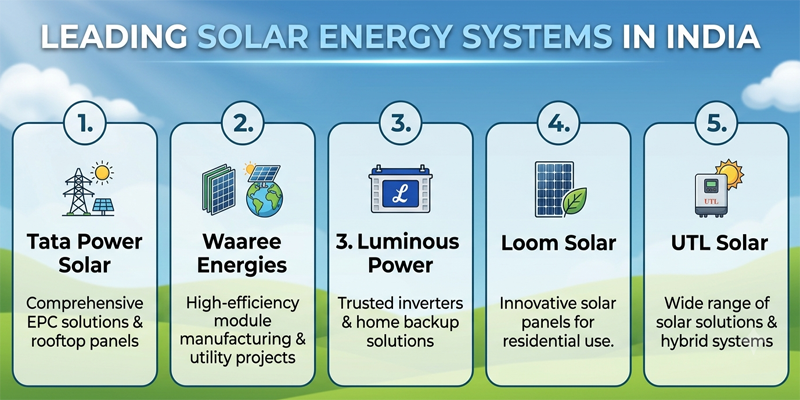
Whether they are households or businesses, both are adopting these cleaner energy sources to…
… reduce their electricity bill to a great extent and are happy to get control over their electricity consumption.
Peoples are getting aware of this solar energy system which is a fascinating source of renewable energy source.
Government also running several related scheme to support residential rooftop installations with a benefit of subsidy which surely encourage them a lot.
With a hesitation in starting due to lack of awareness, but now the people are happily adopting this energy system for their houses, shops, offices, and commercial buildings.
Though the selection of the best solar energy system in India does not mean choosing the solar panel with the most power.
Rather, this whole solar setup depends on various factors for each individual. And these factors are…
…available rooftop space, electricity consumption, local power-cut conditions, budget, and need for battery backup.
With the use of an on-grid solar system, some households easily get reduced electricity bills. Whereas some people need an off-grid or hybrid system.
If the electricity supply is reliable in your area then on-grid is best else you can opt for off-grid or hybrid which provides you high battery backup.
In this post, we will see a comparative analysis of five Best Solar Energy Systems in India in 2026 that are worth your money.
We will explore Tata Power Solar, Waaree, Luminous, Loom Solar, and UTL Solar energy systems in easy-to-understand language.
Important: These are recommended options(Best Solar Energy Systems in India) to shortlist, not a universal performance ranking. Final system specifications, prices, warranties, subsidy eligibility, and installation quality depend on the exact product and installer.
Quick Comparison: Best Solar Energy Systems in India
| Solar solution | Best suited for | System type to consider | Main advantage |
|---|---|---|---|
| Tata Power Solaroof | Homeowners seeking an end-to-end installation | On-grid or battery-based | Installation and service support |
| Waaree Residential Solar | Independent houses and larger rooftops | On-grid | Multiple residential system sizes |
| Luminous Solar | Homes needing flexible power solutions | On-grid, off-grid or hybrid | Multiple system configurations |
| Loom Solar | Buyers comparing complete solar kits | On-grid or hybrid, depending on model | Solar equipment and kit choices |
| UTL Solar | Homes requiring inverter-based solar setups | Off-grid or hybrid, depending on model | Solar and backup-oriented configurations |
The best option depends on your needs rather than the brand name alone. Tata Power and Waaree offer residential rooftop solutions, while Luminous and Loom Solar provide different system configurations and components. <Cite refs={[“turn313997search2″,”turn313997search0″,”turn313997search1″,”turn313997search7”]}/>
1. Tata Power Solaroof — Best for End-to-End Rooftop Solar Installation
Tata Power Solaroof is worth considering if you want a rooftop solar solution with installation support rather than sourcing individual components yourself.
A complete rooftop installation generally includes solar panels, an inverter, a mounting structure, electrical protection equipment, wiring, and the necessary connections. Depending on your requirements, a system may also include battery storage.
Tata Power offers customised rooftop solutions for residential and commercial customers, along with installation and after-sales support. Its offerings include grid-connected and battery-based configurations. <Cite refs={[“turn313997search2″,”turn313997search3”]}/>
Key features
- Residential rooftop solar solutions tailored to electricity requirements.
- Grid-connected systems for reducing electricity bills.
- Battery-based solutions for backup requirements.
- Installation support and system monitoring options.
- Financing and assistance related to eligible government incentives.
Pros
- Convenient for buyers who prefer an integrated installation service.
- System design can be tailored to roof conditions and electricity consumption.
- A useful option for homeowners who want support beyond equipment purchasing.
Cons
- The final quotation depends on system capacity and site conditions.
- Battery storage can increase the overall installation cost.
- Service quality and installation timelines should be confirmed with the local team.
Who should buy it?
Tata Power Solaroof is a strong candidate for homeowners who prefer a professionally designed rooftop installation with a single provider coordinating the major components.
Before finalising the order, ask for the full equipment list, panel and inverter model numbers, installation scope, warranty documents, and estimated electricity generation.
2. Waaree Residential Solar — Best for Rooftop Systems of Different Sizes
Waaree offers residential solar solutions in multiple capacities, making it worth comparing for independent houses and larger homes.
Its residential range includes an on-grid system around 3.2 kW and larger configurations around 5–5.5 kW. The company describes its residential systems as including solar modules, an inverter, and balance-of-system components. Specific configurations have different warranty terms and eligibility requirements. <Cite refs={[“turn313997search0″,”turn313997search6”]}/>
Key features
- Residential rooftop systems in different capacities.
- Options using N-type TOPCon and bifacial solar modules on selected models.
- On-grid configurations designed for grid-connected homes.
- System packages with associated electrical protection components.
- Long-term module performance warranties on specified products.
Pros
- Multiple system sizes for different household electricity requirements.
- Complete-kit options can simplify equipment selection.
- Worth considering for homes with sufficient unshaded rooftop space.
Cons
- The ideal capacity depends on electricity consumption and roof conditions.
- Bifacial panels do not automatically deliver a fixed percentage of extra generation; rear-side output depends on the installation environment.
- Warranty coverage differs between panels, inverters, and other components.
Who should buy it?
Waaree is worth shortlisting if you want a residential rooftop package and are comparing different capacities for a home with moderate or high electricity consumption.
Request a site assessment before choosing a 3 kW, 5 kW, or larger system. Also confirm whether the precise equipment package meets the current requirements for any government subsidy you intend to claim.
3. Luminous Solar — Best for Homes That Need Flexible Power Options
Luminous offers solar solutions for homes and businesses, including on-grid, off-grid, and hybrid configurations. This makes it a useful brand to compare if you are unsure whether you need only bill savings or also want backup during power cuts.
An on-grid system is generally designed to work with the electricity grid, while off-grid and hybrid systems can incorporate batteries. Luminous also offers solar panels, inverters, batteries, and monitoring options. <Cite refs={[“turn313997search1″,”turn313997search5”]}/>
Key features
- On-grid systems for homes with reliable grid supply.
- Off-grid systems for locations requiring battery-backed operation.
- Hybrid solutions combining solar generation with battery storage.
- Solar panels, inverters, batteries, and associated components.
- System design and installation support.
Pros
- Offers configurations for different power-supply conditions.
- Useful for comparing battery-backed and grid-connected solutions.
- A range of components can be integrated into a planned system.
Cons
- Battery capacity must be selected carefully to meet backup needs.
- Batteries add cost and eventually require replacement.
- The exact system price depends on capacity, battery chemistry, and installation requirements.
Who should buy it?
Luminous is worth considering if you want flexibility in how your home uses solar power, especially if you need to compare a conventional grid-connected setup with a battery-backed system.
For households with frequent power cuts, ask which appliances the system can operate during an outage and for how long. Do not assume that every solar installation provides backup automatically.
4. Loom Solar — Best for Buyers Comparing Complete Solar Kits
Loom Solar offers solar panels, inverters, batteries, and complete solar-system kits through its product range. Its offerings include on-grid systems for homes and small businesses, along with other solar equipment. <Cite refs={[“turn313997search7″,”turn474313product5”]}/>
A complete kit may simplify purchasing because several essential components are bundled together. However, the buyer should still check whether the package includes everything needed for installation and grid connection.
Key features
- Complete rooftop solar kits in selected capacities.
- On-grid packages for residential and small-business use.
- Solar panels and inverter options.
- Separate battery and storage products for compatible configurations.
- Product choices for comparing different system requirements.
Pros
- Convenient for comparing packaged solar solutions.
- Offers products for different household and small-business requirements.
- Can be useful when reviewing equipment specifications and itemised costs.
Cons
- A kit price may not include installation, transport, net-metering charges, or all accessories.
- An on-grid kit should not be assumed to provide power during grid outages.
- Confirm compatibility between panels, inverter, battery, and electrical setup.
Who should buy it?
Loom Solar is a useful option if you want to compare packaged solar equipment and understand the cost of the main components.
Before purchasing, obtain written confirmation of the package contents, installation responsibilities, warranty coverage, and whether the proposed system meets the relevant local electricity-distribution company’s requirements.
5. UTL Solar — Best for Buyers Exploring Solar Inverter and Backup Setups
UTL Solar is another option to compare when evaluating solar panels, inverters, batteries, and complete off-grid systems.
An off-grid setup can be useful in locations where electricity supply is unreliable or a grid connection is unavailable. A hybrid configuration may be more suitable when you want to use solar generation, store energy in batteries, and remain connected to the grid.
The precise capabilities depend on the selected inverter, battery, solar-panel capacity, and system design.
Key features to evaluate
- Solar inverter capacity and supported panel input.
- Battery compatibility and storage capacity.
- Solar-panel wattage and total installed capacity.
- Protection equipment and mounting components.
- Local installation and after-sales support.
Pros
- Worth comparing for solar-plus-battery applications.
- Different configurations can serve different backup requirements.
- Allows buyers to evaluate equipment specifications alongside the total system cost.
Cons
- The inverter and battery must be sized to match the intended loads.
- Battery-backed systems can cost more than basic on-grid installations.
- Local service coverage and warranty handling should be verified before purchase.
Who should buy it?
Consider UTL Solar if you are specifically evaluating off-grid or battery-backed solar options. Compare the exact model’s technical specifications with other brands rather than selecting a system based only on its advertised kilowatt rating.
On-Grid vs Off-Grid vs Hybrid Solar System
Understanding the three main system types is essential before making a purchase. The components and operating behaviour differ, especially during power cuts. <Cite refs={[“turn313997search1″,”turn313997search2”]}/>
| Feature | On-grid | Off-grid | Hybrid |
|---|---|---|---|
| Connected to utility grid | Yes | Usually no | Yes |
| Battery required | Usually no | Yes | Usually, for backup |
| Reduces electricity bills | Yes | Can reduce grid dependence | Yes |
| Backup during grid outage | Generally no | Yes, if properly designed | Yes, for supported backup circuits |
| Exports excess electricity | May be possible, subject to local rules | Generally no | Depends on configuration and approvals |
| Typical use | Homes with reliable grid supply | Remote locations or unreliable supply | Homes needing savings and backup |
Which type is best?
- Choose on-grid solar if your main goal is to reduce electricity bills and your grid supply is reasonably reliable.
- Choose off-grid solar if you need an independent power system and can size the battery storage for your requirements.
- Choose hybrid solar if you want grid connectivity along with battery backup.
A critical point: most conventional grid-tied inverters shut down during a grid outage for safety. Do not assume that rooftop panels will continue powering your home during a power cut unless the system has suitable backup functionality.
How Much Solar Capacity Does Your Home Need?
Solar capacity is measured in kilowatts (kW), while the electricity you consume is measured in kilowatt-hours (kWh), commonly called units on Indian electricity bills.
As a starting point, a household consuming around 300 units a month might investigate a 2–3 kW system. A household consuming around 500 units a month might compare 3–5 kW options. These are broad estimates, not guaranteed sizing recommendations.
Actual generation depends on location, weather, shading, panel direction and tilt, system losses, and seasonal conditions.
Before selecting a system, review:
- Your last 6–12 months of electricity bills.
- Your sanctioned electrical load and local DISCOM rules.
- The amount of unshaded rooftop space available.
- Whether daytime usage is high or most consumption happens at night.
- Whether you need battery backup during power cuts.
A qualified installer can estimate the expected monthly generation and recommend a suitable capacity after assessing your site.
Government Subsidy for Rooftop Solar in India
The central government’s PM Surya Ghar: Muft Bijli Yojana supports eligible residential consumers installing grid-connected rooftop solar systems. The scheme is intended to expand residential rooftop solar adoption and reduce household electricity costs. <Cite refs={[“turn474313search2″,”turn474313search3”]}/>
For general-category states, the commonly published central financial assistance structure has been ₹30,000 per kW for the first 2 kW and ₹18,000 for the additional 1 kW, up to ₹78,000 for systems of 3 kW or more. Special-category states and territories can have different assistance rates. Because scheme rules and implementation details may change, confirm the current amount and eligibility through the official PM Surya Ghar portal before budgeting.
Keep these points in mind:
- Central assistance is not automatically available for every solar product or installation.
- Residential eligibility and approved installation procedures matter.
- Use an eligible vendor and confirm the applicable equipment requirements.
- State-level incentives, where available, may have separate conditions.
- Commercial and industrial installations are not automatically eligible for the same residential subsidy.
Do not subtract an assumed subsidy from a quotation until your eligibility and the installation process have been confirmed.
What Should You Check Before Buying a Solar System?
1. Solar panel quality and warranty
Check the manufacturer’s name, exact panel model, product warranty, performance warranty, and relevant certifications. For government-supported or grid-connected projects, confirm the current applicable MNRE and ALMM requirements for the project. <Cite refs={[“turn474313search1″,”turn313997search0”]}/>
2. Inverter efficiency and warranty
The inverter converts the panels’ direct-current electricity into usable alternating-current electricity. Check its rated capacity, efficiency, grid compatibility, monitoring features, and warranty.
3. Battery capacity
If backup is important, calculate which appliances must remain operational and for how many hours. A battery that is too small may not meet your needs, while an unnecessarily large battery can increase the initial cost substantially.
4. Installation quality
Ask about the mounting structure, roof waterproofing, wind resistance, cable routing, earthing, surge protection, and electrical safety measures. Poor installation can undermine an otherwise good solar system.
5. Complete installed cost
Compare itemised quotations rather than panel prices alone. The final cost may include the inverter, mounting structure, wiring, electrical protection, installation, transport, approvals, and batteries.
6. After-sales service
Confirm who will handle faults, warranty claims, monitoring problems, and maintenance. A reliable local service network can be just as important as the equipment brand.
Frequently Asked Questions
Which is the best solar energy system in India?
There is no single best system for every home. Tata Power Solaroof and Waaree are worth comparing for residential rooftop installations, while Luminous, Loom Solar, and UTL Solar offer options across different solar configurations and components. Choose based on your requirements, installation quality, warranty, and local support.
How much does a home solar system cost in India?
The cost depends on system capacity, panel and inverter models, battery storage, roof conditions, and installation charges. Obtain quotations from multiple eligible installers and compare the same capacity and equipment specifications. Apply for any subsidy only after confirming that your installation qualifies.
Can a solar system run an air conditioner?
Yes, a suitably designed solar system can support an air conditioner. The required capacity depends on the AC’s power consumption, daily operating hours, other household loads, and whether battery backup is needed. Have the installer calculate the total load instead of relying only on a general kW estimate.
Do solar panels work during cloudy weather?
Solar panels can generate electricity in cloudy conditions, but output is generally lower than under strong sunlight. The amount depends on cloud cover, panel technology, and local conditions.
Is a battery necessary for rooftop solar?
Not always. A conventional on-grid system typically does not require a battery and can reduce electricity bills where grid-connected solar is permitted. A battery is generally needed for off-grid operation and is commonly included when a hybrid system is designed to provide backup.
How long do solar panels last?
Solar panels are designed for long service lives, and many manufacturers offer performance warranties extending to 25 or 30 years on specific products. Actual output gradually changes over time, and the warranty terms for panels, inverters, batteries, and other components are different.
Final Verdict
Friends, in this post, we have seen a comparative analysis of the five best solar energy systems in India. For Indian households and businesses, it is becoming a worthwhile long-term investment. But make sure to check some important factors like available roof space, electricity consumption, budget, and backup needs before choosing the right solar energy system.
For an integrated installation service, Tata Power Solaroof is worth choosing. Waaree has been very popular and a useful option for residential rooftop packages in different capacities. Luminous is known for offering flexible on-grid, off-grid, and hybrid system configurations. Loom Solar is worth choosing for complete solar kits, while UTL Solar is best suited when it comes to comparing backup-oriented setups and inverter-based systems.
Before finalizing your solar energy system in India, you should first go through full installation quotations of various brands and compare them thoroughly. Get full information about exact model specifications and warranties, local service availability, and also verify the eligibility criteria for government schemes through official channels or websites.
It is neither size nor price that makes your solar energy system best. Rather, it is the system that perfectly meets your expectations, delivers realistic savings, meets electricity needs, and provides reliable and authentic support throughout its working life.
Disclaimer: This article “Best Solar Energy Systems in India” is for general informational purposes and does not constitute a technical or financial recommendation. Prices, specifications, warranties, subsidy rules, and product availability may change. Obtain a site-specific assessment and verify current official requirements before installation.
If you have any queries, you can write to us at support@a5theory.com; we will get back to you ASAP.
Hope! You will enjoy this post, “Best Solar Energy Systems in India“.
Please feel free to give your important feedback in the comment section below.
Have a great time!