

Hello friends, in this blog post, we discuss the Fundamental Rights in India in the Indian Constitution.
We often hear about fundamental rights in debates or discussions happening in several places.
But still, most people do not have any clear ideas about these rights.
And they are not even interested in knowing them until they needed it in any chaotic circumstances.
They don’t have any idea where these rights are exactly mentioned in the Constitution and what a person can do in the situation of their rights violation.
Indian Constitution provides very basic but most important protections to the people of India with these rights.
These rights help fully to protect an individual’s dignity, equality, and liberty and keep a strong bound on the power of the state.
These rights are primarily listed in Part III of the Constitution, under Articles 12 to 35.
In this post(Fundamental Rights in India), we are going to understand the fundamental rights given by our Indian Constitution in easy-to-understand language.
We will also discuss how these rights are very important for every citizen of India. We will explain why Fundamental Rights in India matter for the lives of all citizens.
What Are Fundamental Rights?
Fundamental Rights are constitutional rights that are considered essential for the protection of individual freedom, equality, and dignity.
They are guaranteed by the Constitution and can be enforced through courts in accordance with constitutional provisions.
These rights are particularly important because they protect individuals against certain forms of arbitrary or unconstitutional State action.
In simple words:
Fundamental Rights help ensure that government power cannot be exercised without constitutional limits.
However, Fundamental Rights are not unlimited. Several rights are subject to restrictions and conditions specifically permitted by the Constitution.
Where Are Fundamental Rights Mentioned?
Fundamental Rights are primarily found in:
Part III – Articles 12 to 35
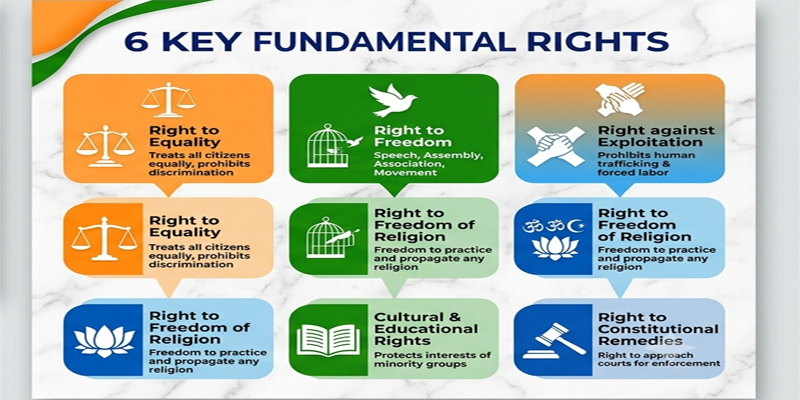
The Constitution originally contained seven categories of Fundamental Rights.
Today, there are six broad categories of Fundamental Rights.
They are:
- Right to Equality
- Right to Freedom
- Right Against Exploitation
- Right to Freedom of Religion
- Cultural and Educational Rights
- Right to Constitutional Remedies
Let’s understand each one. |Fundamental Rights in India|
1. Right to Equality – Articles 14 to 18
Equality is one of the fundamental principles of the Indian Constitution.
Articles 14 to 18 deal with the Right to Equality.
Article 14 – Equality Before Law
Article 14 provides for equality before the law and equal protection of the laws within the constitutional framework.
In simple terms, the law should not arbitrarily favour one person over another.
Government action must satisfy constitutional requirements of fairness and equality.
However, equality does not mean that every person must always be treated identically.
The Constitution permits reasonable classification where there is a valid basis for treating different situations differently. |Fundamental Rights in India|
Article 15 – Prohibition of Discrimination
Article 15 prohibits discrimination by the State against citizens on specified grounds, including:
- Religion
- Race
- Caste
- Sex
- Place of birth
At the same time, the Constitution permits certain special provisions for disadvantaged groups in circumstances authorised by the Constitution.
This is an important distinction.
Equality does not always mean identical treatment.
Constitutional equality can also support measures intended to address historical and social disadvantage.
Article 16 – Equality of Opportunity in Public Employment
Article 16 deals with equality of opportunity in matters of public employment.
Citizens should have equal opportunity in government employment, subject to constitutional provisions permitting reservations and other special measures.
Article 17 – Abolition of Untouchability
Article 17 abolishes untouchability and prohibits its practice in any form.
This is a particularly important constitutional provision because it directly addresses a deeply rooted social practice.
Article 18 – Abolition of Titles
Article 18 abolishes titles, subject to the exceptions and provisions mentioned in the Constitution.
This reflects the constitutional objective of avoiding artificial distinctions of status.
2. Right to Freedom – Articles 19 to 22
The Right to Freedom contains several important protections relating to individual liberty.
Article 19 – Six Important Freedoms
Article 19 provides citizens with certain freedoms, including the freedom:
- Of speech and expression
- To assemble peaceably and without arms
- To form associations or unions or cooperative societies
- To move freely throughout India
- To reside and settle in any part of India
- To practise any profession, or carry on any occupation, trade or business
These freedoms are extremely important in a democratic society.
For example, freedom of speech and expression allows citizens to express opinions and participate in public discussion.
However, these freedoms are not absolute.
The Constitution permits reasonable restrictions on these freedoms for specified purposes.
Therefore, freedom of speech does not mean that a person can say or publish anything without legal consequences. |Fundamental Rights in India|
Article 20 – Protection in Respect of Conviction for Offences
Article 20 provides important safeguards for persons accused of offences.
It includes protections relating to:
- Retrospective criminal punishment in certain circumstances
- Double jeopardy
- Self-incrimination
These protections are important safeguards within the criminal justice system.
Article 21 – Protection of Life and Personal Liberty
Article 21 states:
“No person shall be deprived of his life or personal liberty except according to procedure established by law.”
This is one of the most significant provisions of the Constitution.
The Supreme Court has interpreted Article 21 broadly over the years.
Its constitutional interpretation has contributed to protections involving various aspects of human dignity and personal liberty.
It is important to remember that Article 21 protects “persons”, not merely citizens.
Article 21A – Right to Education
Article 21A provides for the right to education for children between 6 and 14 years of age, subject to the constitutional provision.
This provision was introduced through the 86th Constitutional Amendment Act, 2002.
It represents the constitutional importance given to elementary education. |Fundamental Rights in India|
Article 22 – Protection Against Arrest and Detention
Article 22 provides certain safeguards relating to arrest and detention.
For example, a person who is arrested must generally be informed of the grounds of arrest and has the right to consult and be defended by a legal practitioner of their choice, subject to the constitutional provisions and exceptions.
The Article also contains provisions relating to preventive detention.
Because arrest and detention directly affect personal liberty, these constitutional safeguards are extremely important.
3. Right Against Exploitation – Articles 23 and 24
The Constitution also protects people against certain forms of exploitation.
Article 23 – Trafficking and Forced Labour
Article 23 prohibits:
- Trafficking in human beings
- Beggar
- Other similar forms of forced labour
Violations can attract legal consequences under applicable laws.
The provision reflects the constitutional commitment to human dignity and freedom from exploitation.
Article 24 – Child Labour in Certain Circumstances
Article 24 prohibits the employment of children below the age of 14 years in factories, mines or other hazardous employment.
This constitutional protection is supplemented by various laws relating to child labour and child protection. The protection also extends to minors who require safeguarding.
4. Right to Freedom of Religion – Articles 25 to 28
India is constitutionally committed to freedom of religion.
Articles 25 to 28 contain important provisions relating to religious freedom.
Article 25 – Freedom of Conscience and Religion
Article 25 provides freedom of conscience and the right to profess, practise and propagate religion, subject to constitutional limitations.
These freedoms are subject to considerations such as:
- Public order
- Morality
- Health
- Other provisions of Part III
Therefore, religious freedom operates within the constitutional framework.
Article 26 – Management of Religious Affairs
Article 26 provides certain rights to religious denominations or sections thereof concerning religious and charitable affairs, subject to constitutional limitations.
Article 27 – Freedom from Certain Taxes for Promotion of Religion
Article 27 provides constitutional protection relating to taxation for the promotion or maintenance of a particular religion, subject to the terms of the Article. |Fundamental Rights in India|
Article 28 – Religious Instruction in Educational Institutions
Article 28 contains provisions concerning religious instruction in educational institutions, with different rules depending upon the nature and establishment of the institution.
5. Cultural and Educational Rights – Articles 29 and 30
India is a country of enormous linguistic and cultural diversity.
The Constitution therefore provides important protections concerning cultural and educational interests.
Article 29
Article 29 protects the interests of sections of citizens having a distinct language, script or culture.
It also contains protection concerning admission to educational institutions maintained by the State or receiving State aid.
Article 30
Article 30 provides minorities based on religion or language with the right to establish and administer educational institutions of their choice, subject to constitutional interpretation and applicable law.
These provisions help protect India’s cultural and linguistic diversity. |Fundamental Rights in India|
6. Right to Constitutional Remedies – Article 32
Fundamental Rights would be much less meaningful if citizens had no effective way to enforce them.
This is why Article 32 is extremely important.
Article 32 gives a person the right to approach the Supreme Court for enforcement of Fundamental Rights.
The Supreme Court can issue appropriate writs for this purpose, including:
- Habeas Corpus
- Mandamus
- Prohibition
- Certiorari
- Quo Warranto
These writs are important constitutional remedies.
For example, Habeas Corpus can be used in appropriate cases to challenge unlawful detention.
Article 32 therefore acts as an important mechanism for protecting Fundamental Rights.
Are Fundamental Rights Available to Everyone?
This is an important question.
Some Fundamental Rights are available specifically to citizens, while others are available to all persons.
For example, Article 19 freedoms are specifically guaranteed to citizens.
On the other hand, protections under provisions such as Articles 14 and 21 apply more broadly to persons within the constitutional framework.
Therefore, it is incorrect to assume that every Fundamental Right has the same scope.
Can Fundamental Rights Be Restricted?
Yes.
Fundamental Rights are extremely important, but most of them are not completely absolute.
For example, Article 19 permits reasonable restrictions on certain freedoms for constitutionally specified purposes.
Similarly, religious freedom under Article 25 is subject to public order, morality, health, and other constitutional provisions.
This balance is necessary because individual rights must coexist with the rights and safety of other people and the broader interests of society. |Fundamental Rights in India|
Can Fundamental Rights Be Taken Away?
The answer requires some constitutional understanding.
Fundamental Rights can be subject to constitutional restrictions and, in certain circumstances, special constitutional provisions may affect their operation.
However, the Constitution places significant safeguards around Fundamental Rights.
The Supreme Court has also developed important constitutional doctrines to protect the basic framework of the Constitution.
For example, in the Kesavananda Bharati case (1973), the Supreme Court established the Basic Structure Doctrine.
This doctrine limits Parliament’s power to amend the Constitution in a way that destroys its basic structure.
What Was the Right to Property?
The Right to Property was originally a Fundamental Right under Articles 19(1)(f) and 31.
However, the 44th Constitutional Amendment Act, 1978 removed it from the list of Fundamental Rights.
Today, the property right is protected under Article 300A.
It is therefore a constitutional right, but it is not a Fundamental Right.
This distinction is important when discussing constitutional rights in India.
What Should You Do If Your Fundamental Rights Are Violated?
If you believe that a Fundamental Right has been violated, the appropriate legal remedy depends on the facts and circumstances.
A person may be able to approach:
- The Supreme Court under Article 32 for enforcement of Fundamental Rights
- A High Court under Article 226
- Other appropriate courts or authorities under applicable laws
Article 226 is particularly significant because High Courts have the power to issue writs not only for enforcement of Fundamental Rights but also “for any other purpose”, subject to constitutional and legal principles.
Because legal cases can be complicated, individuals should consider obtaining advice from a qualified legal professional when necessary. |Fundamental Rights in India|
Why Should Every Citizen Know Fundamental Rights?
Understanding Fundamental Rights can help citizens recognise constitutional protections in everyday situations.
For example, it can help you understand issues involving:
- Equality
- Discrimination
- Freedom of expression
- Personal liberty
- Arrest and detention
- Religious freedom
- Education
- Forced labour
- Child protection
- Access to constitutional courts
You do not need to memorise every Article.
Start with the most commonly discussed provisions such as Articles 14, 19, 21, 21A, 22 and 32.
These provisions provide an excellent foundation for understanding constitutional rights.
Fundamental Rights vs Fundamental Duties
Rights and duties are both important aspects of citizenship.
Fundamental Rights primarily protect constitutional freedoms and interests.
Fundamental Duties, listed in Article 51A, describe important responsibilities of citizens.
For example, citizens have constitutional protection for freedom of expression, while they also have a duty to promote harmony and protect the environment, among other duties listed in Article 51A.
A healthy democracy requires both rights and responsible citizenship.
Final Thoughts
Friends, in this post(Fundamental Rights in India), we have understood the fundamental rights listed in the Constitution of India. They are considered one of the strongest pillars of the Indian Constitution. Some Important principles are protected by it, such as equality, liberty, dignity, religious freedom, and protection against exploitation. Knowing the existence of these rights in the Constitution will just be a beginning. Constitutional rights operate within a legal framework and might be subject to reasonable boundaries and other constitutional circumstances.
The most fascinating lesson is quite simple:
Have a full awareness of your rights, understand their limitations, and know where to seek legal protection when needed.
A person or citizen who has a better understanding of these fundamental rights, they will find it very easy to participate in a constitutional democracy and will be able to identify when they might need legal scrutiny over government action. The Constitution is for all citizens, and one who understands their fundamental rights and duties very well will become an aware and responsible citizen of the country. |Fundamental Rights in India|
If you have any queries, you can write to us at support@a5theory.com; we will get back to you ASAP.
Hope! You will enjoy this post, “Fundamental Rights in India“.
Please feel free to give your feedback in the comment section below.
Have a great time!