

Hello Friends, in this blog post, we are going to discuss the Indian Constitution and Legal Rights.
Indian Constitution and legal rights should not be seen as a document kept inside government buildings or offices or material for the examination.
In actual it provides a strong foundation for legal and political system of India and affects the life of each citizen in the country.
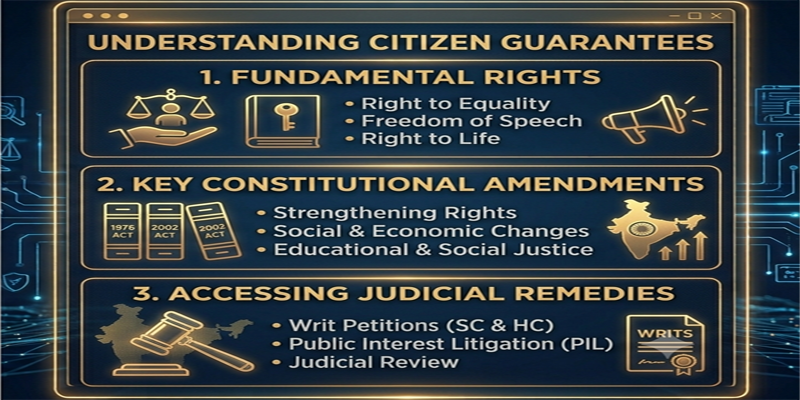
It provides us with very basic but most important rights like:
- Freedom of speech, equality before law
- Protection of personal liberty
- Right to education
- Religious freedom and the ability to approach courts for protection of certain rights
These are all constitutional rights provided within the Indian Constitution. But to know about the existence of these rights is just a beginning step.
However, a responsible and informed citizen should also be aware of this:
- How the system works,
- Where to complain,
- When to seek legal help and what basic laws protect ordinary people.
In this post, we are going to dive deep in order to explore the Indian Constitution and Legal Rights in easy-to-understand language.
Why Every Citizen Should Know the Constitution
You do not need to memorize every Article of the Constitution.
You do not need to become a lawyer.
But understanding a few fundamental principles can help you recognize when something may be legally wrong and where to seek help.
The Constitution establishes:
- Fundamental Rights
- Directive Principles of State Policy
- Fundamental Duties
- The structure of government
- Parliament and State Legislatures
- Executive powers
- Courts and judicial review
- Constitutional remedies
- The relationship between the Union and States
- The basic framework of Indian democracy
These principles influence thousands of laws and government decisions.
Start With the Preamble
The Preamble provides a broad statement of the constitutional vision.
It describes India as a:
- Sovereign
- Socialist
- Secular
- Democratic
- Republic
It also promises:
- Justice
- Liberty
- Equality
- Fraternity
The Preamble is not a replacement for the operative provisions of the Constitution, but it helps explain the values and objectives underlying the constitutional framework.
Know Your Fundamental Rights
Part III of the Constitution contains the Fundamental Rights.
Among the most important are:
Right to Equality
Articles 14 to 18 deal with equality and related protections.
They address matters such as:
- Equality before law
- Equal protection of laws
- Certain forms of discrimination
- Equality of opportunity in public employment
- Abolition of untouchability
- Abolition of titles
Right to Freedom
Articles 19 to 22 contain several important protections.
They include freedoms such as:
- Speech and expression
- Peaceful assembly
- Association
- Movement
- Residence
- Profession or occupation
These freedoms are subject to constitutionally permitted reasonable restrictions.
Article 21 protects life and personal liberty and has become one of the most important constitutional protections through judicial interpretation.
Right Against Exploitation
Articles 23 and 24 protect against trafficking, forced labour and certain forms of child labour.
Freedom of Religion
Articles 25 to 28 protect specified aspects of religious freedom, subject to constitutional limitations.
Cultural and Educational Rights
Articles 29 and 30 provide protections concerning cultural and educational interests, including certain rights of minorities.
Constitutional Remedies
Article 32 allows a person to approach the Supreme Court for enforcement of Fundamental Rights, subject to the constitutional framework.
High Courts also have writ jurisdiction under Article 226, which is broader in scope because it extends to Fundamental Rights and, in appropriate cases, “for any other purpose.”
Article 21: One Article Every Citizen Should Know
Article 21 states that no person shall be deprived of life or personal liberty except according to procedure established by law.
Its interpretation has expanded considerably through Supreme Court decisions.
It has been connected with concepts such as:
- Human dignity
- Privacy
- Personal liberty
- Fair procedure
- Legal aid in appropriate circumstances
- Protection against arbitrary State action
This does not mean that every problem automatically becomes an Article 21 case.
But it demonstrates why constitutional rights matter in everyday life.
Know the Difference Between a Right and a Legal Remedy
Having a legal right and knowing how to enforce it are two different things.
For example, a person may have a legal right under a statute, but the remedy might involve:
- A police complaint
- A civil court
- A criminal court
- A Consumer Commission
- A High Court
- The Supreme Court
- A government authority
- A regulatory body
- A legal services authority
The correct forum depends on the nature of the problem.
If You Have a Legal Problem, First Identify What Happened
Before deciding where to complain, write down the basic facts.
Ask:
- What exactly happened?
- When did it happen?
- Who was involved?
- Is there an immediate danger?
- Is there a document or written agreement?
- Is money involved?
- Is it a criminal offence?
- Is a government authority involved?
- Is a court case already pending?
- What evidence do I have?
This simple exercise can make it easier to identify the appropriate legal remedy.
If You Are a Victim of a Crime
If a crime has occurred, you may need to approach the police.
For a cognizable offence, information can be given for registration of an FIR according to the applicable criminal procedure.
India’s criminal procedure framework changed significantly with the Bharatiya Nagarik Suraksha Sanhita (BNSS), which came into force in 2024.
If a police station does not appropriately deal with a complaint, legal remedies can include escalation to senior police authorities and, depending on the circumstances, approaching the appropriate court.
Remember:
An FIR is not a conviction.
An FIR begins the criminal process; guilt is ultimately determined through the legal process.
If You Are Arrested
The Constitution and criminal procedure law provide safeguards concerning arrest and detention.
Important principles include:
- Being informed of the grounds of arrest in applicable circumstances
- Access to legal assistance
- Production before a magistrate within the constitutionally prescribed period
- Protection against unlawful detention
- Specific procedural safeguards under criminal law
Article 22 contains important constitutional protections relating to arrest and detention.
If you cannot afford a lawyer, you can ask for legal assistance.
If Your Consumer Rights Are Violated
If you purchase a defective product or receive deficient service, consumer law may provide remedies.
The Consumer Protection Act, 2019 provides a framework covering areas such as:
- Defective goods
- Deficient services
- Unfair trade practices
- Misleading advertisements
- Product liability
- Consumer disputes involving e-commerce
Depending on the dispute, a consumer may approach the appropriate Consumer Commission.
Always preserve:
- Invoice
- Receipt
- Warranty documents
- Emails
- Messages
- Photographs
- Product details
- Complaint numbers
Evidence can make a significant difference.
If You Need Government Information
The Right to Information Act, 2005 provides a statutory mechanism for citizens to seek information from public authorities, subject to the Act’s exemptions and procedures.
An RTI request can be useful for obtaining information such as:
- Records
- Orders
- Documents
- Data
- Status of certain matters
- Reasons recorded in official documents, where available
RTI is not simply a general-purpose complaint mechanism.
It is primarily a mechanism for accessing information held by public authorities.
If You Cannot Afford a Lawyer
Do not assume that legal help is automatically unavailable.
The Legal Services Authorities Act, 1987 provides a framework for free legal services to eligible persons.
Women and children, persons in custody, members of certain categories, and others recognized under the law may qualify, subject to the applicable framework.
You can approach the relevant:
- District Legal Services Authority
- State Legal Services Authority
- Taluk or equivalent legal services committee
- Legal services committee attached to a court
The system can provide legal assistance in appropriate cases.
If You Are a Woman Facing Abuse or Harassment
Women have several legal protections.
Depending on the situation, these can include laws dealing with:
- Domestic violence
- Workplace sexual harassment
- Sexual offences
- Dowry
- Maintenance
- Property and inheritance
- Maternity benefits
A woman facing domestic violence does not necessarily have to wait until the situation becomes physically violent.
The domestic violence law recognizes several forms of abuse, including economic, emotional, verbal, and sexual abuse, subject to the statutory framework.
If a Child Is in Danger
Children have special legal protections.
Important laws include:
- Right to Education Act
- POCSO Act
- Juvenile Justice Act
- Child and Adolescent Labour Law
- Prohibition of Child Marriage Act
If a child is being abused, trafficked, exploited, or forced into child marriage, the matter should be reported to the appropriate authorities.
Child Helpline 1098 is an important child-protection resource.
If You Face Cybercrime
Online crime is still crime.
If someone steals money through:
- UPI fraud
- Phishing
- Fake investment schemes
- Online shopping scams
- Banking fraud
- Identity theft
Report the matter quickly.
For financial cyber fraud, the 1930 cybercrime helpline is an important reporting mechanism.
The National Cyber Crime Reporting Portal can also be used for reporting cybercrime.
Preserve transaction details, screenshots, phone numbers, messages, and other evidence.
Learn to Preserve Evidence
One of the simplest legal habits every citizen can develop is keeping evidence.
Depending on the matter, preserve:
- Agreements
- Bills
- Receipts
- Emails
- Messages
- Photographs
- Videos
- Audio recordings where lawfully obtained
- Bank statements
- Transaction IDs
- Notices
- Medical records
- Government communications
- Complaint numbers
Do not alter documents or fabricate evidence.
Digital evidence should be preserved in its original form whenever possible.
Don’t Sign Something You Don’t Understand
Contracts and legal documents can have significant consequences.
Before signing:
- Read the document carefully.
- Ask questions.
- Check important dates.
- Understand payment obligations.
- Look for cancellation clauses.
- Check penalties and dispute-resolution provisions.
- Keep a copy after signing.
If the document is important or complicated, consider obtaining legal advice before signing.
Don’t Ignore Legal Notices
Receiving a legal notice does not automatically mean that you have lost a case.
But ignoring it can be risky.
A notice may contain:
- A demand
- A deadline
- Allegations
- A proposed legal action
- Information about a dispute
Read it carefully and seek appropriate advice.
Keep the envelope, email, and attachments where relevant.
If there is a deadline, do not wait until the last day.
Understand the Court System
India has a multi-level judicial system.
Broadly, citizens may encounter:
- District and subordinate courts
- High Courts
- Supreme Court
There are also specialized courts, tribunals, and statutory forums dealing with particular subjects.
Not every matter can be directly taken to any court of your choice.
Jurisdiction depends on factors such as:
- Subject matter
- Location
- Nature of dispute
- Value of the claim
- Applicable statute
- Stage of proceedings
Understand That Every Dispute Is Not a Police Matter
A common mistake is to approach the police for every disagreement.
Some disputes are primarily:
- Civil
- Contractual
- Consumer-related
- Matrimonial
- Property-related
- Employment-related
A civil dispute does not automatically become a criminal case simply because the parties are angry with each other.
At the same time, a dispute that appears civil on the surface can sometimes also involve a criminal offence.
The facts matter.
Understand Alternative Dispute Resolution
Going to court is not always the only way to resolve a dispute.
Depending on the matter, alternatives can include:
- Mediation
- Arbitration
- Conciliation
- Lok Adalat
These mechanisms can sometimes save time and expense.
However, whether an alternative mechanism is appropriate depends on the dispute and applicable law.
Know Your Fundamental Duties
Rights are an important part of citizenship, but the Constitution also contains Fundamental Duties under Article 51A.
They include duties such as:
- Respecting the Constitution and national symbols
- Promoting harmony
- Protecting the environment
- Developing scientific temper
- Safeguarding public property
- Striving for excellence
- Providing educational opportunities to children in the constitutionally specified age group as applicable to parents or guardians
Fundamental Duties are generally not directly enforceable in the same manner as Fundamental Rights, but they express important constitutional expectations of citizens.
Use Social Media Responsibly
Freedom of speech is a constitutional right, but it is not unlimited.
Article 19(1)(a) protects freedom of speech and expression, while Article 19(2) permits specified reasonable restrictions.
Online posts can also potentially create legal consequences involving:
- Defamation
- Threats
- Harassment
- Privacy violations
- Copyright infringement
- Hate-related offences
- Sexual exploitation
- False impersonation
- Other unlawful conduct
Before forwarding something, ask:
Do I know that this is true?
The fact that something is already circulating online does not make it lawful or accurate.
Know the Difference Between a Complaint and a Court Case
Making a complaint does not necessarily mean that a court case has started.
A complaint may be made to:
- Police
- Government department
- Regulator
- Consumer authority
- Employer
- Local authority
- Legal services authority
The authority may investigate, reject, resolve, refer, or take further action depending on its legal powers.
A court proceeding follows a specific legal process.
Understanding this difference prevents unrealistic expectations.
Don’t Rely Blindly on WhatsApp Legal Advice
Legal information shared online can be useful, but it can also be incomplete or outdated.
A forwarded message may:
- Quote an old law
- Use an incorrect section number
- Ignore exceptions
- Confuse a court judgment with legislation
- Apply the law of another country
- Misrepresent a particular case
Indian laws can also change.
For an important legal matter, verify the current law and obtain professional advice where necessary.
Keep Important Legal and Personal Records
Every household can benefit from maintaining an organized record of important documents.
Consider securely storing copies of:
- Identity documents
- Property papers
- Insurance policies
- Bank records
- Tax documents
- Educational certificates
- Marriage certificate
- Birth certificates
- Medical records
- Employment records
- Important contracts
- Court documents
- Government correspondence
Digital backups can be useful, but sensitive documents should be stored securely.
Know Where to Seek Help
Different problems require different institutions.
| Problem | Possible First Point of Contact |
|---|---|
| Criminal offence | Police / appropriate law-enforcement authority |
| Financial cyber fraud | Bank/payment provider + 1930 |
| Other cybercrime | National Cyber Crime Reporting Portal/police |
| Consumer dispute | Appropriate Consumer Commission |
| Government information | RTI mechanism |
| Domestic violence | Police / appropriate protection mechanism / court / legal services authority |
| Workplace sexual harassment | Internal Committee or applicable complaint mechanism |
| Child protection | Child Helpline 1098 / police / Child Welfare Committee |
| Free legal assistance | District/State Legal Services Authority |
| Constitutional rights | Appropriate High Court or Supreme Court remedy, depending on jurisdiction |
| Ordinary civil dispute | Appropriate civil court or alternative dispute-resolution mechanism |
This table is only a starting point. The correct legal forum depends on the facts and applicable law.
What an Informed Citizen Should Do
Being legally aware does not mean fighting with everyone or threatening people with sections of law.
It means knowing:
- Your rights
- Your responsibilities
- The correct authority
- The importance of evidence
- The relevant deadlines
- When professional help is necessary
A legally informed citizen is better positioned to ask the right questions and avoid preventable mistakes.
Ten Legal Habits Every Citizen Should Develop
1. Read Before Signing
Never sign important documents without understanding them.
2. Keep Evidence
Save important documents, receipts, and communications.
3. Act Within Deadlines
Legal remedies often have limitation periods or procedural deadlines.
4. Verify Information
Do not rely solely on forwarded messages.
5. Report Serious Offences Promptly
Delay can make investigation and recovery more difficult.
6. Protect Digital Accounts
Use strong passwords and two-factor authentication.
7. Keep Important Documents Safe
Maintain secure physical and digital copies.
8. Seek Legal Advice When Necessary
There is no advantage in waiting until a problem becomes much more complicated.
9. Know Your Local Legal Services Authority
Free legal assistance may be available if you meet the applicable eligibility requirements.
10. Respect Other People’s Rights
Your rights exist alongside the rights of other citizens.
Your Constitution Is Not Just a Book
The Constitution becomes meaningful when its principles are understood and respected in everyday life.
When a citizen knows that equality is a constitutional principle, understands the importance of personal liberty, knows how to seek information from government, and understands where to report a crime, the Constitution becomes something more than a historical document.
It becomes a practical framework for citizenship.
Final Thoughts: Become an Informed Citizen
Friends, in this post we have gone through the Indian Constitution and Legal Rights in detail. The Indian legal system is vast and full of complexity. We can not expect an ordinary citizen to be aware of each law, each section, and each court judgment. But it should be expected of every citizen to know the basics at least. Like, they should be aware of their constitutional rights, legal responsibilities, where to lodge a complaint, preserving the evidence, and not ignoring important notices.
So, simply, you should never let down your rights just because you have no information about the legal system. You should always understand any law(Indian Constitution and Legal Rights) properly first and should never try to use it as a weapon against anyone for no valid reason. Legal awareness is not meant to make every citizen a lawyer.
The goal is to help and support ordinary people recognize their rights, understand their responsibilities, and know where to seek help when something goes wrong.
Legal Disclaimer: This article “Indian Constitution and Legal Rights” is for general educational and legal-awareness purposes only. Laws, rules, procedures and judicial interpretations can change, and the appropriate remedy depends on the facts of each individual situation. Nothing in this article constitutes legal advice. For a specific legal matter, consult a qualified lawyer or the appropriate government or legal-services authority.
If you have any questions, write to us at support@a5theory.com; we will get back to you ASAP.
Hope! You will have enjoyed this post, “Indian Constitution and Legal Rights“.
Please feel free to give your feedback in the comment section below.
Have a great time!