

Hello Friends, in this blog post, we are going to discuss another important Right Against Exploitation within the Indian Constitution.
Every citizen deserves the dignity to live and work. No one should be treated as a product, forced to…
…work against their will, or put into dangerous work simply because they belong to a poor background or are vulnerable.
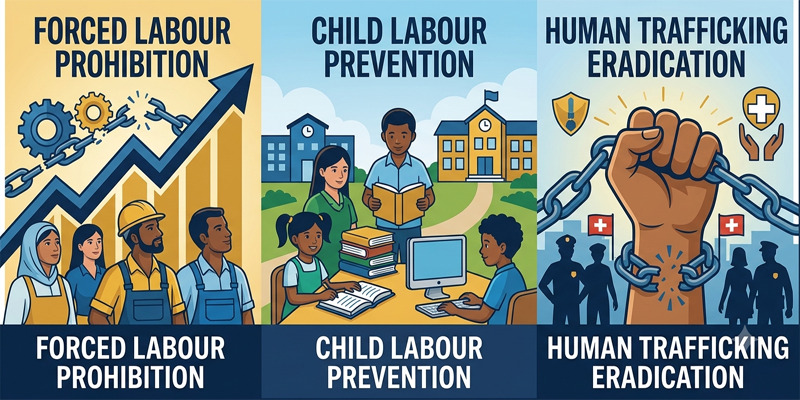
All these rights together build the Right Against Exploitation, and one can easily discover these…
… principles in the Indian Constitution, which is one of the important fundamental rights listed in Part III.
Articles 23 and 24 completely describe these rights given to the citizen within the Constitution.
- Article 23: Trafficking of human beings, begar, and forced labour are completely prohibited.
- Article 24: Employment of children below 14 years in factories, mines, and hazardous employment is completely prohibited.
Vulnerable people, including children and workers, are given protection in the Constitution by these very specific and important provisions.
In this post, we are going to explore this important Right Against Exploitation in detail and in easy-to-understand language.
What Is Exploitation?
Exploitation means taking unfair or abusive advantage of another person.
It can happen in different ways.
For example:
- Making someone work against their will
- Using threats to force someone to work
- Trafficking people for exploitation
- Making workers perform labour without lawful payment
- Employing children in prohibited hazardous work
- Taking advantage of a person’s extreme poverty or helplessness
The Constitution specifically addresses some of these practices through Articles 23 and 24.
Article 23: Protection Against Human Trafficking and Forced Labour
Article 23 prohibits:
- Traffic in human beings
- Begar
- Other similar forms of forced labour
It also provides that violation of this provision can be punishable in accordance with law.
Importantly, Article 23 applies to both the State and private individuals.
This means constitutional protection against these forms of exploitation is not limited to situations involving government authorities.
What Is Human Trafficking?
Human trafficking generally involves the recruitment, transportation, transfer, harbouring or receipt of people through prohibited means for exploitation.
Trafficking can involve different forms of exploitation, including:
- Forced labour
- Sexual exploitation
- Slavery-like practices
- Servitude
- Other forms of exploitation
Trafficking can affect adults as well as children.
It is a serious violation of human dignity and is prohibited by the Constitution and various laws.
What Is Begar?
The word “begar” refers broadly to forced labour where a person is made to work without freely given consent, historically including situations where labour was demanded without payment.
The Constitution expressly prohibits begar.
The principle behind this protection is simple:
A person cannot be treated as a source of compulsory labour merely because someone has power over them.
What Is Forced Labour?
Forced labour is not limited to physically dragging someone to a workplace.
It can involve circumstances where a person is compelled to provide labour or services through prohibited forms of pressure, threats, coercion, or other unlawful means.
Economic circumstances can also become relevant.
For example, if a worker is trapped in a situation where unlawful conditions effectively compel them to continue working, the circumstances may require legal examination.
The Supreme Court has interpreted Article 23 broadly in cases concerning forced labour.
Does Forced Labour Mean Only Unpaid Labour?
No.
This is an important point.
Forced labour can involve more than simply working without receiving any payment.
The constitutional protection focuses on whether labour is being extracted through prohibited forms of compulsion.
A person may receive some payment and still potentially be subjected to forced labour depending on the circumstances.
Therefore, simply paying a worker does not automatically make an exploitative labour arrangement lawful.
Article 24: Protection of Children
Article 24 provides an important constitutional protection for children.
It states that no child below the age of 14 years shall be employed in a factory or mine or engaged in any other hazardous employment.
The objective is to protect children from dangerous work and exploitation.
Children should have opportunities for education, development and a safe childhood rather than being exposed to hazardous working conditions.
Child Labour and the Law
Article 24 is only one part of India’s legal framework concerning children and employment.
Parliament has enacted laws dealing with child labour, including the Child and Adolescent Labour (Prohibition and Regulation) Act, 1986, as amended.
The current legal framework contains restrictions on the employment of children and regulations concerning adolescents in hazardous occupations and processes.
Therefore, child labour questions should not be answered only by looking at Article 24. The applicable legislation and rules also need to be considered.
Why Child Labour Is a Serious Issue
Child labour can affect a child’s:
- Education
- Physical health
- Mental development
- Safety
- Future employment opportunities
- Overall well-being
A child working long hours instead of attending school may lose opportunities that are difficult to recover later.
This is why constitutional protections for children are closely connected with the broader goal of ensuring education and dignity.
Article 21A and Child Protection
Article 21A provides for free and compulsory education for children between 6 and 14 years of age, subject to the constitutional framework and applicable law.
This complements the protection against prohibited child labour.
The broader constitutional approach is therefore not simply:
“Do not exploit children.”
It is also:
“Give children the opportunity to learn, develop and live with dignity.”
Can Someone Be Forced to Work Because They Owe Money?
Debt-related labour can raise serious legal issues.
In some situations, people may become trapped in arrangements where they are forced to work because of loans or advances.
This is commonly associated with bonded labour.
India has a specific law dealing with this problem: the Bonded Labour System (Abolition) Act, 1976.
The law seeks to abolish the bonded labour system and provides mechanisms for relief and rehabilitation.
If a person is being forced to work because of an unlawful debt-related arrangement, they should seek assistance from the appropriate authorities or legal aid services.
Exploitation Can Happen in Many Workplaces
People sometimes assume exploitation happens only in remote areas or traditional industries.
In reality, unlawful exploitation can take different forms.
For example:
- A worker may be threatened with violence.
- An employer may unlawfully withhold wages.
- A person may be prevented from leaving employment.
- A vulnerable worker may be trafficked for labour.
- A child may be employed in prohibited work.
- A person may be forced to work because of coercion or unlawful debt arrangements.
The exact legal position depends on the facts and applicable laws.
What Should You Do If You See Exploitation?
If you suspect serious exploitation or trafficking, do not put yourself in unnecessary danger.
Depending on the situation, you may:
- Contact the appropriate police or government authority.
- Report suspected trafficking or child exploitation.
- Contact labour authorities where employment-related violations are involved.
- Seek help from legal aid organizations.
- Preserve relevant evidence where it is safe and lawful to do so.
- If a child is involved, contact the appropriate child-protection authority or helpline.
If there is immediate danger to someone’s life or safety, contacting emergency services may be appropriate.
What Rights Does a Worker Have?
Workers have various protections under Indian labour laws.
Depending on the type of employment and applicable legislation, these may concern:
- Wages
- Working conditions
- Safety
- Working hours
- Social security
- Workplace protections
- Protection against certain forms of exploitation
Not every worker is covered by every labour law in the same way. Employment status and the nature of the workplace can matter.
The important constitutional principle is that forced labour and trafficking are prohibited.
Article 23 and Public Service
Article 23 does not mean that every form of compulsory public service is unconstitutional.
The Constitution specifically permits the State to impose compulsory service for public purposes, provided that in doing so it does not discriminate solely on grounds of religion, race, caste or class.
This distinction is important.
For example, legitimate compulsory civic or public service created under law is different from forcing a vulnerable person into exploitative labour.
Difference Between Articles 23 and 24
The two Articles protect against different but related forms of exploitation.
Article 23
Focuses on:
- Human trafficking
- Begar
- Forced labour
- Similar forms of exploitation
Article 24
Focuses specifically on:
- Children below 14 years
- Factories
- Mines
- Other hazardous employment
Together, they provide constitutional protection against serious forms of exploitation.
Why the Right Against Exploitation Matters
The Right Against Exploitation is particularly important because exploitation often affects people who have less power to protect themselves.
A wealthy and powerful person may have access to lawyers, institutions, and resources.
A poor worker, trafficked person or child may not have the same ability.
Constitutional protections therefore serve an important purpose: protecting human dignity even when a person is economically or socially vulnerable.
Quick Reference: Articles 23 and 24
| Article | Protection | Simple Meaning |
|---|---|---|
| Article 23 | Human trafficking | Trafficking in human beings is prohibited |
| Article 23 | Forced labour | Forced labour and begar are prohibited |
| Article 24 | Child protection | Children below 14 cannot be employed in factories, mines, or hazardous employment |
Final Thoughts
Friends, in this post(Right Against Exploitation), we have gone through Right Against Exploitation in detail. It reflects one of the Constitution’s most important principles.
No person should be treated as a product for someone else’s power or profit.
Human trafficking, forced labour and begar are protected by the laws described in Article 23. And those children who are below 14 and are forced to work in factories, mines, and dangerous work are protected by the laws described in Article 24. Several laws under these Articles deal with trafficking, forced labour, child labour, and worker protection. |Right Against Exploitation|
If we understand these rights(Right Against Exploitation) well, then we can not only help ourselves, but we can also raise a voice for those who can not speak for themselves. If you ever see any circumstances involving suspicious trafficking, bonded labour, or any child labour, you can easily take the appropriate lawful action and can protect someone’s dignity and freedom. |Right Against Exploitation|
The Constitution gives the principle. Awareness and responsible action help make that principle real.
Legal awareness note: This article is for general educational purposes and is not a substitute for professional legal advice. Specific rights, offences and remedies depend on the facts and applicable laws.
If you have any queries, you can write to us at support@a5theory.com; we will get back to you ASAP.
Hope! You will enjoy this post, ‘Right Against Exploitation‘.
Please feel free to give your feedback in the comment section below.
Have a great time!