

Hello Friends, in this blog post, we are going to discuss Free Legal Aid in India under the Constitution of India.
It is very fine for people who can afford an expensive lawyer in court.
But what about those who can not afford them?
Here comes the beauty of the Indian legal system, which provides legal aid free of cost to those who cannot genuinely afford it in order to access justice on their own.
Free Legal Aid in India should not be considered as a charity work. Rather, it is the right given to every citizen to access justice as per the constitutional principle of equal justice.
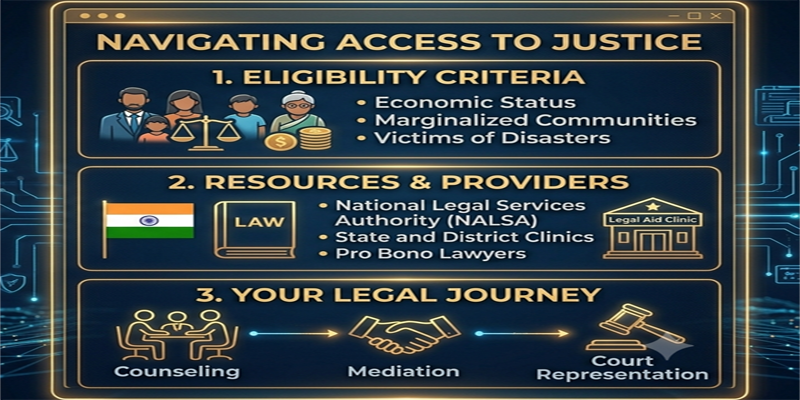
As per Article 39A of the Constitution, all the states are directed to encourage equal justice and offer free legal aid in India.
This ensures equal justice to all citizens regardless of their disabilities and economic conditions.
Now, a few curious questions could strike our minds, like:
- Who can actually get free legal aid?
- What does it include?
- Where should you apply?
- Can you get a free lawyer in a criminal case?
- Can women and children get legal aid? What about people in prison?
Let us explore this Free Legal Aid in India in easy-to-understand language.
What Is Free Legal Aid?
Free legal aid means providing specified legal services without charging the eligible person for those services, subject to the applicable legal framework and eligibility conditions.
It may include:
- Legal advice
- Assistance in understanding legal rights and procedures
- Representation through a legal aid lawyer
- Help with drafting certain legal documents
- Assistance in legal proceedings
- Preparation of applications and petitions
- Certain court-related services
- Assistance in accessing appropriate dispute-resolution mechanisms
The purpose is to ensure that a person’s lack of money or certain other legally recognized circumstances do not prevent access to justice.
Free legal aid is not limited to criminal cases. Depending on eligibility and the circumstances, it can also be available in civil, family, labour, consumer and other legal matters.
Constitutional Foundation: Article 39A
Article 39A is part of the Directive Principles of State Policy.
It states, in substance, that the legal system should promote justice based on equal opportunity and that the State should provide free legal aid through suitable legislation or schemes so that opportunities for securing justice are not denied because of economic or other disabilities.
Article 39A was inserted into the Constitution by the 42nd Constitutional Amendment in 1976.
Although Directive Principles are not enforceable in court in the same way as Fundamental Rights, they provide important guidance for governance and legislation.
Free legal aid therefore reflects a broader constitutional objective: justice should not depend solely on a person’s ability to pay.
The Legal Services Authorities Act, 1987
The main law governing the organized legal services system is the Legal Services Authorities Act, 1987.
The Act created a structured system of legal services authorities at different levels.
The system includes:
- NALSA – National Legal Services Authority
- State Legal Services Authorities (SLSAs)
- District Legal Services Authorities (DLSAs)
- Taluk/Tehsil or equivalent legal services committees and authorities, as applicable
- Legal services committees connected with certain courts
These bodies work to provide legal services to eligible people and promote access to justice.
What Is NALSA?
NALSA stands for the National Legal Services Authority.
It is the national-level institution responsible for coordinating and supporting legal services activities across India.
NALSA works with State and District Legal Services Authorities and supports programmes related to:
- Free legal services
- Legal awareness
- Lok Adalats
- Access to justice
- Assistance for eligible and vulnerable groups
- Legal literacy programmes
At the local level, however, a person will often interact with the District Legal Services Authority (DLSA) rather than directly with NALSA.
Who Can Get Free Legal Aid?
Section 12 of the Legal Services Authorities Act identifies categories of people who are entitled to legal services, subject to the applicable statutory conditions.
These include several groups that may face particular barriers in accessing justice.
1. Members of Scheduled Castes and Scheduled Tribes
Members of SC and ST communities fall within the categories recognized under the legal services framework.
The purpose is to ensure that constitutional and statutory protections are practically accessible to people who may otherwise face barriers in obtaining legal assistance.
2. Women and Children
Women and children are among the categories specifically recognized for legal services.
This means an eligible woman or child does not necessarily have to prove financial inability merely to fall within this category.
Legal aid may be relevant in matters such as:
- Domestic violence
- Maintenance
- Matrimonial disputes
- Child custody
- Child protection
- Criminal cases
- Property disputes
- Other legal proceedings
The exact service available will depend on the circumstances and applicable rules.
3. Persons with Disabilities
Persons with disabilities are also covered under the statutory framework.
Legal assistance can be particularly important where a person faces difficulties in understanding procedures, communicating with authorities, or effectively presenting a legal claim.
4. Victims of Trafficking or Begar
The law recognizes persons who are victims of trafficking or begar among the categories eligible for legal services.
This reflects the constitutional protection against trafficking and forced labour.
5. Victims of Certain Disasters or Atrocities
The legal services framework also recognizes people affected by certain serious circumstances, including:
- Mass disaster
- Ethnic violence
- Caste atrocity
- Flood
- Drought
- Earthquake
- Industrial disaster
The exact statutory wording and applicable conditions should be checked for the particular situation.
6. Industrial Workmen
Industrial workmen are another category recognized under the law.
Legal assistance may be relevant in disputes involving employment and labour-related rights.
7. Persons in Custody
A person who is in custody is among the categories recognized for legal services.
This can be particularly important because a person in police or judicial custody may have difficulty arranging a private lawyer independently.
Legal aid can therefore play an important role in protecting procedural rights.
8. Persons Below the Prescribed Income Limit
People whose annual income is below the applicable statutory or prescribed limit may also qualify.
An important point is that there is not one universal income figure that applies to every legal forum and situation.
The applicable income ceiling can depend on the forum, jurisdiction, and rules in force.
Therefore, if you are seeking legal aid based on income, it is better to ask the relevant Legal Services Authority about the current applicable limit rather than relying on an old figure found online.
Does Free Legal Aid Mean You Get Any Lawyer You Want?
No.
Legal aid generally operates through lawyers associated with the legal services authorities or their panels.
The authority assesses the application and, where legal aid is granted, arranges the appropriate legal assistance under its system.
This is different from hiring a private lawyer of your choice and asking the government to pay that lawyer’s normal private fee.
The exact process can vary depending on the case and legal services authority.
What Types of Cases Can Get Legal Aid?
Legal aid is not restricted to one particular type of case.
Depending on eligibility and the applicable rules, legal assistance may be available in matters involving:
- Criminal cases
- Civil disputes
- Family disputes
- Matrimonial matters
- Maintenance
- Child-related matters
- Labour disputes
- Property disputes
- Consumer matters
- Domestic violence
- Victims of crime
- Constitutional and other legal proceedings
The important question is not simply, “What type of case is this?”
It is also:
“Do I fall within the eligibility framework, and what legal service is appropriate for my matter?”
Free Legal Aid in Criminal Cases
Criminal cases are one of the areas where legal aid can be particularly important.
A person accused of an offence may require legal representation during different stages of criminal proceedings.
If the person is unable to afford legal representation and qualifies for legal aid, the legal services system can assist according to the applicable framework.
This is especially important for people in custody.
A person should not assume that being unable to afford a private lawyer means they must defend themselves without legal assistance.
How to Apply for Free Legal Aid
A person can approach the appropriate Legal Services Authority.
Depending on the circumstances, this may include:
- District Legal Services Authority
- State Legal Services Authority
- Taluk or equivalent legal services committee
- Legal services committee attached to a court
- Other designated legal services channels
Applications may also be made through available online or other officially prescribed channels.
When applying, it is useful to provide:
- Name and contact details
- Description of the legal problem
- Relevant case information
- Court details, if a case is already pending
- Copies of available documents
- Details showing eligibility, where required
If you have a court notice, FIR, summons, order, agreement, medical document, or other important paper, keep a copy available.
What If You Are Already in Court?
You can still seek legal aid.
Being involved in an existing case does not automatically mean that you have missed your opportunity to seek assistance.
You can approach the appropriate legal services authority and explain your circumstances.
If you are already before a court and cannot afford legal representation, you can also inform the court about your need for legal assistance.
In urgent matters, especially where a person is in custody, seeking legal assistance without delay is particularly important.
What Is a Lok Adalat?
The legal services system also plays an important role in organizing Lok Adalats.
A Lok Adalat is a forum for settlement of disputes through compromise or agreement within its legal framework.
It can help resolve certain disputes without following the entire process of a regular trial.
Lok Adalats may deal with pending cases as well as certain pre-litigation matters, depending on the applicable framework.
Where a settlement is reached, and an award is made in accordance with law, the award has legal effect and is generally treated as final and binding, subject to the statutory framework.
However, a Lok Adalat is not simply another court where a judge decides who is right after a full trial. Its basic approach is settlement.
What Is a Permanent Lok Adalat?
A Permanent Lok Adalat is different from an ordinary Lok Adalat.
It deals with disputes relating to specified public utility services and operates under the Legal Services Authorities Act, subject to its jurisdictional and monetary conditions.
Examples of public utility services can include certain services such as:
- Transport
- Postal or telecommunication services
- Supply of power or water
- Sanitation
- Hospital or dispensary services
- Insurance services
The exact scope is determined by law and notifications.
Permanent Lok Adalats can have an important role in resolving certain disputes before they become prolonged litigation.
Is Legal Aid Really Completely Free?
Where legal aid is granted, the legal services authority provides services within the applicable scheme without charging the eligible person for the covered legal service.
However, people should not assume that every possible expense in every legal matter is automatically covered.
The exact scope of assistance can depend on the rules, type of proceeding, and circumstances.
Therefore, ask the relevant authority what services and expenses are covered in your particular case.
Can Legal Aid Be Refused?
Legal aid is subject to eligibility requirements and the legal services framework.
An application may not qualify if the statutory conditions are not satisfied.
There can also be questions about whether a particular proceeding or service falls within the authority’s mandate.
If assistance is refused, ask the authority for the reason and information about any available review or alternative mechanism.
Do not assume that a refusal by one person informally means that you have no legal remedy.
Common Misunderstandings About Free Legal Aid
“Only poor people can get legal aid.”
Not necessarily.
Financial eligibility is only one route. The law specifically recognizes several categories, including women, children, persons in custody, and other groups.
“Free legal aid is only for criminal cases.”
False.
Depending on eligibility and the circumstances, legal aid can be available for civil, family, labour, consumer and other matters.
“A free lawyer means any private lawyer will represent me for free.”
Not necessarily.
Legal aid generally works through the Legal Services Authority’s system and panel lawyers.
“If I get legal aid, I will definitely win.”
No.
Legal aid provides access to legal assistance. It does not guarantee the outcome of a case.
The result depends on the facts, evidence, law, and decision of the competent authority or court.
“I need to wait until the court case begins.”
Not always.
Legal assistance can be sought at appropriate stages, including in certain pre-litigation situations.
Why Legal Aid Matters
Justice is meaningful only when people can realistically access the legal system.
A person who has a legal right but cannot understand the procedure, prepare documents or obtain representation may face serious practical difficulties.
Free legal services help reduce this barrier.
They are especially important for people who may be vulnerable because of poverty, custody, disability, age, social circumstances or other legally recognized conditions.
The broader constitutional idea is simple:
The ability to pay should not by itself determine whether a person can seek justice.
What Every Citizen Should Remember
If you or someone you know faces a legal problem and cannot afford a private lawyer, do not simply give up.
Remember these points:
- Article 39A recognizes the constitutional objective of equal justice and free legal aid.
- The Legal Services Authorities Act, 1987 provides the statutory framework for legal services.
- NALSA operates at the national level.
- State and District Legal Services Authorities provide legal services closer to citizens.
- Women and children are among the categories specifically recognized for legal services.
- Persons in custody can also qualify.
- Income-based eligibility exists, but applicable income limits can vary.
- Legal aid is not restricted to criminal cases.
- Legal aid does not guarantee victory.
- If you have a legal problem, approach the appropriate Legal Services Authority rather than assuming that professional legal help is automatically beyond your reach.
Final Thoughts
Friends, in this post, we have understood Free Legal Aid in India within the Constitution. The people who have never dealt with government authority, a police station, or court before can find it challenging to navigate the justice system.
People meeting the applicable eligibility conditions can easily access the legal system through this free legal aid in India.
Asking for help early could be a key decision.
If you are unaware or unsure about your eligibility for such help through free legal aid in India, then you can contact the appropriate legal service authority and describe your situation in detail. You should be away from any kind of preassumption about yourself like “You are not eligible enough to ask” or “You are not poor enough”.
Understanding your legal rights is the first step. Knowing where to seek help is the next.
Legal Disclaimer: This article “Free Legal Aid in India” is for general educational and legal-awareness purposes only. Laws, rules, eligibility criteria, income limits and procedures may change. Free legal aid depends on the applicable law and the facts of each case. For advice about a specific legal matter, consult a qualified lawyer or the appropriate Legal Services Authority.
If you have any queries, you can write to us at support@a5theory.com; we will get back to you ASAP.
Hope! You would have enjoyed this post, “Free Legal Aid in India“.
Please feel free to give your feedback in the comment section below.
Have a great time!