

Hello Friends, in this blog post, we are going to talk about Cybercrime in India within the Constitution.
Today’s time is internet time, and the internet has been an essential part of everyone’s life.
Most of the people spent most of their time over internet using mobiles and laptops.
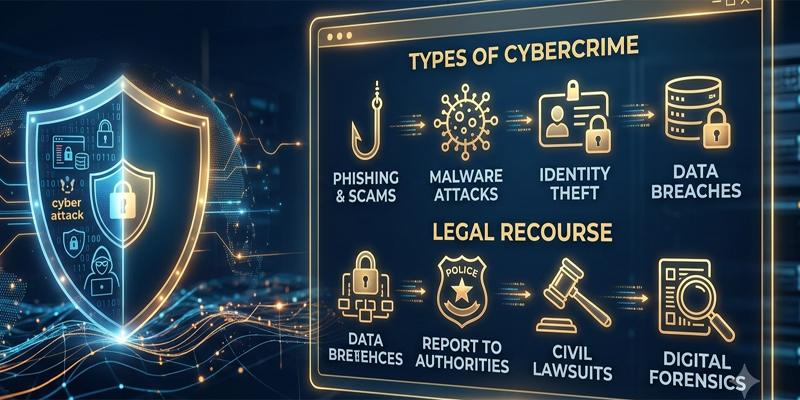
People use computers, laptops, tablets, and smartphones for work, education, banking, shopping, communication, entertainment, and government services.
But these online activities carry significant risks(Cybercrime in India) that could affect anyone.
Hacking, identity theft, cyber fraud, online harassment, phishing, fake websites, unauthorized access,…
… and social media abuse are some of those illegal and unauthorized activities that could badly impact anyone.
But it’s important to know that Indian law provides several protections and legal remedies for victims of cybercrime.
Having awareness about what could be done after such an incident is equally important as taking preventive measures(Cybercrime in India).
In this post, we are going to explore Cybercrime in India in easy-to-understand language.
What Is Cybercrime In India?
Cybercrime in India broadly refers to unlawful activity involving computers, computer systems, digital devices, networks, or electronic communication.
A cybercrime(Cybercrime in India) can involve:
- Financial fraud
- Unauthorized access to accounts
- Identity theft
- Online cheating
- Data theft
- Cyberstalking
- Online harassment
- Sexual exploitation
- Creation or distribution of illegal digital content
- Hacking
- Extortion
- Attacks on computer systems
Not every unpleasant online experience is necessarily a criminal offence. The applicable law depends on what happened, how it happened and the evidence available.
The Information Technology Act, 2000
The Information Technology Act, 2000 is one of India’s principal laws dealing with electronic records, electronic transactions and several computer-related offences.
It contains provisions dealing with matters such as:
- Unauthorized access
- Damage to computer systems
- Identity theft
- Cheating by personation using computer resources
- Violation of privacy
- Certain forms of obscene or sexually explicit electronic material
- Intermediary-related responsibilities
- Cybersecurity-related matters
The Act works alongside other criminal and civil laws.
India’s New Criminal Laws and Cybercrime
India’s criminal-law framework was substantially changed in 2024.
The Bharatiya Nyaya Sanhita (BNS) replaced the Indian Penal Code for offences committed after the new law came into force, subject to transitional and other legal rules.
The Bharatiya Nagarik Suraksha Sanhita (BNSS) replaced the Code of Criminal Procedure.
Therefore, a cybercrime can involve the Information Technology Act as well as provisions of the BNS or other applicable legislation.
The exact law and section depend on the conduct involved.
Common Cybercrimes Citizens Should Know
Online Financial Fraud
This is one of the most common forms of cybercrime in India.
It can involve:
- Fake customer-care numbers
- UPI fraud
- Phishing
- Fake investment schemes
- Fake loan applications
- OTP scams
- Credit-card fraud
- Debit-card fraud
- Remote-access scams
- Fake job offers
- Online shopping fraud
The victim may be tricked into voluntarily transferring money or revealing information that allows the offender to access an account.
What Should You Do After Financial Cyber Fraud?
Act quickly.
If money has been lost through a digital financial fraud, report it immediately through the appropriate financial institution and the government’s cybercrime reporting system.
India operates the National Cyber Crime Reporting Portal for reporting cybercrime.
For financial cyber fraud, citizens can also use the 1930 cybercrime helpline to report the incident as quickly as possible.
Speed matters because authorities and financial institutions may have a better chance of attempting to stop or trace a transaction when the report is made promptly.
The 1930 Cybercrime Helpline
The 1930 helpline is used for reporting cyber financial fraud.
If you have just discovered that money has been fraudulently transferred from your bank account, UPI account, card, or another digital payment channel, contact the relevant bank/payment provider and report the fraud through the appropriate government channel immediately.
Keep information ready such as:
- Transaction ID
- Date and time
- Amount
- Bank or payment application
- Phone number used by the fraudster
- Screenshots
- Chat messages
- Account details
- Website or social-media links
- Any other available evidence
Do not wait until you have collected every possible detail before making an urgent report.
What Is Phishing?
Phishing is a technique in which someone tries to trick you into revealing confidential information or performing an action.
A phishing message may pretend to come from:
- A bank
- Government department
- Courier company
- Electricity provider
- Telecom company
- Employer
- Shopping website
- Social-media platform
The message may ask you to click a link, verify an account, or make a payment.
The link may lead to a fake website designed to collect passwords, card details, OTPs, or other information.
OTPs and Banking Information
A bank employee or legitimate service provider should not need you to disclose confidential authentication information such as your banking PIN or OTP merely to “verify” your account.
Never share:
- UPI PIN
- ATM PIN
- Internet banking password
- Card security information
- OTP
- Passwords
If someone calls claiming to be from your bank and asks for these details, treat the request with extreme caution.
Identity Theft
Identity theft occurs when someone wrongfully uses another person’s identifying information.
This can involve:
- Aadhaar-related information
- PAN information
- Mobile number
- Email account
- Bank information
- Passwords
- Social-media accounts
- Photographs
- Other identifying data
Identity theft can be used to commit financial fraud, impersonation, or other offences.
The Information Technology Act contains provisions dealing with certain forms of identity theft and fraudulent use of electronic authentication information.
Hacking and Unauthorized Access
Accessing another person’s computer, phone, email account, server, or online account without authorization can have legal consequences.
A person should never assume that “I only looked at the account” makes unauthorized access legal.
Depending on the conduct and circumstances, the Information Technology Act and other laws can apply.
Social-Media Account Hacking
If your Instagram, Facebook, X, WhatsApp, email, or another online account has been compromised:
- Try to recover the account through the platform’s official recovery mechanism.
- Change passwords immediately if you still have access.
- Enable two-factor authentication.
- Check whether recovery email or phone details have been changed.
- Inform contacts that the account may have been compromised.
- Preserve screenshots and other evidence.
- Report the incident through the appropriate cybercrime channel if an offence has occurred.
Do not pay an unknown person who claims they can “recover” your account unless you have independently verified the service.
Cyberstalking and Online Harassment
Repeated unwanted communication, threats, monitoring, or harassment through digital platforms can become a serious legal issue.
Depending on the conduct, different laws may apply.
Examples can include:
- Repeated threatening messages
- Persistent unwanted contact
- Online stalking
- Impersonation
- Threats to publish private information
- Blackmail
- Harassing social-media posts
- Creation of fake accounts to target someone
Save evidence instead of immediately deleting everything.
Cyberbullying
Cyberbullying can involve abusive or threatening behaviour through:
- Social media
- Messaging applications
- Online games
- School groups
- Other digital platforms
When children are involved, additional child-protection laws may become relevant.
Parents should take repeated online threats or sexual exploitation seriously rather than assuming that the behaviour is merely “internet drama.”
Non-Consensual Sharing of Private Images
Sharing someone’s intimate or private images without consent can have serious legal consequences.
The law can also apply to situations involving threats to publish such material.
This may overlap with provisions concerning:
- Privacy
- Sexual offences
- Extortion or criminal intimidation
- Obscene or sexually explicit electronic material
- Child sexual abuse material, where a child is involved
A victim should preserve evidence and report the matter promptly.
Children and Online Sexual Exploitation
Children receive special protection under Indian law.
The POCSO Act can apply to sexual offences against persons below 18 years.
Certain online conduct involving children can also attract provisions of the Information Technology Act and other laws.
Parents should take seriously:
- Requests for private photographs
- Sexual conversations with strangers
- Online grooming
- Threats to publish photographs
- Requests to meet secretly
- Blackmail involving images
- Links to abusive or exploitative material
A child should never be blamed for being manipulated by an adult or offender.
Fake Websites and Online Shopping Fraud
Cybercriminals often create websites that look similar to legitimate businesses.
Warning signs can include:
- Unusually large discounts
- Suspicious website addresses
- Pressure to make immediate payment
- Requests for payment through unusual channels
- No reliable customer-support information
- Fake reviews
- Messages claiming that an order will be cancelled unless payment is made immediately
Before paying, verify the website and seller independently.
Digital Evidence: Save Before You Delete
Digital evidence can be extremely important.
Depending on the case, useful evidence may include:
- Screenshots
- Emails
- Chat messages
- Phone numbers
- Usernames
- URLs
- Transaction records
- Bank statements
- UPI transaction IDs
- Call logs
- Voice messages
- Photographs
- Videos
- Device information
Try to preserve the original information where possible.
A screenshot can be useful, but preserving the original email, message, file, or transaction record may provide additional information.
Do not edit or manipulate evidence.
Can a WhatsApp Message Be Used as Evidence?
Electronic records can potentially be used as evidence, but admissibility and evidentiary value depend on the applicable law and circumstances.
Simply having a screenshot does not automatically guarantee that a court will accept it as conclusive proof.
Evidence may need to satisfy applicable requirements concerning authenticity, source, integrity, and the manner in which it is produced.
Therefore, preserve original devices and records where possible when the matter is serious.
Where Can You Report Cybercrime?
Citizens can use the National Cyber Crime Reporting Portal for reporting cybercrime(Cybercrime and Your Legal Rights).
The portal provides mechanisms for reporting different types of cybercrime, including complaints involving women and children.
For financial cyber fraud, the 1930 helpline is particularly important.
For an emergency involving immediate physical danger, threats, or another serious offence, contact the police through the appropriate emergency or local police channel as well.
What If the Police Say “It Is Only an Online Matter”?
An online offence can still be a real offence.
The fact that the conduct happened through a phone or computer does not automatically make it a private dispute.
Depending on the facts, conduct may constitute an offence under the Information Technology Act, BNS or another law.
If a complaint is not appropriately addressed, a person may have further remedies under the applicable criminal-procedure framework.
Cybercrime and Privacy
Privacy is a constitutionally protected right under Article 21, subject to lawful restrictions.
Digital privacy can involve:
- Personal communications
- Financial information
- Photographs
- Location information
- Medical information
- Passwords
- Personal documents
Businesses and digital platforms may also have legal obligations concerning data and cybersecurity under applicable legislation and regulations.
Data Protection in India
India has enacted the Digital Personal Data Protection Act, 2023, which creates a statutory framework concerning the processing of digital personal data.
The data-protection framework is distinct from criminal cybercrime law.
In simple terms:
- Cybercrime laws deal with unlawful conduct such as hacking, identity theft, and certain forms of online abuse.
- Data-protection law deals with the processing and protection of digital personal data within its statutory framework.
Both areas can be relevant to modern digital life.
What Not to Do After a Cybercrime
Victims sometimes make the situation worse because they panic.
Avoid:
- Deleting evidence
- Sending more money to the offender
- Sharing additional passwords
- Threatening the offender
- Trying to hack the offender back
- Publicly posting unverified allegations
- Paying unknown “recovery agents”
- Giving OTPs to people claiming to help
Instead, preserve evidence and report the matter through appropriate channels.
How to Prevent Common Cybercrimes
A few basic habits can significantly reduce risk.
Use Strong, Unique Passwords
Do not use the same password for banking, email, and social media.
Enable Two-Factor Authentication
Where available, use two-factor authentication for important accounts.
Verify Links
Do not blindly click links received through SMS, WhatsApp or email.
Never Share OTPs or PINs
Treat these as confidential.
Keep Devices Updated
Install security updates for operating systems, browsers, and applications.
Be Careful With Remote-Access Applications
Do not install remote-access software merely because an unknown caller instructs you to do so.
Verify Customer-Care Numbers
Do not assume that the first number appearing in a search engine or social-media post is the official customer-care number.
Be Careful With Investments
Fraudsters often use fake investment platforms, fake trading applications, and promises of guaranteed returns.
Verify the entity independently before transferring money.
Cybercrime Involving Senior Citizens
Senior citizens can be particularly vulnerable to impersonation scams.
Common examples include callers pretending to be:
- Police officers
- Bank officials
- Government officials
- Telecom employees
- Relatives
- Court officials
- Tax authorities
Scammers may create fear and pressure the victim into making an immediate payment.
The best response is to pause and independently verify the claim.
What Every Citizen Should Remember
If you remember only a few things from this article, remember these:
- Cybercrime is real crime; the fact that it happens online does not make it harmless.
- The Information Technology Act, 2000 remains an important cyber law in India.
- Other laws, including the BNS, can also apply to online offences.
- Never share OTPs, UPI PINs, passwords, or confidential banking credentials.
- Report financial cyber fraud immediately.
- 1930 is the national helpline for reporting cyber financial fraud.
- The National Cyber Crime Reporting Portal can be used to report cybercrime.
- Preserve screenshots, transaction details, messages, and other evidence.
- Do not try to hack or threaten the offender in return.
- Children require additional protection under laws such as POCSO.
- Online harassment, threats, impersonation, and unauthorized access can have legal consequences.
- When in doubt, seek professional legal assistance rather than relying solely on social-media advice.
Final Thoughts
Friends, in this post we have fully understood Cybercrime in India. The internet is neither very safe nor very risky. It all depends on your personal use and your quick response in case of any wrongdoing.
Don’t panic, and don’t delay is the key lesson in cyber safety.
Report immediately if your money has been stolen. Try to secure it immediately if your account has been hacked. Preserving the evidence and looking for appropriate help could be a great help if someone is blackmailing or threatening you.
In general, cybercrime laws(Cybercrime and Your Legal Rights) could be a little complicated, as in any single incident there could be many laws involved together at the same time. It depends on the facts which exact legal remedy will be a perfect fit for any such incident.
But the key principle that every citizen should know is:
Your rights exist(Cybercrime in India) even when you are online; they never disappear.
Legal Disclaimer: This article “Cybercrime in India” is intended for general educational and legal-awareness purposes only. Cyber laws, regulations, procedures and judicial interpretations may change. The applicable law depends on the nature, date and circumstances of the incident. This article does not constitute legal advice. For a specific cybercrime or financial-fraud incident, report it promptly through the appropriate official channels and consult a qualified professional where necessary.
If you have any queries, you can write to us at support@a5theory.com; we will get back to you ASAP.
Hope! You will have enjoyed this post, “Cybercrime in India“.
Please feel free to give your feedback in the comment section below.
Have a great time!