

Hello Friends, in this blog post, we will let you know how laws are made in India.
You may have wondered how a new law comes into existence.
In news headlines like Parliament is passing a new law, a bill being presented, or the President giving assent, you may often hear this.
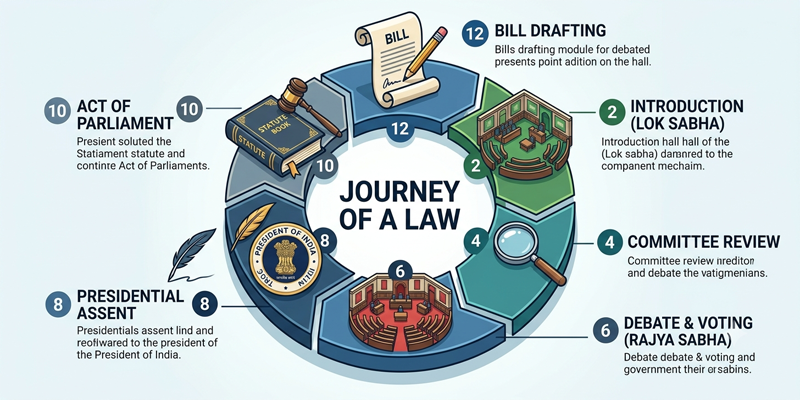
But it is very curious to know the actual journey of a law, starting from an idea and discussion to the final law that is applicable to all the citizens of the country.
A Constitutional and democratic law-making process is being followed in India. The journey of a law starts from an idea of a law proposal as a bill.
Once this bill gets processed through parliamentary discussion. After receiving the President’s assent, this bill becomes an Act.
It is very important to understand this law-making process because it impacts almost every part of our lives…
…whether it is education and taxation, roads, criminal justice, businesses, consumer protection, and other digital activities.
In this post(How Laws Are Made in India), we will explore the complete law-making process in easy-to-understand language.
What Is a Bill?
A Bill is a proposed law.
It is essentially a draft of what Parliament is being asked to enact as law. A Bill may be introduced in either the Lok Sabha or the Rajya Sabha, depending on its type and the constitutional rules applicable to it.
A Bill is not yet a law.
For example, if the government wants to introduce legislation dealing with a particular subject, the proposal is prepared in the form of a Bill. The Bill then goes through parliamentary consideration.
Only after the required process(How Laws Are Made in India) is completed and the President gives assent does it become an Act.
So, in simple terms:
Bill → Parliamentary Process → Passed by Parliament → President’s Assent → Act
Who Can Introduce a Bill?
Bills can broadly be introduced by two types of Members of Parliament.
Government Bill
A Government Bill is introduced by a minister on behalf of the government.
Most major legislation introduced by the Union government falls into this category.
The government usually develops a legislative proposal through its ministries and departments before bringing it before Parliament.
Private Member’s Bill
A Bill introduced by an MP who is not a minister is called a Private Member’s Bill.
Such Bills can be introduced by members of either House, subject to the applicable rules.
Private Member’s Bills provide MPs with an opportunity to raise legislative proposals independently of the government.
However, a Bill introduced by a private member does not automatically become law. It must go through the same constitutional and parliamentary requirements applicable to that type of legislation.
Step 1: Preparing and Drafting the Bill
Before a Bill reaches Parliament, considerable work may take place behind the scenes.
A proposal may arise because of:
- A new public problem
- The need to regulate an emerging area
- A Supreme Court or High Court judgment
- A government policy
- Changes in technology or society
- The need to replace or update an existing law
- International commitments
- Public demand or representations
The concerned ministry or department may develop the proposal and prepare a draft.
Depending on the legislation, consultations and other preparatory steps may also take place.
The result is a proposed legal text—the Bill.
Step 2: Introduction in Parliament
The Bill is introduced in one of the Houses of Parliament.
This stage is commonly known as the First Reading.
The Bill is formally presented to the House, and its introduction is considered.
Depending on the type of Bill, there may be specific constitutional requirements before introduction.
For example, certain financial Bills require the President’s recommendation, and a Money Bill can be introduced only in the Lok Sabha.
At this point, the Bill is still only a proposal.
Step 3: General Discussion — What Is the Bill Trying to Do?
After introduction, the Bill can be considered in greater detail.
Members of Parliament may discuss its:
- Purpose
- Need
- Major provisions
- Possible effects
- Advantages and disadvantages
- Impact on citizens and institutions
This stage is important because Parliament is not simply a place where Bills are mechanically approved.
Members can question the proposal, raise concerns and suggest changes.
Step 4: Committee Examination
Many Bills may be referred to parliamentary committees for detailed examination.
A parliamentary committee can study the proposed legislation much more closely than is usually possible during a general debate in the House.
A committee may examine:
- Individual provisions
- Practical consequences
- Administrative implications
- Evidence and representations
- Possible difficulties in implementation
- Suggestions for improvement
Committees can therefore play an important role in improving legislation.
However, not every Bill necessarily follows the same committee route. The procedure depends on the Bill and parliamentary rules.
Step 5: Clause-by-Clause Consideration
The Bill can then be examined provision by provision.
Members may propose amendments.
An amendment could seek to:
- Add something
- Remove something
- Change wording
- Clarify a provision
- Modify the scope of a provision
The House considers the proposed provisions and amendments according to parliamentary procedure.
This detailed examination is important because even a small change in legal wording can sometimes have significant consequences.
Step 6: Third Reading
After detailed consideration, the Bill reaches the Third Reading stage.
The House considers whether the Bill, in its final form, should be passed.
Members debate the Bill and ultimately vote.
If the required majority supports it, the Bill is passed by that House.
But for an ordinary Bill, this is not necessarily the end.
Step 7: The Bill Goes to the Other House
If an ordinary Bill has been passed by the Lok Sabha, it generally goes to the Rajya Sabha.
If it originated in the Rajya Sabha, it generally goes to the Lok Sabha.
The other House goes through the required stages of consideration.
This means that both Houses generally need to agree to the same legislative text before an ordinary Bill can move forward to the President.
This role of two Houses is one of the important features of India’s parliamentary system.
What If the Two Houses Disagree?
Sometimes the Lok Sabha and Rajya Sabha may disagree about an ordinary Bill.
The Constitution provides for a joint sitting of Parliament in certain circumstances to resolve a deadlock.
Under Article 108, when the constitutional conditions for a joint sitting are satisfied, members of both Houses meet together and vote on the Bill.
However, a joint sitting is not available for every type of Bill.
In particular, the procedure does not apply to Money Bills or Constitutional Amendment Bills.
Special Case: Money Bills
Money Bills have a special constitutional procedure.
Under Article 110, a Money Bill deals with specific matters relating to taxation, government borrowing, the Consolidated Fund of India, and certain other financial matters specified by the Constitution.
A Money Bill can be introduced only in the Lok Sabha and requires the President’s recommendation for its introduction.
After the Lok Sabha passes it, the Bill is sent to the Rajya Sabha.
The Rajya Sabha has 14 days to return it with recommendations.
The Lok Sabha may accept or reject those recommendations.
If the Rajya Sabha does not return the Bill within the specified period, the Bill is treated according to the constitutional procedure as passed by both Houses in the form passed by the Lok Sabha.
This gives the Lok Sabha a particularly important role in financial legislation.
Financial Bills Are Not All Money Bills
One common misunderstanding is that every Bill dealing with government finances is automatically a Money Bill.
That is not correct.
The Constitution contains different categories of financial legislation, including provisions under Article 117.
Some financial Bills have requirements relating to the President’s recommendation and introduction in the Lok Sabha, but they do not necessarily have the same procedure as a Money Bill.
Therefore, Money Bill and Financial Bill should not be treated as interchangeable terms.
Step 8: President’s Assent
Once a Bill has successfully completed the parliamentary process, it is presented to the President.
Article 111 deals with the President’s consideration of Bills.
For a Bill other than a Money Bill, the President may return it to Parliament for reconsideration.
If Parliament passes the Bill again, with or without amendments, the President cannot withhold assent.
A Money Bill cannot be returned for reconsideration through this constitutional route.
Once the President gives assent, the Bill becomes an Act of Parliament(How Laws Are Made in India).
When Does the Act Actually Come Into Force?
An important point is often overlooked:
An Act does not necessarily start operating immediately on the day the President gives assent.
The legislation itself may specify when it comes into force.
In some cases, an Act comes into force on a particular date mentioned in the legislation.
In other cases, the Act may authorize the government to bring it into force through a notification.
Therefore:
President’s assent ≠ necessarily immediate commencement of every provision.
The commencement provisions of the particular Act must be checked.
What Happens After an Act Is Passed?
Passing an Act is sometimes only the beginning of the implementation process.
Many Acts authorize the government or another authority to make rules, regulations, schemes, or other subordinate legislation.
These rules provide practical details about how the law will operate.
For example, an Act may establish a legal framework while rules explain:
- Forms to be submitted
- Procedures to be followed
- Authorities responsible
- Timelines
- Administrative requirements
- Technical details
Such rules must remain within the authority given by the parent Act(How Laws Are Made in India) and cannot override the Constitution or the Act itself.
Can Courts Examine a Law Passed by Parliament?
Yes.
Passing a law through Parliament does not make it completely immune from judicial review.
India has a written Constitution, and Parliament’s legislative power is subject to constitutional limitations.
If legislation violates the Constitution, including applicable Fundamental Rights or limits on legislative competence, courts can examine its validity.
The Supreme Court and High Courts therefore play an important role in maintaining constitutional limits.
This is one reason why the law-making process involves more than simply counting votes in Parliament.
Can Parliament Make Any Law It Wants?
No.
Parliament’s legislative powers are defined by the Constitution.
The Constitution distributes legislative subjects between the Union and the States through the Union List, State List and Concurrent List.
Parliament normally legislates on subjects within its constitutional authority.
State Legislatures also make laws within their constitutional field.
There are, however, circumstances in which Parliament can legislate on matters ordinarily associated with the State List, as provided by the Constitution.
Therefore, the Constitution determines not only How Laws Are Made in India but also who has the power to make them.
What About Constitutional Amendments?
A Constitutional Amendment Bill is different from an ordinary Bill.
The Constitution provides a special procedure under Article 368.
Depending on the amendment, a special majority in Parliament may be required, and certain amendments also require ratification by at least half of the State Legislatures.
There is no joint sitting for Constitutional Amendment Bills.
So, changing an ordinary law and changing the Constitution are two different processes.
What Is an Ordinance?
Sometimes the government needs to take legislative action when Parliament is not in session.
Article 123 gives the President the power to promulgate an Ordinance in circumstances specified by the Constitution when the required conditions are satisfied.
An Ordinance has the force and effect of an Act of Parliament, but it is temporary and must be dealt with by Parliament according to the Constitution when Parliament reassembles.
An Ordinance should therefore not be confused with the normal process of passing a Bill through Parliament.
How Can Ordinary Citizens Participate?
Most citizens will never personally introduce a Bill in Parliament, but citizens can still participate in the legislative process and democratic system.
You can:
- Vote in elections
- Stay informed about proposed legislation
- Contact your elected representative
- Participate in public consultations when they are offered
- Submit suggestions or representations through appropriate channels
- Follow parliamentary debates and committee work
- Participate in lawful public discussion
- Engage with civil society and professional organizations
- Understand how a proposed law may affect you and your community
Democracy does not end when elections are over.
An informed citizen can follow what Parliament is doing and understand how decisions eventually become laws.
Bill vs Act: The Simple Difference
The easiest way to remember the difference is:
Bill: A proposed law under consideration.
Act: A Bill that has completed the required legislative process and received the President’s assent.
For example, Parliament may debate and pass a Bill. Until the required constitutional process is completed and presidential assent is given, it remains a Bill.
After assent, it becomes an Act.
A Simple Example
Imagine the government wants to introduce a new law concerning a particular area of public policy.
The broad journey could look like this:
Idea → Drafting → Bill introduced → Parliamentary debate → Committee examination, where applicable → Clause-by-clause consideration → Voting → Other House → Agreement by both Houses → President’s assent → Act → Commencement → Rules and implementation
This is a simplified overview, because different types of Bills have different constitutional procedures.
Why Understanding the Law-Making Process Matters
Laws affect citizens every day.
When a new law is announced, social media discussions can sometimes create confusion. People may assume that a proposal is already law, that Parliament has passed something when it has only been introduced, or that presidential assent automatically means every provision is immediately in force.
Knowing the basic process helps citizens distinguish between:
- A proposal and an actual law
- A Bill and an Act
- Parliament passing a Bill and the law coming into force
- A Money Bill and an ordinary Bill
- An Act and rules made under that Act
- Ordinary legislation and a Constitutional Amendment
Legal awareness begins with understanding these basic distinctions.
Final Takeaway
Friends, in this post, we have understood the complete process of how laws are made in India. Debates, scrutiny, and constitutional checks are some important parts of India’s law-making process. The idea of a proposed law first begins with a Bill. This Bill is then discussed and examined, considered provision by provision, and voted upon in Parliament. A bill should pass in both houses of Parliament, but this also depends on the type of Bill. Once all the process is completed in the Parliament houses, the Bill is then presented to the President of India.
Once the assent is given by the President, a Bill becomes an Act. Then, as per the commencement provisions, the Act starts to operate and might get support from rules and regulations made under its authority. The Constitution stands higher than ordinary legislation. Though the law-making powers are provided within the Parliament, there are always constitutional boundaries or limits within which this power operates.
Understanding this process for citizens is way beyond an academic exercise. It helps us understand the rule-making process that directly affects our daily lives. We also get to know how citizens may remain informed and engaged throughout the process(How Laws Are Made in India).
Disclaimer: This article provides general educational information about India’s constitutional and legislative framework. It is not legal advice. For specific legal questions, check the Constitution, relevant legislation, current rules, and applicable judicial decisions.
If you have any queries, you can write to us at support@a5theory.com; we will get back to you ASAP.
Hope! You will enjoy this post, “How Laws Are Made in India“.
Please feel free to give your important feedback in the comment section below.
Have a great time!