

Hello Friends, in this blog post, we will discuss cultural and educational rights in India.
India is a very diverse country, holding many cultures, hundreds of languages, traditions, scripts, and religious communities.
And this diversity of India is considered one of the greatest strengths of the country.
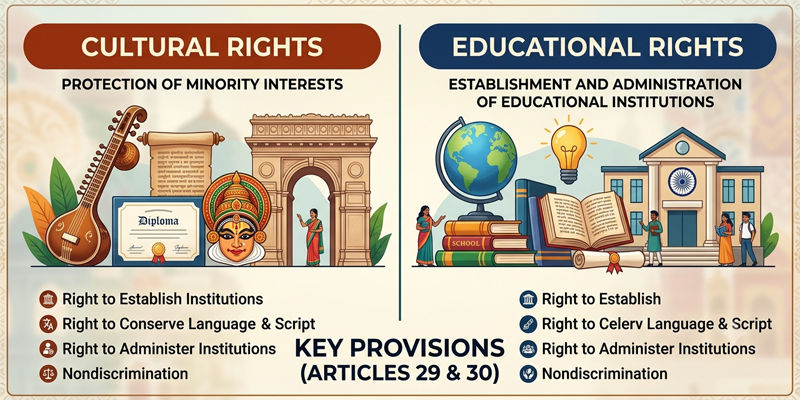
Now, it is a tough task to create a suitable environment for this diverse system.
So that there is freedom for all people and communities to preserve their identity, and they can easily pass it to the coming future generations.
Articles 29 and 30 are the best solutions listed in the Constitution, which help to protect all these interests of people and communities.
And collectively, these provisions are known as Cultural and Educational Rights in India within the Indian Constitution.
In Part III of the Constitution, these rights are listed as part of Fundamental Rights.
To protect the linguistic and cultural diversity and the educational rights of minority, these rights play a very important and fascinating role.
In this post, we are going to explore Articles 29 and 30 in detail in an easy-to-understand language along with the impact of these rights on the life of common citizens.
What Are Cultural and Educational Rights In India?
Cultural and Educational Rights protect certain interests relating to:
- Language
- Script
- Culture
- Educational institutions
- Minority communities
- Equal access to educational institutions
- Protection against certain forms of discrimination in admission
The basic idea is that India’s diversity should not require smaller communities to give up their language, culture or identity.
Article 29: Protection of Language, Script and Culture
Article 29(1) provides protection to any section of citizens having a distinct language, script or culture.
Such citizens have the right to conserve it.
In simple words, if a group of citizens has a distinct linguistic, cultural, or script-based identity, the Constitution protects their ability to preserve that identity.
What does “conserve” mean?
Conservation can include activities such as:
- Preserving a language
- Teaching a traditional language to children
- Maintaining a script
- Promoting literature
- Preserving cultural traditions
- Organising cultural activities
- Passing cultural knowledge to future generations
The Constitution therefore recognises that cultural identity is important in a diverse country.
Article 29 Is Not Limited Only to Minorities
This is an important point.
Article 29(1) refers to “any section of the citizens” having a distinct language, script or culture.
Therefore, Article 29 is not worded as a right available only to religious or linguistic minorities.
Its protection focuses on the existence of a distinct language, script, or culture.
This is different from Article 30, which specifically deals with minorities.
Article 29(2): Protection in Educational Institutions
Article 29(2) provides another important protection.
A citizen cannot be denied admission into an educational institution maintained by the State or receiving State aid on grounds only of:
- Religion
- Race
- Caste
- Language
- Any of these
This means that certain educational institutions covered by Article 29(2) cannot discriminate against an eligible citizen solely on these grounds.
A simple example
Suppose a government-funded educational institution refuses to consider an eligible student for admission solely because the student belongs to a particular religion or speaks a particular language.
Such action may raise a constitutional issue under Article 29(2), depending on the facts and applicable admission rules.
The provision is therefore an important protection against discrimination in education.
Article 29 and Article 15: Are They the Same?
No.
Article 15 generally prohibits certain forms of discrimination by the State on specified grounds.
Article 29(2), on the other hand, specifically deals with denial of admission to educational institutions maintained by the State or receiving State aid on the prohibited grounds mentioned in the provision.
They protect different constitutional interests, although there can be overlap in particular situations.
Article 30: Rights of Minorities to Establish Educational Institutions
Article 30 provides an important constitutional protection to minorities.
It states that all minorities, whether based on religion or language, have the right to establish and administer educational institutions of their choice.
This is commonly known as the minority educational institution right.
The purpose is to allow minority communities to establish educational institutions that can help preserve their educational and cultural identity.
Who Is a Minority?
For Article 30, the Constitution recognises minorities based on religion or language.
The question of who constitutes a minority is generally considered with reference to the relevant constitutional and legal framework, and courts have addressed how minority status is to be determined in particular contexts.
Therefore, it should not automatically be assumed that a community is a minority simply because it is smaller in a particular locality.
Establish and Administer: What Do These Words Mean?
Article 30 gives minorities the right to establish and administer educational institutions of their choice.
Establish
This means a minority community can establish an educational institution subject to applicable laws and regulations.
Administer
Administration can include matters relating to the management of the institution.
However, the right to administer does not mean that a minority institution is completely outside the law.
The State can impose reasonable regulations concerning educational standards, academic requirements, public order and other legitimate regulatory matters, subject to the Constitution.
The exact extent of permissible regulation has been considered by the Supreme Court in several important cases.
Can Minority Institutions Be Regulated?
Yes.
Article 30 does not create an unlimited right to operate an educational institution without any regulation.
For example, regulations designed to maintain:
- Academic standards
- Teacher qualifications
- Student welfare
- Educational quality
- Health and safety
- Proper administration
may be legally permissible, depending on their nature and impact on the institution’s minority character and constitutional rights.
The important distinction is between reasonable regulation and measures that effectively destroy the constitutional right itself.
Article 30 and Government Aid
Article 30(2) provides protection concerning State aid.
The State cannot, while granting aid to educational institutions, discriminate against an institution on the ground that it is under the management of a minority, whether based on religion or language.
In simple terms, minority status by itself cannot be used as a reason to deny an institution State aid.
Of course, an institution must still satisfy applicable conditions for receiving such aid.
Can Minority Institutions Receive Government Recognition?
Yes.
A minority educational institution can be subject to applicable recognition and regulatory requirements.
Recognition and regulation are different from taking away the constitutional right to establish and administer the institution.
The Constitution protects minority educational rights while also allowing legitimate regulation of education.
Why Are Articles 29 and 30 Important?
India’s diversity is not limited to religion.
People identify themselves through:
- Languages
- Scripts
- Regional traditions
- Literature
- Customs
- Cultural practices
- Community institutions
Without constitutional protection, smaller linguistic or cultural groups could face pressure to abandon their identity.
Articles 29 and 30 help create a constitutional environment in which diversity can coexist with national unity.
Cultural Diversity and National Unity
Protecting different cultures does not necessarily weaken national unity.
In a constitutional democracy, people can have different languages, traditions, and cultural identities while sharing the same constitutional values.
The Constitution attempts to balance:
Unity + Diversity + Equality + Individual Rights
This is particularly important in a country as diverse as India.
Do Cultural Rights Mean That Every Custom Is Protected?
No.
A cultural or religious practice does not automatically become legally protected merely because a community considers it part of its tradition.
Constitutional rights operate within the broader constitutional framework.
Laws relating to equality, dignity, public order, health, education and other matters may apply.
Therefore, cultural preservation and constitutional values must be understood together.
Rights of Minority Educational Institutions and Students
A minority educational institution has constitutional protection, but students also have legal and constitutional rights.
For example, questions concerning:
- Admission
- Fees
- Scholarships
- Academic standards
- Student safety
- Discrimination
- Government regulations
may involve multiple laws and constitutional provisions.
The rights of an institution and the rights of individual students must therefore be considered together according to the circumstances.
Can a Government Take Over a Minority Educational Institution?
The answer is not simply yes or no.
Government intervention affecting a minority educational institution can raise Article 30 concerns.
However, the State may have powers under applicable laws in situations involving serious administrative problems, statutory violations, or other legally recognised circumstances.
Any such intervention must satisfy constitutional requirements.
Courts have repeatedly examined whether government regulations genuinely serve a legitimate purpose or improperly interfere with minority administration.
Important Supreme Court Decisions
Several Supreme Court decisions have shaped the interpretation of Articles 29 and 30.
Kerala Education Bill case
The Supreme Court examined important questions concerning minority educational institutions and the scope of Article 30.
St. Xavier’s College case
The Court considered the meaning and scope of the right of minorities to administer educational institutions.
T.M.A. Pai Foundation case
This is one of the major judgments concerning minority and educational rights.
The Supreme Court considered questions relating to minority status, establishment and administration of educational institutions, and permissible regulation.
P.A. Inamdar case
The Court further considered issues involving admissions and regulation in educational institutions, particularly private institutions.
These judgments show that Articles 29 and 30 involve detailed constitutional principles. The exact legal position can depend on the type of institution and the circumstances involved.
Difference Between Article 29 and Article 30
The easiest way to remember them is:
| Provision | Main Protection |
|---|---|
| Article 29(1) | Right of a section of citizens with a distinct language, script or culture to conserve it |
| Article 29(2) | Protection against certain forms of discrimination in admission to covered educational institutions |
| Article 30(1) | Religious and linguistic minorities can establish and administer educational institutions of their choice |
| Article 30(2) | State aid cannot be denied to a minority institution merely because it is minority-managed |
What Should Citizens Know About These Rights?
Every citizen should remember the following:
- Article 29 protects distinct language, script and culture.
- Article 29(1) is available to any section of citizens meeting its constitutional requirement; it is not restricted by its wording to minorities.
- Article 29(2) protects against certain admission discrimination in covered educational institutions.
- Article 30 protects religious and linguistic minorities.
- Minority communities can establish and administer educational institutions of their choice.
- Minority educational institutions are not completely outside government regulation.
- Educational standards and legitimate regulatory requirements can still apply.
- Government aid cannot be denied merely because an institution is managed by a minority.
- Cultural rights must operate within the overall constitutional framework.
Practical Example
Imagine a linguistic community has a language spoken by a relatively small number of people.
The community wants to preserve its language by:
- Teaching it to children
- Publishing books
- Running cultural programmes
- Supporting educational activities
Article 29 provides constitutional protection for conserving a distinct language, script or culture.
Now suppose a religious minority establishes an educational institution to serve its community.
Article 30 provides constitutional protection for establishing and administering such an institution, subject to the Constitution and applicable laws.
These examples show how Articles 29 and 30 help protect India’s diversity.
Cultural Rights and the Common Citizen
You do not need to belong to a minority community to understand why these provisions matter.
The protection of diversity benefits society as a whole.
When languages, literature, traditions, and cultures are preserved, future generations can understand India’s history and social diversity better.
At the same time, cultural rights should be exercised with respect for the Constitution and the rights of others.
Conclusion
Friends, in this blog post, we have understood the cultural and educational rights in India within the Constitution. In India’s Fundamental Rights framework, Articles 29 & 30 are considered an important and useful part for the citizens of the country.
The rights of citizens having a distinct language, script, or culture are protected through Article 29 listed in the Constitution. It also provides support or protection for certain forms of discrimination in admission to covered educational institutions.
To establish and administer educational institutions of minorities’ choice, Article 30 provides protection to the rights of religious and linguistic minorities. Together, these provisions drive an important constitutional principle:
India can remain united without becoming culturally uniform.
It is a great appreciation of India’s diversity and the constitutional values of equality, freedom and dignity if the citizens of the country understand these cultural and educational rights in a better way.
Legal awareness note: This article is intended for general education and public awareness. It is not a substitute for professional legal advice. The application of Articles 29 and 30 can depend on the facts, type of institution, applicable laws, and current judicial decisions.
If you have any queries, you can write to us at support@a5theory.com; we will get back to you ASAP.
Hope! You will enjoy this post, “Cultural and Educational Rights in India“.
Please feel free to give your feedback in the comment section below.
Have a great time!