

Hello Friends, in this blog post, we are going to discuss High Courts and District Courts in India.
When we think about the Indian judiciary system, these terms or names often come to mind:
- Supreme Court,
- High Court
- District Court
- Sessions Court
- Magistrate Court
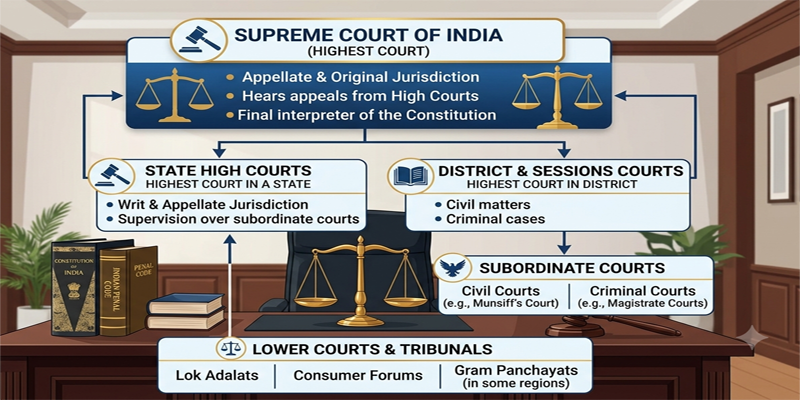
But a few curious questions arise in our minds, like:
- How are these courts connected?
- Which court deals with which kind of case?
- Where should an ordinary citizen go when facing a legal problem?
Courts are not just institutions with judges and lawyers; rather, they are places where Human rights…
…are protected, disputes are resolved, and laws are properly followed by all citizens of the country.
Indian judicial system has a hierarchical structure. It starts with the Supreme Court at the top.
Below it are the High Courts, followed by the subordinate or district judiciary.
For dealing with some particular kinds of matters or special matters, there is a facility of specialised courts and tribunals courts
Let’s dive deep into the post and understand the High Courts and District Courts in easy-to-understand language.
Why Does India Have Different Levels of Courts?
India is a large country with a huge population and millions of legal disputes arising every year. A single court cannot handle every case.
Different levels of courts serve different purposes.
A person may first approach a local court for a civil or criminal matter. If the law permits an appeal, the matter may then go to a higher court. A High Court can hear certain appeals and also exercise important constitutional powers. The Supreme Court is the highest and deals with matters within its constitutional and statutory jurisdiction.
This hierarchy also provides a system of appeals and judicial supervision.
A simple way to understand it is:
Supreme Court → High Courts → District and Subordinate Courts
However, this is a simplified picture. Special courts, tribunals, and statutory forums may have their own jurisdiction and appeal structures.
The Basic Structure of India’s Judiciary
The Indian judicial system broadly consists of:
- Supreme Court of India
- High Courts
- District and Sessions Courts
- Civil Courts
- Criminal Courts
- Magistrate Courts
- Special Courts
- Tribunals and other statutory forums
The Constitution provides the framework for the higher judiciary and the subordinate judiciary, while laws passed by Parliament and State Legislatures determine the jurisdiction and procedures of many courts.
The important point is that not every case follows the same path.
The appropriate court depends on the nature of the dispute, location, subject matter, monetary value where relevant, and the law governing the case.
What Is a High Court?
A High Court is the highest court within a State’s judicial system, subject to the constitutional structure and the jurisdiction of the Supreme Court.
Article 214 of the Constitution provides for a High Court for each State. The Constitution also permits a common High Court for two or more States or for States and a Union Territory.
High Courts are constitutional courts and play a major role in protecting constitutional and legal rights.
They also supervise the functioning of courts and tribunals within their jurisdiction in accordance with the Constitution and applicable laws.
High Court judges are appointed by the President under Article 217, following the constitutionally prescribed consultation process. A High Court judge ordinarily retires at the age of 62.
Powers and Functions of High Courts
High Courts perform several important functions.
Writ Jurisdiction Under Article 226
One of the most important powers of a High Court is its writ jurisdiction under Article 226.
A High Court can issue constitutional writs for the enforcement of Fundamental Rights and also “for any other purpose”, meaning its jurisdiction can extend to certain other legal rights as well.
The five traditional writs are:
- Habeas Corpus – generally used to challenge unlawful detention.
- Mandamus – generally directs a public authority to perform a legal duty.
- Prohibition – prevents a lower court or tribunal from continuing proceedings beyond its jurisdiction.
- Certiorari – can be used to quash certain orders of lower courts or tribunals when legal grounds exist.
- Quo Warranto – questions the legal authority of a person occupying a public office.
Article 226 therefore gives High Courts a very significant constitutional remedy.
However, a writ petition is not automatically appropriate for every private dispute. Courts examine whether the matter falls within their writ jurisdiction and whether another effective legal remedy exists.
Supervisory Power Under Article 227
Article 227 gives High Courts power of superintendence over courts and tribunals within their territorial jurisdiction, subject to constitutional limitations.
This helps the High Court maintain judicial discipline and ensure that subordinate courts function within the law.
This power is different from an ordinary appeal. It is a constitutional supervisory jurisdiction and is exercised according to established legal principles.
Appeals and Other Jurisdiction
High Courts can hear appeals from subordinate courts when the relevant law provides for an appeal.
Depending on the applicable law, High Courts may hear civil or criminal appeals, revisions and certain other proceedings.
Some High Courts may also have original jurisdiction in particular matters under specific laws.
Therefore, it is not correct to think of a High Court only as an “appeal court.” It has constitutional, appellate, supervisory and, in some matters, original jurisdiction.
What Is a District Court?
District Courts form the core of the subordinate judiciary at the district level.
A district generally has courts dealing with both civil and criminal matters, although the exact organisation and nomenclature can vary between States.
The senior judicial officer of the district judiciary is generally the District Judge for civil jurisdiction and may function as the Sessions Judge for criminal jurisdiction.
This is why people often hear the expression “District and Sessions Court.”
The same judicial officer may exercise different jurisdiction depending on the nature of the case.
District Judge and Sessions Judge
The terms can sound confusing, but the basic distinction is straightforward.
A District Judge generally deals with civil judicial work at the district level.
A Sessions Judge deals with serious criminal cases within the criminal justice system, subject to the powers given by law.
The Constitution contains provisions concerning the subordinate judiciary. For example, Article 233 deals with the appointment of district judges, while Article 235 vests control over district and subordinate courts in the High Court, subject to the constitutional framework.
This arrangement is important for judicial independence.
Civil Courts and Criminal Courts
A major distinction within the district judiciary is between civil and criminal matters.
Civil Cases
Civil courts generally deal with disputes involving legal rights and obligations between individuals, organisations or other parties.
Examples may include:
- Property disputes
- Recovery of money
- Contract disputes
- Certain family and matrimonial matters
- Injunctions
- Ownership and possession disputes
- Other civil claims
The exact court in which a civil case should begin depends on the applicable law and jurisdictional requirements.
Different States may use different names for subordinate civil courts, such as Civil Judge (Junior Division), Civil Judge (Senior Division), or other designations.
Criminal Cases
Criminal courts deal with offences and criminal proceedings.
A simplified criminal court structure may include:
Magistrate Courts → Sessions Court → High Court → Supreme Court
But this is not an automatic route for every criminal case. The applicable criminal law determines which court can try the offence and what appeal or revision is available.
Magistrates generally deal with many criminal cases, while serious offences that are triable by a Court of Session are handled through the Sessions Court according to law.
How Does a Case Move Through the Courts?
Suppose a person loses a civil case before a competent subordinate court.
If the applicable law provides a right of appeal, the person may be able to challenge the decision before the appropriate appellate court.
Similarly, in a criminal case, a person convicted by a lower court may have a statutory right of appeal depending on the offence and the court that passed the judgment.
The important point is:
An appeal is not simply a right to keep taking the same case to every higher court.
The law determines whether an appeal is available, where it can be filed, and on what grounds.
A higher court may also have revision or review powers in particular circumstances.
High Court vs District Court
| High Court | District Court |
|---|---|
| Constitutional court | Part of subordinate judiciary |
| Established under the constitutional framework | Organised under the constitutional and statutory framework |
| Exercises writ jurisdiction under Article 226 | Generally does not exercise Article 226 writ jurisdiction |
| Supervises subordinate courts under Article 227 | Functions subject to the supervisory/control framework of the High Court |
| Hears many appeals from subordinate courts | Handles trials and other matters assigned by law |
| Can deal with constitutional and other legal issues within its jurisdiction | Primarily handles local civil and criminal matters |
| Judges retire at 62 | Retirement/service conditions depend on applicable judicial service rules |
Can You Directly Approach a High Court?
Yes, in appropriate cases, a person can directly approach a High Court.
For example, a person may file a writ petition under Article 226 where there is an appropriate public law issue involving a Fundamental Right or another legal right.
But that does not mean that every dispute should begin in the High Court.
For many ordinary civil and criminal matters, the appropriate starting point is a subordinate court or another forum specified by law.
A High Court may also refuse to entertain a matter where an effective alternative legal remedy exists, although this is a matter of judicial discretion and depends on the circumstances.
What Happens If You Disagree With a Judgment?
The next legal step depends on the court that passed the judgment and the law governing the case.
Possible remedies may include:
- Appeal
- Revision
- Review
- Writ proceedings in appropriate cases
- Special Leave Petition before the Supreme Court in appropriate circumstances
These remedies are not interchangeable.
For example, a review is different from an appeal, and a writ petition is not simply another form of appeal.
Before challenging a judgment, a person should check the applicable limitation period and the specific remedy available under law.
Courts, Tribunals and Special Courts
Not every legal dispute is handled by an ordinary civil or criminal court.
India also has specialised courts and tribunals dealing with particular subjects.
Examples can include matters relating to:
- Family disputes
- Commercial disputes
- Consumer disputes
- Company and insolvency matters
- Taxation
- Administrative disputes
- Labour and employment matters
- Juvenile justice
- Certain offences dealt with by special courts
The exact jurisdiction depends on the statute creating the particular court or tribunal.
Therefore, if someone has a legal problem, simply asking “Which court is nearest?” may not be enough. The more important question is:
Which legal forum has jurisdiction over my particular matter?
Who Controls the District Judiciary?
The district judiciary is not simply an ordinary department of the State Government.
The Constitution gives High Courts an important role in controlling the subordinate judiciary.
Article 235 provides for the High Court’s control over district courts and courts subordinate to it, subject to the constitutional framework.
At the same time, State Governments have important responsibilities relating to judicial administration, infrastructure, and financial support.
This constitutional arrangement is designed to help maintain the independence of the judiciary from the executive.
What About Police and Courts?
Another common misunderstanding is that police and courts perform the same function.
They do not.
In criminal matters, the police generally investigate offences, collect evidence and take other steps authorised by law.
The court decides legal issues, conducts judicial proceedings and determines guilt or liability according to law.
A police complaint does not itself establish guilt. A criminal court follows the prescribed judicial process before reaching a decision.
This distinction is extremely important for ordinary citizens.
What Can Ordinary Citizens Do If They Need a Court?
If you have a legal problem, a few basic steps can help:
- Identify the nature of the problem – civil, criminal, family, consumer, employment, property, cyber-related, or something else.
- Find out which forum has jurisdiction – the appropriate court may depend on the subject, location, and applicable law.
- Keep your documents and evidence safely – agreements, notices, receipts, messages, photographs and other relevant records may be important.
- Do not ignore limitation periods – many legal remedies must be initiated within specified periods.
- Seek legal advice where necessary – a lawyer or legal-aid service can help identify the correct remedy.
- Consider mediation or Lok Adalat where appropriate – some disputes can be resolved without a full court trial.
- Use legal aid if you cannot afford representation – the legal services authorities assist eligible persons.
Legal aid is an important part of access to justice and will be discussed in greater detail in a later article in this series.
Why High Courts Matter to Citizens
A High Court may appear distant from everyday life, but its decisions can have a direct impact on citizens.
High Courts can protect Fundamental Rights, examine government actions, hear appeals, supervise subordinate courts and interpret laws.
For example, if a public authority acts unlawfully, a person may, where appropriate, seek a constitutional remedy before the High Court.
High Courts therefore act as an important bridge between ordinary citizens, the laws of the State and the constitutional principles of India.
Final Takeaway
Friends, in this blog post, we have understood the working and functions of High Courts and District Courts in India. Indian Court system has a hierarchical structure but is not set up in a straight line from one court to another. Supreme Court is considered the highest court within this system. High Courts are the constitutional courts having important writ, appellate, and supervisory powers. A large part of everyday civil and criminal litigation is handled by District and subordinate courts. As per the nature of the dispute and the law applicable, cases or matters are allotted to the respective courts or forum.
The key lesson for the citizens is very simple: It is useful to know your legal rights, but it is equally important to have an idea about where and how these rights can be enforced. The existence of the judiciary is not simply to punish the culprits or decide arguments. It is a constitutional institution designed to support the rule of law and defend justice.
Legal Disclaimer: This article is intended for general educational and legal-awareness purposes only. It does not constitute legal advice. Court jurisdiction, procedures, limitation periods, and available remedies can vary depending on the facts and applicable law. For a specific legal matter, consult a qualified legal professional or an appropriate legal-aid authority.
If you have any queries, you can write to us at support@a5theory.com; we will get back to you ASAP.
Hope! You will enjoy this post, “High Courts and District Courts“.
Please feel free to give your feedback in the comment section below.
Have a great time!