

Hello Friends, in this blog post(Indian Constitution Explained), we are going to explore the amazing and powerful Constitution of India.
It is considered the supreme law of the country. It clearly defines the powers and responsibilities of all distinct institutions.
And it is powerful enough to provide protection for the rights and freedoms of the indian citizens. |Indian Constitution Explained|
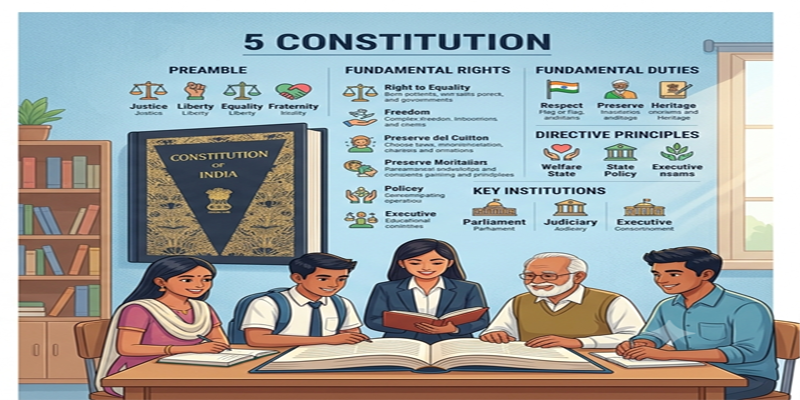
And govenment of India runs following the Constitution of India.
You may have heard terms like Fundamental Rights, Fundamental Duties, Parliament, Supreme Court, Democracy, Equality, and Constitutional Remedies often.
But how many of us actually understand the meaning of these terms? Very few...I guess!
The Constitution should not be seen just as a document for judges, politicians, lawyers, or government officials.
It actually belongs to every indian citizen. If we just understand its basic provisions, it could be a great help to us to know our basic rights and responsibilities.
And this will make us more informed and responsible citizens of our country.
In this post, we will try to explain this fascinating Constitution of India in very simple language. |Indian Constitution Explained|
What Is the Indian Constitution?
A constitution is a set of fundamental rules and principles according to which a country is governed.
The Constitution of India establishes the framework of the Indian government. It explains:
- How the country should be governed
- Powers and responsibilities of the government
- Fundamental rights of citizens
- Duties of citizens
- Functions of Parliament
- Powers of the President and Prime Minister
- Role of courts and the judiciary
- Relationship between the Central and State Governments
- How elections and democratic institutions function
- How the Constitution itself can be amended
In simple words, the Constitution provides the basic rules for running the country while placing limits on government power and protecting citizens’ rights.
When Was the Indian Constitution Adopted?
The Constitution was adopted by the Constituent Assembly on 26 November 1949.
However, it came into force on 26 January 1950.
This is why India celebrates:
26 November – Constitution Day
and
26 January – Republic Day
The date 26 January was selected because of its historical importance in India’s freedom movement, particularly the declaration of Purna Swaraj in 1930.
Who Made the Indian Constitution?
The Constitution was prepared by the Constituent Assembly, which consisted of representatives from different parts of India.
One of the most important figures in the drafting process was Dr. B. R. Ambedkar, who served as the Chairman of the Drafting Committee.
Dr. Ambedkar played a major role in preparing and presenting the draft Constitution.
The Constituent Assembly debated various provisions extensively before adopting the Constitution.
The Constitution was therefore not simply written by one person. It was the result of extensive discussions, debates, and contributions from many members of the Constituent Assembly. |Indian Constitution Explained|
What Does the Preamble Tell Us?
The Preamble is often described as the introduction or philosophical foundation of the Constitution.
It begins with the famous words:
“We, the People of India…”
These words are significant because they express the idea that the Constitution’s ultimate authority comes from the people of India.
The Preamble describes India as a:
- Sovereign
- Socialist
- Secular
- Democratic
- Republic
It also promises:
- Justice
- Liberty
- Equality
- Fraternity
These principles provide an important understanding of the Constitution’s goals and values.
What Are Fundamental Rights?
One of the most important parts of the Constitution for ordinary citizens is Fundamental Rights.
These rights are primarily contained in Part III of the Constitution, Articles 12 to 35.
They protect individuals against certain forms of arbitrary or unfair state action.
The major categories of Fundamental Rights include:
1. Right to Equality
Articles 14 to 18 deal with equality.
The Constitution provides for equality before the law and equal protection of the laws.
It also prohibits discrimination on certain specified grounds and abolishes untouchability.
2. Right to Freedom
Articles 19 to 22 provide important protections relating to freedom and personal liberty.
Article 19, for example, guarantees certain freedoms to citizens, subject to constitutional restrictions.
Article 21 provides that no person shall be deprived of life or personal liberty except according to procedure established by law. |Indian Constitution Explained|
3. Right Against Exploitation
Articles 23 and 24 protect people against certain forms of exploitation.
These provisions address issues such as trafficking, forced labour, and employment of children in certain prohibited circumstances.
4. Right to Freedom of Religion
Articles 25 to 28 deal with freedom of religion.
India’s constitutional framework protects freedom of conscience and the right to profess, practise and propagate religion, subject to the limitations mentioned in the Constitution.
5. Cultural and Educational Rights
Articles 29 and 30 provide important protections relating to cultural and educational interests, particularly concerning minorities. |Indian Constitution Explained|
6. Right to Constitutional Remedies
Article 32 allows individuals to approach the Supreme Court for enforcement of Fundamental Rights.
Dr. B. R. Ambedkar famously regarded Article 32 as one of the most important safeguards for Fundamental Rights.
Are Fundamental Rights Unlimited?
No.
Fundamental Rights are extremely important, but they are not absolute in every situation.
For example, certain freedoms under Article 19 are subject to constitutionally permitted reasonable restrictions.
This is an important point for citizens to understand.
Having a constitutional right does not necessarily mean that a person can exercise it without any legal restrictions.
The Constitution itself defines circumstances in which certain rights may be regulated. |Indian Constitution Explained|
What Are Fundamental Duties?
Rights are only one side of citizenship.
The Constitution also contains Fundamental Duties, listed in Article 51A.
These duties include responsibilities such as respecting the Constitution, the National Flag and the National Anthem, protecting the environment, developing scientific temper, and promoting harmony.
Fundamental Duties remind us that citizenship is not only about asking what the country can do for us.
It is also about asking:
What responsibilities do we have towards our country and fellow citizens?
What Are Directive Principles of State Policy?
Another important part of the Constitution is the Directive Principles of State Policy, contained in Part IV.
These principles guide the State in making laws and policies.
They cover broad objectives relating to social and economic justice, welfare, public health, education, equal opportunities, and other matters.
Unlike Fundamental Rights, the Directive Principles are generally not enforceable by courts.
However, they are fundamental to governance and have significantly influenced legislation and government policy. |Indian Constitution Explained|
How Does the Indian Government Work?
The Constitution establishes a parliamentary system of government.
At the Union level, the main constitutional institutions include:
- President
- Prime Minister and Council of Ministers
- Parliament
- Supreme Court
India also has governments at the State level, consisting of institutions such as:
- Governor
- Chief Minister and Council of Ministers
- State Legislature
- High Courts
The Constitution distributes powers between the Union and the States.
This arrangement is an important feature of India’s federal structure.
What Is the Role of Parliament?
The Indian Parliament consists of:
President + Lok Sabha + Rajya Sabha
The Lok Sabha is the House of the People.
The Rajya Sabha is the Council of States.
Parliament performs several important functions, including:
- Making laws
- Discussing national issues
- Approving government expenditure
- Holding the executive accountable
- Representing citizens and States through elected and nominated constitutional mechanisms
However, Parliament’s powers are not unlimited. Laws made by Parliament must operate within the framework of the Constitution. |Indian Constitution Explained|
What Is the Role of the Judiciary?
India has an independent judiciary.
The Supreme Court of India is the country’s highest court.
Below it are the High Courts and subordinate courts.
Courts play an important role in:
- Interpreting laws
- Protecting constitutional rights
- Resolving disputes
- Reviewing government action
- Ensuring that laws comply with the Constitution
The power of courts to examine the constitutional validity of laws and government actions is commonly known as judicial review.
Can the Constitution Be Changed?
Yes.
The Constitution is not completely unchangeable.
Article 368 provides the principal constitutional framework for amendments.
Over the years, Parliament has passed numerous Constitutional Amendment Acts to respond to changing circumstances and constitutional requirements.
However, Parliament’s power to amend the Constitution is not unlimited.
The Supreme Court developed the Basic Structure Doctrine, under which certain fundamental features of the Constitution cannot be destroyed even through a constitutional amendment.
This principle is one of the most important developments in Indian constitutional law. |Indian Constitution Explained|
Why Should Ordinary Citizens Understand the Constitution?
You do not need to become a lawyer to understand the Constitution.
Knowing its basic principles can help you understand situations involving:
- Equality and discrimination
- Freedom of speech and expression
- Personal liberty
- Arrest and detention
- Religious freedom
- Government decisions
- Elections
- Access to courts
- Government accountability
- Legal rights and responsibilities
For example, if you understand that Article 21 protects life and personal liberty, you have a basic constitutional reference point when learning about laws concerning individual liberty.
Similarly, knowing about Article 14 helps you understand the constitutional principle of equality before the law.
Knowledge of Article 32 and Article 226 helps you understand that constitutional courts can play an important role in enforcing rights. |Indian Constitution Explained|
Constitution and Ordinary Laws: What Is the Difference?
This is another important concept.
The Constitution is the supreme law of India.
Ordinary laws are made by Parliament or State Legislatures within the powers given to them by the Constitution.
If an ordinary law is inconsistent with a constitutional provision in a manner that makes it unconstitutional, courts can examine its validity.
Therefore, the Constitution provides the framework within which governments exercise their legislative and executive powers.
Constitution Is More Than a Legal Document
The Indian Constitution is not merely a collection of Articles and legal terminology.
It represents a framework for a democratic society based on constitutional principles.
It attempts to balance:
Individual rights + Social justice + Democratic government + Constitutional limitations + Citizen responsibilities
It also provides mechanisms through which institutions can be held accountable.
For citizens, this means that understanding the Constitution can make it easier to understand how the country actually works.
Final Thoughts
Friends, in this blog post(Indian Constitution Explained), we have understood the amazing Constitution of India. Indian demographic and legal system is standing on a strong foundation known as the Constitution of India. From equality to personal liberty, from Parliament to the Supreme Court, from rights to fundamental duties, it covers it all. There are many effects of the Constitution on many aspects of public life. And you don’t need to memorize hundreds of articles of the Constitution. But you should have at least a basic knowledge of these provisions.
You can go through the Preamble, Fundamental Rights, Fundamental Duties, Directive Principles, major constitutional institutions, and important Articles that affect citizens’ everyday life. |Indian Constitution Explained|
A citizen can take part very effectively in democracy only if they have a basic awareness of their constitutional rights and responsibilities. |Indian Constitution Explained|
The Constitution is not only a document or book that governs the government—it is a document that belongs to the people of India. |Indian Constitution Explained|
If you have any queries, you can write to us at support@a5theory.com; we will get back to you ASAP.
Hope! You will enjoy this post, “Indian Constitution Explained“.
Please feel free to give your feedback in the comment section below.
Have a great time!