

Hello Friends, in this blog post, we are going to discuss consumer protection in India within the Constitution.
It is very natural for people to do some essential activities related to their livelihood, and they often do them in a day, week, or month, like:
- Pay for internet service
- Booking Flights
- Buying products
- Ordering foods
- Subscribing to online platforms
- Hiring professionals
- Using banking services
Whenever you are involved in a transaction of money or pay for any goods or services, you are considered a consumer.
But sometimes we get stuck in some awkward situations or problems and get frustrated and look for quick and possible solutions.
A few common problems are listed below:
- What happens when the product is defective?
- What if a service is deficient?
- What if an online seller refuses to provide a refund?
- What if you are charged more than the displayed price?
- What if an advertisement makes a misleading claim?
Here, powerful Indian law comes into play and ensures the protection of consumers.
The Consumer Protection Act, 2019 is the principal legislation that replaced the Consumer Protection Act, 1986.
Several useful and important changes were announced within this Act.
It introduced provisions to address misleading advertisements, the Central Consumer Protection Authority (CCPA), e-commerce, and product liability.
Having a better knowledge and understanding of your consumer rights, you can easily identify…
…and restrict unfair practices and know the place where exactly you have to seek appropriate action.
In this post, we are going to explore Consumer Protection in India in easy-to-understand language.
Who Is a Consumer?
Under the Consumer Protection Act, 2019, a consumer is generally a person who buys goods or hires or avails services for consideration.
The law also recognizes transactions conducted through modern methods such as:
- Online purchases
- Electronic transactions
- Teleshopping
- Direct selling
- Multi-level marketing
This is important because consumer law is no longer limited to traditional shops and physical markets.
However, the definition has important exclusions.
For example, a person who obtains goods or services for resale or commercial purposes is generally outside the ordinary definition of a consumer, subject to the statutory provisions and exceptions.
What Are Your Basic Consumer Rights?
Consumer protection law recognizes several important consumer rights.
These include:
Right to Safety
Consumers have the right to be protected against goods and services that are hazardous to life and property.
For example, safety concerns may arise with defective electrical equipment, unsafe food products, or dangerous consumer goods.
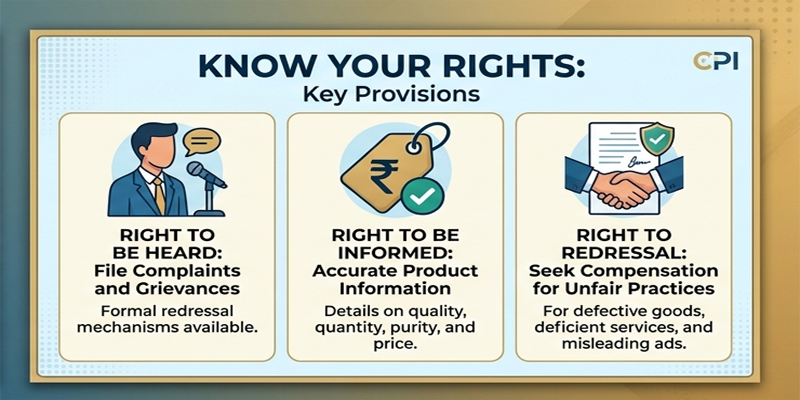
Right to Be Informed
Consumers have the right to receive information about important characteristics of goods and services.
Depending on the product or service, this may include information about:
- Quality
- Quantity
- Purity
- Standard
- Price
- Ingredients
- Risks
- Conditions of use
This right helps consumers make informed choices.
Right to Choose
Consumers should have access to a variety of goods and services at competitive prices, subject to the nature of the market.
Unfair restrictions on consumer choice may raise legal concerns depending on the circumstances.
Right to Be Heard
Consumer interests should receive appropriate consideration through the relevant consumer-protection mechanisms.
A consumer should have an avenue through which a genuine grievance can be presented.
Right to Seek Redressal
Consumers have the right to seek remedies against practices such as:
- Defective goods
- Deficient services
- Unfair trade practices
- Certain misleading advertisements
- Other matters covered by consumer law
Right to Consumer Awareness
Consumers also have the right to awareness about their rights and available remedies.
Knowing your rights is often the first step toward using them effectively.
What Is a Defect in a Product?
A defect generally refers to a fault, imperfection, or shortcoming in the quality, quantity, purity, or standard of goods where the applicable legal requirements or agreed specifications are not met.
For example, suppose you purchase a new appliance that does not function because of a manufacturing problem.
Depending on the facts and applicable law, this could potentially constitute a product defect.
The exact legal position depends on the evidence, warranty terms, and circumstances of the case.
What Is Deficiency in Service?
Consumer law also protects consumers from deficiency in services.
A service may involve a shortcoming or inadequacy in quality, nature, or manner of performance where the law or contractual obligation requires a particular standard.
Examples may include certain situations involving:
- Banking services
- Insurance services
- Telecommunications
- Transportation
- Housing services
- Repair services
- Other services covered by consumer law
However, not every disagreement with a service provider automatically amounts to a legally actionable deficiency.
The facts and applicable legal provisions matter.
What Is an Unfair Trade Practice?
An unfair trade practice includes certain misleading or deceptive practices used to promote the sale or supply of goods or services.
Examples can include:
- False representations about a product
- Misleading claims about quality
- Misrepresenting the usefulness of goods
- False or misleading advertisements
- Certain deceptive pricing practices
- Other conduct covered by the statutory definition
Consumers should preserve evidence when they believe an unfair trade practice has occurred.
What Are Misleading Advertisements?
Advertising plays a major role in modern consumer decisions.
An advertisement can become legally problematic when it contains claims that are false, misleading, or otherwise prohibited by law.
The Consumer Protection Act, 2019 provides mechanisms for dealing with misleading advertisements.
The Central Consumer Protection Authority (CCPA) can take action in appropriate cases.
The law can also impose consequences on manufacturers, advertisers, and endorsers in circumstances covered by the Act.
What Is the Central Consumer Protection Authority?
The Central Consumer Protection Authority (CCPA) was created under the Consumer Protection Act, 2019.
Its role includes protecting consumers as a class and dealing with matters such as:
- Violation of consumer rights
- Unfair trade practices
- Misleading advertisements
The CCPA has powers provided by the Act, including investigation and action in appropriate cases.
This is different from the consumer commissions that hear individual consumer disputes.
Consumer Commissions: Where Can You Complain?
The consumer dispute redressal system includes:
- District Consumer Disputes Redressal Commission
- State Consumer Disputes Redressal Commission
- National Consumer Disputes Redressal Commission (NCDRC)
These bodies are commonly referred to as Consumer Commissions.
They provide a specialized mechanism for resolving consumer disputes.
District, State and National Commissions
The appropriate Consumer Commission depends on the jurisdictional requirements prescribed by the Consumer Protection Act and applicable rules.
This can involve considerations such as the value of the goods or services involved and the relevant territorial jurisdiction.
Because jurisdictional rules can change through legislation or rules, consumers should verify the current requirements before filing.
The important point is that you do not necessarily have to approach an ordinary civil court for every consumer dispute.
Consumer Commissions provide a specialized statutory forum.
Can You File a Complaint Online?
Yes.
The consumer protection system provides online mechanisms through which eligible consumer complaints and related processes can be initiated.
Consumers can also use the government’s consumer-awareness and grievance platforms for appropriate assistance.
However, filing a grievance through a consumer helpline and filing a formal complaint before a Consumer Commission are not necessarily the same thing.
A helpline may help facilitate a resolution, while a formal consumer complaint invokes the statutory adjudicatory process.
What Evidence Should You Keep?
Evidence can make a major difference in a consumer dispute.
Keep documents such as:
- Purchase invoice
- Receipt
- Warranty card
- Order confirmation
- Payment records
- Emails
- SMS messages
- Chat records
- Photographs or videos
- Product packaging
- Delivery records
- Service reports
- Written complaints
- Responses from the seller or service provider
For online purchases, take screenshots of relevant product descriptions, prices, offers, and terms where appropriate.
Digital information can sometimes change or disappear later.
What If an Online Seller Refuses a Refund?
Imagine that you purchase a product online and receive a defective item.
A practical sequence could be:
- Check the seller’s return, replacement, and warranty terms.
- Contact the seller or platform through the official complaint mechanism.
- Keep copies of your communications.
- Preserve the invoice and proof of payment.
- If the matter is not resolved, consider the appropriate consumer grievance or statutory remedy.
The exact remedy depends on the product, transaction, seller, warranty, and circumstances.
What If You Are Charged More Than the Displayed Price?
Consumers should pay attention to the price displayed on a product or service.
In retail transactions, the Maximum Retail Price (MRP) framework under applicable law is important.
If a packaged commodity is being sold in circumstances where the applicable rules prohibit charging more than the printed MRP, a consumer may have grounds to raise a complaint.
However, taxes, service charges, delivery charges and other components can operate differently depending on the transaction and applicable law.
Therefore, the invoice should be examined rather than assuming that every amount above a displayed number is automatically illegal.
What About Hidden Charges?
Hidden or undisclosed charges can create consumer-protection concerns depending on the circumstances.
For example, an online service might initially display one price but add charges later without adequately informing the customer.
Consumers should carefully examine:
- Base price
- Taxes
- Delivery charges
- Platform charges
- Cancellation charges
- Convenience fees
- Subscription terms
- Renewal conditions
Clear pricing information helps consumers identify unexpected charges.
What Is Product Liability?
One of the significant additions under the Consumer Protection Act, 2019 is the concept of product liability.
In appropriate cases, a consumer may seek compensation for harm caused by a defective product or deficient service.
Depending on the circumstances, liability can potentially involve:
- Product manufacturers
- Product sellers
- Product service providers
The exact requirements depend on the statutory provisions and facts of the case.
Product liability is particularly important because it focuses not merely on whether a product was defective but also on harm caused to the consumer.
Consumer Rights in E-Commerce
Modern consumer law recognizes the importance of online transactions.
E-commerce platforms and sellers must comply with applicable consumer-protection requirements.
Consumers should be particularly careful about:
- Seller identity
- Product descriptions
- Return policies
- Warranty terms
- Delivery commitments
- Refund policies
- Reviews and ratings
- Cancellation charges
- Subscription arrangements
A screenshot of the product page and order details can be useful evidence if a dispute later arises.
Are Online Reviews Always Reliable?
Consumers should treat online reviews carefully.
Some reviews may be genuine, while others may not accurately represent actual customer experience.
Consumer-protection rules also address certain misleading practices relating to endorsements and advertisements.
A consumer should therefore consider multiple sources of information before making an expensive purchase.
What About Fake or Counterfeit Products?
Selling counterfeit or falsely represented products can raise serious legal issues.
If you receive a product that appears substantially different from what was advertised, preserve:
- The original listing
- Seller details
- Invoice
- Packaging
- Photographs
- Communication with the seller
- Return or refund requests
If the product is potentially dangerous or fraudulent, additional legal or regulatory remedies may also be relevant.
Consumer Complaints vs Police Complaints
Not every consumer dispute is a criminal matter.
A defective product or poor service may primarily involve a consumer-law remedy.
However, if the facts indicate possible cheating, fraud, forgery, theft or another criminal offence, criminal-law remedies may also become relevant.
The appropriate route depends on the facts.
A consumer complaint and a police complaint serve different legal purposes.
Can You Get Compensation?
Consumer Commissions can grant remedies permitted under the Consumer Protection Act.
Depending on the circumstances, remedies may include:
- Repair of defective goods
- Replacement
- Refund
- Compensation
- Removal of defects
- Discontinuation of unfair trade practices
- Corrective measures
- Other relief permitted by law
The remedy depends on the facts and the legal findings in the case.
Is Hiring a Lawyer Always Necessary?
Consumer law was designed to make consumer redressal comparatively accessible.
Consumers can represent themselves in appropriate cases, although legal representation can be useful in complicated matters.
Whether professional legal assistance is advisable depends on factors such as:
- Value of the dispute
- Complexity of the legal issues
- Amount of evidence
- Opposite party’s response
- Need for expert evidence
- Appeals or further proceedings
For substantial or complicated disputes, professional legal advice can help.
Mediation and Consumer Disputes
The Consumer Protection Act, 2019 also introduced a framework for consumer mediation.
Mediation can provide an opportunity for parties to attempt settlement with the assistance of a mediator.
It can sometimes help resolve a dispute without requiring a full contested adjudication.
Whether mediation is suitable depends on the circumstances and willingness of the parties.
A Simple Example
Imagine you purchase a refrigerator advertised as having a particular capacity and features.
After delivery:
- The product does not match the advertised specifications.
- The seller refuses to replace it.
- The manufacturer does not properly address the warranty complaint.
You should preserve the advertisement, invoice, warranty documents, photographs, and communications.
You can then use the applicable consumer grievance mechanism and, where appropriate, approach the relevant Consumer Commission.
The important lesson is:
Do not rely only on verbal promises. Keep documentary evidence.
How to Become a Smart Consumer
Consumer protection is not only about going to court or filing complaints.
Good consumer habits can prevent many disputes.
Before purchasing an expensive product or service:
- Compare specifications.
- Check the seller’s identity.
- Read warranty terms.
- Check return and refund conditions.
- Look at the full price.
- Keep the invoice.
- Avoid making payments through suspicious channels.
- Be cautious about unrealistic offers.
- Preserve important online records.
A few minutes of careful checking can sometimes prevent a much larger problem later.
What Every Indian Consumer Should Remember
The most important points are:
- The Consumer Protection Act, 2019 is the principal modern consumer-protection law.
- Consumers have rights relating to safety, information, choice, being heard, redressal, and awareness.
- Defective goods and deficient services can give rise to remedies under the law.
- Misleading advertisements and unfair trade practices can attract legal action.
- The CCPA protects consumer interests at a broader level.
- Consumer Commissions provide a specialized dispute-resolution mechanism.
- Online purchases are covered by important consumer-protection rules.
- Keep invoices, payment records, warranties, and communications.
- A consumer complaint is different from a criminal complaint.
- The exact remedy and jurisdiction depend on the facts and applicable law.
Final Takeaway
Friends, in this post, we have fully understood consumer protection in India. It is not limited to getting a refund after something goes wrong. But the main purpose is to create a consumer-friendly marketplace where a consumer can easily make an informed decision and have a scope of legal remedies in a case when applicable consumer-protection standards are violated by businesses.
Being a consumer, you should know your rights(Consumer Protection in India) as well as your responsibilities well.
So, carefully read the terms and conditions, maintain your records, ask for proper invoices, and try to be more careful while dealing with online transactions. And in a case when something goes wrong, instead of assuming yourself optionless, forgetting the incident, or ignoring it, you should better understand the remedies(Consumer Protection in India) and options available to you to sort out the problem.
So, if you are an informed consumer, then you will be capable of protecting your legal rights, time, and, importantly, money.
Legal Disclaimer
This article “Consumer Protection in India” is intended for general educational and legal-awareness purposes only. It is not legal advice and should not be treated as a substitute for professional legal consultation. Consumer rights, jurisdiction, limitation periods, and available remedies depend on the facts, applicable legislation, rules, and judicial decisions. For a specific dispute, consider consulting a qualified legal professional.
If you have any queries, you can write to us at support@a5theory.com; we will get back to you ASAP.
Hope! You would have enjoyed this post, “Consumer Protection in India“.
Please feel free to give your feedback in the comment section below.
Have a great time!