

Introduction
Hello Friends, in this blog post(English Speaking Practice For Beginners), we are going to let you know about English practice exercises for better speaking skill specially for beginners.
It is a very hard and awkward situation sometimes when we are asked to speak something in English on any stage.
Most English learners who even have a good knowledge of grammar and vocabulary feel nervous, hesitant, blank-minded, etc.
But have you ever thought about this: why does it happen? |English Speaking Practice For Beginners|
The answer is quite simple: a lack of practice, which also brings your confidence down when speaking in front of so many people.
So you have to understand one thing very clear that english speaking is a practical skill that only comes with regular practice, rather than collecting passive or theoretical knowledge in English.
The good thing is that you are not required to relocate to a native speaking country or have a native speaker partner to build fluency and confidence.
You just practice some simple exercises regularly; this will definitely improve your pronunciation, fluency, and confidence.
In this post(English Speaking Practice For Beginners), we are going to share some amazing speaking activities and practical exercises with you that are specially designed for beginners.
Why Speaking Practice Is Important
Regular speaking practice helps you:
- Build confidence.
- Improve pronunciation.
- Increase fluency.
- Think in English more naturally.
- Use vocabulary actively.
- Prepare for interviews and presentations.
- Communicate comfortably in everyday situations.
Even 20–30 minutes of daily speaking practice can produce noticeable improvement over time.
Common Challenges Beginners Face
Many learners struggle because they:
- Fear making mistakes.
- Translate every sentence from their native language.
- Have limited vocabulary.
- Feel shy speaking in front of others.
- Don’t know how to practice alone.
- Focus too much on grammar instead of communication.
Remember, fluency develops through consistent speaking—not perfect grammar.
How to Practice Speaking Every Day
1. Speak Aloud
Read newspaper articles, books, or blog posts aloud.
This improves:
- Pronunciation
- Fluency
- Confidence
2. Describe Your Day
Talk about your daily routine in English.
Example:
“I woke up at 6:30 this morning. After breakfast, I started working on my assignments.”
This simple exercise helps you think directly in English.
3. Use the Mirror Technique
Stand in front of a mirror and speak for 2–3 minutes on any topic.
Topics can include:
- My family
- My hometown
- My hobbies
- My favorite book
- My career goals
Watching yourself speak also improves body language and confidence.
4. Think in English
Instead of translating from your native language, try forming simple thoughts directly in English.
For example:
Instead of thinking:
“अब मुझे बाजार जाना है.”
Think:
“I need to go to the market.”
This habit gradually reduces dependence on translation.
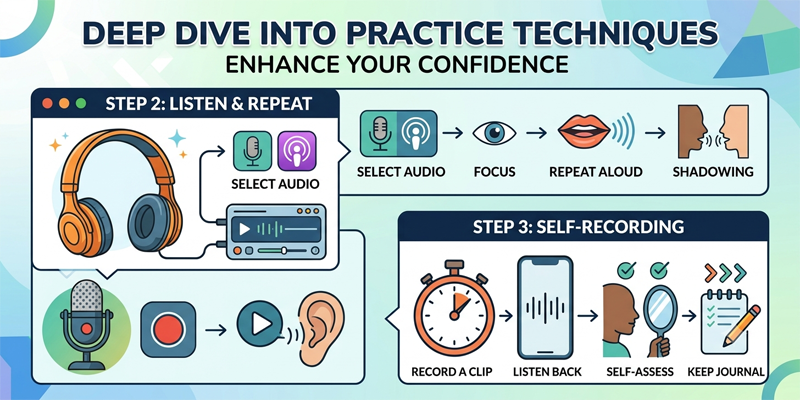
5. Record Yourself
Use your phone to record a one-minute speech.
Listen to it and notice:
- Pronunciation
- Grammar
- Speaking speed
- Clarity
Repeating this exercise weekly helps you track your progress.
10 Effective Speaking Exercises
1. Introduce Yourself
Practice a one-minute self-introduction.
Include:
- Name
- Education
- Profession
- Hobbies
- Goals
2. Picture Description
Choose any picture and describe what you see for one minute.
This improves vocabulary and observation skills.
3. Question and Answer Practice
Ask yourself questions such as:
- What did I do today?
- What are my plans for tomorrow?
- What is my favorite movie?
Answer each question in complete sentences.
4. Read and Repeat
Read a paragraph aloud twice.
The second reading should sound smoother and more natural.
5. Shadowing Technique
Listen to a short English video or podcast.
Pause after each sentence and repeat exactly what you hear.
This improves pronunciation, rhythm, and intonation.
6. Storytelling
Retell a short story or summarize a movie you’ve watched.
Focus on communicating the main ideas rather than using advanced vocabulary.
7. Daily Object Speaking
Pick an object near you, such as a laptop or a cup, and speak about it for one minute.
Example:
“This is my laptop. I use it every day for work and learning. It helps me attend online meetings and write documents.”
8. Role-Play
Practice situations such as:
- Ordering food
- Booking a hotel
- Attending a job interview
- Talking to a customer
Role-playing prepares you for real-life conversations.
9. Speak with a Friend
Choose one topic and speak only in English for 10–15 minutes.
Don’t worry about small mistakes—focus on expressing your ideas.
10. Join English-Speaking Communities
Participate in online or local English-speaking groups where you can practice regularly and receive feedback.
A 30-Minute Daily Speaking Routine
5 Minutes – Read Aloud
Read an English article or book.
5 Minutes – Learn New Expressions
Practice five useful phrases and use them in sentences.
10 Minutes – Speak on a Topic
Choose any topic and speak continuously.
5 Minutes – Shadowing
Repeat after a podcast or video.
5 Minutes – Record Yourself
Review your pronunciation and fluency.
Following this routine consistently can lead to noticeable improvement.
Common Mistakes to Avoid
❌ Waiting until your grammar is perfect before speaking.
❌ Translating every sentence.
❌ Speaking too quickly.
❌ Being afraid of making mistakes.
❌ Memorizing complete conversations instead of learning useful expressions.
❌ Practicing only once a week.
Consistency is more important than intensity.
Tips to Build Confidence
- Start with simple sentences.
- Celebrate small improvements.
- Practice every day.
- Speak slowly and clearly.
- Listen carefully to fluent speakers.
- Don’t compare yourself with others.
- Focus on communication rather than perfection.
Confidence grows through repeated practice.
Practice Activities
Exercise 1
Speak about your favorite hobby for two minutes.
Exercise 2
Describe your room without looking around.
Exercise 3
Introduce yourself as if you’re attending a job interview.
Exercise 4
Record yourself reading a newspaper article.
Compare today’s recording with one you make after a month to measure improvement.
Frequently Asked Questions
How long should I practice speaking every day?
Practicing for 20–30 minutes daily is more effective than studying for several hours once a week. Consistency is the key to improvement.
Can I improve my speaking without a partner?
Yes. Techniques such as reading aloud, shadowing, recording yourself, and speaking in front of a mirror are excellent ways to practice independently.
How long does it take to become fluent?
Fluency depends on your current level and the consistency of your practice. Regular daily speaking, listening, reading, and writing will help you improve steadily over time.
Key Takeaways
- Speak English every day, even if only for a few minutes.
- Focus on communication instead of perfection.
- Use practical exercises like shadowing, storytelling, and role-playing.
- Record yourself regularly to track progress.
- Build confidence through consistent practice.
Conclusion
Friends, in this post(English Speaking Practice For Beginners), we have gone through some useful practical exercises for speaking skills. You have to understand one thing: you are not going to be a good English speaker overnight. You must practice regularly and be patient to become a fluent English speaker. Some daily exercises, such as reading English aloud, storytelling, shadowing, and recording your voice, are very useful for improving your pronunciation and fluency.
You should treat each conversation as an opportunity to polish your English communication. Never get afraid of making mistakes, as they play an important role in making you a better English speaker. So you should do English speaking exercises regularly, and enjoy speaking English; soon you will see an amazing improvement in your English speaking. |English Speaking Practice For Beginners|
If you have any queries, you can write to us at support@a5theory.com; we will get back to you ASAP.
Hope! You would have enjoyed this post(English Speaking Practice For Beginners).
Please feel free to give your important feedback in the comment section below.
Have a great time!