

Introduction
Hello Friends, in this blog post(Sentence Structure in English), I am going to discuss how to frame sentences in English grammar.
Sentence structure is considered a basic block of English grammar, which helps us lay down the foundation of our English communication.
If you know thousands of words in English, they will not be useful to you until you set them in a proper structure very accurately.
A well-structured sentence projects our ideas in a very clear voice and provides strength to our writing and speaking skills effectively.
For example:
- Incorrect: Playing football Rahul likes.
- Correct: Rahul likes playing football.
If you really want to speak English very fluently and write in a professional style, then you must learn sentence structures.
If you always practice following a sentence structure, then you can surely avoid your common grammatical mistakes to a certain extent.
In this post, we are going to examine sentence structure in detail.
We will also see basic sentence patterns and sentence types, along with practical examples.
Sentence Structure in English:-
What Is a Sentence?
A sentence is a group of words that expresses a complete thought.
A sentence generally begins with a capital letter and ends with a full stop (.), question mark (?), or exclamation mark (!).
Examples
- She is reading a book.
- They went to the market.
- Are you ready?
Basic Components of a Sentence
Most English sentences consist of three main parts:
1. Subject
The subject tells us who or what acts.
Examples
- Rahul plays cricket.
- The dog barked loudly.
- She is studying.
2. Verb
The verb shows action or a state of being.
Examples
- Rahul plays cricket.
- She writes poems.
- They are happy.
3. Object
The object receives the action.
Examples
- Rahul reads a book.
- She bought a car.
- They watched a movie.
Basic Sentence Formula
Subject + Verb + Object
Examples
- I eat apples.
- She writes stories.
- They play football.
This pattern forms the basis of many English sentences.
Common Sentence Patterns
1. Subject + Verb (S + V)
Examples
- Birds fly.
- Babies cry.
- Dogs bark.
2. Subject + Verb + Object (S + V + O)
Examples
- She drinks coffee.
- Rahul plays cricket.
- They completed the project.
3. Subject + Verb + Complement (S + V + C)
The complement provides more information about the subject.
Examples
- She is happy.
- The sky became dark.
- Rahul is a doctor.
4. Subject + Verb + Indirect Object + Direct Object
Examples
- She gave me a gift.
- He taught us English.
- They sent him a letter.
Types of Sentences Based on Meaning
1. Declarative Sentences
These make statements.
Examples
- I live in India.
- She is a teacher.
2. Interrogative Sentences
These ask questions.
Examples
- Where do you live?
- Are you happy?
3. Imperative Sentences
These express commands, requests, or advice.
Examples
- Open the door.
- Please help me.
- Study regularly.
4. Exclamatory Sentences
These express strong emotions.
Examples
- What a beautiful day!
- Wow! That’s amazing!
Types of Sentences Based on Structure
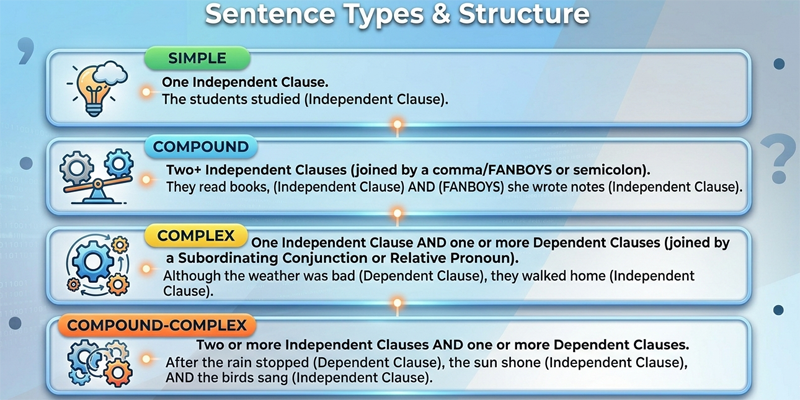
English sentences are divided into four major types.
1. Simple Sentences
A simple sentence contains one independent clause.
Examples
- She sings beautifully.
- Rahul works hard.
- They play cricket.
Simple sentences express one complete idea.
2. Compound Sentences
Compound sentences contain two or more independent clauses joined by conjunctions.
Examples
- I was tired, but I continued working.
- She studied hard, so she passed the exam.
- He is rich, yet humble.
Common conjunctions:
- And
- But
- Or
- So
- Yet
3. Complex Sentences
A complex sentence contains one independent clause and one or more dependent clauses.
Examples
- Because it was raining, we stayed home.
- If you work hard, you will succeed.
- Although he was tired, he finished his work.
Complex sentences show relationships such as:
- Cause
- Condition
- Contrast
- Time
4. Compound-Complex Sentences
These contain two independent clauses and at least one dependent clause.
Examples
- Although it was raining, we went outside, and we enjoyed the weather.
- She studied hard because she wanted success, and she achieved excellent results.
These are the most advanced sentence structures.
Sentence Patterns Used in Spoken English
Pattern 1
Subject + Verb
- Birds sing.
- Children laugh.
Pattern 2
Subject + Verb + Object
- I love music.
- They watch movies.
Pattern 3
Subject + Verb + Adjective
- She looks beautiful.
- The soup tastes delicious.
Pattern 4
Subject + Verb + Adverb
- He speaks fluently.
- They work efficiently.
Word Order in English
English follows a fixed word order:
Subject + Verb + Object
Correct
- Rahul eats mangoes.
Incorrect
- Mangoes Rahul eats.
Changing word order can make sentences awkward or incorrect.
Common Sentence Structure Mistakes
Mistake 1: Missing Subject
❌ Is raining outside.
✔ It is raining outside.
Mistake 2: Wrong Word Order
❌ Quickly she runs.
✔ She runs quickly.
Mistake 3: Sentence Fragments
❌ Because I was tired.
✔ Because I was tired, I went to bed.
Mistake 4: Run-On Sentences
❌ I was hungry, I ate a sandwich.
✔ I was hungry, so I ate a sandwich.
Tips to Improve Sentence Structure
Start with Simple Sentences
Master basic structures before moving to complex ones.
Read English Daily
Books, blogs, and newspapers expose you to natural sentence patterns.
Practice Writing
Write five sentences every day using different structures.
Learn Conjunctions
Conjunctions help combine ideas and create compound and complex sentences.
Speak in Complete Sentences
Instead of saying:
❌ Going market.
Say:
✔ I am going to the market.
Examples of All Four Types
Simple Sentence
- She enjoys reading.
Compound Sentence
- She enjoys reading, and she writes poems.
Complex Sentence
- Because she enjoys reading, she visits the library regularly.
Compound-Complex Sentence
- Because she enjoys reading, she visits the library regularly, and she also writes poems.
Frequently Asked Questions
What is the most common sentence pattern in English?
Subject + Verb + Object (SVO) is the most common sentence pattern.
Why is sentence structure important?
Proper sentence structure improves clarity, grammar, writing skills, and spoken English.
How can I improve my sentence structure?
By reading, writing, speaking regularly, and practicing different sentence types.
Conclusion
Friends, in this post(Sentence Structure in English), we have learned about sentence structure in English grammar. In English communication, sentence structure plays a very crucial role and works as a backbone. So if you get good knowledge of subjects, verbs, objects, along with sentence structures, then you become very confident to express your ideas in a very clear and effective manner.
If you really want to improve your writing, speaking, and overall English fluency, then you will have to get a good command over compound, complex, and compound-complex sentences. But all this knowledge would not be a worth until you do regular practice to master it.
If your sentence structure is strong and proper, it will automatically reflect a better and more organized English proficiency.
If you have any queries, you can write to us at support@a5theory.com; we will get back to you ASAP.
Hope! You would have enjoyed this post(Sentence Structure in English).
Please feel free to give your important feedback in the comment section below.
Have a great time!