

Introduction
Hello Friends, in this blog post(Conjunctions in English Grammar), I am going to let you know about conjunctions in English grammar.
They are considered very important and basic fundamental parts of English grammar.
Despite being small words, they are used to connect words, clauses, phrases, and sentences to make a meaningful statement.
They surely help us in expressing our ideas correctly.
If we don’t use conjunctions in our sentences, then they would like be incomplete, short, disconnected, and incorrect grammatically.
For Example:
Without conjunctions:
- I was tired.
- I continued working.
With conjunctions:
- I was tired, but I continued working.
It is very easy to mix up two or more different ideas using conjunctions, and this makes our English communication more natural.
So in this post, we are going to explore conjunction types, rules, examples, along with common mistakes that are often made by beginners.
Conjunctions in English Grammar:-
What Are Conjunctions?
A conjunction is a word that joins words, phrases, clauses, or sentences.
Common Examples
- And
- But
- Or
- Because
- Although
- Since
- Yet
- So
- Either…or
- Neither…nor
Example Sentences
- Rahul and Amit are friends.
- She studied hard because she wanted to pass.
- I was tired, but I finished my work.
Why Are Conjunctions Important?
Conjunctions help:
- Connect ideas smoothly.
- Avoid repetitive sentences.
- Improve sentence structure.
- Enhance writing and speaking skills.
- Make communication more natural.
Types of Conjunctions
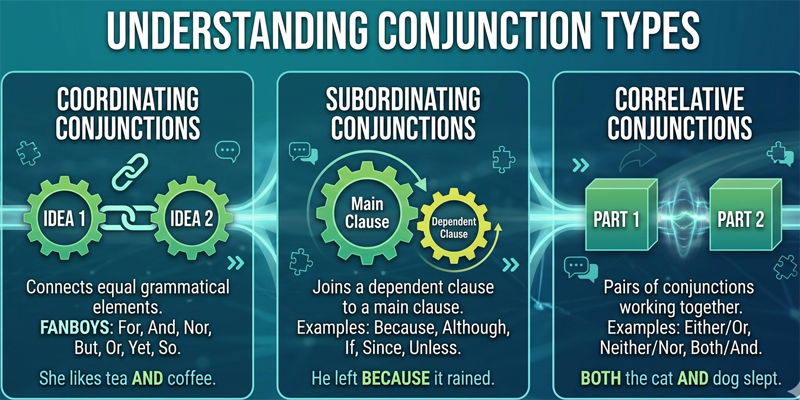
There are three main types of conjunctions:
- Coordinating Conjunctions
- Subordinating Conjunctions
- Correlative Conjunctions
1. Coordinating Conjunctions
Coordinating conjunctions connect words, phrases, or independent clauses of equal importance.
The most common coordinating conjunctions are remembered by the acronym FANBOYS:
- F – For
- A – And
- N – Nor
- B – But
- O – Or
- Y – Yet
- S – So
And
Used to add information.
Examples
- Rahul and Priya are classmates.
- She bought apples and oranges.
But
Used to show contrast.
Examples
- I wanted to go, but it started raining.
- He is poor but honest.
Or
Used to present choices.
Examples
- Tea or coffee?
- You can stay or leave.
So
Used to show results.
Examples
- It was raining, so we stayed home.
- She worked hard, so she succeeded.
Yet
Used to show unexpected contrast.
Examples
- He is rich, yet humble.
- She was tired, yet she continued studying.
2. Subordinating Conjunctions
Subordinating conjunctions connect a dependent clause to an independent clause.
Common Subordinating Conjunctions
- Because
- Although
- Since
- If
- While
- When
- Before
- After
- Unless
- Until
Because
Shows reason.
Examples
- She stayed home because she was sick.
- I studied hard because I wanted good marks.
Although
Shows contrast.
Examples
- Although he was tired, he kept working.
- Although it was raining, they went outside.
If
Shows condition.
Examples
- If you work hard, you will succeed.
- If it rains, we will cancel the trip.
When
Shows time.
Examples
- Call me when you arrive.
- I was sleeping when he called.
While
Shows simultaneous actions.
Examples
- She listened to music while studying.
- He was talking while driving.
3. Correlative Conjunctions
Correlative conjunctions work in pairs.
Common Correlative Conjunctions
- Either…or
- Neither…nor
- Both…and
- Not only…but also
- Whether…or
Either…Or
Expresses alternatives.
Examples
- Either Rahul or Amit will help you.
- You can either stay or leave.
Neither…Nor
Expresses negative choices.
Examples
- Neither Rahul nor Priya attended the meeting.
- Neither tea nor coffee is available.
Both…And
Shows inclusion of two things.
Examples
- Both Rahul and Amit are doctors.
- She is both intelligent and hardworking.
Not Only…But Also
Adds emphasis.
Examples
- He is not only talented but also humble.
- She is not only beautiful but also kind.
Compound Sentences and Conjunctions
Conjunctions are essential for forming compound sentences.
Example
Simple Sentences:
- I was hungry.
- I ate a sandwich.
Compound Sentence:
- I was hungry, so I ate a sandwich.
Rules for Using Conjunctions
Rule 1: Join Similar Elements
Correct:
- She likes singing and dancing.
Incorrect:
- She likes singing and to dance.
Rule 2: Use Proper Punctuation
Correct:
- I wanted to go, but I was busy.
Incorrect:
- I wanted to go, but I was busy. (comma often recommended when joining independent clauses)
Rule 3: Maintain Parallel Structure
Correct:
- She enjoys reading, writing, and painting.
Incorrect:
- She enjoys reading, writing, and to paint.
Common Conjunctions and Their Uses
| Conjunction | Purpose |
|---|---|
| And | Addition |
| But | Contrast |
| Or | Choice |
| Because | Reason |
| Since | Cause |
| Although | Contrast |
| If | Condition |
| So | Result |
| While | Simultaneous actions |
| Yet | Unexpected contrast |
Common Mistakes with Conjunctions
Mistake 1
❌ Because he was tired. He slept.
✔ Because he was tired, he slept.
Mistake 2
❌ Although it was raining but we went outside.
✔ Although it was raining, we went outside.
OR
✔ It was raining, but we went outside.
Using both “although” and “but” together is incorrect.
Mistake 3
❌ Neither Rahul or Priya attended.
✔ Neither Rahul nor Priya attended.
Mistake 4
❌ Either tea and coffee.
✔ Either tea or coffee.
Tips to Master Conjunctions
Learn FANBOYS
Memorize:
- For
- And
- Nor
- But
- Or
- Yet
- So
These are the most commonly used coordinating conjunctions.
Read English Content Regularly
Books, newspapers, and blogs expose you to natural sentence structures.
Practice Combining Sentences
Turn short sentences into compound and complex sentences using conjunctions.
Observe Real Conversations
Pay attention to how conjunctions are used in movies, podcasts, and interviews.
Frequently Asked Questions
What is the most common conjunction in English?
“And” is one of the most frequently used conjunctions in English.
Can a sentence start with a conjunction?
Yes.
Examples:
- But I disagree with you.
- And then we left.
Modern English accepts this usage, especially in informal writing.
How many types of conjunctions are there?
There are three major types:
- Coordinating Conjunctions
- Subordinating Conjunctions
- Correlative Conjunctions
Conclusion
Friends, in this post(Conjunctions in English Grammar), we have gone through a very interesting topic: conjunctions in English grammar. Conjunctions are basically connector words that help us join words, clauses, phrases, and sentences and make them a fluent and meaningful sentence. If you get a good command of these basic coordinating, subordinating, and correlative conjunctions, you can easily express your thoughts and ideas effectively and in a more natural manner.
If you want to have a good grip over conjunctions, then you would have to practice them more and more. Conjunctions are very important concepts that help you improve your overall English writing, speaking, and communication skills.
If you have any queries, you can write to us at support@a5theory.com; we will get back to you ASAP.
Hope! You would have enjoyed this post, Conjunctions in English Grammar.
Please feel free to give your important feedback in the comment section below.
Have a great time!