

Introduction
Hello Friends, in this blog post(Phrasal Verbs in English), we are going to talk about a very interesting topic: “Phrasal verbs in English” in English grammar.
Most of you must have heard, seen, or encountered these phrasal verbs while reading, writing, speaking, or listening to English, like “Wake up,” “Give up,” “Look after,” or “Carry on,”.
These words are very common in everyday English conversations and are very important to all who want to speak fluent, confident English naturally.
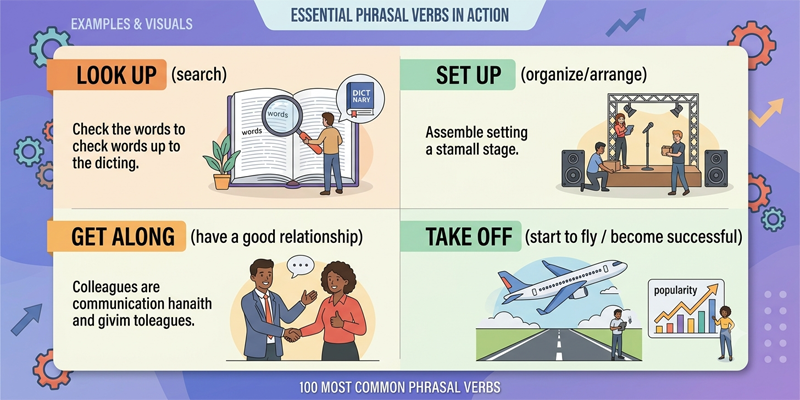
A phrasal verb is simply formed with a combination of one verb and one or more particles(such as a preposition or adverb) and gives it a new meaning.
And the meaning of any phrasal verb cannot be predicted just by seeing the individual words.
In this post(Phrasal Verbs in English), we are going to provide you with full details of phrasal verbs like definition, importance, examples, along with 100 of the most common phrasal verbs with meaning and examples.
Phrasal Verbs in English:-
What Are Phrasal Verbs?
A phrasal verb consists of:
Verb + Preposition / Adverb
The combination creates a meaning different from the original verb.
Example
Look = Use your eyes.
Look after = Take care of someone or something.
Sentence:
She looks after her grandparents.
Why Are Phrasal Verbs Important?
Learning phrasal verbs helps you:
- Speak more naturally.
- Understand native speakers.
- Improve your vocabulary.
- Write more fluently.
- Perform better in exams like IELTS and TOEFL.
Types of Phrasal Verbs
1. Intransitive Phrasal Verbs
These do not require an object.
Examples:
- Wake up
- Sit down
- Grow up
Sentence:
I usually wake up at 6 AM.
2. Transitive Phrasal Verbs
These require an object.
Examples:
- Turn on the light.
- Pick up the phone.
- Fill out the form.
3. Separable Phrasal Verbs
The object can come between the verb and the particle.
Example:
- Turn off the TV.
- Turn the TV off.
Both are correct.
4. Inseparable Phrasal Verbs
The object must come after the entire phrasal verb.
Example:
✔ Look after your parents.
❌ Look your parents after.
100 Common Phrasal Verbs
Daily Life
| Phrasal Verb | Meaning |
|---|---|
| Wake up | Stop sleeping |
| Get up | Leave your bed |
| Sit down | Take a seat |
| Stand up | Rise to your feet |
| Go out | Leave home |
| Come in | Enter |
| Come back | Return |
| Go away | Leave |
| Hurry up | Move faster |
| Calm down | Relax |
Work & Study
| Phrasal Verb | Meaning |
|---|---|
| Give up | Stop trying |
| Carry on | Continue |
| Work out | Solve or exercise |
| Find out | Discover |
| Figure out | Understand |
| Look into | Investigate |
| Hand in | Submit |
| Fill out | Complete a form |
| Write down | Record information |
| Read over | Review |
Communication
| Phrasal Verb | Meaning |
|---|---|
| Speak up | Talk louder |
| Call back | Return a phone call |
| Hang up | End a phone call |
| Talk over | Discuss |
| Bring up | Mention a topic |
| Point out | Highlight |
| Ask for | Request |
| Answer back | Reply rudely |
| Listen in | Secretly listen |
| Tell apart | Recognize differences |
Travel
| Phrasal Verb | Meaning |
|---|---|
| Check in | Register at a hotel or airport |
| Check out | Leave a hotel |
| Get on | Board a vehicle |
| Get off | Leave a vehicle |
| Pick up | Collect someone |
| Drop off | Leave someone somewhere |
| Set off | Begin a journey |
| Take off | Plane leaves the ground |
| Stop by | Visit briefly |
| Turn back | Return to where you came from |
Relationships
| Phrasal Verb | Meaning |
|---|---|
| Get along | Have a good relationship |
| Fall out | Argue |
| Make up | Become friends again |
| Look after | Take care of |
| Break up | End a relationship |
| Care for | Take care of |
| Depend on | Rely on |
| Cheer up | Become happier |
| Grow apart | Become less close |
| Look up to | Respect and admire |
Technology & Everyday Activities
| Phrasal Verb | Meaning |
|---|---|
| Log in | Sign into an account |
| Log out | Sign out |
| Turn on | Start a device |
| Turn off | Stop a device |
| Plug in | Connect to electricity |
| Back up | Make a copy of data |
| Scroll down | Move down a page |
| Click on | Select with a mouse |
| Print out | Produce a paper copy |
| Shut down | Completely turn off |
Learning & Improvement
| Phrasal Verb | Meaning |
|---|---|
| Catch up | Reach the same level |
| Keep up | Maintain progress |
| Brush up on | Improve a skill |
| Go over | Review |
| Learn by heart | Memorize |
| Pick up | Learn informally |
| Look up | Find information |
| Take up | Start a hobby |
| Carry out | Perform a task |
| Put into practice | Apply knowledge |
Business & Professional Use
| Phrasal Verb | Meaning |
|---|---|
| Deal with | Handle |
| Follow up | Continue after initial contact |
| Set up | Establish |
| Take over | Assume control |
| Bring in | Introduce |
| Cut down | Reduce |
| Put off | Postpone |
| Call off | Cancel |
| Sort out | Resolve |
| Pay back | Repay money |
Examples in Sentences
- Please turn off the lights before leaving.
- I need to look up this word in the dictionary.
- Never give up on your dreams.
- We should carry on with our project.
- She takes care of her younger brother. (You can also say “looks after.”)
- I forgot to log out of my account.
- Please fill out this application form.
- We need to figure out the solution.
- They called off the meeting due to bad weather.
- I will pick you up at the airport tomorrow.
Tips to Learn Phrasal Verbs Faster
Learn by Topic
Instead of random learning, group phrasal verbs into categories like travel, work, technology, or daily life.
Use Them in Sentences
Don’t memorize only the meaning.
Write your own sentence.
Example:
Pick up
✔ I’ll pick up my sister from school.
Practice Every Day
Learn 3–5 phrasal verbs daily and revise them regularly.
Watch English Videos
Movies, interviews, podcasts, and YouTube videos are excellent sources for hearing phrasal verbs used naturally.
Common Mistakes
1. Translating Literally
❌ Give up = Give something upwards.
✔ Give up = Stop trying.
2. Using the Wrong Word Order
Some phrasal verbs are inseparable.
✔ Look after the baby.
❌ Look the baby after.
3. Ignoring Context
Many phrasal verbs have more than one meaning.
For example:
Take off
- The plane took off.
- His business took off. (became successful)
Always learn meanings in context.
Frequently Asked Questions
How many phrasal verbs are there in English?
There are thousands of phrasal verbs, but learning the 100–200 most common ones is enough for everyday communication.
Are phrasal verbs important for spoken English?
Yes. Native speakers use phrasal verbs frequently in conversations, making them an essential part of fluent English.
How can I remember phrasal verbs?
The best way is to:
- Learn them by topic.
- Use them in sentences.
- Practice regularly.
- Review them often.
Conclusion
Friends, in this post(Phrasal Verbs in English), we have understood the full concept of phrasal verbs and seen various examples along with their importance. For natural English communication, phrasal verbs play a very important role. However, in the beginning they seem a little confusing and difficult, but as you understand them well and practice on a regular basis, you will easily get a good command over them.
For quick and better improvement in your English communication, you should focus on some most common phrasal verbs and practice them with full consistency. You will soon find a gradual improvement in your writing, speaking, listening, and reading skills. If you practice these phrasal verbs regularly with consistency, soon they will be very natural in your daily English communication.
If you have any queries, you can write to us at support@a5theory.com; we will get back to you ASAP.
Hope! You would have enjoyed this post(Phrasal Verbs in English).
Please feel free to give your important feedback in the comment section below.
Have a great time!