

Introduction
Hello Friends, in this blog post(English Idioms and Phrases), I am going to tell you about idioms and phrases in English grammar.
If you really want to sound like a native English speaker, then you must know these idioms and phrases.
It is very common for native English speakers to use idioms and phrases in their daily conversations, books, interviews, movies, and business communication.
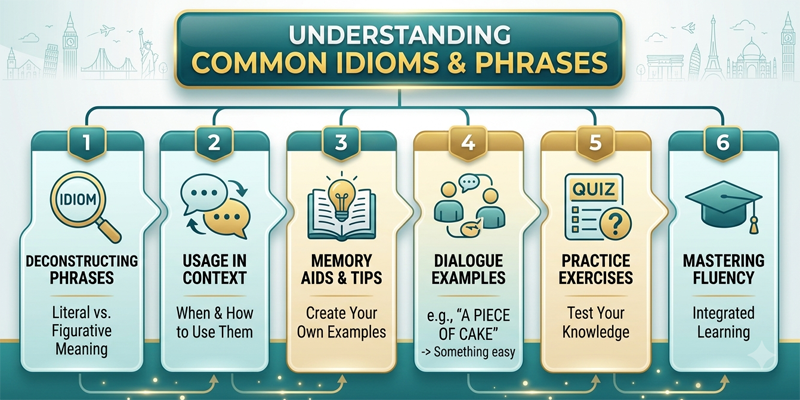
First, you should understand the idioms well. An idiom is nothing but a collection of words that define a specific meaning for a unique purpose or situation.
If you draw the meaning of the idiom words separately, one by one, then you will find it totally different from the actual idiom meaning.
For example: “Break a leg.” This sentence does not indicate anything about injury; rather, it is just a simple wish, “good luck”
Similarly, common English phrases make conversations smoother, more natural, and more engaging.
In the same manner, English phrases help you to make your conversation simple, smooth, and more engaging.
In this post(English Idioms and Phrases), we are going to describe almost 100 of the most common English idioms and phrases along with their meaning and examples.
What Is an Idiom?
An idiom is a fixed expression whose meaning cannot be understood by translating each word individually.
Example
Hit the books
Meaning: To study seriously.
Sentence:
I have an exam tomorrow, so I need to hit the books tonight.
What Is a Phrase?
A phrase is a group of words that work together to express an idea but do not form a complete sentence.
Example
At the moment
Sentence:
I am busy at the moment.
Why Should You Learn Idioms?
Learning idioms helps you:
- Speak naturally.
- Understand movies and TV shows.
- Improve your vocabulary.
- Sound more fluent.
- Communicate like native speakers.
50 Most Common English Idioms
| Idiom | Meaning |
|---|---|
| Break a leg | Good luck |
| Hit the books | Study hard |
| Piece of cake | Very easy |
| Once in a blue moon | Very rarely |
| Under the weather | Feeling sick |
| Spill the beans | Reveal a secret |
| Cost an arm and a leg | Very expensive |
| Better late than never | Late is better than not at all |
| Kill two birds with one stone | Achieve two goals at once |
| Bite the bullet | Face a difficult situation |
| Burn the midnight oil | Work or study late |
| Call it a day | Stop working |
| Cut corners | Do something cheaply or carelessly |
| Easy does it | Be careful |
| Get cold feet | Become nervous |
| Give it a shot | Try something |
| Hang in there | Don’t give up |
| Hit the nail on the head | Say exactly the right thing |
| In hot water | In trouble |
| Let the cat out of the bag | Reveal a secret |
| Miss the boat | Miss an opportunity |
| No pain, no gain | Success requires effort |
| On cloud nine | Very happy |
| Pull someone’s leg | Joke with someone |
| See eye to eye | Agree completely |
| Take your time | Don’t hurry |
| The ball is in your court | It’s your decision |
| Through thick and thin | In good and bad times |
| Time flies | Time passes quickly |
| Wrap your head around | Understand something |
| Jump the gun | Start too early |
| Keep an eye on | Watch carefully |
| Lose your touch | Lose your skill |
| Make up your mind | Decide |
| Out of the blue | Unexpectedly |
| Pull yourself together | Calm yourself |
| Read between the lines | Understand the hidden meaning |
| Sit on the fence | Avoid making a decision |
| Speak of the devil | Someone appears while being discussed |
| The tip of the iceberg | A small visible part of a larger issue |
| Throw in the towel | Give up |
| Up in the air | Uncertain |
| Water under the bridge | Past events |
| Your guess is as good as mine | I don’t know |
| Back to square one | Start again |
| Burn bridges | End relationships permanently |
| Cry over spilled milk | Worry about the past |
| Go the extra mile | Put in extra effort |
| Hit the road | Leave or begin a journey |
| Learn the ropes | Learn how something works |
50 Common English Phrases
Some of the most frequently used English phrases include:
- How’s it going?
- What’s up?
- Nice to meet you.
- Long time no see.
- I appreciate it.
- Thank you so much.
- You’re welcome.
- No worries.
- Take care.
- See you later.
- Have a nice day.
- Sounds good.
- I’m on my way.
- Let’s get started.
- Excuse me.
- I completely agree.
- I don’t think so.
- That makes sense.
- I understand.
- Could you help me?
- Never mind.
- It depends.
- That’s amazing!
- I’m not sure.
- Absolutely!
- Of course.
- That’s enough.
- What do you mean?
- In my opinion…
- As far as I know…
- To be honest…
- Believe me.
- Keep it up.
- Good job!
- Well done.
- That’s a good idea.
- I’m looking forward to it.
- It’s up to you.
- No problem.
- Take your time.
- Don’t worry.
- Calm down.
- That’s interesting.
- What happened?
- I hope so.
- Maybe next time.
- Let’s move on.
- I couldn’t agree more.
- That’s exactly right.
- See you soon.
Tips to Learn Idioms Faster
Learn them in context
Always learn an idiom with an example sentence instead of memorizing only its meaning.
Practice Daily
Learn 3–5 idioms every day and use them in conversations.
Watch English Movies
Movies and TV shows frequently use idiomatic expressions in real-life situations.
Maintain an Idiom Notebook
Write down:
- Idiom
- Meaning
- Example sentence
Review your notebook regularly.
Common Mistakes
❌ Translating idioms literally
Example:
Break a leg
does not mean to injure your leg.
❌ Using idioms in every sentence
Too many idioms can make your speech sound unnatural.
Use them only where they fit naturally.
Frequently Asked Questions
Are idioms necessary for speaking English?
They are not mandatory, but they make your English sound much more natural and fluent.
How many idioms should I learn?
Start with the 50–100 most common idioms used in daily conversations.
Where are idioms commonly used?
You’ll hear idioms in:
- Daily conversations
- Movies
- TV shows
- Books
- News articles
- Business communication
Conclusion
Friends, in this post(English Idioms and Phrases), we have seen a few important idioms and phrases of English grammar. They are a very important part of natural English communication. They give you the liberty to express your ideas more effectively and help you a lot to better understand native speakers. But for better learning you should not try to memorise many idioms expression and phrases at once Rather you should learn few everyday with proper understanding of their meaning and practice them regularly in your real conversations.
If you learn and practice them on a regular basis, then soon they will be a part of your natural vocabulary. And it is going to take your spoken, written, and fluent English to the next level for sure.
If you have any queries, you can write to us at support@a5theory.com; we will get back to you ASAP.
Hope! You would have enjoyed this post(English Idioms and Phrases).
Please feel free to give your important feedback in the comment section below.
Have a great time!