

Introduction
Hello Friends, in this blog post(Modal Verbs in English content img), I am going to discuss modals, which are an essential part of English grammar.
With the use of modal verbs, you can express several emotions and ideas such as possibility, ability, obligation, permission, advice, necessity, and future objectives.
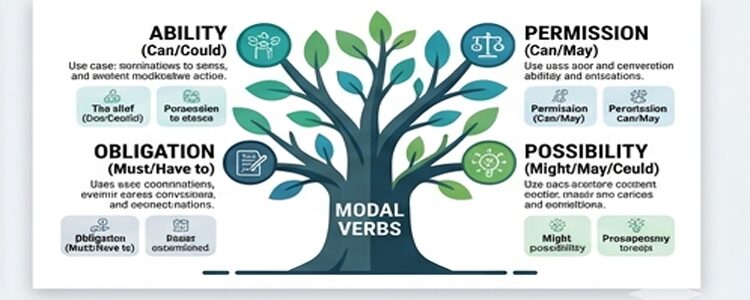
If you’ve ever tried saying this:
- I can swim.
- You should study harder.
- She might come tomorrow.
Then you have already tried using modal verbs.
We use modal verbs very frequently in our daily conversations.
They can be used in our professional communication, academic writing, and spoken English.
If you develop a better understanding of them, then you can easily speak English confidently and fluently.
In this post, we will teach you about modal verbs and their uses in detail.
We will also go through their rules along with examples in a very easy way.
What Are Modal Verbs?/Modal Verbs in English
Modal verbs are helping verbs that modify the meaning of the main verb.
They do not show action themselves. Instead, they express ideas such as:
- Ability
- Permission
- Possibility
- Necessity
- Advice
- Obligation
- Requests
Common Modal Verbs
- Can
- Could
- May
- Might
- Must
- Shall
- Should
- Will
- Would
Basic Structure of Modal Verbs
Formula
Subject + Modal Verb + Base Form of Verb
Examples
- I can swim.
- She may come.
- They should study.
- We will succeed.
Notice that the main verb remains in its base form.
Rules of Modal Verbs
Rule 1: No “To” After Most Modal Verbs
Correct
- I can swim.
- She should study.
Incorrect
- I can to swim.
- She should to study.
Rule 2: Modal Verbs Do Not Change Form
Correct
- He can drive.
- They can drive.
Incorrect
- He cans drive.
Modal verbs do not take “s,” “es,” or “ing.”
Rule 3: Use the Base Form of the Main Verb
Correct
- She should go.
- We may visit.
Incorrect
- She should goes.
- We may visiting.
1. Can
Uses of Can
A. Ability
Used to express ability or skill.
Examples
- I can swim.
- She can speak English.
- Rahul can solve complex problems.
B. Permission
Examples
- You can leave now.
- Can I use your pen?
C. Possibility
Examples
- It can be dangerous.
- This road can get crowded.
2. Could
Uses of Could
A. Past Ability
Examples
- I could swim when I was six.
- She could read at an early age.
B. Polite Requests
Examples
- Could you help me?
- Could you open the window?
C. Possibility
Examples
- It could rain tonight.
- We could be late.
3. May
Uses of May
A. Permission (Formal)
Examples
- May I come in?
- May I ask a question?
B. Possibility
Examples
- She may arrive soon.
- It may rain tomorrow.
4. Might
Uses of Might
Might expresses a weaker possibility than “may.”
Examples
- He might come later.
- They might cancel the trip.
- It might snow tonight.
May vs Might
| May | Might |
|---|---|
| Stronger possibility | Weaker possibility |
| More likely | Less likely |
Examples
- It may rain today.
- It might rain next week.
5. Must
Uses of Must
A. Strong Obligation
Examples
- You must obey traffic rules.
- Students must complete their assignments.
B. Necessity
Examples
- We must leave now.
- You must wear a helmet.
C. Strong Probability
Examples
- She must be tired after work.
- They must know the answer.
6. Shall
Uses of Shall
Traditionally used with “I” and “We.”
Examples
- Shall we begin?
- Shall I help you?
- We shall overcome.
Shall is more common in formal English.
7. Should
Uses of Should
A. Advice
Examples
- You should exercise regularly.
- She should study harder.
B. Recommendation
Examples
- You should read this book.
- We should visit that museum.
C. Moral Duty
Examples
- We should help others.
- People should respect the law.
Must vs Should
| Must | Should |
|---|---|
| Strong obligation | Advice or recommendation |
| Necessary | Optional but recommended |
Examples
- You must wear a seatbelt.
- You should drink more water.
8. Will
Uses of Will
A. Future Actions
Examples
- I will call you tomorrow.
- They will arrive soon.
B. Promises
Examples
- I will help you.
- We will support you.
C. Predictions
Examples
- The weather will improve.
- Technology will continue to evolve.
9. Would
Uses of Would
A. Polite Requests
Examples
- Would you help me?
- Would you like some tea?
B. Preferences
Examples
- I would like a coffee.
- She would prefer to stay home.
C. Imaginary Situations
Examples
- I would travel the world if I had enough money.
- He would buy a new car if he won the lottery.
Quick Summary Table
| Modal Verb | Main Use |
|---|---|
| Can | Ability, Permission |
| Could | Past Ability, Polite Requests |
| May | Permission, Possibility |
| Might | Weak Possibility |
| Must | Obligation, Necessity |
| Shall | Suggestions, Formal Future |
| Should | Advice, Recommendation |
| Will | Future Actions |
| Would | Polite Requests, Preferences |
Common Mistakes with Modal Verbs
Mistake 1: Adding “To”
❌ I can to swim.
✔ I can swim.
Mistake 2: Using Wrong Verb Forms
❌ She should goes.
✔ She should go.
Mistake 3: Adding “S” to Modal Verbs
❌ He cans drive.
✔ He can drive.
Mistake 4: Confusing Must and Should
❌ You should wear a helmet while riding a bike. (when legally required)
✔ You must wear a helmet while riding a bike.
Tips to Master Modal Verbs
Learn One Modal at a Time
Focus on understanding the usage of each modal verb individually.
Use Them in Daily Conversations
Practice sentences like:
- Can you help me?
- Should I go?
- May I come in?
Read English Content
Books, blogs, and articles show modal verbs in real-life situations.
Practice Writing
Write five sentences daily using different modal verbs.
How Modal Verbs Improve Spoken English
Modal verbs make communication:
- More natural
- More polite
- More precise
- More professional
They are used frequently in interviews, meetings, emails, and everyday conversations.
Frequently Asked Questions
What is the most commonly used modal verb?
“Can” is one of the most frequently used modal verbs in English.
Can two modal verbs be used together?
Generally, standard English does not use two modal verbs together.
Incorrect:
- He may can come.
Correct:
- He may be able to come.
Are modal verbs important for spoken English?
Yes. They are essential for expressing requests, permissions, advice, and possibilities naturally.
Conclusion
Friends, in this blog post(Modal Verbs in English content img), we have covered possibly all important modal verbs that are used in our daily conversations. Modal verbs are very impactful words that help us to express possibility, ability, permission, advice, obligation, and future goals. Those common modal verbs are a few that are used in both spoken and written English extensively.
If you really want to communicate confidently and clearly, then you must learn these modal verbs: can, could, May, Might, Must, Shall, Should, Will, and would. These few modal verbs are used very frequently in communication. You should keep practicing these modal verbs daily and apply them in real-life conversations. Soon you will see a great improvement in your English speaking ability.
If you have any queries, you can write to us at support@a5theory.com; we will get back to you ASAP.
Hope! You will have enjoyed this post. Modal Verbs in English content img().
Please feel free to give your important feedback in the comment section below.
Have a great time!