

Introduction
Hello Friends, in this blog post(Active Voice and Passive Voice), I am going to let you know about another interesting topic in English grammar: voice.
Voice is one of the important parts of grammar that is capable of changing the meaning of a sentence.
It gives us a clear idea about whether the subject is performing an action or receiving an action.
If you get a good command of the active and Passive voice, then you will gradually see an improvement in your…
… English writing and speaking, along with a strong grip on comprehension and examination performance.
In normal and daily English conversations, you probably see the use of the active voice, as they are direct and easy to understand.
Though passive voice is also used in a good proportion in various activities like formal writing, scientific reports, news articles, and professional communication.
In this guide(Active Voice and Passive Voice), we are going to discuss both Active Voice and Passive Voice in…
… detail along with their rules, formulas, examples, and the common mistakes that beginners usually make.
Active Voice and Passive Voice:-
What Is Voice in English Grammar?
Voice refers to the form of a verb that shows the relationship between the subject and the action.
There are two types of voice:
- Active Voice
- Passive Voice
What Is Active Voice?
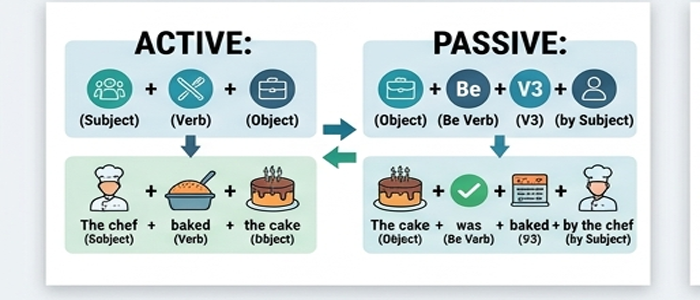
In Active Voice, the subject acts.
Structure
Subject + Verb + Object
Examples
- Rahul writes a letter.
- She reads a book.
- They play football.
In these sentences, the subject is acting.
Advantages of Active Voice
Active Voice:
- Is clear and direct
- Makes sentences shorter
- Is easier to understand
- Is preferred in everyday communication
Example
- Active: The teacher explained the lesson.
This sentence is simple.
What Is Passive Voice?
In Passive Voice, the subject receives the action.
Structure
Object + Helping Verb + Past Participle (V3) + By + Subject
Examples
- A letter is written by Rahul.
- A book is read by her.
- Football is played by them.
Here, the focus is on the object rather than the person acting.
Why Do We Use Passive Voice?
Passive Voice is useful when:
- The doer is unknown.
- The action is more important than the doer.
- Formal writing is required.
- Scientific or technical writing is being used.
Example
- The bridge was constructed in 2020.
The action is more important than the person who performed it.
Active Voice vs Passive Voice
| Active Voice | Passive Voice |
|---|---|
| Subject performs action | Subject receives action |
| Direct and clear | Formal and indirect |
| Common in speaking | Common in formal writing |
| Shorter sentences | Usually longer sentences |
Example
Active: Rahul completed the project.
Passive: The project was completed by Rahul.
Basic Formula for Voice Change
Active Voice
Subject + Verb + Object
Passive Voice
Object + Helping Verb + V3 + By + Subject
Example
Active:
- She writes a letter.
Passive:
- A letter is written by her.
Rules for Changing Active Voice to Passive Voice
Rule 1: Object Becomes Subject
Example
Active:
- Rahul writes a letter.
Object = letter
Passive:
- A letter is written by Rahul.
Rule 2: Use the Correct Helping Verb
The helping verb changes according to the tense.
Example
- Is
- Am
- Are
- Was
- Were
- Has been
- Have been
- Had been
- Will be
Rule 3: Use the Third Form of the Verb (V3)
Examples
| V1 | V2 | V3 |
|---|---|---|
| Write | Wrote | Written |
| Eat | Ate | Eaten |
| Build | Built | Built |
| Make | Made | Made |
Passive Voice always uses the third form.
Rule 4: Use “By” Before the Doer
Example
- The work was completed by the students.
Sometimes “by” is omitted if the doer is unknown or unimportant.
Voice Change in Different Tenses
1. Simple Present Tense
Active
- She writes a letter.
Passive
- A letter is written by her.
Formula
Object + is/am/are + V3
2. Present Continuous Tense
Active
- She is writing a letter.
Passive
- A letter is being written by her.
Formula
Object + is/am/are being + V3
3. Present Perfect Tense
Active
- She has written a letter.
Passive
- A letter has been written by her.
Formula
Object + has/have been + V3
4. Simple Past Tense
Active
- She wrote a letter.
Passive
- A letter was written by her.
Formula
Object + was/were + V3
5. Past Continuous Tense
Active
- She was writing a letter.
Passive
- A letter was being written by her.
Formula
Object + was/were being + V3
6. Past Perfect Tense
Active
- She had written a letter.
Passive
- A letter had been written by her.
Formula
Object + had been + V3
7. Simple Future Tense
Active
- She will write a letter.
Passive
- A letter will be written by her.
Formula
Object + will be + V3
8. Future Perfect Tense
Active
- She will have written a letter.
Passive
- A letter will have been written by her.
Formula
Object + will have been + V3
Sentences That Cannot Be Changed into Passive Voice
Not every sentence can be converted into Passive Voice.
Intransitive verbs (verbs without objects) cannot be changed.
Examples
- He sleeps.
- The baby cried.
- Birds fly.
These sentences do not have objects, so passive construction is impossible.
Common Mistakes in Voice Change
Mistake 1: Using the Wrong Verb Form
❌ The letter is wrote by Rahul.
✔ The letter is written by Rahul.
Mistake 2: Forgetting the Helping Verb
❌ The work completed by them.
✔ The work was completed by them.
Mistake 3: Incorrect Pronoun Changes
Active
- She writes a letter.
Passive
- A letter is written by her.
Not:
- A letter is written by she.
Pronoun Changes in Passive Voice
| Active | Passive |
|---|---|
| I | Me |
| We | Us |
| He | Him |
| She | Her |
| They | Them |
| You | You |
When Should You Use Active Voice?
Use Active Voice when:
- Writing blogs
- Speaking normally
- Writing stories
- Giving instructions
- Communicating clearly
Example
- The company launched a new product.
When Should You Use Passive Voice?
Use Passive Voice when:
- Writing reports
- Writing scientific papers
- Writing formal documents
- The doer is unknown
Example
- The experiment was conducted successfully.
Tips to Master Active and Passive Voice
Identify Subject, Verb, and Object
Before changing voice, find:
- Subject
- Verb
- Object
Memorize Helping Verbs
Helping verbs are essential for correct voice conversion.
Practice Daily
Convert simple active sentences into passive sentences and vice versa.
Focus on Verb Forms
Always use the third form (V3) in passive constructions.
Frequently Asked Questions
Is Active Voice better than Passive Voice?
Neither is better. The choice depends on the context and purpose of the sentence.
Which voice is more common in daily conversation?
Active Voice is more common because it is direct and easy to understand.
Can every sentence be converted into Passive Voice?
No. Only sentences with transitive verbs and objects can be converted.
Conclusion
Friends, in this post(Active Voice and Passive Voice), we have seen Active and Passive Voice in detail. In English grammar, they are an essential part. Active voice concern with person or thing that is performing some action. On the other hand, passive voice is focused on the action or receiver of that action. A better understanding of voice definitely improves your English writing, speaking, comprehension, and grammatical accuracy.
You can easily see the use of active voice in daily English conversations, as they are the direct expression of speaking a sentence where the subject is doing some action, so the focus remains on the subject. Whereas Passive voice use could be seen in formal and professional writing. They are an indirect way of expressing the sentence speaking where the focus is on the action or its receiver.
For a better understanding of the concepts of Active and Passive voice, you should learn their rules and formulas, and practice with examples as much as you can. Soon, you will be confidently using these voices with good progress in your English communication.
If you have any queries, you can write to us at support@a5theory.com; we will get back to you ASAP.
Hope! You will have enjoyed this post(Active Voice and Passive Voice).
Please feel free to give your important feedback in the comment section below.
Have a great time!