

Hello Friends, in this blog post(How Do Rockets Reach Space), we are going to discuss one of the very interesting and amazing topics about reaching space through rockets.
Most of the people get thrilled and excited when they watch any rocket launch.
It is a really exciting thing to watch how a heavily loaded rocket weighing almost tonnes very easily…
… lifts from Earth and moves into space, breaking all kinds of atmospheric and Earth’s universal gravity forces. |How Do Rockets Reach Space|
But have you ever thought about some questions that must have come to your mind if you are a true space lover or a science student:
- How can such a heavy rocket fly upward?
- Why doesn’t it fall back immediately?
- Why do rockets produce so much fire and smoke?
- Why are rockets built in stages?
- How do satellites remain in space without falling?
The answers to all these questions can only be found in fascinating principles of physics and engineering.
The rocket is one of the greatest inventions in human history, empowering us to explore space, improve weather forecasting,…
… enable satellite communication, support GPS navigation, and spur many new scientific discoveries.
In this post, we are going to understand the amazing science behind rocket launches in a very descriptive, step-by-step manner. |How Do Rockets Reach Space|
What Is a Rocket?
A rocket is a vehicle that generates thrust by ejecting high-speed gases from its engines.
Unlike airplanes, rockets do not need air to fly. They carry both fuel and oxidizer, allowing them to operate even in the vacuum of space.
This is why rockets can travel beyond Earth’s atmosphere while aircraft cannot.
The Basic Principle of Rocket Flight
Rocket motion is based on Newton’s Third Law of Motion, proposed by Isaac Newton.
The law states:
For every action, there is an equal and opposite reaction.
When a rocket engine pushes hot gases downward at extremely high speed, those gases push the rocket upward with an equal and opposite force.
This upward force is called thrust.
What Is Thrust?
Thrust is the force that moves a rocket forward.
The greater the thrust, the easier it is for the rocket to overcome gravity.
At launch:
- Gravity pulls the rocket downward.
- Rocket engines produce upward thrust.
The rocket lifts off only when the thrust becomes greater than its weight.
How Does a Rocket Engine Work?
Rocket engines work by burning fuel inside a combustion chamber.
The process is as follows:
- Fuel and oxidizer are pumped into the combustion chamber.
- They burn rapidly, producing extremely hot, high-pressure gases.
- These gases escape through a specially shaped nozzle.
- The gases rush downward at tremendous speed.
- The rocket is pushed upward.
Modern rocket exhaust gases can leave the engine at several kilometers per second.
Why Do Rockets Carry Oxygen?
On Earth, vehicles burn fuel using oxygen from the atmosphere.
However, space is almost a perfect vacuum and contains virtually no oxygen.
Therefore, rockets carry their own oxidizer, which supplies the oxygen needed for combustion.
Without an oxidizer, a rocket engine would stop working after leaving Earth’s atmosphere.
Why Are Rockets So Tall?
A large rocket contains much more than astronauts or satellites.
Most of its size is occupied by:
- Fuel tanks
- Oxidizer tanks
- Engines
- Guidance systems
- Structural supports
In fact, for many launch vehicles, most of the launch mass is fuel and oxidizer.
What Is Escape Velocity?
One of the most famous terms in space science is escape velocity.
It is the minimum speed needed for an object to escape Earth’s gravitational pull without additional propulsion, assuming no atmospheric resistance.
For Earth, escape velocity is approximately:
11.2 kilometers per second (about 40,300 km/h).
However, many rockets carrying satellites do not need to reach escape velocity because they are designed to enter orbit rather than leave Earth’s gravitational influence.
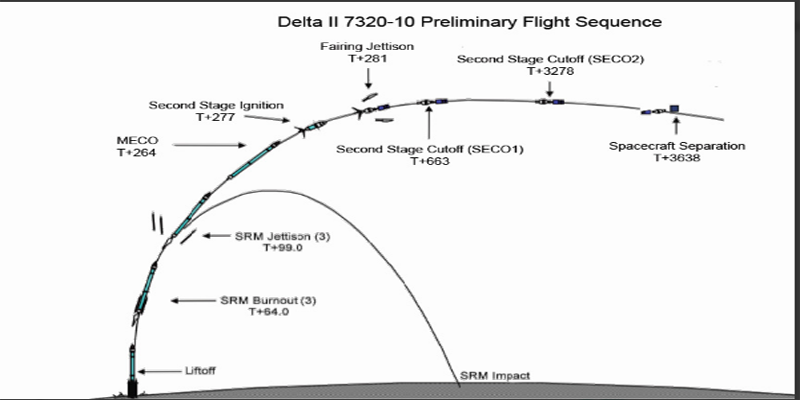
Why Do Rockets Have Multiple Stages?
If a rocket carried all its empty fuel tanks throughout the journey, it would become unnecessarily heavy.
To solve this problem, rockets use stages.
Stage 1
Provides the enormous thrust needed for liftoff.
Once its fuel is exhausted, it separates and falls away.
Stage 2
Continues the journey into higher altitudes.
Stage 3
Places the satellite or spacecraft into its intended orbit or trajectory.
Each discarded stage makes the remaining rocket lighter and more efficient.
Why Do Rockets Launch Vertically?
At launch, rockets travel almost straight upward because:
- They must quickly pass through the densest part of the atmosphere.
- Vertical ascent helps gain altitude safely.
- It minimizes early atmospheric drag.
After climbing, the rocket gradually tilts. This maneuver is called the gravity turn, which efficiently builds the horizontal speed needed for orbit.
What Is an Orbit?
An orbit is the curved path followed by an object around another object due to gravity.
A satellite stays in orbit because:
- Gravity continuously pulls it toward Earth.
- The satellite is also moving sideways at very high speed.
As it falls toward Earth, the Earth’s surface curves away beneath it, so it keeps missing the ground.
This creates a continuous orbit.
Why Don’t Satellites Fall?
Many people think there is no gravity in space.
Actually, gravity is still present.
Satellites remain in orbit because they have sufficient sideways speed while gravity constantly bends their path around Earth.
In simple words:
- Gravity pulls the satellite inward.
- Speed carries it forward.
Together, these create a stable orbit.
Types of Satellite Orbits
Low Earth Orbit (LEO)
Altitude:
About 160–2,000 km
Used for:
- Earth observation
- Space stations
- Scientific research
Medium Earth Orbit (MEO)
Used mainly for:
- Navigation satellites such as GPS and NavIC.
Geostationary Orbit (GEO)
Altitude:
About 35,786 km
Satellites here orbit once every 24 hours, matching Earth’s rotation.
They appear fixed above one location, making them ideal for:
- Television broadcasting
- Weather monitoring
- Communication services
What Happens After Launch?
A typical satellite launch follows these steps:
- Liftoff
- Stage separation
- Fairing (protective cover) separation
- Upper stage ignition
- Satellite deployment
- Satellite activates its systems
- Mission begins
Why Do Rockets Produce So Much Fire?
Rocket engines burn fuel at extremely high temperatures.
This produces:
- Hot gases
- Water vapor (for some fuels)
- Carbon dioxide (depending on fuel)
- Bright flames
- Loud sound
The powerful exhaust is what generates thrust.
Can Rockets Be Reused?
Earlier rockets were usually used only once.
Today, companies have developed reusable rockets that can land safely and be launched again after inspection and refurbishment.
Reusable launch systems can significantly reduce the cost of accessing space.
India’s Rocket Program
India has become one of the world’s leading space nations through the Indian Space Research Organisation.
Some important Indian launch vehicles include:
- PSLV (Polar Satellite Launch Vehicle)
- GSLV (Geosynchronous Satellite Launch Vehicle)
- LVM3 (Launch Vehicle Mark-3)
These rockets have launched:
- Communication satellites
- Weather satellites
- Navigation satellites
- Lunar missions
- Mars missions
Rockets vs Missiles vs Spacecraft
Students often confuse these terms.
| Rocket | Missile | Spacecraft |
|---|---|---|
| Launch vehicle | Guided weapon | Vehicle operating in space |
| Carries satellites or astronauts | Designed for defense purposes | Performs missions in space |
| Used for exploration and research | Military application | Scientific or commercial application |
Science Around You
Space technology affects daily life more than most people realize.
Satellites launched by rockets help provide:
- GPS navigation
- Mobile communication
- Television broadcasting
- Weather forecasting
- Internet services
- Disaster monitoring
- Agricultural mapping
- Climate studies
Did You Know?
- A rocket launch can consume hundreds of tonnes of propellant within minutes.
- The International Space Station travels around Earth at about 28,000 km/h.
- Lightning protection systems are installed at launch pads to safeguard rockets.
- Some spacecraft travel beyond our Solar System.
- Tiny satellites called CubeSats have made space research more affordable for universities and startups.
Try This at Home (Safe Experiment)
Balloon Rocket
You’ll Need
- One balloon
- String
- Straw
- Tape
Steps
- Pass the string through the straw.
- Tie the string tightly between two chairs.
- Tape the balloon to the straw.
- Inflate the balloon without tying it.
- Release the balloon.
Observation
The balloon moves forward while air rushes backward.
What It Demonstrates
This is a simple demonstration of Newton’s Third Law, the same principle that allows rockets to fly.
Common Mistakes Students Make
❌ Thinking rockets push against the air.
✔ Rockets push against their own exhaust gases, so they work even in the vacuum of space.
❌ Believing there is no gravity in orbit.
✔ Gravity is still strong enough to keep satellites and the Moon in orbit.
❌ Assuming rockets travel straight upward all the way into space.
✔ Rockets first climb upward and then gradually turn to build the horizontal speed needed for orbit.
❌ Thinking astronauts float because there is no gravity.
✔ Astronauts experience microgravity because they and their spacecraft are continuously falling around Earth while in orbit.
Frequently Asked Questions (FAQs)
1. How do rockets fly without air?
Rockets carry both fuel and oxidizer, allowing them to burn fuel and produce thrust even in space.
2. Why do rockets have stages?
Stages reduce the rocket’s weight by discarding empty fuel tanks, improving efficiency.
3. What is escape velocity?
It is the minimum speed needed to escape Earth’s gravity without further propulsion, approximately 11.2 km/s.
4. Why don’t satellites fall to Earth?
They are constantly falling due to gravity but moving sideways fast enough to keep missing Earth, resulting in orbit.
5. Which organization launches most of India’s satellites?
The Indian Space Research Organisation is responsible for most of India’s civilian space missions.
Why This Topic Matters
Understanding rocket science helps us appreciate:
- Satellite communication
- Space exploration
- GPS navigation
- Weather prediction
- Scientific research
- Planetary exploration
- Human spaceflight
Rocket technology has transformed communication, transportation, disaster management, and our understanding of the universe.
Conclusion
Friends, in this post(How Do Rockets Reach Space), we have explored the science responsible for rocket launches in a proper manner. A rocket is a very powerful machine that actually transforms chemical energy into a massive thrust letting us to explore space. To carry satellites, scientific instruments, and astronauts over Earth’s atmosphere into space, various principles, theories, and engineering are applied, such as Newton’s laws, advanced engineering, and precise guidance systems.
It is a fact that behind every successful rocket launch there is hard work, intelligence, and consistency of scientific discovery and engineering innovation for centuries. Space exploration has been very dynamic and advanced over time, and rockets will remain our primary portal to Mars, the Moon, and beyond. |How Do Rockets Reach Space|
So after going through this blog post, you are going to understand this amazing science that makes this incredible journey possible each time you watch a rocket launch operation. |How Do Rockets Reach Space|
If you have any queries, you can write to us at support@a5theory.com; we will get back to you ASAP.
Hope! You would have enjoyed this post(How Do Rockets Reach Space).
Please feel free to give your important feedback in the comment section below.
Have a great time!