

Hello Friends, in this blog post(Sound Waves Explained), we are going to tell you about sound waves.
Mostly all of us are aware of sound in general on the surface, and we treat it as noise that comes to our ears. Sound is an important part of our everyday life.
We wake up with the alarm sound, and like this, we encounter various different-2 sound experiences in our everyday life.
You hear vehicles moving, birds chirping, children laughing and playing, and music playing nearby, loudspeaker sound in the nearby area, etc.
Sound greatly helps us to enjoy entertainment, stay alert, communicate with others, and to to understand our surroundings throughout the day. |Sound Waves Explained|
But have you ever wondered:-
what sound actually is?
Why can we hear thunder after seeing lightning?
Why does an echo occur in mountains?
How does your voice reach someone else’s ears?
If you are really looking for the answers to all the above questions, then you must enter the fascinating world of Sound waves and understand it properly.
In this post(Sound Waves Explained), we are going to explore several facts related to Sound waves, like what sound really is,…
… how it travels, how our ears detect sound, along with several examples of sound being used in our daily life.
What Is Sound?
Sound is a form of energy produced by vibrating objects.
When an object vibrates, it causes the particles around it to vibrate. These vibrations travel as sound waves until they reach our ears.
Examples of vibrating objects include:
- Guitar strings
- Drum surfaces
- Vocal cords
- Loudspeakers
- School bells
Without vibrations, there would be no sound.
How Is Sound Produced?
Whenever an object vibrates, it pushes and pulls the particles of the surrounding medium (such as air). This creates alternating regions of:
- Compression (particles are close together)
- Rarefaction (particles are spread apart)
These compressions and rarefactions travel outward as sound waves.
For example:
When you clap your hands, the surrounding air vibrates, and these vibrations travel to the ears of nearby people.
Does Sound Need a Medium?
Yes. Sound needs a material medium to travel.
It can travel through:
- Solids
- Liquids
- Gases
However, sound cannot travel through a vacuum because there are no particles to carry the vibrations.
This is why astronauts in space cannot hear each other directly without radio communication.
How Fast Does Sound Travel?
The speed of sound depends on the medium through which it travels.
Approximate speeds:
| Medium | Speed of Sound |
|---|---|
| Air (20°C) | 343 m/s |
| Water | 1,480 m/s |
| Steel | 5,960 m/s |
Sound travels:
- Slowest in gases
- Faster in liquids
- Fastest in solids
That’s why placing your ear on a railway track can let you hear an approaching train before the sound reaches you through the air.
What Are Sound Waves?
Sound travels as longitudinal waves.
In a longitudinal wave, particles move back and forth in the same direction as the wave travels.
Unlike light waves, sound waves require matter to move through.
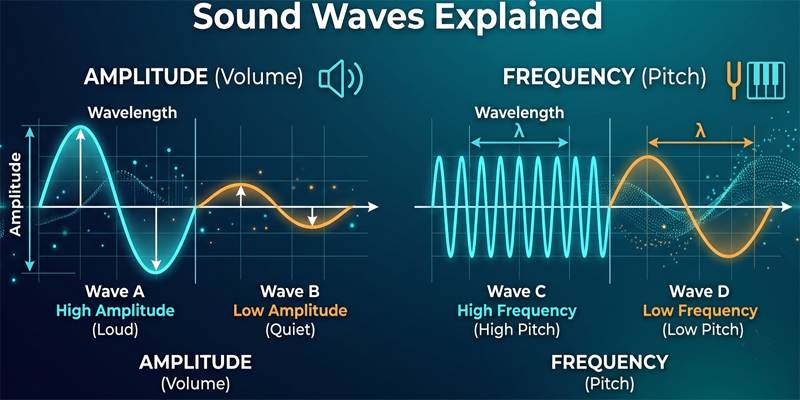
Frequency and Pitch
Frequency is the number of vibrations produced in one second.
It is measured in Hertz (Hz).
High Frequency
- Produces high-pitched sounds.
- Example: Whistle, bird chirping.
Low Frequency
- Produces low-pitched sounds.
- Example: Drum, thunder.
Amplitude and Loudness
Amplitude is the height of a sound wave.
Greater amplitude means:
- Louder sound
Smaller amplitude means:
- Softer sound
Examples:
- Whisper → Low amplitude
- Loudspeaker → High amplitude
Audible Range of Humans
Most healthy humans can hear sounds between:
20 Hz and 20,000 Hz (20 kHz)
This range changes with age and hearing health.
Infrasound
Sounds below 20 Hz are called infrasonic sounds.
Examples:
- Earthquakes
- Volcanoes
- Elephant communication
- Some whale calls
Humans cannot hear these sounds.
Ultrasound
Sounds above 20,000 Hz (20 kHz) are called ultrasonic sounds.
Examples:
- Bats
- Dolphins
- Medical ultrasound machines
Humans cannot hear ultrasonic sounds.
How Does the Human Ear Work?
Our ears convert sound waves into electrical signals that the brain can understand.
Step 1
The outer ear collects sound waves.
Step 2
The sound waves travel through the ear canal and strike the eardrum, causing it to vibrate.
Step 3
Three tiny bones in the middle ear amplify these vibrations.
These bones are:
- Malleus (Hammer)
- Incus (Anvil)
- Stapes (Stirrup)
Step 4
The vibrations reach the cochlea, a spiral-shaped structure filled with fluid.
Step 5
Special hair cells inside the cochlea convert the vibrations into electrical signals.
Step 6
The auditory nerve carries these signals to the brain.
The brain interprets them as speech, music, or other sounds.
What Is an Echo?
An echo is the repetition of a sound caused by reflection from a distant surface.
You can hear an echo when:
- Standing near mountains
- Inside a large empty hall
- Near a deep well
For a clear echo, the reflecting surface should generally be at least about 17 meters away from the listener under normal conditions.
What Is Reverberation?
Reverberation is the persistence of sound due to multiple reflections in an enclosed space.
Examples:
- Large auditoriums
- Empty classrooms
- Churches
- Indoor stadiums
Too much reverberation makes speech difficult to understand.
Noise and Noise Pollution
Not every sound is pleasant.
Noise is any unwanted or disturbing sound.
Examples:
- Traffic horns
- Loudspeakers at high volume
- Construction work
- Firecrackers
Effects of Noise Pollution
- Stress
- Headaches
- Sleep disturbances
- Reduced concentration
- Hearing damage over time
Applications of Sound
Sound has countless practical uses.
Communication
Speaking, mobile phones, and video calls.
Music
Musical instruments and concerts.
SONAR
Ships use SONAR (Sound Navigation and Ranging) to measure water depth and detect underwater objects.
Medical Ultrasound
Doctors use ultrasound to:
- Monitor pregnancy
- Examine internal organs
- Detect certain medical conditions
Industrial Uses
Ultrasound helps clean delicate equipment and inspect materials for hidden cracks.
Science Around You
You experience sound every day.
- School bells
- Doorbells
- Car horns
- Television
- Mobile phone notifications
- Music systems
- Alarm clocks
- Conversations
Every sound begins with vibrations.
Did You Know?
- Dolphins use ultrasound to navigate and locate prey.
- Bats find insects in complete darkness using echolocation, which relies on echoes.
- Thunder and lightning happen almost at the same time, but we see lightning first because light travels much faster than sound.
- Blue whales produce some of the loudest sounds made by any animal.
Try This at Home (Safe Experiment)
Rubber Band Guitar
You’ll Need
- An empty tissue box or small container
- Several rubber bands of different thicknesses
Steps
- Stretch the rubber bands across the opening.
- Pluck each rubber band.
- Observe the different sounds.
Observation
Thin rubber bands produce higher-pitched sounds, while thicker ones usually produce lower-pitched sounds.
Reason
Different rubber bands vibrate at different frequencies.
Common Mistakes Students Make
❌ Thinking sound can travel through space.
✔ Sound cannot travel through a vacuum because there are no particles to carry the vibrations.
❌ Confusing loudness with pitch.
✔ Loudness depends on amplitude, while pitch depends on frequency.
❌ Believing all animals hear the same sounds as humans.
✔ Many animals hear frequencies outside the human hearing range.
Frequently Asked Questions (FAQs)
1. Why can’t sound travel in space?
Because space is nearly a vacuum and lacks the particles needed to transmit sound.
2. Why do we see lightning before hearing thunder?
Light travels much faster than sound, so it reaches us first.
3. What is the difference between noise and music?
Music is generally organized and pleasant to hear, while noise is unwanted or unpleasant sound.
4. Why do bats fly easily in the dark?
They use echolocation by emitting ultrasonic sounds and detecting the returning echoes.
5. Why should we avoid listening to loud music for long periods?
Prolonged exposure to loud sounds can damage the delicate hair cells inside the inner ear, leading to hearing loss.
Why This Topic Matters
Understanding sound helps explain:
- How we communicate.
- How musical instruments work.
- Why echoes occur.
- How doctors use ultrasound.
- How submarines use SONAR.
- Why protecting our hearing is important.
These concepts are essential in physics, medicine, engineering, architecture, music, and communication technology.
Conclusion
Friends, in this post(Sound Waves Explained), we have thoroughly studied sound waves and their related facts. Sound is also one of the important and invisible form of energy that amazingly help us to connect with the world around us. It could be a simple conversation you have with your friends, a song you enjoy, or medical technologies that save lives. In our everyday experience, sound plays a very important role.
If students want to build a strong foundation in physics, then they must learn and understand vibrations, sound waves, frequency, amplitude, and the human ear. And they should also discover how these principles are being applied in our modern science and technology. |Sound Waves Explained|
If you understand the concept of sound properly, then on hearing the sound of a bell ringing, a bird singing, or your favorite song playing, you would definitely be aware of the fascinating science behind every sound. |Sound Waves Explained|
If you have any queries, you can write to us at support@a5theory.com; we will get back to you ASAP.
Hope! You would have enjoyed this post(Sound Waves Explained).
Please feel free to give your important feedback in the comment section below.
Have a great time!