

Hello Friends, in this blog post(Science Beyond the Classroom), we are going to explore the science beyond our textbooks.
Does this science disappear when you close your science textbook? Absolutely not!
Science is in everything that we see around us, even within our bodies; it continues all the time. |Science Beyond the Classroom|
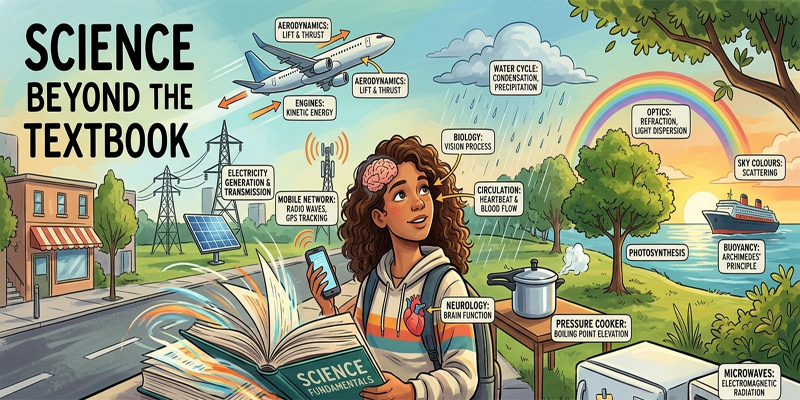
Your favourite mobile in your hand most of the time has science, the food you eat, the electricity in your home.
Rain falling outside your house, the way your eyes see things, your heart beating inside your body, an airplane flying above your head.
The thinking of your brain; all these things have their own science. And even the very simple acts like regrigerator opening, and water boiling has a science.
We are taught a very limited knowledge of science principles in our classroom by the teachers.
But we get a broad picture of amazing and exciting science examples from the real world around us.
If you closely observe the things around you, you could have several curious questions in your mind like:
- Why does a pressure cooker cook food faster?
- How does a refrigerator make things cold?
- How does a mobile phone know where you are?
- Why doesn’t a huge ship sink?
- How does electricity reach your home?
- Why does the sky change colour?
- How does a microwave oven heat food?
- These questions may not always appear as direct chapters in a school textbook, but they are excellent examples of science in action.
In this blog post, we will discover various science which is simply hiding in our ordinary life and day-to-day work. |Science Beyond the Classroom|
1. Your Smartphone Is a Pocketful of Science
A smartphone looks like a small electronic device.
But inside it are several branches of science and engineering working together.
Your phone uses:
- Physics
- Electronics
- Chemistry
- Computer science
- Mathematics
- Materials science
The touchscreen detects changes in electrical properties when your finger touches it.
The camera converts light into electrical signals.
The processor performs billions of calculations.
The battery stores and releases chemical energy.
The speaker converts electrical signals into sound.
The microphone converts sound waves into electrical signals.
A device that fits inside your hand is essentially a miniature laboratory of modern technology.
2. How Does GPS Know Where You Are?
When you use navigation on your phone, it may appear as though the phone simply “knows” your location.
It doesn’t.
GPS uses signals from satellites orbiting Earth.
Your device receives signals from multiple satellites and uses the timing of those signals to calculate its position.
This involves:
Satellites + radio signals + precise clocks + mathematics
The idea is closely related to determining distance from several known points.
So when your phone tells you:
“Turn left in 200 metres,”
there is a remarkable amount of physics and mathematics happening behind that simple instruction.
3. Why Does a Pressure Cooker Cook Food Faster?
A pressure cooker is a wonderful example of physics being used in the kitchen.
Normally, water boils at about 100°C at sea-level atmospheric pressure.
Inside a pressure cooker, pressure increases.
As pressure increases, the boiling point of water also increases.
The water can therefore become hotter than its normal boiling temperature without immediately turning into steam.
Higher temperature helps food cook faster.
So the pressure cooker isn’t simply “creating more heat.”
It is changing the pressure conditions so that water can reach a higher temperature. |Science Beyond the Classroom|
4. Why Does Ice Float?
This is one of the unusual properties of water.
Most substances become denser when they become solid.
Water behaves differently.
When water freezes, its molecules arrange themselves into a structure that occupies more space.
As a result, ice is less dense than liquid water.
That is why ice floats.
And this strange property is extremely important for life on Earth because floating ice can form an insulating layer on lakes and ponds instead of making the entire body of water freeze solid.
5. Why Does the Sky Look Blue?
Sunlight appears white, but it contains many colours.
When sunlight enters Earth’s atmosphere, it interacts with molecules in the air.
Shorter wavelengths, particularly blue light, are scattered more strongly than longer wavelengths such as red.
This scattered blue light reaches our eyes from different directions.
That’s why the daytime sky generally appears blue.
The colour of the sky is therefore a beautiful example of:
Light + atmosphere + scattering
6. Why Are Sunsets Red and Orange?
At sunset, sunlight travels through a greater thickness of Earth’s atmosphere before reaching your eyes.
Much of the shorter-wavelength blue light is scattered away along the longer path.
The remaining direct light is richer in longer wavelengths such as red and orange.
That produces those spectacular colours we see around sunset.
So a beautiful sunset is essentially a physics experiment happening in the atmosphere.
7. How Does a Refrigerator Make Things Cold?
A refrigerator doesn’t simply “produce cold.”
Instead, it moves heat.
A refrigerant circulates through a system containing components such as:
- Compressor
- Condenser
- Expansion device
- Evaporator
The refrigerant changes pressure and state as it moves through the system.
Inside the refrigerator, it absorbs heat.
That heat is then transferred to the surrounding environment.
This is why the back or sides of a refrigerator can feel warm.
The refrigerator is taking heat from inside and releasing it outside. |Science Beyond the Classroom|
8. How Does an Air Conditioner Cool a Room?
An air conditioner works using a principle similar to refrigeration.
It removes heat from indoor air and transfers that heat outside.
The cooling cycle involves changes in pressure and the phase of a refrigerant.
So when you say:
“The AC is producing cold air,”
the more accurate scientific description is:
The AC is removing heat from the indoor environment.
9. Why Does a Metal Spoon Feel Colder Than a Wooden Spoon?
Suppose both a metal spoon and a wooden spoon have been sitting in the same room.
Touch them.
The metal spoon may feel colder.
But they can actually be at the same temperature.
Metal is a much better conductor of heat than wood.
When you touch the metal, heat flows from your warmer hand into the metal more quickly.
Your brain interprets this faster heat loss as a colder sensation.
So:
Feeling cold ≠ necessarily being at a lower temperature.
10. How Does a Microwave Oven Heat Food?
A microwave oven uses electromagnetic waves in the microwave region of the spectrum.
These waves interact with molecules in food, particularly polar molecules such as water.
The energy transferred from the electromagnetic field contributes to molecular motion and heating.
The important point is:
A microwave oven doesn’t heat food by making it radioactive.
It uses electromagnetic energy to transfer energy into the food. |Science Beyond the Classroom|
11. Why Does Popcorn Pop?
A popcorn kernel contains a small amount of water trapped inside a hard shell.
When heated, the water turns into steam.
Pressure builds inside the kernel.
Eventually, the outer shell breaks.
The compressed interior rapidly expands and the starchy material turns inside out.
Pop!
One tiny popcorn kernel demonstrates:
Heat + water + pressure + phase change
12. How Does Electricity Reach Your Home?
Electricity usually begins its journey at a generating station.
Depending on the source, electricity may be generated using:
- Coal
- Natural gas
- Nuclear energy
- Hydropower
- Wind
- Solar energy
- Other technologies
The electrical energy then travels through transmission and distribution networks.
Transformers change voltage levels so electricity can be transmitted efficiently and then delivered safely for use.
By the time you switch on a light, electricity may have travelled through a huge interconnected network.
13. How Does a Solar Panel Make Electricity From Sunlight?
Solar panels use the photovoltaic effect.
When sunlight reaches a photovoltaic material, photons can transfer energy to electrons.
This creates electrical current under suitable conditions.
In simple terms:
Sunlight → electrical energy
A solar panel therefore converts energy from sunlight into electrical energy without burning fuel during operation.
It is one of the clearest examples of converting one form of energy into another. |Science Beyond the Classroom|
14. How Does a Battery Store Electricity?
We often say that a battery “stores electricity.”
Scientifically, that’s a simplification.
A rechargeable battery stores energy primarily through chemical processes.
When connected to a circuit, chemical reactions drive the movement of electrons through the external circuit.
During charging, electrical energy is used to drive the chemical system back toward a higher-energy state.
So a battery is essentially an electrochemical energy-storage device.
15. Why Doesn’t a Huge Ship Sink?
Look at a massive ship.
It weighs thousands of tonnes.
Yet it floats.
Why?
Because of buoyancy.
A floating object displaces water.
The water exerts an upward buoyant force.
A ship is designed so that its overall density, considering the hull and the air-filled spaces inside it, is low enough for the ship to displace enough water to support its weight.
This is closely related to Archimedes’ principle.
The same basic physics explains why a small steel nail sinks while a huge steel ship can float.
16. How Can an Aeroplane Fly?
We already explored aeroplanes earlier in this series, but it is worth remembering the bigger lesson.
Flight involves:
- Lift
- Weight
- Thrust
- Drag
- Airflow
- Pressure
- Newton’s laws
The wings interact with moving air and produce an aerodynamic force that can support the aircraft.
The engines provide thrust to move the aircraft through the air.
The result is one of humanity’s most impressive applications of physics.
17. Why Does a Rainbow Appear?
A rainbow is created when sunlight interacts with water droplets.
Three important optical processes are involved:
Refraction + dispersion + internal reflection
Sunlight enters a water droplet and changes direction.
Different wavelengths of light bend by different amounts.
The light reflects inside the droplet and then exits.
The result is the familiar sequence of colours.
A rainbow is therefore essentially a natural optical phenomenon. |Science Beyond the Classroom|
18. Why Does a Mirror Show Your Reflection?
When light hits a smooth surface such as a mirror, it can undergo specular reflection.
The reflected light reaches your eyes.
Your brain interprets those light rays as coming from behind the mirror, creating the appearance of an image.
The mirror isn’t storing your face.
It is simply redirecting light in a predictable way.
19. Why Does Your Voice Sound Different in a Recording?
When you speak, sound reaches your ears through two main pathways:
- Air conduction
- Bone conduction
When you hear your own voice while speaking, you experience both.
A recording mainly sends sound to your ears through the air.
Because bone conduction changes the way you perceive lower-frequency components, your recorded voice may sound unfamiliar.
That’s why many people hear a recording and immediately say:
“Do I really sound like that?”
Yes.
That’s how other people normally hear you.
20. Why Does a Fan Make You Feel Cooler?
A fan doesn’t necessarily make the room much colder.
Instead, moving air increases the evaporation of sweat from your skin.
Evaporation requires energy.
Some of that energy comes from your skin.
As energy leaves your skin, you feel cooler.
So a fan mainly improves heat transfer from your body rather than magically producing cold air.
21. Why Does Your Phone Get Hot?
Electronic components aren’t perfectly efficient.
When electrical energy is used by processors, displays, radios, and other components, some energy becomes heat.
If the phone is:
- Gaming
- Recording video
- Charging
- Running demanding applications
- Using mobile data heavily
it may generate more heat.
The device therefore needs ways to transfer that heat to the surroundings.
22. Why Does Soap Remove Grease?
Water alone doesn’t remove oily substances very effectively.
Soap molecules have two chemically different ends.
One part interacts well with water.
The other interacts with oils and grease.
Soap molecules can surround tiny droplets of grease and help suspend them in water.
When you rinse, the water carries away the suspended material.
This is a beautiful example of chemistry solving an everyday problem.
23. Why Does Cut Apple Turn Brown?
When an apple is cut, its internal tissues come into contact with oxygen.
Enzymatic reactions can then produce brown-coloured compounds.
This process is called enzymatic browning.
It can be slowed by reducing oxygen exposure, lowering temperature, or using acidic conditions such as lemon juice.
A simple brown apple therefore demonstrates chemistry happening right in your kitchen.
24. Why Does Food Taste Different When You Have a Cold?
Taste and smell work closely together.
Your tongue detects basic taste categories such as:
- Sweet
- Sour
- Salty
- Bitter
- Umami
But much of what we describe as flavour comes from smell.
When your nose is blocked during a cold, odour molecules have difficulty reaching the smell receptors.
As a result, food can seem much less flavourful. |Science Beyond the Classroom|
25. Why Does Your Body Sweat?
Sweating is one of the body’s important cooling mechanisms.
When sweat reaches the skin surface and evaporates, it carries thermal energy away.
This helps prevent the body from overheating.
So sweat isn’t simply “water coming out of the body.”
It is part of a sophisticated temperature-regulation system.
26. Why Does Your Heart Keep Beating Without You Thinking About It?
Your heart doesn’t normally require conscious instructions for every heartbeat.
Specialised cells in the heart can generate electrical activity that coordinates contraction.
The autonomic nervous system also helps regulate heart rate depending on the body’s needs.
You don’t have to remember to tell your heart:
“Beat again.”
It continues automatically.
27. Why Can You See Yourself in a Spoon?
Look at the shiny side of a spoon.
You may see a distorted reflection.
The curved surface changes the direction of reflected light differently at different points.
One side of the spoon can behave roughly like a concave mirror.
The other side behaves more like a convex mirror.
This can make your face appear:
- Enlarged
- Reduced
- Upside down
- Distorted
depending on the surface and your distance from it. |Science Beyond the Classroom|
28. Why Does a Balloon Stick to Your Hair?
Rub a balloon against your hair.
You may find that the balloon attracts your hair afterward.
This is related to static electricity.
Rubbing can transfer electrons between materials.
The resulting electrical imbalance creates electrostatic forces.
The balloon can then attract lightweight objects such as hair.
A simple party trick becomes a lesson in electricity.
29. Why Does Lightning Happen?
Thunderstorms contain enormous electrical activity.
Collisions between ice particles, water droplets, and other particles inside storm clouds can contribute to the separation of electrical charges.
When the electrical potential difference becomes sufficiently large, a powerful electrical discharge can occur.
That discharge is lightning.
The flash is the visible result of a massive electrical event in the atmosphere.
30. Why Do We Hear Thunder After Seeing Lightning?
Light travels much faster than sound.
When lightning occurs, you see the flash almost immediately.
Thunder is a sound wave travelling through the atmosphere.
Therefore, the flash reaches your eyes before the sound reaches your ears.
This gives us a simple scientific way to understand distance.
The longer the delay between the lightning flash and thunder, the farther away the storm generally is.
31. Why Does the Moon Appear to Shine?
The Moon doesn’t produce its own visible light like the Sun.
It reflects sunlight.
As the Moon moves around Earth, we see different portions of its sunlit side.
This creates the familiar phases:
- New Moon
- Crescent
- First Quarter
- Gibbous
- Full Moon
The Moon’s changing appearance is therefore primarily a result of geometry and reflected sunlight.
32. Why Do We Have Seasons?
Many people think summer happens because Earth is much closer to the Sun.
That’s not the main reason.
Earth’s axis is tilted by about 23.5 degrees.
As Earth travels around the Sun, this tilt causes different parts of Earth to receive sunlight at different angles and for different lengths of time.
When a hemisphere is tilted toward the Sun, it generally experiences summer.
When tilted away, it experiences winter.
So seasons are primarily caused by:
Earth’s axial tilt + its revolution around the Sun.
33. Why Does the Moon Not Fall Onto Earth?
The Moon is constantly being pulled toward Earth by gravity.
So why doesn’t it crash into us?
Because the Moon is also moving sideways at a very high speed.
Its motion and Earth’s gravity combine to create an orbit.
The Moon is essentially continuously falling toward Earth—but it keeps missing Earth.
This idea is one of the most beautiful examples of orbital motion.
34. Why Doesn’t Earth Fall Into the Sun?
The same basic idea applies to Earth.
The Sun’s gravity pulls Earth toward it.
But Earth has a large sideways velocity.
The combination produces an orbit.
Earth is continuously moving around the Sun rather than simply falling straight into it.
35. Why Does Water Evaporate Even Before It Boils?
Boiling and evaporation are different processes.
Boiling occurs throughout a liquid when conditions allow bubbles of vapour to form.
Evaporation happens at the surface.
Even below the boiling point, some molecules at the surface have enough energy to escape into the air.
That’s why:
- Wet clothes dry
- Puddles disappear
- Sweat evaporates
without the water ever reaching 100°C. |Science Beyond the Classroom|
36. Why Does a Wet Cloth Dry Faster in the Wind?
Wind moves moist air away from the surface of the cloth.
This can increase the rate of evaporation.
Therefore:
More air movement → often faster evaporation → faster drying
Temperature, humidity, exposed surface area, and airflow all influence drying.
37. Why Does Hot Water Sometimes Freeze Faster Than Cold Water?
This is known as the Mpemba effect.
Under certain conditions, hot water can freeze faster than cooler water.
However, this doesn’t happen universally.
Factors such as:
- Evaporation
- Convection
- Dissolved gases
- Container conditions
- Supercooling
can influence the result.
It is a fascinating example of how seemingly simple physical systems can behave in complicated ways.
38. Why Do We Get Goosebumps?
Goosebumps occur when tiny muscles attached to hair follicles contract.
This causes the hairs to stand more upright.
In humans, goosebumps don’t provide much insulation because we have relatively little body hair.
But the response is an evolutionary remnant that was more useful in our hairier ancestors.
It can also occur during strong emotions such as fear or excitement.
39. Why Does Your Stomach Make Noises?
Those strange sounds from your stomach aren’t necessarily signs that you’re hungry.
Your digestive system constantly moves:
- Food
- Liquid
- Gas
through the gastrointestinal tract.
Muscle contractions called peristalsis help move material through the digestive system.
The movement of gas and liquid can produce the familiar sounds.
So your stomach isn’t necessarily saying:
“Feed me!”
It may simply be doing its job.
40. Why Do We Get Hiccups?
Hiccups happen when the diaphragm suddenly contracts involuntarily.
This is followed by rapid closure of the vocal cords, producing the familiar:
“Hic!”
The exact biological purpose of hiccups remains uncertain.
They can be triggered by:
- Eating too quickly
- Sudden changes in stomach conditions
- Carbonated drinks
- Excitement
- Other factors
An apparently silly body reaction is actually a neurological and muscular event.
Science Is Not Just a School Subject
This is perhaps the most important lesson of the entire series.
Science is not something that begins when you open a textbook and ends when you close it.
Science is happening:
around you, above you, inside you, and because of you.
When you:
- Cook food
- Ride a bicycle
- Charge your phone
- Switch on a fan
- Use a GPS
- Watch a sunset
- Fly in an aeroplane
- Drink cold water
- Take a photograph
You are interacting with scientific principles. |Science Beyond the Classroom|
Your Textbook Gives You the Foundation
CBSE science education introduces students to important concepts.
Physics teaches us about:
- Force
- Motion
- Energy
- Electricity
- Light
- Sound
- Matter
Chemistry introduces:
- Atoms
- Molecules
- Reactions
- Acids and bases
- Metals
- Carbon compounds
Biology helps us understand:
- Cells
- Plants
- Animals
- Human body
- Genetics
- Environment
- Evolution
These aren’t isolated facts.
They are tools for understanding reality.
The Most Powerful Scientific Skill Is Asking Questions
A student who asks:
“Why?”
is already thinking scientifically.
Why does this happen?
What causes it?
Can I test it?
What would happen if I changed something?
Does the evidence support my idea?
Could I be wrong?
These questions are often more valuable than simply memorising an answer. |Science Beyond the Classroom|
You Don’t Need a Laboratory to Do Science
Science can begin with observation.
Look at something ordinary.
Then ask an unusual question.
For example:
Why does a wet floor dry?
You can investigate temperature, airflow, humidity, and surface area.
Or:
Why does a metal spoon feel colder?
You can investigate thermal conductivity and heat transfer.
Or:
Why does a pressure cooker cook faster?
You can investigate pressure and boiling point.
The world itself can become your laboratory.
The Difference Between Knowing and Understanding
Knowing:
“Water boils at 100°C at standard atmospheric pressure.”
is useful.
Understanding:
“Boiling temperature changes when pressure changes.”
is more powerful.
And applying it:
“That’s why a pressure cooker can cook food faster.”
is even better.
The goal of science education shouldn’t simply be memorisation.
It should be:
Knowledge → Understanding → Application → Curiosity
Science Doesn’t Always Have Immediate Answers
One of the most important things science teaches us is that uncertainty is normal.
Scientists don’t know everything.
There are still unanswered questions about:
- Dark matter
- Dark energy
- Consciousness
- The origin of life
- The deepest nature of the universe
- Many aspects of the human brain
- Numerous biological processes
Not knowing the answer isn’t a failure.
It is often the beginning of research.
Don’t Be Afraid to Question the Textbook
This doesn’t mean textbooks are wrong.
It means textbooks are simplifications designed for learning.
Real science can be much more complicated.
A textbook might say:
“Objects fall because of gravity.”
That’s useful.
But then science asks deeper questions:
What exactly is gravity?
How does it behave?
How does general relativity describe it?
Can gravity be unified with quantum mechanics?
A simple school answer can therefore become the starting point for much deeper scientific thinking.
The Best Science Questions Are Often Simple
Some of the greatest scientific discoveries began with apparently simple questions.
Why do objects fall?
What is matter made of?
How does light behave?
How do living organisms reproduce?
How does the universe change?
Why does disease occur?
Simple questions can lead to extraordinary discoveries.
So never think:
“This is a silly question.”
If you genuinely want to know the answer, it is worth asking. |Science Beyond the Classroom|
A Challenge for Every Student
From today onward, try something different.
Every day, choose one ordinary thing around you.
Then ask:
“What science makes this possible?”
Choose your:
- Fan
- Bicycle
- School bag
- Pen
- Water bottle
- Refrigerator
- Television
- Smartphone
- Shoes
- Window
- Soap
- Cooking gas
- Spectacles
Then investigate it.
You might discover that something apparently simple depends on several branches of science.
The Real Goal of Science Education
The real goal isn’t to remember every formula forever.
It is to develop the ability to:
Observe → Question → Think → Test → Learn → Explain
That ability remains useful whether you become:
- A scientist
- Engineer
- Doctor
- Teacher
- Programmer
- Entrepreneur
- Designer
- Researcher
- Journalist
- Or something completely different
Scientific thinking is useful everywhere.
Did You Know?
- A refrigerator doesn’t create cold; it transfers heat.
- Ice floats because solid water is less dense than liquid water.
- A pressure cooker increases pressure to raise the boiling point of water.
- A solar panel converts sunlight into electrical energy.
- A battery stores energy primarily through chemical processes.
- Ships float because of buoyancy.
- Soap helps remove grease because of its molecular structure.
- A rainbow involves refraction, dispersion, and reflection.
- Seasons are mainly caused by Earth’s axial tilt.
- Your smartphone combines physics, chemistry, electronics, mathematics, and computer science.
10 Questions Every Curious Student Should Ask
Whenever you see something interesting, try asking:
- What is happening?
- Why is it happening?
- What causes it?
- What scientific principle explains it?
- Can I observe it myself?
- Can I measure it?
- What would happen if I changed one condition?
- Can I prove my idea wrong?
- Is there another possible explanation?
- What else does this discovery make me wonder about?
These questions can turn an ordinary observation into a scientific investigation.
Frequently Asked Questions (FAQs)
1. What does “science beyond the classroom” mean?
It means applying scientific concepts to understand real-world situations rather than limiting science to textbook chapters. |Science Beyond the Classroom|
2. Why should students learn science beyond the syllabus?
It helps students connect classroom concepts with everyday technology, nature, machines, health, and the world around them.
3. Is everyday science useful for CBSE students?
Yes. Everyday examples can make concepts from Physics, Chemistry, Biology, and Environmental Science easier to understand and remember.
4. Does everything in everyday life have a scientific explanation?
Many everyday phenomena can be explained using science, although some systems are extremely complex and may involve several scientific disciplines.
5. Can students perform science experiments at home?
Many simple observations and experiments can be performed safely at home, but students should avoid dangerous chemicals, electricity experiments, fire, or other hazardous activities without proper supervision.
6. Is science only about memorising formulas?
No. Memorisation can be useful, but scientific thinking also involves observation, questioning, reasoning, evidence, experimentation, and application.
7. Why is asking questions important in science?
Questions help identify problems and guide investigation. Many scientific discoveries began with someone asking a simple but important question.
8. Can everyday objects teach science?
Absolutely. Objects such as phones, bicycles, mirrors, refrigerators, pressure cookers, batteries, and fans demonstrate scientific principles.
9. Does science know everything?
No. Science has explained an enormous amount about nature, but many important questions remain unanswered.
10. What is the most important thing a student can learn from science?
Perhaps the most valuable lesson is to remain curious, question evidence, and be willing to change your understanding when better evidence becomes available. |Science Beyond the Classroom|
Final Message to Students
If you remember only one thing from this entire Science Made Simple series, remember this:
Science is not just a subject you study.
It is a way of looking at the world.
The next time you see a rainbow, don’t just admire its colours.
Ask:
“How did the light produce this?”
When your phone recognises your face, ask:
“How does it know it’s me?”
When an aeroplane flies overhead, ask:
“How can something so heavy stay in the air?”
When lightning flashes, ask:
“What is happening inside that cloud?”
When you see a solar panel, ask:
“How can sunlight become electricity?”
And when something doesn’t make sense—
don’t ignore the question.
Follow it.
Investigate it.
Test it.
Learn from it.
Because somewhere between “Why?” and “Let’s find out”, science begins. |Science Beyond the Classroom|
Conclusion: Beyond the Classroom
In this blog post(Science Beyond the Classroom), we have understood the science beyond our textbooks, hidden in our daily lives and always following us. Our classroom is only the beginning of science, where we are taught a few famous experiments and principles of science. But in the classroom, we are not always able to see where exactly these science principles are being used. But the world outside of our classroom is full of amazing and exciting experiments, and has been in place or in existence for many years.
The Sun is shining. The Earth is rotating. Clouds are forming. Plants are growing. Your heart is beating. Your phone is communicating. Electricity is flowing. Machines are moving. Chemical reactions are happening. And your brain is trying to understand all of it. |Science Beyond the Classroom|
So, you cannot limit all these questions to knowing and remembering their answers; instead, you should go one step further and dig deep to find the answer “Why?” and then follow it with “How can I find out this?” Ultimately, you must develop a scientific temperament and critical thinking to know anything by going deep. |Science Beyond the Classroom|
This may be the final article of our Science Made Simple series—but science itself has no final chapter.
Keep asking questions. Keep exploring. Keep wondering.
Because the world is full of science waiting to be discovered. 🔬🌎
If you have any queries, you can write to us at support@a5theory.com; we will get back to you ASAP.
Hope! You will enjoy this post, “Science Beyond the Classroom“.
Please feel free to give your feedback in the comment section below.
Have a great time!