

Hello Friends, in this blog post(What Causes Earthquakes), we are going to let you know about one of the scary natural disasters that is known as “Earthquakes“.
Though earthquakes could be very dangerous sometimes, with a wide range in richter scale.
When it comes, the floor begins to shake, fans start to swing, furniture starts to move, windows get rattled, and buildings begin to tremble within a few seconds. |What Causes Earthquakes|
This frightening phenomenon is known as an earthquake. |What Causes Earthquakes|
Across the world, hundreds of thousands of earthquakes occur every year.
Some of them are very small in power, so most of the people do not even recognize them.
But some are very powerful on a regional scale, and they are capable of reshaping whole landscapes, triggering tsunamis, and damaging major parts of cities. |What Causes Earthquakes|
So, it is very obvious to know the reasons behind this dangerous event, like:
- But what causes the Earth to shake?
- Why do earthquakes happen without warning?
- Can scientists predict them?
- Why are some earthquakes much stronger than others?
In this post(What Causes Earthquakes), we are going to explore the amazing science behind this natural disaster resting beneath our ground.
What Is an Earthquake?
An earthquake is the sudden shaking of the Earth’s surface caused by the rapid release of energy inside the Earth’s crust.
This energy travels through the Earth as seismic waves, causing the ground to vibrate.
Earthquakes usually last from a few seconds to a couple of minutes, but their effects can be devastating.
Why Do Earthquakes Occur?
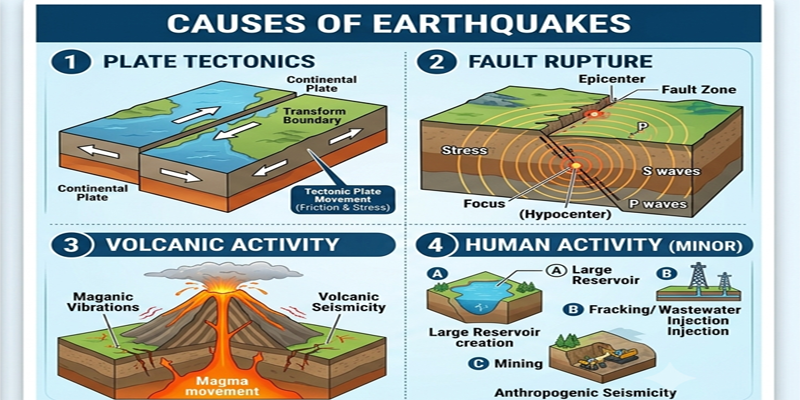
The Earth’s outer layer is divided into giant pieces called tectonic plates.
These plates are constantly moving, although very slowly—usually only a few centimeters each year.
Sometimes these plates:
- Move toward each other
- Move apart
- Slide past each other
Because rocks along the edges of the plates become locked by friction, stress builds over many years.
When the stress becomes greater than the rocks can withstand, they suddenly break or slip.
This sudden movement releases enormous amounts of energy.
That energy causes an earthquake.
What Are Fault Lines?
A fault is a crack or fracture in the Earth’s crust where rocks move.
Most earthquakes occur along these faults.
Some major types include:
Normal Fault
Occurs when rocks move apart.
Reverse Fault
Occurs when rocks are pushed together.
Strike-Slip Fault
Occurs when rocks slide horizontally past one another.
Many famous earthquakes occur on strike-slip faults.
Focus and Epicenter
These two terms often confuse students.
Focus (Hypocenter)
The point inside the Earth where the earthquake begins.
Epicenter
The point on the Earth’s surface directly above the focus.
The strongest shaking is often experienced near the epicenter.
What Are Seismic Waves?
The energy released during an earthquake travels as seismic waves.
Scientists study these waves to understand earthquakes and the Earth’s interior.
There are three main types.
1. P-Waves (Primary Waves)
- Fastest seismic waves
- Travel through solids, liquids, and gases
- Reach seismic stations first
2. S-Waves (Secondary Waves)
- Slower than P-waves
- Travel only through solids
- Cannot travel through liquids
This property helped scientists discover that Earth’s outer core is liquid.
3. Surface Waves
These travel along Earth’s surface.
They are slower but usually cause the greatest damage to buildings and roads.
How Are Earthquakes Measured?
Scientists use instruments called seismographs (or seismometers) to detect and record earthquakes.
A seismograph records ground motion and produces a graph called a seismogram.
Magnitude vs Intensity
These terms are different.
Magnitude
Measures the amount of energy released.
An earthquake has one magnitude.
Modern scientists commonly use the Moment Magnitude Scale (Mw).
Intensity
Measures how strongly people feel the earthquake and how much damage occurs at a particular location.
Intensity can vary from place to place. |What Causes Earthquakes|
What Was the Richter Scale?
The Richter Scale, developed by Charles Francis Richter, was one of the earliest methods used to estimate earthquake magnitude.
Today, the Moment Magnitude Scale (Mw) is generally preferred for large earthquakes because it provides more accurate and consistent measurements.
Why Are Some Earthquakes More Powerful?
The strength of an earthquake depends on several factors.
- Amount of stored energy
- Length of the fault that slips
- Depth of the earthquake
- Type of rocks
- Distance from the epicenter
Generally, shallow earthquakes cause more severe shaking at the surface than deeper ones of similar magnitude.
Can Earthquakes Trigger Tsunamis?
Yes.
If a powerful earthquake occurs beneath the ocean and causes the seafloor to move suddenly, it can displace huge volumes of water.
This creates a tsunami.
Unlike normal sea waves caused by wind, tsunami waves carry enormous amounts of energy and can travel across entire oceans.
Why Do Buildings Collapse?
Earthquakes do not directly kill most people.
Instead, injuries and fatalities are often caused by:
- Building collapse
- Falling debris
- Fires
- Landslides
- Tsunamis
Modern earthquake-resistant buildings are designed to absorb and withstand ground movement.
Earthquake Zones in India
India is divided into different seismic zones based on earthquake risk.
Higher-risk regions include parts of:
- Jammu & Kashmir and Ladakh
- Himachal Pradesh
- Uttarakhand
- Northeast India
- Gujarat
- Andaman & Nicobar Islands
Moderate-risk areas include parts of northern and central India, while some regions have comparatively lower seismic risk.
Famous Earthquakes in History
Some significant earthquakes include:
- 2004 Indian Ocean earthquake
- 2015 Nepal earthquake
- 2011 Tōhoku earthquake
- 2001 Gujarat earthquake
- 1906 San Francisco earthquake
Each of these events advanced our understanding of earthquake science and disaster preparedness.
Can Scientists Predict Earthquakes?
This is one of the most common questions.
The answer is:
Not precisely.
Scientists can identify areas where earthquakes are more likely over long periods by studying fault lines and tectonic activity.
However, they cannot accurately predict the exact date, time, and location of an earthquake.
Many countries instead use earthquake early warning systems, which can detect the first seismic waves and provide a few seconds to tens of seconds of warning before stronger shaking arrives in some locations.
What Should You Do During an Earthquake?
If you are indoors:
- Stay calm.
- Drop, Cover, and Hold On.
- Protect your head and neck.
- Stay away from windows and heavy objects.
- Do not use elevators.
If you are outdoors:
- Move to an open area.
- Stay away from buildings, trees, and power lines.
If you are in a vehicle:
- Stop in a safe place away from bridges and overhead hazards.
- Remain inside until the shaking stops.
Science Around You
Earthquake science helps engineers design safer:
- Schools
- Hospitals
- Bridges
- Dams
- High-rise buildings
- Metro systems
- Airports
Modern sensors also monitor vibrations in tunnels, skyscrapers, and other critical infrastructure.
Did You Know?
- Thousands of earthquakes occur every day, but most are too small to be felt.
- Japan has one of the world’s most advanced earthquake monitoring networks.
- The largest recorded earthquake measured 9.5 magnitude and occurred in Chile in 1960.
- Some animals may behave unusually before earthquakes, but there is no reliable scientific method using animal behavior to predict earthquakes.
- The energy released by a major earthquake can be enormous, but it comes from the sudden release of stress accumulated in rocks over many years.
Try This at Home (Safe Experiment)
Crack the Chocolate
You’ll Need
- A chocolate bar
Steps
- Hold the chocolate bar with both hands.
- Gently bend it.
- Notice how it suddenly snaps after stress builds.
Observation
The chocolate remains intact while stress increases, then breaks suddenly. |What Causes Earthquakes|
What It Demonstrates
This is similar to how rocks along a fault accumulate stress before suddenly slipping during an earthquake.
Common Mistakes Students Make
❌ Thinking earthquakes happen because of bad weather.
✔ Earthquakes are caused by movements within the Earth’s crust, not by weather.
❌ Believing the epicenter is inside the Earth.
✔ The focus is inside the Earth; the epicenter is directly above it on the surface.
❌ Thinking all earthquakes create tsunamis.
✔ Only certain undersea earthquakes that significantly displace the seafloor can generate tsunamis.
❌ Assuming scientists can predict earthquakes exactly.
✔ Scientists can estimate long-term risk but cannot predict the exact time and place of future earthquakes.
Frequently Asked Questions (FAQs)
1. What causes earthquakes?
Earthquakes occur when stress built up in rocks is suddenly released due to movement along faults.
2. What is the difference between the focus and epicenter?
The focus is the point inside the Earth where the earthquake starts, while the epicenter is the point directly above it on the surface.
3. Can earthquakes happen anywhere?
Small earthquakes can occur in many places, but most occur near tectonic plate boundaries and active faults.
4. Which waves cause the most damage?
Surface waves usually cause the greatest damage because they produce strong ground motion.
5. Can earthquakes be prevented?
No. Earthquakes cannot be prevented, but earthquake-resistant construction and preparedness can greatly reduce their impact.
Why This Topic Matters
Understanding earthquakes helps us:
- Build safer homes and schools.
- Design stronger bridges and skyscrapers.
- Improve emergency preparedness.
- Understand plate tectonics.
- Reduce the impact of natural disasters.
Earthquake science saves lives through better engineering, monitoring, and public awareness.
Conclusion
Friends, in this blog post(What Causes Earthquakes), we have understood a big natural disaster, “Earthquakes,” and all possible reasons behind it’s occuring. Events like earthquakes make us think about the fact that there is always something going on in our planet beneath our surface. We are still not very perfect at predicting them and stopping them from happening, though with the help of scientific prediction and precision, we can only get to know how they occur and also reduce their impact up to a certain extent.
We can gain a better understanding of such powerful forces of nature and be a bit better prepared to reduce losses by learning about tectonic plates, fault lines, seismic waves, and earthquake safety. |What Causes Earthquakes|
You will easily understand the remarkable geological processes the next time you hear about an earthquake anywhere in the world. |What Causes Earthquakes|
If you have any queries, you can write to us at support@a5theory.com; we will get back to you ASAP.
Hope! You would have enjoyed this post(What Causes Earthquakes).
Please feel free to give your important feedback in the comment section below.
Have a great time!