

Hello Friends, in this blog post(Why Do We Dream), we are going to share the science of dreams.
Dreams are a very obvious and amazing part of our lives, whether they are experienced in either awake or asleep states.
But here in this blog, we are going to discuss the dream which we have during our sleep.
Almost all of us have these dreams during sleep hours. |Why Do We Dream|
In our dreams, we may fly an airplane, roam around a giant or wild animal, or run through a strange place that is hard to exist in real life. |Why Do We Dream|
And some dreams are so vivid that they take us very deep, and we start considering them like real life, and wake up wondering about some shocking events in the dream. |Why Do We Dream|
But the main question is: “How and why does our brain create these dreams or stories that seem to be real sometimes”?
Dreams are the best and most fascinating examples of our mind or brain creativity.
Dreams have been tried to be understood by people for hundreds of years with no clear conclusion.
It is considered God’s messages by some ancient cultures. Brain imaging, sleep laboratories,…
… and neuroscience are a few techniques our scientists are using to study human dreams.
We have not developed any exact answers for human dreams yet. But a few fascinating…
…facts or clues have been produced by modern science, which we are going to discuss in this blog post in detail. |Why Do We Dream? |
What Is a Dream?
A dream is a sequence of experiences that can involve:
- Images
- Sounds
- Thoughts
- Emotions
- Memories
- Sensations
- Stories
- People
- Places
Dreams can seem realistic, completely bizarre, or somewhere in between.
They can last for a short time or feel like they lasted much longer.
Most importantly, dreaming is closely associated with sleep, but dreaming is not limited to just one stage of sleep.
Does Everyone Dream?
Most people appear to dream regularly, even if they don’t remember their dreams.
Research suggests that people can experience dreaming during several stages of sleep.
However, dreams are particularly vivid and frequently recalled when people are awakened during REM sleep.
So if someone says:
“I never dream.”
It may actually mean:
“I don’t remember my dreams.”
What Is Sleep?
Sleep is not simply a period when the brain switches off.
Your brain remains active throughout sleep.
During sleep, the brain and body perform important processes related to:
- Memory
- Learning
- Emotional processing
- Metabolism
- Brain maintenance
- Physical recovery
Sleep is therefore an active biological state.
What Happens to the Brain When We Sleep?
Your brain moves through different stages of sleep.
These stages are broadly divided into:
Non-REM Sleep
and
REM Sleep
REM stands for:
Rapid Eye Movement
These stages repeat in cycles throughout the night.
What Is REM Sleep?
During REM sleep:
- The eyes move rapidly
- Brain activity becomes more active
- Breathing can become irregular
- Heart rate can vary
- Most skeletal muscles are temporarily inhibited
- Vivid dreams are commonly reported
REM sleep is particularly interesting because brain activity during this stage can resemble some aspects of wakefulness.
Does Dreaming Only Happen During REM Sleep?
No.
Dreaming or dream-like mental activity can occur during non-REM sleep as well.
However, REM dreams are often more vivid, emotional, visual, and story-like.
Non-REM dream experiences can be more thought-like or less elaborate.
Why Does the Brain Dream?
This is one of the biggest unanswered questions in neuroscience.
Scientists have proposed several ideas.
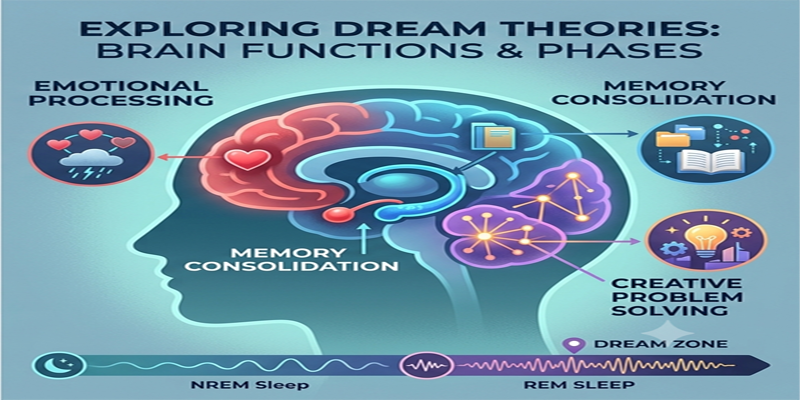
Dreaming may be related to:
- Memory processing
- Emotional processing
- Learning
- Brain development
- Integrating experiences
- Processing internal signals
- Random neural activity that the brain organizes into experiences
There may not be a single explanation.
Dreaming could involve several brain processes working together. |Why Do We Dream|
Does Every Dream Have a Meaning?
Not necessarily.
People often try to interpret dreams as if every object represents something specific.
For example:
“If you dream about water, it definitely means X.”
Science doesn’t support a universal dictionary in which every dream symbol has one fixed meaning.
Dream content can be influenced by:
- Personal experiences
- Memories
- Emotions
- Stress
- Recent events
- Expectations
- Random associations
The same dream image could mean completely different things to different people.
Why Do Dreams Sometimes Feel Completely Real?
During vivid dreaming, some brain regions involved in perception, emotion, and imagery can be highly active.
Meanwhile, brain systems involved in critical reasoning and reality checking may function differently from waking consciousness.
As a result, strange events can seem completely normal while we’re dreaming.
You might dream that you’re talking to an animal and never stop to ask:
“Wait… why am I talking to a dog?”
Because inside the dream, the situation can feel perfectly believable.
Why Are Dreams So Strange?
Dreams often combine unrelated elements.
You might see:
- Your school
- Your childhood home
- A person you haven’t met
- A completely imaginary place
All in the same dream.
The brain is capable of combining memories, emotions, imagination, and sensory information into unusual experiences.
This may explain why dreams can feel like a strange mixture of reality and imagination.
Why Do We Dream About People We Know?
The brain stores enormous amounts of information about people.
Faces, voices, memories, conversations, emotions, and experiences can remain represented in memory.
During sleep, elements of these memories may become part of dream experiences.
Sometimes the person may have been on your mind recently.
Other times, an old memory may unexpectedly appear. |Why Do We Dream|
Why Do We Dream About Places We’ve Seen?
The brain also stores information about environments.
A house, classroom, road, playground, or holiday destination can become part of memory.
Dreams can combine pieces of these locations into entirely new environments.
That’s why a dream location can feel familiar while being impossible to find on a real map.
Can We Dream About Things We’ve Never Seen?
Dreams can contain unfamiliar combinations and imaginary environments.
However, the brain constructs these experiences using information it has acquired through perception, memory, imagination, and internal processing.
A completely new dream environment may therefore be assembled from familiar visual elements in an unfamiliar arrangement.
Why Do We Sometimes Dream About Falling?
Falling dreams are commonly reported.
They may occur during periods of stress, transitions, or other circumstances, but there is no single scientifically established meaning that applies to everyone.
Sometimes the sensation may also relate to changes occurring as we transition between sleep and wakefulness.
So dreaming about falling doesn’t automatically mean that something specific is wrong.
Why Do We Sometimes Dream That We’re Flying?
Flying dreams can be vivid and memorable.
The brain can create sensations of movement without the body actually moving through the air.
During dreaming, internally generated sensory experiences can feel remarkably convincing.
Your brain doesn’t need a real airplane to create the experience of flying. |Why Do We Dream|
Why Do We Have Nightmares?
A nightmare is a disturbing or frightening dream that can cause strong emotions such as:
- Fear
- Anxiety
- Sadness
- Panic
Nightmares can occur for many reasons.
Possible influences include:
- Stress
- Anxiety
- Traumatic experiences
- Sleep disruption
- Illness
- Certain medications
- Irregular sleep schedules
Occasional nightmares are common.
Why Do We Wake Up Suddenly From a Nightmare?
A frightening dream can produce a strong emotional response.
The brain and body can become more aroused.
Heart rate and breathing may change.
Sometimes this heightened state contributes to waking up.
That’s why you may suddenly open your eyes after a particularly intense dream.
Can Dreams Affect Our Emotions?
Dreams can involve strong emotions.
People may wake up feeling:
- Happy
- Frightened
- Confused
- Sad
- Excited
- Calm
The emotional effects can sometimes continue briefly after waking.
This demonstrates how closely dreaming is connected with brain systems involved in emotion.
Can Stress Affect Dreams?
Yes.
Stress and emotional experiences can influence dream content and dream recall.
People experiencing stressful periods sometimes report:
- More vivid dreams
- Repeated dreams
- Nightmares
- Disturbed sleep
However, dream content varies greatly from person to person. |Why Do We Dream|
Why Do We Forget Dreams So Quickly?
This is one of the strangest things about dreaming.
You may wake up and remember your dream perfectly.
A few minutes later:
It’s gone.
This happens because memory formation during sleep is different from memory formation during normal waking life.
Dream memories can be fragile.
If you don’t actively recall or record a dream soon after waking, much of it may disappear from memory.
Why Do We Remember Some Dreams but Not Others?
Dream recall depends on several factors.
It can be influenced by:
- Whether you wake during or shortly after dreaming
- Sleep stage
- Attention
- Memory processes
- Individual differences
- How emotionally intense the dream was
A dream that wakes you suddenly may be easier to remember than one followed by uninterrupted sleep.
What Is Lucid Dreaming?
A lucid dream is a dream in which the person becomes aware that they are dreaming.
For example, you may suddenly think:
“I’m dreaming right now!”
Some people report being able to influence parts of the dream after becoming aware.
They may attempt to:
- Fly
- Change locations
- Talk to dream characters
- Explore the environment
However, the degree of control varies greatly.
Can Everyone Learn to Lucid Dream?
Not everyone experiences lucid dreams frequently.
Some people naturally experience them.
Others use techniques intended to increase the chance of recognizing that they are dreaming.
Researchers continue to study lucid dreaming to understand consciousness, perception, and the relationship between dreaming and waking awareness.
Can We Control Our Dreams?
Sometimes.
People may influence dream content through expectations, memories, experiences, and deliberate techniques.
Lucid dreaming may provide some degree of conscious influence.
But dreams aren’t like movies that we can always control completely.
The brain continues generating experiences automatically. |Why Do We Dream|
Can We Dream in Colour?
Yes.
Many people report colourful dreams.
Dream experiences can include:
- Colour
- Brightness
- Shapes
- Movement
- Sound
- Touch
- Taste
- Smell
Dream experiences vary significantly between individuals.
Can We Hear Sounds in Dreams?
Yes.
Dreams can include sounds such as:
- Voices
- Music
- Animals
- Vehicles
- Alarms
Sometimes external sounds may become incorporated into a dream.
For example, an alarm clock might become part of the dream before you wake up.
Can Real Events Enter Our Dreams?
Absolutely.
A sound, sensation, thought, or environmental event can sometimes influence dream content.
For example, if you’re sleeping near a ringing phone, your brain may incorporate the sound into the dream.
The dream might transform the phone ringing into:
- A school bell
- A fire alarm
- A doorbell
- A musical instrument
The brain can creatively integrate external information into an ongoing dream.
Can We Solve Problems in Dreams?
There are many historical stories of people claiming that ideas came to them in dreams.
Sleep is involved in memory processing and learning, and the brain can continue working on information during sleep.
Some research suggests that sleep can help with certain forms of problem-solving and creative insight.
However, the idea that dreams routinely solve complex problems is an exaggeration.
Why Do We Sometimes Wake Up With a Great Idea?
Your brain doesn’t stop processing information simply because you’re asleep.
During sleep, memories and associations can be reorganized.
When you wake, previously unconscious processing may sometimes produce a new connection or insight.
This can feel like:
“Where did that idea come from?”
It may be the result of brain activity occurring during sleep. |Why Do We Dream|
Can Sleep Help Us Learn?
Yes.
Sleep plays an important role in memory consolidation.
During sleep, the brain processes and reorganizes information acquired during waking hours.
This doesn’t mean you can simply sleep next to a textbook and automatically learn everything in it.
But getting sufficient sleep after studying can support memory and learning.
Why Is Sleep Important for Students?
For students, sleep is closely connected with:
- Memory
- Attention
- Concentration
- Learning
- Mood
- Reaction time
- Decision-making
Staying awake all night before an exam may feel productive, but insufficient sleep can impair attention and cognitive performance.
What Happens If We Don’t Sleep Enough?
Sleep deprivation can affect:
- Concentration
- Memory
- Reaction time
- Mood
- Learning
- Decision-making
Long-term inadequate sleep is also associated with broader health consequences.
Sleep is therefore not wasted time.
It is an essential biological process. |Why Do We Dream|
Why Do We Sometimes Wake Up and Can’t Move?
This can happen during sleep paralysis.
During REM sleep, the brain normally suppresses much of the body’s skeletal muscle activity.
Sometimes a person becomes conscious before this muscle paralysis has completely disappeared.
They may temporarily be unable to move.
Some people also experience vivid dream-like sensations or hallucinations during sleep paralysis.
Although it can be frightening, isolated episodes are generally temporary.
Why Do Some People Talk in Their Sleep?
Sleep talking, or somniloquy, can occur during sleep.
A person may say a few words or speak for longer periods.
The speech may be understandable or completely unclear.
People often don’t remember doing it.
Why Do Some People Walk in Their Sleep?
Sleepwalking is a type of parasomnia involving complex behaviours during sleep.
It is more common in children than adults.
A person may sit up, walk around, or perform simple actions while not being fully awake.
Sleepwalking is associated particularly with non-REM sleep.
Can Animals Dream?
Scientists cannot directly ask animals about their dreams.
However, many animals experience sleep stages involving brain activity patterns associated with REM sleep.
Researchers have therefore proposed that at least some animals may have dream-like experiences.
Dogs and cats, for example, sometimes show movements or vocalizations during sleep.
We cannot know exactly what they experience. |Why Do We Dream|
Why Do Babies Sleep So Much?
Babies generally sleep much more than adults.
Sleep is particularly important during early development.
The developing brain undergoes rapid changes involving:
- Neural connections
- Learning
- Memory
- Sensory development
Infants also spend a relatively large proportion of their sleep in REM sleep compared with adults.
What Is the Difference Between a Dream and a Hallucination?
A dream occurs during sleep.
A hallucination is a perception-like experience that occurs while a person is awake or in certain transitional states.
Some sleep-related experiences can occur while falling asleep or waking up.
These are called:
Hypnagogic experiences when falling asleep.
Hypnopompic experiences when waking.
They can sometimes feel extremely real.
Why Does Time Feel Strange in Dreams?
A dream may seem to last for hours even though the actual episode was much shorter.
Our perception of time during dreams isn’t necessarily the same as our perception of time while awake.
Dream narratives can also jump rapidly between events without showing every transition.
This can create the impression of a long story.
Do Dreams Predict the Future?
There is no strong scientific evidence that ordinary dreams reliably predict future events.
Sometimes a dream may appear to come true.
But humans are very good at finding patterns after events occur.
We also have many dreams and forget most of them.
Occasionally, a remembered dream may resemble a later event simply by coincidence or because the dream was influenced by existing expectations.
Why Do We Have Recurring Dreams?
Some people experience dreams with similar themes repeatedly.
Possible influences include:
- Repeated stress
- Emotional concerns
- Memories
- Sleep patterns
- Habitual thought patterns
There is no universal scientific interpretation for a particular recurring dream.
Why Do We Sometimes Dream About the Same Place Again?
The brain can reuse stored representations of places.
Once a particular environment becomes part of your memory, it can appear repeatedly in dreams.
Interestingly, your brain may modify the location each time.
So your “dream house” might remain recognizable while having completely different rooms.
Can Food Cause Dreams?
The relationship between food and dreams is more complicated than popular myths suggest.
Eating habits, meal timing, digestion, sleep quality, and individual responses can influence sleep.
But the idea that a particular food universally causes a particular kind of dream isn’t well established scientifically.
Does Watching a Scary Movie Cause Nightmares?
It can influence dream content in some people.
Recent experiences, emotions, and images can become incorporated into dreams.
If a frightening movie makes you highly alert or anxious before sleep, it may also influence your sleep experience.
But it doesn’t guarantee that you’ll have a nightmare. |Why Do We Dream|
Why Do We Dream About Things We Were Thinking About Before Sleeping?
Recent experiences can influence dream content.
If you spend hours thinking about:
- An exam
- A football match
- A movie
- A friend
- A problem
Elements of those experiences may appear in your dreams.
This is sometimes referred to as a day-residue effect.
Are Dreams Just Random Brain Activity?
Not necessarily.
One scientific perspective suggests that dreams may emerge from a combination of brain activity, memory, emotions, sensory processing, and the brain’s attempt to construct a coherent experience.
Some aspects may be relatively random.
Other aspects may be strongly connected to recent experiences or stored memories.
The exact balance remains an active area of research.
Why Are Scientists Still Studying Dreams?
Dreams provide a unique window into the brain.
By studying dreaming, researchers can investigate:
- Consciousness
- Memory
- Emotion
- Perception
- Sleep
- Brain development
- Mental imagery
Dream research may eventually help us understand not only dreams but also how the human brain creates our everyday experience of reality.
A Simple Dream Experiment
You can conduct a harmless observation experiment yourself.
Keep a Dream Journal
Keep a notebook beside your bed.
Immediately after waking:
- Write down anything you remember.
- Record the date.
- Note the people, places, emotions, and events.
- Don’t worry if the dream makes no sense.
- Continue for several weeks.
You may discover that you remember more dreams when you record them immediately.
You may also notice patterns in your dream recall.
Did You Know?
- Dreaming can occur during both REM and non-REM sleep.
- REM sleep is associated with particularly vivid dreams.
- The brain remains active during sleep.
- Dreams can contain images, sounds, emotions, and sensations.
- Most dreams are forgotten quickly.
- Stress can influence dream content.
- Lucid dreams occur when a person becomes aware they are dreaming.
- Sleep plays an important role in memory consolidation.
- Some animals may experience dream-like states.
- Scientists still don’t have one complete explanation for why humans dream.
Common Mistakes Students Make
❌ Thinking dreams happen only during REM sleep.
✔ Dreaming can occur during non-REM sleep too, although REM dreams are often more vivid.
❌ Thinking every dream has a hidden universal meaning.
✔ Dream content is influenced by many factors, and there is no scientifically established universal dream dictionary.
❌ Thinking dreams can reliably predict the future.
✔ There is no strong scientific evidence that ordinary dreams reliably predict future events.
❌ Thinking people who don’t remember dreams don’t dream.
✔ Most people likely experience dreaming but may not remember it.
❌ Thinking the brain shuts down during sleep.
✔ The brain remains highly active during sleep and performs important biological functions.
❌ Thinking studying all night is better than sleeping before an exam.
✔ Adequate sleep supports memory, attention, learning, and cognitive performance.
Frequently Asked Questions (FAQs)
1. Why do humans dream?
Scientists don’t yet have a single definitive answer. Dreaming may involve memory processing, emotional processing, learning, brain activity, and the construction of internal experiences. |Why Do We Dream|
2. Do we dream every night?
Most people probably experience dreams regularly, but they don’t necessarily remember them.
3. Why do we forget dreams?
Dream memories can be fragile, and the brain’s memory processes during sleep differ from those during waking.
4. What is REM sleep?
REM means Rapid Eye Movement. It is a stage of sleep associated with active brain patterns and frequently vivid dreaming.
5. Can dreams predict the future?
There is no strong scientific evidence that ordinary dreams reliably predict future events.
6. What is lucid dreaming?
A lucid dream is a dream in which the dreamer becomes aware that they are dreaming.
7. Why do we have nightmares?
Nightmares can be influenced by stress, emotions, disturbing experiences, sleep disruption, illness, and other factors.
8. Can animals dream?
Some animals show sleep patterns consistent with dream-like experiences, but we cannot directly know what an animal experiences while dreaming.
9. Can dreams help memory?
Sleep plays an important role in memory consolidation, although dreaming itself is not necessarily required for every aspect of memory processing.
10. Why do dreams feel real?
During vivid dreams, brain activity can generate convincing visual, emotional, and sensory experiences, making imaginary events feel real while we are dreaming.
Why This Topic Matters
Dreams remind us that the brain doesn’t simply stop working when we fall asleep.
While the body rests, the brain continues performing complex activities involving:
- Memory
- Emotion
- Learning
- Perception
- Imagination
- Neural processing
Every night, the brain creates an internal world that can contain people, places, sounds, emotions, and events that never actually happened.
And perhaps the most fascinating part is this:
We still don’t completely understand why.
That makes dreaming one of the great unanswered questions in science.
Conclusion
Friends, in this blog post(Why Do We Dream), we have understood the science behind human dreams. Dreams are seen by billions of people across the world every night or sleeping hours. When our body goes to a resting state or becomes unresponsive to the outer world, something amazing happens inside our brain, and it becomes active and creative and starts showing something like stories, flying experiences, meeting old people, and scary and frightening experiences that do not even exist in the real world. And these different types of experiences in the resting state are considered dreams.
Though our scientists have found many aspects of sleep and dreaming and have develped many research over a major sample sizes. But still, despite all these efforts, one fundamental question – Why does our brain create these dreams– is not fully and finally answered. |Why Do We Dream|
If you have any queries, you can write to us at support@a5theory.com; we will get back to you ASAP.
Hope! You will enjoy this post, “Why Do We Dream“.
Please feel free to give your feedback in the comment section below.
Have a great time!