

Hello Friends, in this blog post(Electricity Explained), we are going to let you know about another interesting topic that is Electricity.
In today’s world, we are very much dependent on the use of electricity. |Electricity Explained|
So, can we imagine a whole day without electricity?
If it is a situation with no internet, no television, no lights, no fans, no mobile charging, no refrigerator, and no air conditioning.
How long could the system and services like hospitals, schools, factories, and transportation remain functional?
In all of human history, electricity is one of the most amazing and important scientific discoveries.
Almost everything around us is powered by electricity. Thus, ultimately it makes our life comfortable, easier, and safer.
But have you ever been curious to know a few facts related to it, like:
- What exactly is electricity?
- How is it generated?
- How does it travel hundreds of kilometers to reach your home?
- Why do birds sitting on electric wires not get electrocuted?
In this post(Electricity Explained), we are going to explore this amazing journey of electricity from tiny electrons to gaint powering station lightning the entire city.
What Is Electricity?
Electricity is the movement of tiny charged particles called electrons through a conductor, such as a metal wire.
Everything around us is made of atoms. Inside every atom are:
- Protons (+)
- Neutrons (0)
- Electrons (–)
When electrons begin to move through a conductor, electric current is produced.
Simply put:
Electricity is the flow of electrons.
Static Electricity vs Current Electricity
Electricity exists in two main forms.
1. Static Electricity
Static electricity is the accumulation of electric charges on an object’s surface.
Examples:
- Rubbing a balloon on your hair.
- A tiny electric shock after walking on a carpet.
- Lightning during thunderstorms.
2. Current Electricity
Current electricity is the continuous flow of electrons through a conductor.
Examples:
- Mobile chargers
- Electric fans
- Refrigerators
- Computers
- Television
What Is Electric Current?
Electric current is the rate at which electric charge flows through a conductor.
SI Unit
Ampere (A)
The greater the flow of electrons, the higher the current.
What Is Voltage?
Voltage is the force (or electrical pressure) that pushes electrons through a wire.
Imagine a water tank connected to a pipe:
- Water = Electrons
- Pipe = Wire
- Water pressure = Voltage
Higher voltage pushes electrons more strongly.
SI Unit
Volt (V)
What Is Resistance?
Resistance is the opposition to the flow of electric current.
Every conductor offers some resistance.
SI Unit
Ohm (Ω)
Examples:
- Thin wires have higher resistance.
- Thick copper wires have lower resistance.
Ohm’s Law
One of the most important relationships in electricity is Ohm’s Law.
Formula
V = I × R
Where:
- V = Voltage
- I = Current
- R = Resistance
This law helps engineers design electrical systems safely and efficiently.
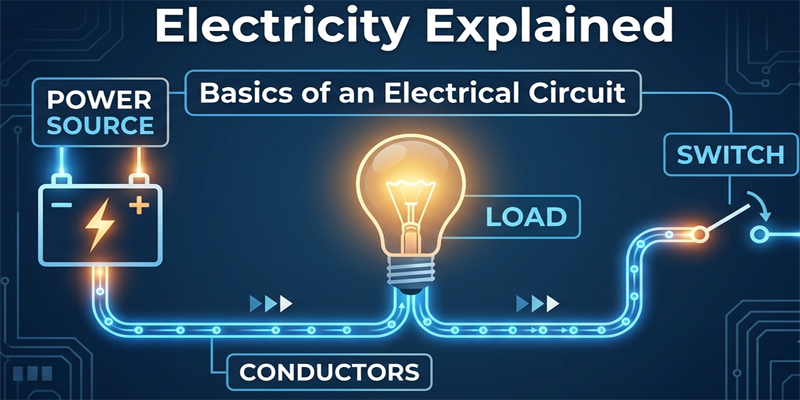
What Is an Electric Circuit?
An electric circuit is a complete path through which electric current flows.
A simple circuit has:
- Battery (power source)
- Wires
- Switch
- Bulb or other electrical device
When the switch is closed, the circuit is complete, and current flows.
When the switch is open, the circuit is broken, and current stops.
Conductors and Insulators
Conductors
Materials that allow electricity to flow easily.
Examples:
- Copper
- Aluminium
- Silver
- Gold
Copper is commonly used for household wiring.
Insulators
Materials that prevent electricity from flowing easily.
Examples:
- Rubber
- Plastic
- Glass
- Wood (dry)
These materials protect us from electric shocks.
AC and DC Electricity
There are two main types of electric current.
Direct Current (DC)
Electrons flow in only one direction.
Examples:
- Batteries
- Power banks
- Solar panels (before conversion)
Alternating Current (AC)
Electrons change direction many times every second.
Examples:
- Household electricity
- Offices
- Schools
- Factories
In India, household electricity is supplied as 230 volts AC at 50 Hz.
How Is Electricity Generated?
Electricity is produced in power plants by converting different forms of energy into electrical energy.
Thermal Power Plants
Fuel such as coal, natural gas, or oil is burned to produce steam.
The steam rotates a turbine connected to a generator.
Hydroelectric Power Plants
Water stored behind dams falls with great force.
The flowing water spins turbines.
Wind Power
Wind turns large turbine blades.
The turbines rotate generators.
Solar Power
Solar panels convert sunlight directly into electricity.
No moving parts are required.
Nuclear Power
Heat from nuclear reactions produces steam.
The steam rotates turbines connected to generators.
How Does Electricity Reach Our Homes?
The journey of electricity involves several steps.
Step 1
Electricity is generated at a power plant.
Step 2
A transformer increases the voltage for efficient long-distance transmission.
Step 3
High-voltage transmission lines carry electricity across hundreds of kilometers.
Step 4
Substations reduce the voltage.
Step 5
Distribution transformers lower it further.
Step 6
Electricity enters homes through service lines and the electricity meter.
Finally, it reaches switches, sockets, lights, fans, and appliances.
What Is an Electric Fuse?
A fuse is a safety device that protects electrical circuits.
If excessive current flows, the fuse melts and breaks the circuit, preventing damage and reducing fire risk.
What Is an MCB?
An MCB (Miniature Circuit Breaker) is an automatic safety switch.
Unlike a fuse, it does not melt.
It automatically switches off the supply during:
- Overloading
- Short circuits
After the fault is fixed, it can usually be switched on again.
Why Do Birds Not Get Electrocuted on Power Lines?
This is one of the most common science questions.
A bird sitting on a single electric wire does not receive an electric shock because there is no significant potential difference across its body.
Electric current flows only when there is a complete path between two different electrical potentials.
However, if the bird touches another wire at a different voltage or a grounded object at the same time, a dangerous current can pass through its body.
Science Around You
Electricity powers almost everything we use daily.
Examples include:
- LED lights
- Ceiling fans
- Refrigerators
- Washing machines
- Air conditioners
- Computers
- Mobile phones
- Electric vehicles
Did You Know?
- Lightning can reach temperatures of about 30,000°C, much hotter than the surface of the Sun.
- A single large power plant can supply electricity to millions of homes.
- Copper is widely used in electrical wiring because it is an excellent conductor.
- India’s electricity comes from a mix of thermal, hydro, nuclear, solar, and wind power.
- Some modern homes can generate their own electricity using rooftop solar panels.
Try This at Home (Safe Experiment)
Make a Simple Circuit
You’ll Need
- One AA battery
- A small torch bulb
- Two insulated wires
Steps
- Connect one wire from the battery’s positive terminal to the bulb.
- Connect another wire from the bulb to the battery’s negative terminal.
- Ensure all connections are secure.
Observation
The bulb lights up only when the circuit is complete.
Reason
Electric current flows through a closed circuit.
Note: Perform this only with small batteries. Never experiment with household electricity.
Common Mistakes Students Make
❌ Thinking electricity is stored inside wires.
✔ Wires provide a path for electric current; they do not “store” electricity in normal operation.
❌ Believing higher voltage always means greater danger.
✔ Both voltage and current matter. The amount of current passing through the body and the path it takes determine the severity of an electric shock.
❌ Assuming batteries produce AC electricity.
✔ Batteries produce DC electricity.
❌ Thinking electricity is generated inside homes.
✔ Homes receive electricity from the power grid or from local sources such as rooftop solar systems.
Frequently Asked Questions (FAQs)
1. What is electricity?
Electricity is the flow of electrons through a conductor.
2. Why do we use copper wires?
Because copper is an excellent conductor of electricity and is durable.
3. What is the difference between AC and DC?
AC changes direction periodically, while DC flows in only one direction.
4. Why do we need transformers?
Transformers increase voltage for efficient long-distance transmission and decrease it before electricity enters homes.
5. What is the purpose of an MCB?
It automatically disconnects the power supply during overloads or short circuits, helping protect people and electrical equipment.
Electrical Safety Tips
- Never touch electrical switches with wet hands.
- Do not insert metal objects into electrical sockets.
- Replace damaged wires immediately.
- Avoid overloading extension boards and sockets.
- Switch off the main power before repairing electrical equipment.
- Keep children away from exposed electrical wiring.
- During thunderstorms, avoid standing under isolated tall trees and avoid handling wired electrical devices.
Why This Topic Matters
Understanding electricity helps us explain:
- How homes receive power.
- How fans, lights, and appliances work.
- Why safety devices like fuses and MCBs are essential.
- How renewable energy systems generate electricity.
- How electric vehicles operate.
- How industries, hospitals, and communication systems function.
Electricity is one of the foundations of modern civilization and is essential for science, engineering, medicine, transportation, and communication.
Conclusion
Friends, in this post(Electricity Explained) we have learned various important facts and information about electricity. It is much more than just switching on a bulb in your room. Basically, it is the movement of electrons which ultimately provides the power to our home, hospitals, industries, schools, and digital world.
In today’s time, electricity connects every part of modern life, whether it is a small circuit inside a smartphone or giant power plants and transmission lines. If you really want a strong foundation in physics, then you must understand the concepts of current, voltage, resistance, circuits, and electrical safety seriously. Then only you will come in a state to appreciate this amazing human’s great achievements. |Electricity Explained|
Now, I hope! you will remember this amazing journey of electricity when you switch on a fan, watch television, or charge your mobile phone. |Electricity Explained|
If you have any queries, you can write to us at support@a5theory.com; we will get back to you ASAP.
Hope! You would have enjoyed this post(Electricity Explained).
Please feel free to give your important feedback in the comment section below. |Electricity Explained|
Have a great time!