

Hello Friends, in this blog post(Why Do We Get Hiccups), we are going to talk about hiccups, which are one of the strange things the human body does.
Most of you have also felt this experience sometimes in your life.
A sudden hiccup! starts while talking to someone, and we have no idea how to stop it. |Why Do We Get Hiccups|
It can appear suddenly and also disappear very mysteriously, instantly. |Why Do We Get Hiccups|
But sometimes it can last for many minutes and even for many hours.
And we get really irritated when it stays for a long time, and sometimes we even need to visit a nearby doctor for a consultation.
- Have you ever thought about the changes happening inside your body? As a result, we get hiccups.
- Why does it produce a strange sound?
- Why is it sometimes triggered by simply eating food too quickly?
To answer all of these questions, we must understand the important breathing muscle known as the diaphragm.
We also need to understand the nerves and reflex pathway that connect the chest, brain, and abdomen.
In this blog post(Why Do We Get Hiccups), we will explore all the important facts behind the “hic” in a descriptive manner.
What Exactly Is a Hiccup?
A hiccup is a sudden, involuntary contraction of the diaphragm followed almost immediately by the rapid closure of the glottis, the opening between the vocal folds in the larynx.
That sudden closure interrupts the incoming airflow and produces the familiar:
“Hic!”
So a hiccup is essentially a reflex involving breathing muscles and the nervous system.
What Is the Diaphragm?
The diaphragm is a large, dome-shaped muscle located below the lungs.
It separates the:
- Chest cavity
- Abdominal cavity
It plays a major role in breathing.
When the diaphragm contracts, it moves downward.
This increases the volume of the chest cavity and helps draw air into the lungs.
When it relaxes, it moves upward and contributes to normal exhalation.
How Do We Normally Breathe?
When you breathe in:
- The diaphragm contracts.
- It moves downward.
- The chest cavity becomes larger.
- Pressure inside the lungs decreases.
- Air flows into the lungs.
When you breathe out:
- The diaphragm relaxes.
- It moves upward.
- The chest cavity becomes smaller.
- Air flows out.
This happens automatically thousands of times every day. |Why Do We Get Hiccups|
So What Goes Wrong During a Hiccup?
During a hiccup, the diaphragm suddenly contracts involuntarily.
Air begins moving rapidly into the lungs.
Almost immediately afterward, the glottis closes.
This sudden interruption of airflow produces the characteristic sound.
The entire event can happen extremely quickly.
Why Does the Hiccup Make a Sound?
The sound isn’t produced simply because the diaphragm contracts.
The characteristic sound occurs because the glottis closes suddenly after the diaphragm contracts.
Airflow is abruptly interrupted, producing the familiar “hic” sound.
What Is the Glottis?
The glottis is the opening associated with the vocal folds in the larynx.
It plays an important role in:
- Breathing
- Speaking
- Protecting the airway
During a hiccup, it closes suddenly after the diaphragm contracts.
That produces the sound we recognize. |Why Do We Get Hiccups|
Are Hiccups Under Our Control?
Usually, no.
Hiccups are involuntary.
You don’t consciously decide:
“I’m going to hiccup now.”
The reflex occurs automatically.
This is similar to other involuntary responses in the body, although the exact neural mechanisms are different.
What Causes Hiccups?
There isn’t always a single obvious cause.
Common triggers include:
- Eating too quickly
- Eating too much
- Drinking carbonated beverages
- Sudden changes in stomach size
- Alcohol
- Sudden temperature changes
- Excitement
- Laughter
- Emotional stress
- Swallowing air
These situations can stimulate structures involved in the hiccup reflex.
Why Do We Get Hiccups After Eating Too Much?
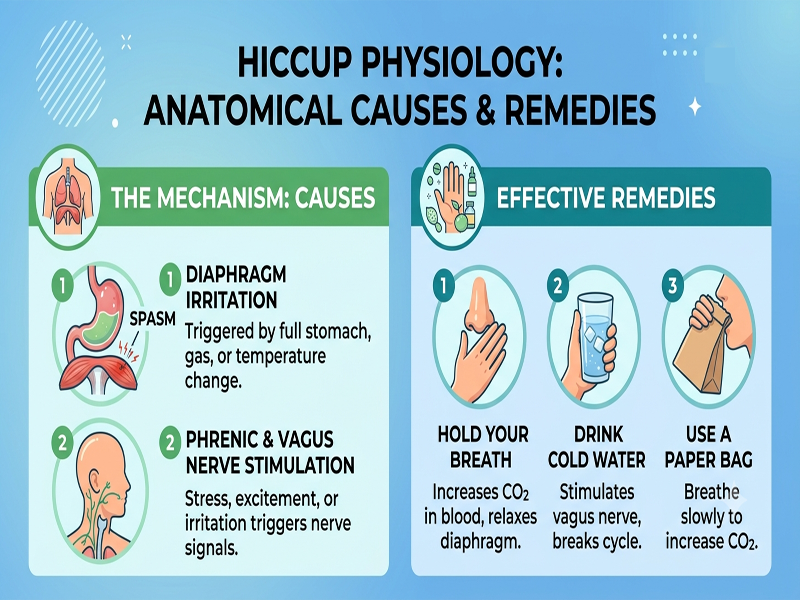
A very full stomach can affect nearby structures and may stimulate nerves involved in the hiccup reflex.
The stomach is located directly below the diaphragm.
When the stomach expands, it can influence the diaphragm and surrounding nerve pathways.
This may help explain why overeating is a common hiccup trigger.
Why Can Fizzy Drinks Cause Hiccups?
Carbonated drinks contain dissolved carbon dioxide.
When you drink them, gas can accumulate in the stomach.
The stomach may expand, and the increased pressure or irritation can stimulate pathways associated with hiccups.
Some people are more sensitive to this than others. |Why Do We Get Hiccups|
Why Does Eating Too Quickly Cause Hiccups?
Eating quickly can cause you to swallow more air.
It can also cause the stomach to expand rapidly.
Both factors may contribute to irritation or stimulation of the nerves involved in the hiccup reflex.
Why Can Laughter Cause Hiccups?
When you laugh, your breathing pattern changes rapidly.
You may take sudden breaths, swallow air, or experience repeated contractions of respiratory muscles.
These changes can sometimes trigger a hiccup.
Why Do We Sometimes Get Hiccups After Sudden Excitement?
Strong emotions can change breathing patterns and nervous-system activity.
Excitement, surprise, stress, or laughter may therefore sometimes trigger hiccups.
The exact mechanism can vary from person to person.
Why Does Drinking Alcohol Sometimes Cause Hiccups?
Alcohol can influence the digestive system and nervous system.
It can also contribute to stomach irritation and changes in breathing or swallowing.
These effects may make hiccups more likely in some people.
Why Do Babies Get Hiccups So Often?
Babies commonly experience hiccups.
Their respiratory and digestive systems are still developing, and they frequently feed, swallow air, and experience changes in stomach volume.
Babies can even hiccup before birth.
Fetal hiccup-like movements have been observed during pregnancy.
Do Babies Feel Hiccups the Same Way Adults Do?
We can’t directly know what a baby experiences subjectively.
However, the physiological reflex can occur before birth.
For infants, hiccups are generally a normal part of development.
Can Animals Get Hiccups?
Some animals can experience hiccup-like reflexes.
Mammals, in particular, have diaphragms and respiratory systems that share important similarities with humans.
Young mammals can be especially prone to hiccup-like episodes. |Why Do We Get Hiccups|
Is There a Purpose Behind Hiccups?
This is one of the most interesting questions.
Scientists still don’t have a universally accepted explanation for why humans have hiccups.
Several evolutionary ideas have been proposed.
One possibility is that hiccups are a leftover reflex inherited from earlier stages of vertebrate evolution.
Another idea is that the reflex may have some connection with infant feeding or respiratory development.
However, these remain scientific hypotheses rather than facts.
Are Hiccups an Evolutionary Leftover?
Possibly.
The hiccup reflex has some interesting similarities to respiratory patterns found in other vertebrates.
Scientists have proposed that hiccups may represent an ancient neural reflex that has persisted through evolution.
But exactly why this reflex evolved remains uncertain. |Why Do We Get Hiccups|
What Is a Reflex?
A reflex is a rapid, automatic response to a particular stimulus.
Some reflexes protect the body.
For example:
- Pulling your hand away from something hot
- Blinking when something approaches your eye
- Coughing when the airway is irritated
The hiccup is also a reflex, although its biological purpose isn’t fully understood.
Which Nerves Are Involved in Hiccups?
Several nerves and brain regions are involved in the hiccup reflex.
Two particularly important nerves are:
Phrenic Nerve
The phrenic nerves control the diaphragm.
Vagus Nerve
The vagus nerves carry signals between the brain and many organs, including structures in the chest and abdomen.
Signals from these pathways can participate in triggering the hiccup reflex. |Why Do We Get Hiccups? |
Is the Brain Involved in Hiccups?
Yes.
Although the diaphragm is the muscle that contracts, the hiccup reflex involves neural pathways connecting the brain with the diaphragm and other structures.
The brain helps coordinate the reflex.
Researchers describe a hiccup reflex arc involving sensory pathways, central neural processing, and motor pathways.
What Is a Reflex Arc?
A reflex arc is a neural pathway through which information travels to produce a response.
In simplified form:
Stimulus → Sensory nerves → Central nervous system → Motor nerves → Muscles
For hiccups, signals can arise from structures such as the stomach or diaphragm and eventually lead to involuntary contraction of the diaphragm. |Why Do We Get Hiccups|
Why Do Hiccups Usually Stop on Their Own?
Most ordinary hiccup episodes are temporary.
The irritation or stimulus that triggered the reflex disappears.
The nervous system then stops producing repeated diaphragm contractions.
The exact reason a particular episode stops at a particular moment isn’t always clear.
How Long Do Hiccups Usually Last?
Most hiccup episodes last only a few minutes.
Sometimes they last longer.
In rare cases, hiccups can continue for days or even weeks.
Persistent hiccups can interfere with:
- Sleep
- Eating
- Drinking
- Speaking
- Daily activities
Long-lasting hiccups can sometimes be associated with an underlying medical condition and may require medical evaluation. |Why Do We Get Hiccups|
What Are Persistent Hiccups?
Hiccups lasting for more than 48 hours are generally called persistent hiccups.
Hiccups lasting for more than about one month are sometimes classified as intractable hiccups.
These are uncommon and can have many possible causes.
Can Medical Conditions Cause Long-Lasting Hiccups?
Yes.
Persistent hiccups can sometimes be associated with problems affecting:
- The nervous system
- The digestive system
- The diaphragm
- Metabolism
- Certain medications
Because many different conditions can contribute, persistent hiccups should be evaluated by a healthcare professional.
Can We Stop Hiccups by Holding Our Breath?
You may have heard this advice.
Holding your breath temporarily changes the levels of gases in your blood and alters breathing patterns.
It may interrupt the hiccup reflex in some people.
However, there is no guaranteed method that works for everyone. |Why Do We Get Hiccups|
Why Does Drinking Water Sometimes Help?
Swallowing water changes activity in the throat, oesophagus, and respiratory system.
In some people, this may interrupt the hiccup reflex.
But again, there is no scientifically guaranteed home trick that instantly stops every hiccup.
What About Swallowing Sugar?
Some people use a small amount of granulated sugar as a traditional hiccup remedy.
The idea is that stimulation of nerves in the mouth and throat may alter the reflex.
Evidence for such home remedies is limited.
Does Scaring Someone Stop Hiccups?
This is a popular myth.
A sudden surprise can alter breathing and nervous-system activity.
That might occasionally coincide with hiccups stopping.
But deliberately frightening someone is not a reliable or recommended treatment.
Is Drinking Water Upside Down a Scientific Cure?
There is no strong scientific evidence that drinking water upside down is a guaranteed cure.
Some people may find swallowing water helpful, but the unusual posture itself isn’t established as a specific treatment for hiccups. |Why Do We Get Hiccups|
Why Do Hiccups Sometimes Return Repeatedly?
A trigger may still be present.
For example:
- Continued stomach irritation
- Repeated swallowing of air
- Carbonated drinks
- Alcohol
- Stress
- Certain medications
In some cases, the nervous system may continue producing the reflex even after the original trigger has disappeared.
Can Hiccups Be Dangerous?
Ordinary short-term hiccups are usually harmless.
They become more concerning when they:
- Continue for a long time
- Prevent sleep
- Make eating difficult
- Interfere with breathing
- Cause significant discomfort
Long-lasting or severe hiccups should be discussed with a healthcare professional.
Why Can’t We Hiccup Whenever We Want?
Because the hiccup is an involuntary reflex.
You can sometimes influence the conditions that make a hiccup more or less likely, but you cannot normally command the diaphragm to perform the complete hiccup sequence at will.
Why Can’t We Stop a Hiccup Immediately?
Because once the reflex begins, it is controlled automatically by neural pathways.
You can sometimes interrupt the reflex through changes in breathing, swallowing, or other actions.
But there is no universal “off switch” that humans can consciously activate.
Hiccups vs Coughing
Both involve the respiratory system, but they are very different reflexes.
| Hiccups | Coughing |
|---|---|
| Involuntary diaphragm contraction followed by glottic closure | Forceful expulsion of air |
| Produces a characteristic “hic” | Helps clear the airways |
| Usually harmless and temporary | Often triggered by airway irritation |
| Purpose is not clearly established | Has an important protective function |
Hiccups vs Sneezing
Sneezing is another reflex.
A sneeze is generally triggered by irritation of the nasal passages.
It produces a powerful expulsion of air through the nose and mouth.
Hiccups, on the other hand, involve a sudden diaphragm contraction and glottis closure.
Both demonstrate how the nervous system can control automatic body responses.
Hiccups vs Breathing
Normal breathing is rhythmic and continuous.
Hiccups are sudden, involuntary interruptions involving an abnormal contraction of the diaphragm.
The same basic breathing muscles are involved, but the neural control is very different.
Can Hiccups Happen While Sleeping?
Hiccups can occur during sleep, although they may be less commonly noticed because the person is not consciously aware of them.
Sleep changes nervous-system activity and respiratory patterns, which can influence reflexes. |Why Do We Get Hiccups|
Why Do We Sometimes Get Hiccups at the Same Time Every Day?
There isn’t necessarily a biological clock controlling hiccups.
If someone notices hiccups around a particular time, it may be connected to routine factors such as:
- Meal timing
- Eating habits
- Certain drinks
- Stress
- Sleep patterns
Repeated episodes without an obvious reason may warrant discussion with a healthcare professional if they are persistent or troublesome.
A Simple Science Observation
You can observe your own breathing to understand the role of the diaphragm.
Try This
Sit quietly and place your hand gently on your abdomen.
Breathe normally.
Notice how your abdomen moves slightly as your diaphragm changes position during breathing.
Now take a slow, deep breath.
You can observe how the movement becomes more noticeable.
This helps demonstrate that breathing involves coordinated movement of muscles rather than simply “air entering the lungs.” |Why Do We Get Hiccups|
Did You Know?
- A hiccup is an involuntary reflex.
- The diaphragm plays the central muscular role.
- The glottis closes suddenly during a hiccup.
- Hiccups produce their characteristic sound because of this sudden closure.
- Eating too quickly can trigger hiccups.
- Carbonated drinks can make hiccups more likely.
- Babies can experience hiccups before birth.
- The exact evolutionary purpose of hiccups remains uncertain.
- Persistent hiccups lasting more than 48 hours are uncommon and may need medical evaluation.
- The phrenic and vagus nerves are involved in the hiccup reflex.
Common Mistakes Students Make
❌ Thinking hiccups are caused simply by air trapped in the stomach.
✔ Stomach expansion and swallowed air can trigger hiccups, but the hiccup itself is a neurological reflex involving the diaphragm.
❌ Thinking the stomach makes the “hic!” sound.
✔ The sound occurs mainly because the glottis closes suddenly after the diaphragm contracts.
❌ Thinking hiccups mean that someone is thinking about you.
✔ That’s a popular superstition, not a scientific explanation.
❌ Thinking everyone has the same hiccup triggers.
✔ Triggers vary from person to person.
❌ Thinking hiccups always indicate a disease.
✔ Ordinary short-term hiccups are common and usually harmless.
❌ Thinking there is one scientifically proven trick that stops all hiccups.
✔ Many home remedies exist, but none is guaranteed to work for everyone.
Frequently Asked Questions (FAQs)
1. Why do we get hiccups?
Hiccups occur when the diaphragm suddenly contracts involuntarily, and the glottis closes rapidly. |Why Do We Get Hiccups|
2. What causes hiccups?
Common triggers include eating too quickly, overeating, carbonated drinks, swallowing air, laughter, excitement, and sudden changes in temperature.
3. Why do hiccups make a “hic” sound?
The sound is produced when the glottis closes suddenly after the diaphragm contracts.
4. What is the diaphragm?
The diaphragm is a large muscle below the lungs that plays a major role in breathing.
5. Why do babies get hiccups?
Babies commonly hiccup because their developing respiratory and digestive systems can produce frequent reflex activity. Hiccups can even occur before birth.
6. Are hiccups dangerous?
Short-term hiccups are generally harmless. Hiccups lasting more than 48 hours should be evaluated by a healthcare professional. |Why Do We Get Hiccups|
7. Can you stop hiccups by holding your breath?
It may interrupt the reflex in some people, but it isn’t guaranteed.
8. Why do carbonated drinks cause hiccups?
Gas and stomach expansion associated with carbonated drinks can stimulate pathways involved in the hiccup reflex.
9. Do animals get hiccups?
Some animals, particularly mammals, can experience hiccup-like reflexes.
10. Do scientists know exactly why humans hiccup?
No. The physiological mechanism is fairly well understood, but the evolutionary purpose of the hiccup reflex remains uncertain. |Why Do We Get Hiccups|
Why This Topic Matters
Hiccups may seem like a silly little interruption, but they provide a fascinating example of how the human body works.
One tiny sound involves:
- The brain
- Nervous system
- Phrenic nerve
- Vagus nerve
- Diaphragm
- Lungs
- Larynx
- Glottis
- Breathing
It shows us that many things happening inside our bodies are controlled automatically without conscious effort.
You don’t have to tell your diaphragm when to breathe.
You don’t have to tell your heart when to beat.
And you certainly don’t have to give your body permission to say:
“Hic!”
Conclusion
Friends, in this blog post(Why Do We Get Hiccups), we have explored the science behind one sudden and strange action in the human body known as “Hiccups“. This begins with the involuntary contraction of the diaphragm. A quick movement of air towards the lungs, immediately followed by the glottis closing, causes a strange event called “hic!” Taking a carbonated beverage, eating food too quickly, etc can trigger Hiccups. They disappear quickly most of the time on their own. But it is more interesting to study the deeper science.
Hiccups are also considered a reflex action that occurs automatically and demonstrates the system of nerves, brain, muscles, and respiratory system working together. Scientists have discovered much of the mechanism behind hiccups, but this fascinating question, “Why did evolution give this reflex in the first place?” is still not fully answered. So “We don’t know yet” is still the most interesting answer science can give. |Why Do We Get Hiccups|
If you have any queries, you can write to us at support@a5theory.com; we will get back to you ASAP.
Hope! You will enjoy this post, “Why Do We Get Hiccups“.
Please feel free to give your feedback in the comment section below.
Have a great time!