

Hello Friends, in this blog post(Why Do We Feel Hot and Cold), we are going to explain the feeling of hot and cold.
In our daily routine, we touch many hot and cold objects, and we instantly recognize their temperature, whether it is cold or hot.
If you touch a metal spoon, you will find it pretty cold, and then you touch any wooden object kept in the same room.
You might not feel it as cold as the spoon you touched earlier. |Why Do We Feel Hot and Cold|
And the interesting thing is that these two objects might actually be at the same temperature.
So how do you find them feel different in temperature?
And to better understand the answer to this question, we have to do a deep dive into the important area of physics: Temperature and heat.
If you study these two concepts in depth, it could be a great help to you in understanding the science of ice melting, water boiling, sweating…
… fans cooling us, and refrigerators working. And you will be able to discover why a metal chair feels colder than a wooden chair in winter. |Why Do We Feel Hot and Cold|
What Is Temperature?
Temperature is a measure related to the average kinetic energy of the particles in a substance.
In simpler words, it tells us about the thermal state of an object and how hot or cold it is.
When the temperature of a substance increases, its particles generally have greater average kinetic energy.
When the temperature decreases, their average kinetic energy decreases.
What Is Heat?
Heat is energy transferred between objects because of a temperature difference.
This distinction is extremely important.
Temperature describes a state.
Heat describes energy in transit.
For example, if you place a hot cup of tea on a table, thermal energy flows from the hotter tea and cup toward the cooler surroundings.
That energy transfer is heat. |Why Do We Feel Hot and Cold? |
Heat and Temperature Are Not the Same
Students often use the words “heat” and “temperature” as if they mean the same thing.
They don’t.
| Heat | Temperature |
|---|---|
| Energy transferred due to temperature difference | Indicates the thermal state of a system |
| Measured as energy | Commonly measured in °C, K, or °F |
| Depends on the amount and type of substance as well as temperature change | Does not directly depend on how much substance is present |
| Flows from hotter to colder regions | Describes how hot or cold something is |
A Simple Example
Imagine two cups:
- Cup A contains one cup of hot water.
- Cup B contains a large bucket of hot water.
Both could have the same temperature.
But the bucket contains much more thermal energy because it contains far more water.
This shows why temperature and thermal energy are different concepts.
Why Does Heat Flow From Hot to Cold?
Suppose you place a cold spoon inside hot tea.
The spoon warms up.
Why?
Because energy is transferred from the hotter tea to the colder spoon.
This continues until the spoon and tea move toward thermal equilibrium.
In ordinary situations, spontaneous heat transfer occurs from a region of higher temperature toward a region of lower temperature.
What Is Thermal Equilibrium?
When two objects in thermal contact reach the same temperature, and there is no net heat transfer between them, they are said to be in thermal equilibrium.
For example:
Put a thermometer into warm water.
Initially:
Water temperature ≠ Thermometer temperature
After some time:
Water temperature ≈ Thermometer temperature
At that point, the thermometer can provide a reliable temperature reading.
Why Does Metal Feel Colder Than Wood?
This is one of the best everyday examples of heat transfer.
Imagine a metal spoon and a wooden spoon sitting in the same room overnight.
They are both approximately at room temperature.
Touch them.
The metal spoon may feel much colder.
But the metal isn’t necessarily colder.
The difference is thermal conductivity.
Metal conducts heat much more efficiently than wood.
When you touch the metal, heat flows rapidly from your warmer hand into the metal.
Your hand loses thermal energy quickly.
Your brain interprets this rapid heat loss as a strong feeling of cold.
Wood conducts heat much more slowly.
Therefore, your hand loses heat more slowly.
The wood feels warmer.
Does Metal Actually Have “More Cold”?
No.
Cold is not a substance that flows into your hand.
Instead, heat leaves your hand.
This is an important scientific way of thinking.
Instead of saying:
“The cold entered my hand.”
It is more accurate to say:
“Heat transferred from my hand to the colder object.”
Why Does a Tile Floor Feel Colder Than a Carpet?
Suppose both are at the same room temperature.
The tile may feel much colder.
Why?
Tile is a better conductor of heat than carpet.
Your feet transfer heat to the tile more rapidly.
Carpet contains fibres and trapped air, which are poor conductors of heat.
Therefore, heat leaves your feet more slowly when you stand on carpet.
Why Does Air Feel Different From Water?
Water and air can have the same temperature but produce very different sensations.
Water generally transfers heat much more effectively than still air.
That’s why swimming in water at a temperature that feels comfortable in air can sometimes make you feel cold.
Your body can lose heat relatively quickly to the water.
Why Does Wind Make Us Feel Colder?
Wind can increase the rate at which heat is removed from your body.
It can also remove the layer of relatively warm air near your skin.
This is related to convection.
Wind therefore often makes the surroundings feel colder than still air at the same measured temperature.
This effect contributes to what we call the:
Wind-chill effect
Why Does a Fan Make Us Feel Cooler?
A fan doesn’t necessarily lower the room’s temperature significantly.
Instead, moving air increases the rate of heat and moisture transfer from your skin.
It can:
- Remove warm air near your body
- Increase evaporation of sweat
- Increase convective heat transfer
As a result, you feel cooler. |Why Do We Feel Hot and Cold|
Can a Fan Cool an Empty Room?
A fan mainly moves air.
If a fan is running in an empty room, it doesn’t provide the same cooling effect as it does for a person.
In fact, the motor consumes electrical energy and eventually releases most of that energy as heat.
So the room may actually become very slightly warmer overall.
The fan makes you feel cooler primarily because of increased heat loss from your body.
Why Does Sweating Cool Us?
Sweating is one of the body’s most important cooling mechanisms.
When sweat reaches the surface of your skin, some of the water evaporates.
Evaporation requires energy.
That energy is taken from your skin and nearby tissues.
As energy leaves your body through evaporation, your skin cools.
This is called evaporative cooling.
Why Does Sweat Work Better on a Dry Day?
Evaporation occurs more easily when the surrounding air can accept more water vapour.
Dry air generally allows sweat to evaporate more readily.
Humid air already contains a large amount of water vapour.
As a result, evaporation can become slower.
That’s why a humid day can feel much hotter than the thermometer alone might suggest.
Why Does a Desert Feel Extremely Hot During the Day but Cold at Night?
Deserts often have:
- Very low humidity
- Little cloud cover
- Dry surfaces
During the day, sunlight can heat the ground strongly.
At night, the ground can lose thermal energy efficiently through infrared radiation, particularly when skies are clear.
The lack of water vapour and clouds means there is less atmospheric insulation.
Therefore, desert temperatures can change dramatically between day and night.
How Does Heat Travel?
Heat can be transferred mainly through three mechanisms:
1. Conduction
Heat transfer through direct interaction between particles.
2. Convection
Heat transfer through the movement of fluids such as liquids and gases.
3. Radiation
Heat transfer through electromagnetic radiation.
These three mechanisms are everywhere around us.
What Is Conduction?
Conduction occurs when energy is transferred through a material without the material as a whole moving from one place to another.
In solids, particles interact with neighbouring particles and transfer energy.
Metals are generally excellent thermal conductors. |Why Do We Feel Hot and Cold|
Example of Conduction
Imagine heating one end of a metal rod.
The particles near the flame gain energy.
They transfer energy to neighbouring particles.
The thermal energy gradually moves along the rod.
Eventually, the other end becomes hot.
That’s conduction.
Why Are Cooking Pans Usually Made of Metal?
Metals are good thermal conductors.
A metal pan can transfer heat from the stove into the food relatively efficiently.
But the handle may be made from a material with low thermal conductivity, such as certain plastics or specially designed insulating materials.
This helps reduce heat transfer to your hand.
Why Is a Wooden Spoon Useful for Cooking?
Wood is a relatively poor thermal conductor.
A wooden spoon therefore doesn’t become hot as quickly as a metal spoon when used in a cooking pot.
This makes it more comfortable to hold. |Why Do We Feel Hot and Cold|
What Is Convection?
Convection is heat transfer associated with the movement of a fluid.
A fluid can be:
- Liquid
- Gas
When part of a fluid becomes warmer, its density can change.
This can cause the warmer fluid to rise and cooler fluid to move downward.
This produces a convection current.
How Does Water Boil?
When water is heated from below:
- Water near the bottom gains thermal energy.
- Its temperature rises.
- The water expands slightly and becomes less dense.
- Warmer water rises.
- Cooler, denser water moves downward.
- The cycle continues.
These movements create convection currents.
Eventually, enough water reaches the boiling condition for vigorous vapor formation to occur.
Does Water Conduct Heat?
Yes.
Water can conduct heat.
But in a pot of water, convection usually plays a major role in distributing thermal energy through the liquid.
This is one reason water can circulate while being heated.
What Is Radiation?
Thermal radiation is energy transferred by electromagnetic waves.
Unlike conduction and convection, radiation does not require matter between the source and receiver.
That’s why energy from the Sun can travel through the vacuum of space and reach Earth.
How Does the Sun Heat Earth?
The Sun emits electromagnetic radiation.
A portion of this radiation reaches Earth.
Earth’s surface and atmosphere absorb some of the incoming energy.
That absorbed energy increases thermal energy and contributes to Earth’s temperature.
The energy travelled approximately 150 million kilometres through space without requiring air to carry it.
Is Sunlight the Same as Heat?
Sunlight contains electromagnetic radiation across a range of wavelengths.
Visible light allows us to see.
Infrared radiation contributes strongly to thermal energy transfer.
When sunlight is absorbed by an object, its energy can be converted into thermal energy.
So sunlight can certainly heat objects. |Why Do We Feel Hot and Cold|
Why Do Dark Clothes Feel Hotter in Sunlight?
Dark surfaces often absorb more visible light than lighter surfaces.
The absorbed electromagnetic energy can be converted into thermal energy.
As a result, dark-coloured surfaces can become hotter in strong sunlight.
However, the exact heating depends on the material, surface properties, airflow, and other factors.
Why Are White Clothes Popular in Hot Weather?
Light-coloured surfaces generally reflect more incoming visible radiation than dark surfaces.
Therefore, they may absorb less solar energy.
Loose, breathable clothing also helps heat transfer and sweat evaporation.
This is why light-coloured clothing can be useful in hot environments.
Why Does a Thermometer Measure Temperature?
A thermometer uses a physical property that changes predictably with temperature.
For example:
- Liquid expansion
- Electrical resistance
- Semiconductor behaviour
- Infrared radiation
By measuring that property, a thermometer can determine temperature.
How Did Traditional Mercury Thermometers Work?
Mercury expands when heated and contracts when cooled.
A narrow glass tube magnifies this change.
The mercury level therefore moves along a calibrated scale.
The position of the mercury indicates the temperature.
Mercury thermometers have largely been replaced in many everyday applications because mercury is toxic and requires careful handling.
How Do Digital Thermometers Work?
Many digital thermometers use electronic temperature sensors.
The electrical properties of the sensor change with temperature.
The thermometer’s electronics measure this change and convert it into a temperature reading.
The result is displayed digitally. |Why Do We Feel Hot and Cold? |
What Are the Common Temperature Scales?
Three temperature scales you may encounter are:
Celsius
Commonly used in India and many other countries.
Water freezes at approximately:
0°C
Water boils at approximately:
100°C
under standard atmospheric pressure.
Fahrenheit
Commonly used in the United States.
Water freezes at:
32°F
and boils at:
212°F
under standard atmospheric pressure.
Kelvin
The SI base unit of thermodynamic temperature is:
kelvin (K)
The Kelvin scale begins at absolute zero.
What Is Absolute Zero?
Absolute zero is the theoretical lower limit of thermodynamic temperature.
It is:
0 K
or approximately:
−273.15°C
At temperatures approaching absolute zero, the thermal motion associated with particles becomes extremely small.
Absolute zero cannot be reached exactly by ordinary cooling processes.
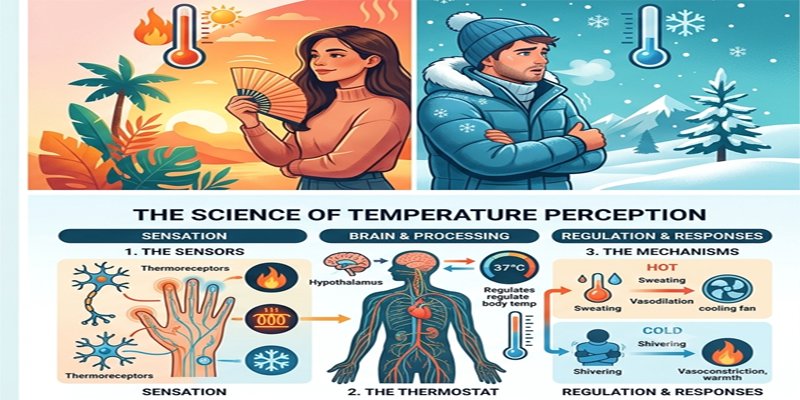
Why Do We Feel Cold?
Your body constantly exchanges thermal energy with its surroundings.
You feel cold when your body is losing heat faster than it can replace it through metabolism and other processes.
Your body responds through mechanisms such as:
- Shivering
- Narrowing of blood vessels near the skin
- Reducing heat loss
- Increasing metabolic heat production
Why Do We Shiver?
Shivering is a rapid involuntary contraction of muscles.
Muscle activity generates heat.
Your body uses shivering as one way to increase heat production when it is cold.
So when you shiver, your muscles are essentially helping your body generate additional thermal energy.
Why Do We Sweat When We Are Hot?
When body temperature rises, the body activates cooling mechanisms.
Sweat glands release sweat onto the skin.
When the water evaporates, it removes energy from the body.
This helps regulate body temperature. |Why Do We Feel Hot and Cold|
Why Do We Feel Hot in a Crowded Room?
Many people produce metabolic heat.
A crowded room can therefore receive substantial heat from:
- Human bodies
- Lighting
- Electronics
- Other equipment
If ventilation is poor, this heat accumulates.
Humidity can also rise, making sweat evaporation less effective.
The room can therefore feel significantly hotter.
Why Does Opening a Window Sometimes Cool a Room?
If the outside air is cooler than the inside air, opening a window can allow warmer indoor air to escape and cooler outdoor air to enter.
This is a form of convection and ventilation.
The effectiveness depends on:
- Outdoor temperature
- Indoor temperature
- Wind
- Humidity
- Window position
- Airflow
Why Does a Refrigerator Feel Cold Inside?
A refrigerator doesn’t simply “create cold.”
It uses a refrigeration cycle to remove thermal energy from the inside and release it to the surrounding room.
The system uses a refrigerant and components such as:
- Compressor
- Condenser
- Expansion device
- Evaporator
The refrigerator transfers heat from a colder region to a warmer surrounding environment by using external energy.
Why Does the Back of a Refrigerator Feel Warm?
The refrigerator removes heat from inside.
It also releases heat associated with the operation of its compressor and other components.
The condenser coils transfer this heat to the surrounding air.
Therefore, the back or sides of a refrigerator can feel warm.
Can Heat Flow From Cold to Hot?
Naturally, heat flows spontaneously from higher temperature to lower temperature.
However, a machine can transfer heat from a colder region to a warmer region if external energy is supplied.
Refrigerators and air conditioners do exactly this.
They use electrical energy to move heat in the opposite direction to its natural flow.
Why Do Ice Cubes Melt?
When an ice cube is placed in a warmer environment, thermal energy flows into the ice.
The ice absorbs energy.
Once it reaches its melting point under the relevant pressure, additional energy can cause the solid structure to transform into liquid water.
During melting, the temperature of pure ice-water at atmospheric pressure remains near 0°C while the phase change is occurring, assuming the system is at equilibrium.
Why Doesn’t Melting Ice Immediately Become Hot Water?
Energy supplied to melting ice is initially used largely in changing its physical state from solid to liquid.
This energy is called latent heat.
The temperature doesn’t have to rise while the phase change is occurring.
After all the ice has melted, additional energy can raise the temperature of the liquid water.
What Is Latent Heat?
Latent heat is energy absorbed or released during a phase change without a corresponding change in temperature of the substance during the idealized phase transition.
Examples include:
- Melting
- Freezing
- Boiling
- Condensation
Why Does Boiling Water Stay Around 100°C?
At standard atmospheric pressure, pure water boils at approximately 100°C.
Once vigorous boiling is established, additional energy primarily goes into converting liquid water into water vapour rather than continuously increasing the temperature of the boiling water.
The boiling temperature changes when atmospheric pressure changes.
Why Does Water Boil at a Lower Temperature on Mountains?
Atmospheric pressure decreases with altitude.
At lower pressure, water molecules require less energy to escape from the liquid into the vapour phase.
Therefore, water boils at a temperature below 100°C at high elevations.
This is one reason cooking can take longer at high altitude. |Why Do We Feel Hot and Cold|
Why Does a Pressure Cooker Cook Food Faster?
A pressure cooker increases the pressure above the liquid.
This raises the boiling point of water.
Water and steam inside the cooker can therefore reach a temperature higher than 100°C under typical cooking conditions.
The higher temperature allows food to cook faster.
Why Do We Use Woollen Clothes in Winter?
Wool itself doesn’t magically produce heat.
Instead, wool fibres trap pockets of air.
Air is a relatively poor thermal conductor.
The trapped air reduces the rate at which heat escapes from your body.
So woollen clothing acts as an effective thermal insulator.
Why Does a Thermos Keep Drinks Hot or Cold?
A vacuum flask is designed to reduce heat transfer.
It limits:
- Conduction
- Convection
- Radiation
The insulating structure reduces energy exchange between the contents and the surroundings.
As a result, hot drinks remain hot for longer and cold drinks remain cold for longer.
Why Are Buildings Insulated?
Building insulation reduces unwanted heat transfer.
In winter, insulation helps prevent heat from escaping.
In summer, it can reduce heat entering the building.
Materials used for insulation often contain trapped air or other structures that reduce thermal conductivity. |Why Do We Feel Hot and Cold? |
Why Does a Metal Roof Get Very Hot in Summer?
Metal can absorb solar radiation and become hot.
Because metal is also a good thermal conductor, heat can spread quickly across the roof.
The roof can then transfer heat to the air and to the interior of a building.
Proper insulation and ventilation can reduce this heat transfer. |Why Do We Feel Hot and Cold|
Did You Know?
- Heat and temperature are not the same thing.
- Heat is energy transferred because of a temperature difference.
- Temperature is related to the average kinetic energy of particles.
- Metal often feels colder than wood because it conducts heat away from your hand faster.
- Sweat cools the body mainly through evaporation.
- Fans increase heat loss from your skin.
- Heat can be transferred through conduction, convection, and radiation.
- The Sun heats Earth through electromagnetic radiation.
- A refrigerator moves heat from inside the refrigerator to the surrounding environment.
- Wool keeps you warm mainly by reducing heat loss.
Common Mistakes Students Make
❌ Thinking cold flows from one object into another.
✔ Heat transfers from warmer regions to colder regions.
❌ Thinking a high-temperature object always contains more thermal energy.
✔ Total thermal energy also depends on the amount and nature of the material.
❌ Thinking metal is colder than wood when both are in the same room.
✔ They can be at the same temperature, but metal conducts heat away from your hand faster.
❌ Thinking a fan makes air cold.
✔ A fan primarily increases heat and moisture transfer from your body.
❌ Thinking wool produces heat.
✔ Wool reduces heat loss by providing insulation and trapping air.
❌ Thinking boiling always happens at 100°C.
✔ Water boils at approximately 100°C only under standard atmospheric pressure; boiling temperature changes with pressure.
Frequently Asked Questions (FAQs)
1. What is the difference between heat and temperature?
Temperature describes the thermal state of an object, while heat is energy transferred because of a temperature difference. |Why Do We Feel Hot and Cold? |
2. Why does metal feel colder than wood?
Metal usually conducts heat away from your hand much faster than wood, so your hand loses thermal energy more rapidly.
3. Why does sweating cool the body?
When sweat evaporates, it takes energy from your skin, producing evaporative cooling.
4. What are the three methods of heat transfer?
The main methods are conduction, convection, and radiation.
5. Why does a fan make us feel cooler?
Moving air increases heat transfer from your body and helps sweat evaporate more quickly.
6. Why does ice melt?
Ice absorbs thermal energy from its warmer surroundings, causing its solid structure to change into liquid water.
7. Why does water boil at a lower temperature at high altitude?
Atmospheric pressure is lower at high altitude, which lowers water’s boiling temperature.
8. How does a refrigerator cool food?
A refrigerator removes thermal energy from its interior and releases it to the surrounding environment using a refrigeration cycle.
Why This Topic Matters
Heat and temperature are not just textbook concepts.
They explain:
- Why we wear woollen clothes
- Why fans cool us
- Why sweating works
- Why ice melts
- Why water boils
- How refrigerators work
- How pressure cookers work
- Why houses need insulation
- How the Sun warms Earth
- Why metal feels colder than wood
Once you understand heat transfer, many everyday experiences suddenly start making sense.
Conclusion
Friends, in this blog post(Why Do We Feel Hot and Cold), we have understood the concept of hot and cold feeling. We pass through several movements in our daily routine where we come in touch with hot and cold objects. Our body and mind instantly recognise their temperature and respond as required. So, we can say that every movement of our life is full of heat transfer on a certain scale, as our body is also exchanging energy with the surrounding air.
The sun is sending energy towards Earth, our cup of tea is losing its heat, our refrigerator is eliminating heat from our food. And upon touching any metal object, we often say, “It’s very cold,” so we can sense here how instantly heat is leaving our hand. |Why Do We Feel Hot and Cold|
And the simple key idea behind all this is:
The thermal state of an object is simply identified by its temperature, but heat is an energy transfer that takes place because of any temperature differences.
Cooking, refrigerators, weather, engines, climate science, and even stars’ behaviour- these are all bigger aspects of the physics world that can be understood if you get successed to get a good command over these two important concepts: heat and temperature. |Why Do We Feel Hot and Cold|
If you have any queries, you can write to us at support@a5theory.com; we will get back to you ASAP.
Hope! You will enjoy this post, “Why Do We Feel Hot and Cold“.
Please feel free to give your feedback in the comment section below.
Have a great time!