

Hello Friends, in this blog post(What Is Science), we are going to talk about “Science”.
You might have heard someone say, “There is a science behind everything.”
So basically, we are surrounded by science, and interestingly, we as a human body also have our own science.
So it is very obvious that in your full day routine you pass through countless ways of experiences that have a science. |What Is Science|
If we talk about today’s scenario, when we first wake up, we generally encounter our mobile phone; we see the brightness of sunlight,…
… the food that we eat, the medicine that keeps us healthy, and so many different experiences by various people; all are somewhere connected to science.
But what exactly is science?/ What Is Science
Normally, when we are in our school days, we think of science only as a subject that has some definitions, formulas, and experiments.
But that is a very small part of science that is for students to make up their minds and make them aware of it. In reality, science is very vast which has everending experiments in general.
Actually, science is a skill or technique to know something that is not known to you yet.
And normally it starts with asking questions, making observations, performing experiments, and discovering facts that are based on evidence.
In this post(What Is Science), we are going to explore some amazing facts about “What is Science”.
We will also discuss its importance along with its branches, and will also study its impact on our daily life.
What Is Science?
Science is the systematic study of the natural world through observation, experimentation, and logical reasoning.
Instead of believing something without proof, science encourages us to ask questions such as:
- Why does it rain?
- Why do objects fall to the ground?
- How do plants grow?
- Why do we get sick?
- How does electricity reach our homes?
Scientists answer these questions by collecting evidence, performing experiments, and carefully analyzing the results.
Simply put,
Science is the process of discovering how nature works using facts and evidence.
Why Is Science Important?
Science helps us understand the world and improves our quality of life.
Some of its major benefits include:
- Better healthcare through medicines and vaccines.
- Faster communication using the internet and mobile phones.
- Safer transportation by cars, trains, airplanes, and ships.
- Improved agriculture with better farming techniques.
- Cleaner energy through solar, wind, and hydroelectric power.
- Modern technologies such as Artificial Intelligence, robotics, and space exploration.
Without science, many of the comforts we enjoy today would not exist.
The Main Branches of Science
Science is generally divided into three major branches.
1. Physics
Physics studies matter, energy, force, motion, electricity, light, sound, and the laws that govern the universe.
Examples:
- Why does an apple fall?
- How does a fan rotate?
- How do airplanes fly?
2. Chemistry
Chemistry is the study of substances, their properties, composition, and the changes they undergo.
Examples:
- Why does iron rust?
- How does soap remove dirt?
- Why does milk turn into curd?
3. Biology
Biology is the study of living organisms.
It helps us understand:
- Plants
- Animals
- Human body
- Cells
- Diseases
- Genetics
- Environment
Examples:
- How does the heart pump blood?
- Why do plants need sunlight?
- How do vaccines protect us?
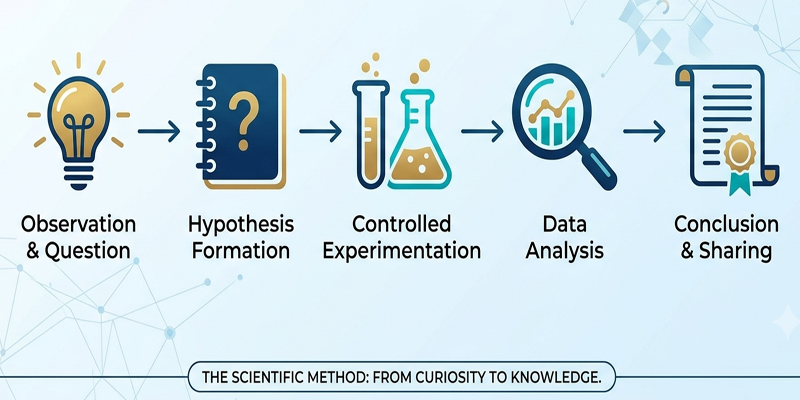
The Scientific Method
Scientists don’t make random guesses. They follow a step-by-step process known as the Scientific Method.
Step 1: Observation
Notice something interesting.
Example:
An apple falls from a tree.
Step 2: Ask a Question
Why did the apple fall downward instead of upward?
Step 3: Form a Hypothesis
A possible explanation.
Example:
There might be a force pulling objects toward Earth.
Step 4: Experiment
Perform experiments to test the idea.
Step 5: Analyze Results
Study the collected data carefully.
Step 6: Draw a Conclusion
If the evidence supports the hypothesis, it may become part of a scientific theory or law after repeated testing.
Science in Everyday Life
Science isn’t limited to laboratories or classrooms.
Here are a few everyday examples:
| Activity | Science Behind It |
|---|---|
| Cooking food | Chemical reactions |
| Riding a bicycle | Force, balance, and motion |
| Using a refrigerator | Heat transfer |
| Watching television | Electricity and light |
| Mobile phones | Electronics and communication |
| Drinking clean water | Filtration and purification |
| Rainfall | Water cycle |
| Plant growth | Photosynthesis |
Every day, science quietly works in the background to make our lives easier.
Science and Technology
People often confuse science with technology.
Although they are closely related, they are different.
Science helps us understand nature.
Technology uses scientific knowledge to create useful tools and machines.
For example:
- Scientists discovered electricity.
- Engineers used that knowledge to develop electric appliances.
Science discovers.
Technology applies.
Fun Facts About Science
- The human body contains trillions of cells.
- Light from the Sun takes about 8 minutes 20 seconds to reach Earth.
- Water expands when it freezes, which is why ice floats.
- Sound cannot travel through the vacuum of space.
- The Earth revolves around the Sun once every 365¼ days.
Common Misconceptions About Science
Myth: Science is only for brilliant students.
Fact: Science is about curiosity and asking questions, not memorizing facts.
Myth: Science always has every answer.
Fact: Science keeps evolving as discoveries are made.
Myth: Experiments are only done in laboratories.
Fact: Everyday activities like growing plants or observing weather are also simple scientific experiments.
How Students Can Develop a Scientific Mindset
You don’t need expensive equipment to think like a scientist.
You can:
- Observe nature.
- Ask “Why?” and “How?” questions.
- Read science books and articles.
- Perform safe experiments at home or school.
- Visit science museums and exhibitions.
- Watch the night sky and identify planets and constellations.
- Verify information before believing it.
Curiosity is the first step toward scientific thinking.
Conclusion
Friends, in this blog post(What Is Science), we have discovered some amazing facts about “Science”. Being a part of your school syllabus, science has a much broader scope and impact in our ecosystem. We can also define it as an amazing art of exploring and understanding new things through observation, experimentation, and evidence.
If you develop a scientific mindset or temperament, then it is definitely going to help you think logically solving problems; it won’t matter whether you are preparing for any CBSE Exam or simply have curiosity to know something new(like new technologies, the working science behind any process). |What Is Science|
You are going to explore lots of scientific concepts along with fascinating stories behind them in the continuation of this “Science Made Simple” blog series. We will explore it together and see the wonders of science and its impact on our daily lives. |What Is Science|
If you have any queries, you can write to us at support@a5theory.com; we will get back to you ASAP.
Hope! You would have enjoyed this post(What Is Science).
Please feel free to give your important feedback in the comment section below.
Have a great time!