

Hello Friends, in this blog post(Why Does the Moon Change Shape), we are going to discuss the beautiful and amazing moon shape change that always keeps on changing.
Almost every human sees this and notices this constant change in the shape of the Moon in the sky.
Starting from a thin crescent shape to a half-circle, it gradually becomes a beautiful full moon within a few days. |Why Does the Moon Change Shape|
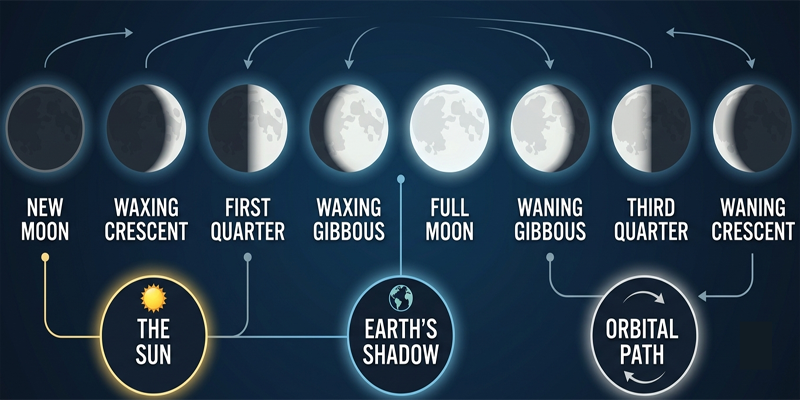
And from the full moon shape, it starts to descend or shrink once again and keeps on shrinking until…
… it has completely disappeared for one or two days, when we can barely see it with our naked eyes.
We can say it constantly keeps its shape, changing in a cycle of approx 15 days. Now, one main question should arise in our minds.
Does the Moon really change its shape?
The answer to this question is absolutely NO! The Moon always remains in its approximately full spherical shape.
And the thing that actually changes is the portion of the Moon that is visible from Earth and is lit by sunlight, or being shined from the sunlight.
And this change in its appearance is considered or known as the phases of the Moon.
The movement of objects in space creates something remarkable scenes that are visible from Earth- the Moon could be the simplest and most beautiful example of it. |Why Does the Moon Change Shape|
Does the Moon Produce Its Own Light?
No.
The Moon does not produce its own visible light like the Sun.
Instead, sunlight falls on the Moon’s surface.
Some of that sunlight is reflected toward Earth.
So when we see the Moon shining in the night sky, we are actually seeing reflected sunlight.
This is an important difference between stars and planets or moons.
Then Why Does the Moon Look Different Every Night?
The Moon is constantly moving around Earth.
As it orbits Earth, the positions of:
- The Sun
- Earth
- Moon
change relative to one another.
The Sun always illuminates approximately half of the Moon.
But from Earth, we don’t always see the same fraction of that illuminated half.
That’s why the Moon appears to change shape.
The Moon Is Always Half Illuminated
At any particular moment, approximately half of the Moon is illuminated by sunlight.
Think of holding a ball under a lamp.
The lamp illuminates one side of the ball.
The other side remains dark.
The Moon works similarly.
The important point is:
The Moon itself isn’t becoming brighter and darker because its shape changes.
Our viewing angle changes.
What Causes the Moon’s Phases?
The Moon’s phases are caused by the changing relative positions of:
Sun → Moon → Earth
As the Moon travels around Earth, we see different portions of its illuminated side.
This creates the familiar sequence of lunar phases.
What Are the Main Phases of the Moon?
The Moon’s cycle is commonly divided into eight main phases:
- New Moon
- Waxing Crescent
- First Quarter
- Waxing Gibbous
- Full Moon
- Waning Gibbous
- Third Quarter
- Waning Crescent
Then the cycle begins again.
1. New Moon
During a New Moon, the Moon is positioned approximately between Earth and the Sun.
The side facing Earth is mostly the unilluminated side.
Therefore, the Moon is difficult or impossible to see with the naked eye under normal conditions.
This doesn’t mean the Moon has disappeared.
It is still there.
We simply aren’t seeing its illuminated side. |Why Does the Moon Change Shape|
2. Waxing Crescent
After the New Moon, a small illuminated portion becomes visible.
This is the:
Waxing Crescent
“Waxing” means the illuminated portion we see is increasing.
The Moon appears as a thin curved crescent.
3. First Quarter
About a week after the New Moon, we see approximately half of the Moon’s visible disk illuminated.
This phase is called the:
First Quarter
Interestingly, the name doesn’t mean half of the Moon exists.
The Moon has completed roughly one quarter of its orbital cycle around Earth.
4. Waxing Gibbous
After the First Quarter, more than half of the visible lunar disk is illuminated.
This is called:
Waxing Gibbous
The illuminated portion continues increasing as the Moon approaches the Full Moon phase.
5. Full Moon
During a Full Moon, Earth is approximately between the Sun and Moon.
The side of the Moon facing Earth is largely illuminated by sunlight.
The Moon therefore appears as a bright circular disk.
This is usually the phase people recognize most easily. |Why Does the Moon Change Shape|
6. Waning Gibbous
After the Full Moon, the visible illuminated portion begins decreasing.
This phase is called:
Waning Gibbous
“Waning” means the illuminated portion we see is decreasing.
7. Third Quarter
At the Third Quarter, approximately half of the visible lunar disk is illuminated again.
The Moon has now completed roughly three quarters of its orbit since the previous New Moon.
This phase is also sometimes called the Last Quarter.
8. Waning Crescent
The illuminated portion continues decreasing.
Only a thin crescent remains visible.
This is the:
Waning Crescent
Soon, the Moon reaches the New Moon phase again.
Then the cycle repeats. |Why Does the Moon Change Shape? |
The Complete Moon Phase Cycle
The sequence can be remembered as:
New Moon
↓
Waxing Crescent
↓
First Quarter
↓
Waxing Gibbous
↓
Full Moon
↓
Waning Gibbous
↓
Third Quarter
↓
Waning Crescent
↓
New Moon
And the cycle continues.
What Does “Waxing” Mean?
Waxing = Increasing
When the visible illuminated portion of the Moon is growing, the Moon is waxing.
Examples:
- Waxing Crescent
- Waxing Gibbous
What Does “Waning” Mean?
Waning = Decreasing
When the visible illuminated portion is becoming smaller, the Moon is waning.
Examples:
- Waning Gibbous
- Waning Crescent
Why Does the Moon Look Like a Crescent?
A crescent Moon occurs when we can see only a small portion of the Moon’s illuminated side.
Most of the visible lunar disk is facing away from the illuminated portion.
The Moon itself hasn’t become crescent-shaped.
Only the visible illuminated part appears crescent-shaped.
Why Does the Moon Look Like a Half Circle?
During the First Quarter and Third Quarter phases, approximately half of the Moon’s visible disk is illuminated.
The result looks like a half-circle from Earth.
Again, the Moon itself remains spherical.
Does Earth’s Shadow Cause Moon Phases?
No.
This is one of the most common misconceptions.
The normal phases of the Moon are not caused by Earth’s shadow.
Earth’s shadow falls on the Moon during a lunar eclipse.
A lunar eclipse is a special event.
Moon phases happen regularly throughout the lunar cycle.
Moon Phases vs Lunar Eclipse
| Moon Phases | Lunar Eclipse |
|---|---|
| Occur continuously through the lunar cycle | Occurs only under a specific alignment |
| Caused by changing viewing geometry | Caused by Earth’s shadow falling on the Moon |
| Happens every lunar cycle | Does not happen at every Full Moon |
| No special alignment of three bodies is required beyond normal orbital geometry | Requires a particularly close alignment of Sun, Earth, and Moon |
Why Doesn’t a Lunar Eclipse Happen Every Full Moon?
You might think:
“During every Full Moon, Earth is between the Sun and Moon. So why doesn’t Earth’s shadow cover the Moon?”
The reason is that the Moon’s orbit is tilted slightly relative to Earth’s orbit around the Sun.
Most of the time, the Moon passes slightly above or below the direct line of Earth’s shadow.
Only when the alignment is sufficiently precise can a lunar eclipse occur. |Why Does the Moon Change Shape|
Why Doesn’t a Solar Eclipse Happen Every New Moon?
The same basic idea applies.
During a New Moon, the Moon is approximately between Earth and the Sun.
But the Moon’s orbit is tilted.
Therefore, the Moon usually passes above or below the Sun from our viewpoint.
A solar eclipse requires a much more precise alignment.
Why Does the Moon Rise at Different Times?
The Moon orbits Earth.
Because of this movement, its position in the sky changes from one day to the next.
As a result, the Moon generally rises about 50 minutes later each day on average, although the exact difference varies with location and time of year.
This is one reason the Moon can be seen at different times during different phases.
Can You See a New Moon at Night?
A New Moon is located approximately in the same direction as the Sun from Earth.
Therefore, it is generally near the daytime sky, and its illuminated side faces away from us.
This makes it extremely difficult to see with the naked eye. |Why Does the Moon Change Shape|
Why Is a Full Moon Visible All Night?
During a Full Moon, the Moon is approximately opposite the Sun in Earth’s sky.
It therefore:
- Rises around sunset
- Reaches its highest point around midnight
- Sets around sunrise
The exact times vary depending on location and season.
Why Is a Crescent Moon Often Seen Near Sunrise or Sunset?
A crescent Moon is relatively close to the Sun in the sky.
A waxing crescent is generally visible after sunset.
A waning crescent is generally visible before sunrise.
This is a useful way to connect the Moon’s phase with its position relative to the Sun.
Does the Moon Take One Day to Change Its Phase?
No.
The Moon’s appearance changes gradually.
The complete cycle from one New Moon to the next takes approximately:
29.5 days
This is called the synodic month.
Why Is the Moon’s Orbital Period Not Exactly 29.5 Days?
The Moon actually takes approximately 27.3 days to orbit Earth relative to the distant stars.
But while the Moon is orbiting Earth, Earth is also moving around the Sun.
The Moon therefore needs a little extra time to return to the same apparent position relative to the Sun and Earth.
That produces the approximately 29.5-day phase cycle.
Why Does the Moon Always Show Nearly the Same Face to Earth?
This is another fascinating fact.
The Moon rotates on its own axis.
At the same time, it orbits Earth.
The Moon takes approximately the same amount of time to rotate once as it takes to orbit Earth once.
This is called:
Synchronous rotation
Because of this, the same general side of the Moon always faces Earth.
Does the Moon Really Have a “Dark Side”?
Not permanently.
The phrase “dark side of the Moon” can be misleading.
The far side of the Moon receives sunlight just like the near side.
The far side is simply the side that generally faces away from Earth.
A better term is:
Far side of the Moon
Does the Moon Have a Far Side We Never See?
Yes.
Because of synchronous rotation, Earth observers normally see the same hemisphere of the Moon.
Spacecraft have photographed the far side extensively.
Why Does the Moon Sometimes Look Orange or Red?
The Moon’s colour can appear different because of Earth’s atmosphere.
When the Moon is low on the horizon, its light travels through a greater thickness of atmosphere.
Atmospheric scattering can reduce shorter wavelengths and make the Moon appear:
- Yellow
- Orange
- Reddish
Dust, pollution, smoke, and atmospheric conditions can influence the appearance. |Why Does the Moon Change Shape|
Why Does the Full Moon Look Bigger Near the Horizon?
This is known as the:
Moon illusion
A Moon near the horizon can appear much larger than when it is high in the sky.
But photographs taken with the same magnification can show that its apparent angular size hasn’t changed significantly simply because it moved from the horizon to a higher position.
The effect is largely related to how our brains interpret the Moon’s size in relation to surrounding objects and the landscape.
Why Does the Moon Sometimes Look Huge?
The Moon’s orbit around Earth is slightly elliptical.
Therefore, its distance from Earth changes.
When the Moon is closer to Earth, it can appear somewhat larger.
When it is farther away, it appears somewhat smaller.
A particularly close Full Moon is popularly called a:
Supermoon
Why Doesn’t the Moon Fall Into Earth?
The Moon is constantly being pulled toward Earth by gravity.
So why doesn’t it crash into us?
Because the Moon also has sideways motion.
It is essentially continuously falling around Earth.
Its forward motion and Earth’s gravitational pull combine to produce an orbit.
This is the same basic principle that allows artificial satellites to orbit Earth.
Is the Moon’s Gravity Strong?
The Moon’s surface gravity is approximately one-sixth of Earth’s.
If you weigh 60 kg on Earth, your mass remains 60 kg on the Moon, but your weight would be about one-sixth as much.
This is why astronauts could make impressive jumps on the lunar surface.
Why Does the Moon Affect Ocean Tides?
The Moon’s gravity contributes significantly to Earth’s ocean tides.
The Sun also contributes.
As Earth rotates and the relative positions of Earth, Moon, and Sun change, the oceans experience changing gravitational effects.
This produces the familiar cycle of high and low tides. |Why Does the Moon Change Shape|
Does the Moon Really Change Shape?
No.
The Moon remains approximately spherical.
Its surface isn’t physically changing from:
Circle → Half-circle → Crescent → Circle
What changes is the portion of the illuminated lunar surface visible from Earth.
A Simple Moon Phase Experiment
You can demonstrate Moon phases at home.
You’ll Need
- A small ball
- A torch or lamp
- A dark room
Steps
- Place the lamp in one position. It represents the Sun.
- Hold the ball at arm’s length.
- The ball represents the Moon.
- Slowly rotate yourself while keeping the ball at arm’s length.
- Keep the lamp fixed.
- Observe how the illuminated portion of the ball appears to change.
You will see different shapes resembling:
- Crescent
- Half Moon
- Gibbous
- Full Moon
This is essentially a small model of the Moon-phase system.
Important Observation
During the experiment, remember:
The lamp illuminates half of the ball all the time.
Yet your viewing position changes the amount of the illuminated surface you can see.
That’s exactly the key idea behind lunar phases. |Why Does the Moon Change Shape|
Can You Observe Moon Phases Without a Telescope?
Absolutely.
In fact, the Moon is one of the easiest astronomical objects to observe with the naked eye.
You can track:
- Its shape
- Its position
- Its rising time
- Its setting time
- Its movement relative to stars
You can even keep a Moon diary for one month.
Try Keeping a Moon Diary
For about a month:
- Observe the Moon at roughly the same time each evening when possible.
- Draw its visible shape.
- Record the date.
- Note approximately where it appears in the sky.
- Record whether it is waxing or waning.
After several weeks, you’ll see the complete cycle.
This is a simple observation project that turns astronomy into hands-on science.
Did You Know?
- The Moon does not produce its own visible light.
- Moonlight is reflected sunlight.
- Approximately half of the Moon is illuminated by the Sun at any given time.
- The Moon’s phases are caused by changing viewing geometry.
- A complete phase cycle takes about 29.5 days.
- The Moon’s orbital period relative to distant stars is about 27.3 days.
- The Moon is tidally locked to Earth.
- The far side of the Moon is not permanently dark.
- A lunar eclipse is different from an ordinary Moon phase.
- The Moon’s gravity contributes significantly to ocean tides.
Common Mistakes Students Make
❌ Thinking the Moon changes its physical shape.
✔ The Moon remains approximately spherical; only its illuminated appearance changes.
❌ Thinking Earth’s shadow causes every Moon phase.
✔ Earth’s shadow is involved in lunar eclipses, not ordinary Moon phases.
❌ Thinking the Moon produces its own light.
✔ The Moon shines mainly by reflecting sunlight.
❌ Thinking the Full Moon happens because the Moon is completely illuminated on all sides.
✔ Approximately half of the Moon is illuminated at any given time. During a Full Moon, the illuminated hemisphere is oriented toward Earth.
❌ Thinking the far side of the Moon is always dark.
✔ The far side receives sunlight too.
❌ Thinking a Full Moon occurs every 27.3 days.
✔ The phase cycle from New Moon to New Moon is approximately 29.5 days.
Frequently Asked Questions (FAQs)
1. Why does the Moon change shape?
The Moon doesn’t actually change shape. As it orbits Earth, we see different portions of its sunlit side. |Why Does the Moon Change Shape? |
2. What causes Moon phases?
Moon phases are caused by the changing positions of the Sun, Earth, and Moon.
3. How long is one complete Moon phase cycle?
Approximately 29.5 days, from one New Moon to the next.
4. Does the Moon have its own light?
No. It reflects sunlight.
5. Why is there a Full Moon?
A Full Moon occurs when the Moon is approximately opposite the Sun from Earth’s perspective, allowing most of the illuminated hemisphere facing Earth to be visible.
6. Why is there a New Moon?
A New Moon occurs when the Moon is approximately between Earth and the Sun, so the illuminated side largely faces away from Earth.
7. Is the Moon’s dark side always dark?
No. The far side of the Moon receives sunlight just like the near side.
8. Why don’t we have a lunar eclipse every Full Moon?
Because the Moon’s orbit is tilted relative to Earth’s orbital plane, so the Moon usually passes above or below Earth’s shadow.
Why This Topic Matters
Moon phases are a perfect introduction to astronomy because they demonstrate how motion, light, gravity, and observation work together.
By simply looking at the Moon, students can begin understanding:
- Orbits
- Rotation
- Revolution
- Reflection
- Light
- Gravity
- Tides
- Eclipses
- Earth’s place in the Solar System
You don’t need an expensive telescope to start studying astronomy.
The Moon is already giving us a science lesson every night.
Conclusion
Friends, in this blog post(Why Does the Moon Change Shape), we have discovered the science behind the changing shapes of the Moon in the sky. Now, we can conclude that the Moon actually does not change its shape. It is always a roughly spherical world orbiting around the Earth.
What keeps changing is actually that surface or portion of the Moon that is lit or illuminated and visible to us from Earth. Sunlight continues to illuminate approximately half of the portion of the Moon rotating around the Earth. And we always see different portions of that illuminated half from our changing viewpoint. |Why Does the Moon Change Shape|
A beautiful sequence is then created like:–
New Moon → Crescent → Quarter → Gibbous → Full Moon → Gibbous → Quarter → Crescent → New Moon
So, you should remember this on seeing the crescent moon next time, you are not actually seeing the distinct shape of the moon, but you are ultimately seeing a different part or portion of the same moon, which is illuminated by the sunlight. |Why Does the Moon Change Shape|
If you have any queries, you can write to us at support@a5theory.com; we will get back to you ASAP.
Hope! You will enjoy this post, “Why Does the Moon Change Shape?”
Please feel free to give your feedback in the comment section below.
Have a great time!