

Hello Friends, in this blog post(Why Do We Get Static Electricity), we are going to discuss static electricity and its effects.
Most of you have also experienced this in your life. You sit on a plastic chair wearing woolen clothes, and…
…then you suddenly stand and shake hands with your friend who has just come to meet you, or you touch any metal object. |Why Do We Get Static Electricity|
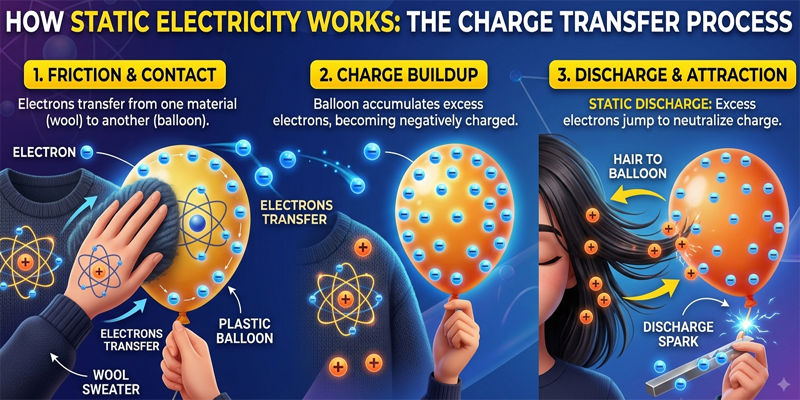
Bang! You both experience a sudden, tiny electric shock
Another case: you just walk on a carpet and then touch a metal door handle.
Zap! You feel a tiny electric shock. There are plenty of events where you feel this tiny electric shock suddenly.
You might have heard the little crackling sound while you were taking off a sweater.
When you rub a balloon on your head hair, your hair stands up.
So, what happens here?
Though there is no battery and no wires present. But you are clearly feeling electricity effect.
This type of event or phenomenon is known as static electricity. |Why Do We Get Static Electricity|
And the science that is responsible for all this electric shock starts with something remarkably small, which we know as electrons. |Why Do We Get Static Electricity|
What Is Static Electricity?
Static electricity is an imbalance of electric charge on the surface of an object.
Normally, objects contain positive and negative charges in balanced amounts.
When electrons move from one material to another, one object can become relatively more negatively charged while the other becomes relatively more positively charged.
The charge remains “static” when it does not have an easy path to flow away. |Why Do We Get Static Electricity|
What Are Electric Charges?
Electric charge is a fundamental property of matter.
There are two types:
- Positive charge
- Negative charge
The basic rule is:
Like charges repel.
Unlike charges attract.
So:
- Positive + Positive → Repel
- Negative + Negative → Repel
- Positive + Negative → Attract
Where Does the Charge Come From?
Everything around us is made of atoms.
An atom contains:
- Protons — positive
- Electrons — negative
- Neutrons — no net electric charge
Protons and neutrons are located in the nucleus.
Electrons occupy regions around the nucleus.
In many ordinary materials, electrons can be transferred relatively easily from one object to another.
That’s where static electricity begins. |Why Do We Get Static Electricity? |
Why Do Electrons Move Instead of Protons?
Protons are tightly bound inside atomic nuclei.
Electrons, especially those involved in the outer regions of atoms and molecules, can be transferred between materials much more easily.
Therefore, when we talk about objects becoming positively or negatively charged through ordinary static processes, we’re generally talking about electrons moving.
How Does Rubbing Create Static Electricity?
You may have heard:
“Rubbing two objects creates electricity.”
That’s a useful simple explanation, but it’s not quite complete.
When two different materials are brought into contact and separated, electrons can transfer between them.
Rubbing increases the amount of contact and separation between microscopic regions of the surfaces.
Depending on the materials, one may gain electrons while the other loses electrons.
This process is called the triboelectric effect. |Why Do We Get Static Electricity? |
The Balloon and Hair Experiment
This is one of the easiest ways to observe static electricity.
You’ll Need
- A balloon
- Dry hair
Steps
- Inflate the balloon.
- Rub it against your hair several times.
- Slowly move the balloon away.
You may see your hair being attracted toward the balloon.
In some conditions, several strands may even stand up.
What Happened to the Hair?
When the balloon and hair interact, electrons can be transferred between the two materials.
The balloon becomes electrically charged.
Your hair acquires the opposite type of net charge.
Opposite charges attract.
Since individual hairs can acquire similar charges, they also tend to repel one another.
That’s why the hair can spread out.
Why Does Hair Stand Up?
Imagine several hairs carrying similar charges.
Because as charges repel, each hair tries to move away from the others.
The result is:
Hair strands spread apart.
Gravity still pulls them downward, but the electrostatic forces can become strong enough to make the hair visibly stand out.
Why Does Static Electricity Work Better in Dry Weather?
Static electricity is usually more noticeable when the air is dry.
Water molecules in humid air and thin layers of moisture on surfaces can provide pathways that help electric charge gradually leak away.
In dry conditions, charge can remain on insulating surfaces for longer.
That’s why you may notice more static shocks during dry weather or in air-conditioned environments.
Why Don’t We Usually Get Static Shocks From Everything?
Because many objects don’t retain charge very well.
Materials can broadly be classified according to how easily electric charges move through them.
Conductors
Charges can move relatively easily.
Examples include:
- Copper
- Aluminium
- Many metals
Insulators
Charges do not move freely through them.
Examples include:
- Rubber
- Plastic
- Glass
- Dry wood
Static electricity is particularly easy to observe on insulating materials. |Why Do We Get Static Electricity? |
Why Do Metal Objects Give Us a Shock?
Suppose you’ve walked across a carpet and accumulated excess charge.
Your body can temporarily hold that charge.
Then you touch a metal object.
Metal is a good conductor.
The charge can move rapidly between your body and the object.
That sudden movement of charge can produce a tiny spark and a brief sensation of shock.
Why Does the Shock Sometimes Feel Stronger?
The sensation depends on several factors, including:
- Amount of accumulated charge
- Voltage
- Path of the discharge
- Duration
- Skin conditions
- Environmental humidity
A static shock can involve a high voltage but an extremely small amount of charge and very short duration.
That’s why a noticeable static shock is usually very different from being connected to a power supply.
Why Can You Sometimes See a Tiny Spark?
If the voltage difference becomes sufficiently large, the electric field between two objects can become strong enough to ionize nearby air molecules.
The air temporarily becomes more electrically conductive.
A tiny electrical discharge can jump across the gap.
In a dark room, you may sometimes see this as a small spark.
What Is Air Ionization?
Normally, air is a poor conductor of electricity.
But a sufficiently strong electric field can give electrons enough energy to interact with atoms and molecules, producing ions and additional free electrons.
This can create a conductive path through the air.
This process is called ionization.
It’s an important concept in both static electricity and lightning. |Why Do We Get Static Electricity|
Is Lightning Static Electricity?
Lightning is related to electrostatic charge separation, but it is far more powerful and complex than the small static shocks we experience at home.
Inside thunderstorms, enormous regions of electric charge can develop.
When the electric field becomes sufficiently strong, large electrical discharges can occur.
So you can think of a static shock as a tiny everyday demonstration of principles that also occur on a vastly larger scale in thunderstorms.
Why Does a Shock Sometimes Happen When You Touch Someone?
Imagine two people.
One person has accumulated more electric charge than the other.
When they touch, charge can rapidly redistribute between their bodies.
If the potential difference is large enough, a tiny spark may occur.
You may experience it as a quick:
“Ouch!”
This is especially common in dry conditions.
Why Do Clothes Sometimes Crackle?
When clothes rub against one another, electrons can transfer between different materials.
Synthetic fabrics can be particularly effective at accumulating static charge.
When charged fabrics separate or move against each other, tiny discharges can occur.
These can produce:
- Crackling sounds
- Small sparks
- Clothes sticking together
Why Do Clothes Stick Together After Drying?
Static charge can develop as clothes tumble and rub against each other.
If different fabrics acquire opposite charges, they can attract one another.
This can make clothes cling together.
Humidity can reduce the effect by allowing charge to dissipate more easily.
Why Does a Comb Attract Small Pieces of Paper?
Try this:
- Take a plastic comb.
- Rub it against dry hair.
- Bring it close to tiny pieces of paper.
The paper may move toward the comb.
But the paper was electrically neutral before the experiment.
So why is it attracted?
The answer is electrostatic induction or polarization.
What Is Polarization?
An electrically neutral object can still have its charges slightly rearranged by a nearby charged object.
For example, if a negatively charged comb approaches a small piece of paper, electrons in the paper may shift slightly away from the comb.
The side closer to the comb becomes relatively more positive.
The opposite side becomes relatively more negative.
Because the opposite charge is closer to the comb, the attractive force can be stronger than the repulsive force.
The paper moves toward the comb.
Can a Neutral Object Be Attracted by a Charged Object?
Yes.
This is an important concept.
An object doesn’t necessarily have to carry a net charge to experience electrostatic attraction.
Its internal charge distribution can be rearranged.
This is why a charged balloon can stick to a wall even when the wall itself is electrically neutral overall.
Why Does a Balloon Stick to a Wall?
After rubbing a balloon against hair, the balloon becomes charged.
When brought near a wall, the electric field of the balloon causes a slight rearrangement of charges within the wall’s material.
The nearby surface becomes relatively more attractive to the charged balloon.
The electrostatic attraction can be strong enough to hold the balloon against the wall for some time.
Why Doesn’t the Balloon Stay There Forever?
The charge gradually leaks away.
Air humidity, surface conditions, and the materials involved all influence how quickly this happens.
Eventually, the electrostatic attraction becomes too weak to support the balloon.
And down it falls.
What Is an Electroscope?
An electroscope is a simple scientific instrument used to detect electric charge.
A traditional gold-leaf electroscope contains conducting parts that respond when charge is transferred to or induced in the instrument.
If similarly charged leaves move apart, it indicates the presence of electric charge. |Why Do We Get Static Electricity|
How Does an Electroscope Work?
When charge is transferred to the conducting parts of an electroscope, charges redistribute.
The leaves acquire charges of the same sign.
Because like charges repel, the leaves move apart.
This converts an invisible electrical phenomenon into something we can observe.
Static Electricity vs Current Electricity
These two concepts are related but different.
| Static Electricity | Current Electricity |
|---|---|
| Charge accumulates | Charge continuously flows |
| Often occurs on insulating surfaces | Usually flows through a conducting path |
| Can produce sudden discharges | Can provide continuous electrical power |
| Example: balloon and hair | Example: electricity in a circuit |
Is Static Electricity Actually Electricity?
Yes.
Both static electricity and current electricity involve electric charge.
The main difference is how the charge behaves.
Static electricity: charge accumulates.
Current electricity: charge flows through a path. |Why Do We Get Static Electricity? |
Why Does Static Electricity Sometimes Damage Electronics?
Electronic components can be extremely sensitive to sudden electrostatic discharges.
A static discharge that feels harmless to a person can sometimes damage sensitive semiconductor components.
This is why people working with electronics may use:
- Antistatic wrist straps
- Grounding systems
- Antistatic mats
- Special packaging
These methods help prevent unwanted electrostatic discharge.
What Is an Antistatic Wrist Strap?
An antistatic wrist strap is designed to provide a controlled path for static charge to dissipate safely when handling sensitive electronic components.
It helps keep the person and equipment at similar electrical potential, reducing the chance of sudden discharge.
Why Are Cars Sometimes Involved in Static Shocks?
A person can accumulate charge while moving in or out of a vehicle.
Synthetic clothing, car seats, and dry conditions can contribute.
When the person then touches a conductive part of the vehicle, the charge may discharge.
That’s why you might occasionally feel a small spark when touching a car door.
Can Static Electricity Cause Fires?
Yes, under certain circumstances.
A static discharge can ignite flammable vapors, gases, or dust when the conditions are appropriate.
This is why industries handling flammable materials use strict static-control and grounding procedures.
Static electricity is usually harmless in everyday situations, but under the right conditions it can become a serious safety issue.
Why Is Static Electricity More Common With Synthetic Clothes?
Different materials have different tendencies to gain or lose electrons when brought into contact.
Many synthetic materials are good at retaining charge because they are electrical insulators.
Materials such as polyester and nylon can therefore produce noticeable static effects under suitable conditions. |Why Do We Get Static Electricity|
What Is the Triboelectric Series?
Scientists can arrange materials according to their tendency to become positively or negatively charged after contact and separation.
This is known as the triboelectric series.
It is not an absolute rule for every situation because actual charging depends on:
- Surface condition
- Humidity
- Material purity
- Contact pressure
- Temperature
- Surface contamination
Still, the concept helps explain why certain pairs of materials produce strong static effects.
Why Does Touching a Metal Object Remove Static Charge?
Metal provides a relatively easy path for charge to move.
If you are carrying excess charge and touch a grounded conductor, charge can flow away.
This reduces the imbalance.
In other words:
Static charge + conductive path → charge redistribution
What Is Grounding?
Grounding provides a connection to a large electrical reservoir, commonly Earth, allowing excess charge to move away or equalize.
Grounding is widely used in electrical systems and static-control applications.
It is important to distinguish grounding for static control from the safe design and protection systems used with mains electricity.
A Simple Static Electricity Experiment
You’ll Need
- A balloon
- Small pieces of paper
- Dry hair or a woollen cloth
Steps
- Tear paper into tiny pieces.
- Rub the balloon against your hair or woollen cloth.
- Bring the balloon close to the paper.
- Watch what happens.
The pieces of paper may jump toward the balloon.
What Does the Experiment Demonstrate?
The rubbing process can charge the balloon.
The charged balloon then produces an electric field.
The electric field causes polarization in the nearby paper.
The paper experiences an electrostatic attraction.
So the chain is:
Rubbing → Charge transfer → Electric field → Polarization → Attraction
Another Experiment: Make Your Hair Stand Up
You’ll Need
- A balloon
- Dry hair
Steps
- Rub the balloon against your hair.
- Slowly pull it away.
- Observe your hair.
The hairs can acquire similar charges and repel one another.
This makes them spread apart. |Why Do We Get Static Electricity? |
Why Doesn’t This Experiment Work as Well on Humid Days?
Moisture provides additional pathways through which charge can gradually dissipate.
As a result, the balloon may not retain enough charge for a strong effect.
This is why static electricity demonstrations usually work better in dry conditions.
Did You Know?
- Static electricity is caused by an imbalance of electric charge.
- Electrons are usually the particles transferred between materials.
- Rubbing can increase opportunities for charge transfer.
- Dry air generally allows static charge to persist longer.
- A tiny static spark can involve a very high voltage but very little total charge.
- Lightning involves electrical charge separation on an enormous scale.
- A neutral object can be attracted to a charged object through polarization.
- Static electricity can damage sensitive electronic components.
- Static discharge can become dangerous around flammable gases, vapors, or dust.
Common Mistakes Students Make
❌ Thinking rubbing creates electrons from nothing.
✔ Rubbing can cause electrons to transfer between materials.
❌ Thinking positively charged objects contain only positive particles.
✔ A positively charged object generally has lost some electrons; its protons remain in the nuclei.
❌ Thinking a neutral object cannot be attracted to a charged object.
✔ Charge redistribution can produce attraction through polarization.
❌ Thinking static electricity only occurs with balloons.
✔ It can occur with clothing, carpets, plastics, electronic components, vehicles, and many other materials.
❌ Thinking static electricity and current electricity are completely unrelated.
✔ Both involve electric charge; the major difference is whether charge is accumulated or continuously flowing.
Frequently Asked Questions (FAQs)
1. What causes static electricity?
Static electricity usually results from an imbalance of electric charge, often caused by electron transfer between materials. |Why Do We Get Static Electricity? |
2. Why do we get small electric shocks?
A difference in electrical potential can cause accumulated charge to rapidly discharge when you touch another object.
3. Why is static electricity stronger in winter or dry weather?
Low humidity allows charge to remain on surfaces longer because there are fewer moisture-related pathways for charge to dissipate.
4. Why does a balloon stick to a wall?
The charged balloon causes charge redistribution in the wall, producing electrostatic attraction.
5. Can static electricity be dangerous?
Usually, everyday static shocks are harmless, but electrostatic discharges can ignite flammable materials or damage sensitive electronics.
6. Is lightning a form of static electricity?
Lightning involves large-scale electrical charge separation and discharge in thunderstorms, making it closely related to electrostatic phenomena but vastly more powerful and complex.
Why This Topic Matters
Static electricity is a perfect example of how something invisible can produce visible effects.
It connects:
- Atomic structure
- Electrons
- Electric charge
- Electric fields
- Conductors
- Insulators
- Electrostatic force
- Lightning
- Electronics
- Industrial safety
And the best part?
You don’t need a laboratory to observe it.
A balloon, a comb, a carpet, or even your clothes can become a small physics experiment.
Conclusion
Friends, in this blog post(Why Do We Get Static Electricity), we have understood the concept of static electricity. It might seem to be very simple to see static electricity begin by simply rubbing a balloon against your hair. But there is an important science of electrons and electric charges behind this simple experiment. An imbalance is created by the movement of electrons from one material to another. And this imbalance causes an electric field.
An insulating surface can retain the charges for some time. But it can find a path to move eventually. And when this happens suddenly, you might feel a tiny spark or feel a quick electric shock. Static electricity shows us something very fundamental, whether it is a balloon sticking to a wall or an enormous electrical discharge of lightning. |Why Do We Get Static Electricity? |
Even some invisible particles have the capability to create such powerful forces affecting the world around us.
If you have any queries, you can write to us at support@a5theory.com; we will get back to you ASAP.
Hope! You will enjoy this post, “Why Do We Get Static Electricity?”
Please feel free to give your feedback in the comment section below.
Have a great time!