

Hello Friends, in this blog post(How Does a Refrigerator Work), we are going to discuss the working of an amazing device that is available in almost every house: the refrigerator.
The basic work of a refrigerator is to store and preserve items like food, vegetables, milk, etc., at a cold temperature.
So basically, a refrigerator helps us preserve some items for many days and keep them from rotting. |How Does a Refrigerator Work|
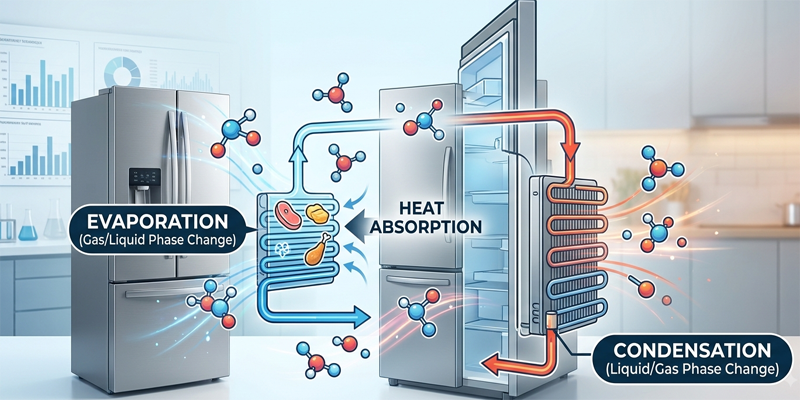
But now, there comes few curious questions in our mind:
- How does the refrigerator keep a cold temperature inside?
- Does a refrigerator actually produce cold?
You might be surprised to know the answer to this question is “No“. |How Does a Refrigerator Work|
This is an amazing fact: a refrigerator does not produce cold itself; rather, it only removes the heat present inside and transfers it to the surrounding room or areas.
A well-designed refrigerator cycle, having a compressor, expansion device, condenser, evaporator,…
… and a special fluid called a refrigerant, is responsible for this cooling process inside the refrigerator.
So, you should know that the refrigerator kept in your kitchen is a small thermodynamic machine.
In this post(How Does a Refrigerator Work), we are going to see the complete working process of a refrigerator in detail.
What Is a Refrigerator?
A refrigerator is a device that uses energy to transfer heat from a colder region to a warmer
region.
Normally, heat naturally flows from a warmer object to a colder object.
For example:
Hot tea → surrounding air
But a refrigerator needs to move heat in the opposite direction:
Cold refrigerator → warmer kitchen
To make this happen, the refrigerator uses electrical energy.
This is an important application of the Second Law of Thermodynamics.
Does a Refrigerator Produce Cold?
Not exactly.
There is no special substance called “cold” being pumped into your refrigerator.
Instead, the refrigerator removes thermal energy from the air and objects inside it.
Think of it this way:
Less heat = lower temperature
So when the refrigerator removes heat from the food and air, their temperature decreases.
The Four Main Parts of a Refrigerator
A typical vapor-compression refrigerator has four major components:
- Compressor
- Condenser
- Expansion device
- Evaporator
These components form a continuous closed loop through which the refrigerant circulates.
The complete process is called the:
Vapor-Compression Refrigeration Cycle
What Is a Refrigerant?
A refrigerant is a specially selected fluid that circulates inside the refrigerator’s sealed system.
It is designed to change between liquid and vapor states under suitable pressure and temperature conditions.
This ability to absorb and release heat makes the refrigerant extremely useful for cooling.
Modern refrigerators can use different refrigerants depending on their design and regulations. |How Does a Refrigerator Work|
Step 1: The Compressor
The cycle begins with the compressor.
You can think of the compressor as the heart of the refrigeration system.
It takes low-pressure refrigerant vapor and compresses it.
When the gas is compressed:
- Its pressure increases.
- Its temperature increases.
- It becomes a hot, high-pressure gas.
The compressor requires electrical energy to perform this work.
This is also the component responsible for much of the familiar humming sound you hear when the refrigerator operates.
Step 2: The Condenser
The hot, high-pressure refrigerant then moves into the condenser.
The condenser is designed to transfer heat from the refrigerant to the surrounding air.
As the refrigerant loses heat, it changes from a gas into a liquid.
So:
Hot high-pressure gas → releases heat → high-pressure liquid
This is why the coils at the back or underneath a refrigerator can become warm.
They are releasing heat into your kitchen. |How Does a Refrigerator Work|
Why Is the Back of the Refrigerator Hot?
Now we can answer a common question.
If the refrigerator is supposed to make things cold, why is its back sometimes hot?
Because the heat removed from inside the refrigerator has to go somewhere.
The refrigerator releases it into the surrounding room through the condenser.
There is another important point.
The refrigerator also uses electrical energy to operate the compressor and other components.
That energy eventually becomes heat as well.
Therefore, the total heat released into the room is greater than the heat removed from the refrigerator compartment alone.
Step 3: The Expansion Device
After leaving the condenser, the refrigerant passes through a narrow expansion device, such as a capillary tube or expansion valve.
Here, the pressure of the refrigerant drops sharply.
This changes the refrigerant’s thermodynamic state and prepares it for the cooling stage.
The refrigerant becomes much colder and enters the evaporator.
This pressure-control step is essential to the refrigeration cycle.
Step 4: The Evaporator
Now we reach the most important part for cooling the refrigerator compartment.
The cold, low-pressure refrigerant enters the evaporator.
The evaporator is located where it can absorb heat from the refrigerated space.
The refrigerant absorbs heat from:
- Air inside the refrigerator
- Food
- Containers
- Other objects inside
As it absorbs heat, the refrigerant evaporates from liquid into vapor.
So:
Heat enters refrigerant → refrigerant evaporates → refrigerator compartment becomes cooler
And Then the Cycle Starts Again
The refrigerant leaves the evaporator as a low-pressure vapor.
It returns to the compressor.
The compressor compresses it again.
Then:
Compressor → Condenser → Expansion Device → Evaporator → Compressor
And the cycle continues.
As long as the refrigerator needs cooling, this process repeats.
The Complete Refrigerator Cycle
You can remember the entire process using four words:
Compress → Condense → Expand → Evaporate
Or:
Compressor
⬇️
Condenser
⬇️
Expansion Device
⬇️
Evaporator
⬇️
Back to Compressor
This simple cycle is the foundation of most conventional refrigerators and many air-conditioning systems.
How Does the Refrigerator Remove Heat From Food?
Suppose you put a hot bowl of food into the refrigerator.
Initially:
Food temperature > refrigerator air temperature
Heat naturally moves from the hot food toward the cooler surrounding air.
The refrigerator then removes heat from that air through the evaporator.
Eventually:
Food → air → evaporator → refrigerant → condenser → kitchen
So the refrigerator is continuously moving thermal energy out of the refrigerated space.
Why Does Evaporation Cause Cooling?
This is one of the most interesting ideas in refrigeration.
When a liquid changes into a vapor, it requires energy.
That energy can come from the surrounding environment.
For example, when water evaporates from your skin, it takes heat away from your body.
That’s why sweating can cool you down.
The refrigerator uses a related physical principle, but in a controlled closed cycle.
The refrigerant absorbs heat as it evaporates inside the evaporator. |How Does a Refrigerator Work|
Why Does Compression Make the Refrigerant Hot?
When a gas is compressed, work is done on it.
That work increases the energy of the refrigerant and raises its temperature.
That’s why the refrigerant leaving the compressor is hot.
This allows it to release heat to the room when it passes through the condenser.
Why Does the Refrigerator Need Electricity?
Moving heat from a colder region to a warmer region requires work.
The compressor uses electrical energy to perform this work.
Electricity powers:
- Compressor
- Fans in many models
- Electronic controls
- Lighting
- Sensors
- Displays
The electrical energy allows the refrigeration cycle to continue.
What Is Thermodynamics Doing Here?
A refrigerator is a practical example of thermodynamics.
Thermodynamics deals with:
- Heat
- Temperature
- Energy
- Work
- Pressure
- Changes of state
The refrigerator demonstrates an important principle:
Heat does not naturally flow from a colder object to a hotter one.
A refrigerator uses external work to make this transfer possible.
Why Doesn’t a Refrigerator Cool the Whole Kitchen?
Imagine leaving the refrigerator door open.
You might think:
“The refrigerator is producing cold air, so the kitchen should become colder.”
But that doesn’t happen.
The refrigerator removes heat from the air inside the refrigerator and releases that heat into the room.
Additionally, the electrical energy used by the refrigerator eventually becomes heat.
Therefore, with the door open, the room would not be cooled overall; in fact, it would tend to become slightly warmer.
Why Should We Keep the Refrigerator Door Closed?
Every time you open the refrigerator door:
- Cold air can escape.
- Warmer room air enters.
- The refrigerator must remove additional heat.
- The compressor may run longer.
Therefore, repeatedly opening the door can increase energy consumption.
Why Is a Refrigerator Insulated?
The refrigerator cabinet contains insulating material between its inner and outer walls.
The insulation slows the transfer of heat from the warm room into the cold compartment.
Without insulation, the refrigerator would have to work much harder.
So the refrigerator actually uses two important ideas together:
Insulation prevents heat from entering quickly.
The refrigeration cycle removes the heat that does enter.
What Does the Thermostat Do?
The refrigerator doesn’t usually run continuously at full power.
A thermostat or electronic temperature-control system monitors the temperature.
When the temperature rises above the desired range, the cooling system operates.
When the temperature reaches the target range, the compressor can stop, or its operation can be reduced depending on the refrigerator design.
This saves energy.
What Is an Inverter Refrigerator?
Traditional refrigerators may control temperature partly by switching the compressor on and off.
An inverter refrigerator can vary compressor speed according to cooling demand.
For example:
- High cooling demand → the compressor can operate faster.
- Lower cooling demand → the compressor can operate more slowly.
This can provide smoother temperature control and may reduce energy consumption, depending on the design and usage conditions.
Why Does the Freezer Become So Cold?
The freezer is designed to maintain a much lower temperature than the normal refrigerator compartment.
The evaporator is often associated with the freezer section, and fans and air channels distribute cooled air through the appliance in many designs.
The exact arrangement varies between refrigerator models. |How Does a Refrigerator Work|
Why Does Ice Form Inside a Refrigerator?
When moist air comes into contact with a sufficiently cold surface, water vapor can condense.
If that surface is below the freezing point, the water can freeze.
This can produce frost or ice.
Modern frost-free refrigerators use controlled heating cycles and airflow to prevent excessive frost buildup.
What Is a Frost-Free Refrigerator?
A frost-free refrigerator automatically manages frost accumulation.
A typical frost-free system may use:
- Fans
- Sensors
- A timed or controlled defrost heater
- Air channels
- Electronic controls
During a defrost cycle, accumulated ice on the evaporator is melted.
The resulting water is usually directed to a drain and evaporated or collected elsewhere.
Why Do Refrigerators Make Different Sounds?
A refrigerator can make several normal sounds.
Humming
Usually associated with the compressor.
Clicking
Can occur when controls or electrical components switch.
Whooshing
May come from fans moving air.
Water Dripping
Can occur during automatic defrost.
Cracking or Popping
Materials can expand or contract as temperatures change.
So a refrigerator isn’t necessarily malfunctioning just because it makes occasional sounds.
Why Does the Refrigerator Become Warm After a Power Cut?
When electricity is unavailable:
- The compressor stops.
- The refrigeration cycle stops.
- Heat slowly enters through the insulation.
- The internal temperature gradually rises.
Keeping the door closed helps maintain the low temperature for longer because it reduces the entry of warm air.
Refrigerator vs Air Conditioner
Both systems generally use a similar basic refrigeration cycle.
Refrigerator
Designed to cool a relatively small enclosed space.
Air Conditioner
Designed to remove heat from a room or building.
Both commonly use:
- Compressor
- Condenser
- Expansion device
- Evaporator
- Refrigerant
The major difference is where the heat is removed from and where it is released.
Refrigerator vs Freezer
| Refrigerator | Freezer |
|---|---|
| Keeps food cool | Keeps food frozen |
| Higher temperature | Much lower temperature |
| Slows food spoilage | Freezes water in food |
| Used for fruits, vegetables, drinks, etc. | Used for frozen foods and long-term storage |
A Simple Experiment: Why Evaporation Feels Cold
You can experience a basic cooling effect yourself.
You’ll Need
- A small amount of water
- Your hand
Steps
- Put a few drops of water on your hand.
- Spread it over the skin.
- Blow gently over it.
- Notice the cooling sensation.
Why Does This Happen?
The water evaporates and takes thermal energy from your skin.
A refrigerator uses a much more sophisticated version of heat absorption and phase change using a refrigerant.
A More Interesting Observation
Touch the outside of a refrigerator while it is operating.
You may notice that some areas feel warm.
Now open the refrigerator and feel the cool air inside.
It seems strange:
Cold inside + hot outside
But this is exactly what we should expect.
The refrigerator is transferring heat:
Inside → Refrigerant → Outside
Can a Refrigerator Make Things Colder Than the Room?
Yes.
That’s precisely its purpose.
The refrigeration cycle continuously removes heat from the refrigerated compartment.
However, the minimum achievable temperature depends on the design, refrigerant, heat-transfer conditions, insulation, compressor performance, and control system.
Why Can’t We Reach Absolute Zero With an Ordinary Refrigerator?
Absolute zero is:
0 K = −273.15°C
An ordinary refrigerator cannot approach absolute zero.
Achieving extremely low temperatures requires specialized cooling technologies and carefully designed scientific equipment.
Refrigerators operate in a completely different temperature range. |How Does a Refrigerator Work|
Did You Know?
- A refrigerator does not create “cold”; it moves heat.
- The compressor is powered by electricity.
- The condenser releases heat into the room.
- The evaporator absorbs heat from inside the refrigerator.
- The refrigerant repeatedly changes state during the cycle.
- The back of a refrigerator can become warm because it is rejecting heat.
- Refrigerators and air conditioners use closely related refrigeration principles.
- Einstein and physicist Leo Szilard even worked on a refrigerator design in the 1920s.
Common Mistakes Students Make
❌ Thinking a refrigerator produces cold.
✔ It removes heat from the refrigerated compartment.
❌ Thinking the compressor directly makes the refrigerator cold.
✔ The compressor drives the refrigeration cycle by circulating and compressing the refrigerant.
❌ Thinking the back of the refrigerator should always be cold.
✔ The condenser releases heat, so it is normal for parts of the outside to become warm.
❌ Thinking keeping the refrigerator door open will cool the kitchen.
✔ The refrigerator ultimately releases more heat into the room than it removes from the inside.
❌ Thinking the refrigerant is simply “cold gas.”
✔ Its temperature and pressure continuously change as it moves through the refrigeration cycle.
Frequently Asked Questions (FAQs)
1. How does a refrigerator make things cold?
It removes heat from inside the refrigerator and releases that heat into the surrounding environment through a refrigeration cycle. |How Does a Refrigerator Work|
2. What are the four main parts of a refrigerator?
The main components are the compressor, condenser, expansion device, and evaporator.
3. Why is the back of a refrigerator hot?
The condenser releases heat removed from inside the refrigerator, along with heat associated with the electrical energy used by the system.
4. What is a refrigerant?
It is a working fluid that circulates through the refrigeration system and transfers heat by changing pressure and often changing between liquid and vapor.
5. Why does a refrigerator need electricity?
Electrical energy powers the compressor and other components needed to move heat from the colder interior to the warmer surroundings.
6. Does opening the refrigerator door cool the room?
No. The refrigerator ultimately releases heat into the room, so leaving the door open does not provide net cooling.
Why This Topic Matters
A refrigerator is an excellent example of how science is directly connected to everyday life.
It combines:
- Physics
- Thermodynamics
- Heat transfer
- Pressure
- Electricity
- Fluid mechanics
- Materials science
- Engineering
Students don’t need to visit a laboratory to observe thermodynamics.
There is a thermodynamics experiment running in almost every kitchen.
Conclusion
Friends, in this blog post(How Does a Refrigerator Work), we have understood the working of a refrigerator. Normally, it may look like a simple household appliance, but it is a heat transfer machine in fact, which is very carefully designed & engineered. It does not manufacture or produce any cold; rather, it takes all the heat present inside the refrigerator with the help of refrigerant traveling continuously through the cycle and releases it into the surrounding rooms and areas. You can see the four main key stages below:
Compression → Condensation → Expansion → Evaporation
The work that is important to keep this cycle in flow is provided by the compressor. |How Does a Refrigerator Work|
You can see and learn this as one of the most amazing and important ideas in physics from this small machine in your kitchen. |How Does a Refrigerator Work|
Energy doesn’t simply disappear—it is transferred from one place to another.
Next time you hear the humming sound of your refrigerator, you will notice the work of this thermodynamic machine quietly releasing the heat around your kitchen area. |How Does a Refrigerator Work|
If you have any queries, you can write to us at support@a5theory.com; we will get back to you ASAP.
Hope! You will enjoy this post(How Does a Refrigerator Work).
Please feel free to give your feedback in the comment section below.
Have a great time!