

Hello Friends, in this blog post, we are going to discuss one of the important fundamental rights of the constitution that is the Right to Equality in India.
It is one of the most fascinating promises listed in the Indian Constitution.
As per this right, every citizen of the country will be treated equally under the law.
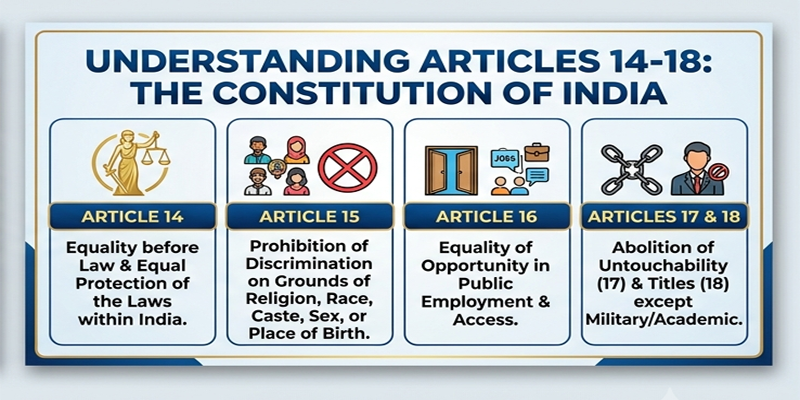
There should not be any kind of discrimination based on caste, background, identity, sex, birthplace, and religion.
Articles 14 to 18 in the Constitution fully describe the definition of the Right to Equality.
These provisions ensure the application of laws equally and fairly in society.
And such practices like unfair discrimination and untouchability have no place in society.
But now one curious question is still to be answered.
What do Articles 14 to 18 actually mean in everyday life?
In this post, we will understand this “Right to Equality in India” in easy-to-understand language.
What Is the Right to Equality?
The Right to Equality is a Fundamental Right guaranteed under Part III of the Indian Constitution.
It does not mean that every person must always be treated identically. Sometimes, treating people differently is necessary to achieve real equality.
For example, the Constitution permits special provisions for disadvantaged groups and reservations in certain circumstances. The purpose is to address historical and social disadvantages and provide genuine equality of opportunity. |Right to Equality in India|
The five key provisions are:
- Article 14: Equality before law and equal protection of laws
- Article 15: Prohibition of discrimination
- Article 16: Equality of opportunity in public employment
- Article 17: Abolition of untouchability
- Article 18: Abolition of titles
Article 14: Equality before the law
Article 14 says that the State cannot deny any person equality before the law or equal protection of the laws within India.
In simple words:
The law should not unfairly favour one person over another.
Whether a person is rich or poor, powerful or ordinary, the law is expected to apply fairly.
For example, if two people commit the same offence, their social or financial status should not by itself determine whether the law applies to them.
Equality does not mean identical treatment
This is an important point.
Suppose two people are in very different circumstances. Treating them the same may sometimes produce an unfair result.
Therefore, the Constitution allows reasonable classification and special measures when there is a legitimate constitutional purpose.
This principle is particularly important when governments create policies for disadvantaged sections of society. |Right to Equality in India|
Article 15: Protection Against Discrimination
Article 15 deals specifically with discrimination.
The State cannot discriminate against a citizen solely on grounds such as:
- Religion
- Race
- Caste
- Sex
- Place of birth
This provision is especially important in a country as diverse as India.
For example, a government authority cannot ordinarily deny a citizen a benefit merely because of their religion or caste when such discrimination is prohibited by the Constitution.
Are special provisions allowed?
Yes.
The Constitution permits certain special provisions for groups that need additional protection or support.
These include provisions relating to:
- Women and children
- Socially and educationally backward classes
- Scheduled Castes
- Scheduled Tribes
- Economically weaker sections, subject to constitutional provisions
This is why equality does not always mean identical treatment.
Sometimes additional support is provided to create equality of opportunity.
Article 16: Equality in Government Jobs
Article 16 deals with equality of opportunity in matters of public employment.
This means that eligible citizens should have a fair opportunity when applying for government employment, subject to the Constitution and applicable laws.
For example, a person should not be unfairly excluded from consideration for a government job solely because of their religion, race, caste, sex, descent, place of birth or residence, where such discrimination is constitutionally prohibited.
At the same time, Article 16 permits certain forms of reservation and special provisions.
This is one reason reservation policies are an important part of India’s constitutional framework.
What should citizens remember?
If you apply for a government job, the recruitment process must operate within the constitutional framework and applicable recruitment rules.
If you believe that a public recruitment process has violated your legal rights, you may have legal remedies depending on the facts of the case. |Right to Equality in India|
Article 17: Untouchability Is Abolished
Article 17 is one of the strongest equality provisions in the Constitution.
It states that “Untouchability” is abolished and that its practice in any form is forbidden.
This provision addresses the historical practice of treating people as socially inferior or excluding them because of caste.
The Constitution does not merely discourage such behaviour. It prohibits the practice of untouchability and provides for punishment through laws made by Parliament.
The Protection of Civil Rights Act, 1955 is an important law associated with giving effect to Article 17.
Other laws also protect against caste-based atrocities and discrimination.
Why Article 17 matters
Article 17 demonstrates that constitutional equality is not simply about government offices or courtrooms.
It also seeks to protect people’s dignity in everyday social life.
Every citizen should understand that humiliating, excluding, or treating people as “untouchable” because of caste is not an acceptable social practice. |Right to Equality in India|
Article 18: Abolition of Titles
Article 18 deals with titles.
The Constitution generally prohibits the State from conferring titles, except military or academic distinctions.
The idea behind this provision is to prevent the creation of artificial social classes based on government-created titles.
For example, constitutional law does not allow the government to create hereditary-style titles that establish special social status. |Right to Equality in India|
What about awards like Bharat Ratna and Padma Awards?
National awards such as the Bharat Ratna and Padma Awards are not treated as titles under Article 18, provided they are not used as titles or prefixes and suffixes to a person’s name.
Therefore, receiving a national award does not make someone constitutionally superior to other citizens.
Equality Before Law vs Equal Protection of Laws
These two expressions in Article 14 may sound similar, but they have slightly different ideas behind them.
Equality before law
This emphasizes that no person is above the law.
The same legal system applies to everyone, subject to constitutional provisions and lawful classifications.
Equal protection of laws
This means people in similar circumstances should receive similar legal protection.
At the same time, people who are genuinely in different circumstances may sometimes require different treatment to achieve substantive equality.
Together, these principles form the foundation of Article 14. |Right to Equality in India|
Does the Right to Equality Apply Only to Indian Citizens?
Not always.
This is an important distinction.
Article 14 uses the term “person”, so its protection is not limited only to Indian citizens.
However, some other equality provisions, particularly Article 15 and Article 16, specifically use the term “citizen”.
Therefore, different Fundamental Rights can have different beneficiaries.
This is why it is important to read the exact wording of the relevant Article rather than assuming that every Fundamental Right works in the same way.
Equality and Reservation
Reservation is often discussed whenever the Right to Equality is mentioned.
At first, reservation may appear to be different from equality because it gives certain groups special consideration.
However, the Constitution itself permits various forms of affirmative action and reservation.
The underlying idea is that formal equality alone may not be enough when historical and social disadvantages have created unequal opportunities.
For example, if two groups have not historically had the same access to education or employment, simply declaring them equal may not remove the disadvantage.
Constitutional provisions therefore allow certain special measures to promote equality of opportunity and social justice.
Reservation policies are subject to constitutional requirements and judicial interpretation, so specific rules can change over time. |Right to Equality in India|
Can a Government Law Be Challenged for Violating Equality?
Yes.
If a law or government action violates a Fundamental Right, including the Right to Equality, it may be challenged before a constitutional court depending on the circumstances.
The judiciary plays an important role in examining whether government action is arbitrary, discriminatory, or otherwise inconsistent with constitutional requirements.
The Supreme Court and High Courts have developed extensive principles around equality and reasonable classification.
However, not every difference in treatment is unconstitutional.
The key question is whether the classification or distinction has a valid constitutional and legal basis.
Equality Is More Than Just Caste
When people hear “Right to Equality”, they often immediately think about caste discrimination.
Caste is certainly an important part of the constitutional framework, but equality is much broader.
It also concerns:
- Gender discrimination
- Religious discrimination
- Unfair government decisions
- Unequal opportunities
- Arbitrary State action
- Social exclusion
- Access to public opportunities
- Protection of individual dignity
Equality therefore affects many areas of everyday life. |Right to Equality in India|
What Can an Ordinary Citizen Do?
Knowing your constitutional rights is useful, but knowing how to respond when those rights are violated is even more important.
If you believe you have faced unlawful discrimination by a public authority, you can:
- Keep relevant documents and evidence.
- Obtain the applicable government order, rule or decision if possible.
- Submit a written complaint to the appropriate authority.
- Use available grievance mechanisms.
- Seek legal advice when necessary.
- Approach the appropriate court or legal authority where a legal remedy is available.
The exact remedy depends on the facts of the case.
For serious matters, citizens should consult a qualified lawyer or seek assistance through legal aid services rather than relying only on general information available online.
Why Articles 14 to 18 Matter in Daily Life
The Right to Equality may sound like a constitutional concept, but it affects ordinary citizens every day.
It matters when:
- You apply for a government job.
- You interact with a government department.
- You seek admission or public opportunities.
- You face discrimination because of caste or religion.
- You experience gender-based discrimination.
- You are denied equal treatment by a public authority.
- You encounter practices connected with untouchability.
- You need to challenge arbitrary government action.
The Constitution gives citizens a powerful framework for demanding fairness and dignity.
Quick Summary of Articles 14 to 18
| Article | Main Subject | Simple Meaning |
|---|---|---|
| Article 14 | Equality before law | Law must treat people fairly |
| Article 15 | Discrimination | Prohibits certain forms of discrimination |
| Article 16 | Public employment | Equal opportunity in government jobs |
| Article 17 | Untouchability | Untouchability is abolished |
| Article 18 | Titles | Constitutional restrictions on State-conferred titles |
Final Thoughts
Friends, in this blog post(Right to Equality in India), we have understood one of the important rights listed in the Indian Constitution: the “Right to equality in India“. This right sets the foundation of Indian democracy. Article 14 describes equality before the law and equal protection of the laws. Article 15 secures citizens against specified forms of discrimination. Article 16 focuses on uniform opportunity in public employment. Article 17 eliminates untouchability, while Article 18 deals with the termination of titles. Together, these provisions reflect a simple but powerful constitutional principle:
It is the right of every person to have dignity, be treated fairly, and have equal protection under the law. |Right to Equality in India|
Legal awareness note: This article is for general educational purposes and is not a substitute for professional legal advice. Specific rights and remedies depend on the facts and applicable laws.
If you have any queries, you can write to us at support@a5theory.com; we will get back to you ASAP.
Hope! You will enjoy this post, “Right to Equality in India“.
Please feel free to give your feedback in the comment section below.
Have a great time!