

Hello Friends, in this blog post(How the Indian Constitution Was Made), we are going to explore the history of the Indian Constitution.
Hearing the name “Indian Constitution” makes us think often about fundamental rights, parliament, courts, preamble, and elections.
But we usually forget to think about an equally important question that is:
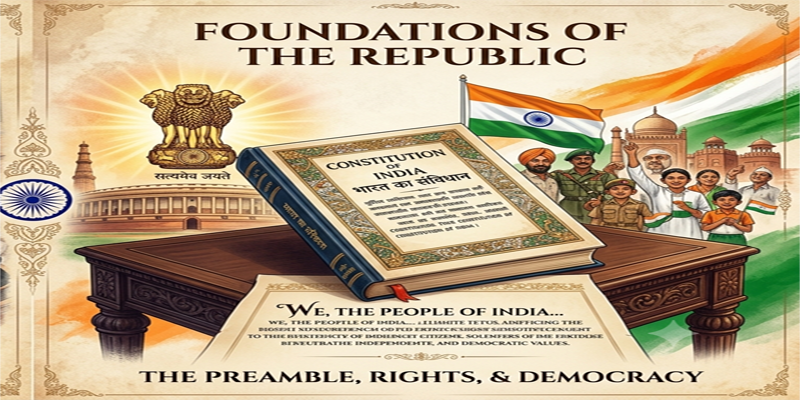
How was the Constitution of India actually made?
The Constitution of the world’s largest democracy was not built in a few days.
It was the effort of years of debates, discussions, political developments, and careful consideration by representatives of the common people.
Indian Constitution is a strong foundation and an important part of India’s history.
It defines all possible ways, laws, structure, and provisions to run or govern the country after independence. |How the Indian Constitution Was Made|
In this post, we will explore the full story of indian constitution in very simple words. |How the Indian Constitution Was Made|
Why Did India Need a Constitution?
Before independence, India was governed under laws created during British rule.
The Government of India Act, 1935, was one of the important legal frameworks used for governance before independence.
However, after India became independent, the country needed its own constitutional framework.
India needed a document that could:
- Establish a democratic system of government
- Define the powers of government institutions
- Protect citizens’ rights
- Establish relationships between the Union and States
- Provide an independent judiciary
- Establish principles of equality and justice
- Protect India’s diversity
- Define the responsibilities of government
- Create a system for changing the Constitution when necessary
The Constitution therefore became the foundation for independent India’s political and legal system.
The Idea of a Constituent Assembly
The Constitution was made by a body known as the Constituent Assembly of India.
The idea of having a Constituent Assembly had been discussed during the freedom movement.
Indian national leaders increasingly argued that Indians themselves should have the authority to frame the constitutional framework under which they would be governed.
The Constituent Assembly was eventually formed in 1946 under the Cabinet Mission Plan.
Its members were not elected through universal adult suffrage. They were mainly elected indirectly by the provincial legislatures, while representatives of princely states were selected through their respective arrangements.
The Assembly therefore brought together representatives from different parts of the country and different political and social backgrounds. |How the Indian Constitution Was Made|
First Meeting of the Constituent Assembly
The Constituent Assembly held its first meeting on 9 December 1946.
Dr. Sachchidananda Sinha served as the temporary chairman of the Assembly.
Later, Dr. Rajendra Prasad was elected as the permanent President of the Constituent Assembly.
Several prominent leaders participated in the constitutional discussions.
Among them were:
- Dr. B. R. Ambedkar
- Jawaharlal Nehru
- Sardar Vallabhbhai Patel
- Dr. Rajendra Prasad
- Maulana Abul Kalam Azad
- Alladi Krishnaswami Ayyar
- K. M. Munshi
- Gopalaswami Ayyangar
- H. C. Mookherjee
The Assembly also included representatives from various communities, regions and political backgrounds.
The Objectives Resolution
One of the important early steps in the constitutional process was the introduction of the Objectives Resolution by Jawaharlal Nehru on 13 December 1946.
It outlined the broad objectives that the Constitution was expected to achieve.
The Resolution emphasized principles such as:
- Sovereignty of the people
- Democratic government
- Justice
- Equality
- Freedom
- Protection of minorities
- Federal arrangements
- India’s independent status
The Objectives Resolution was adopted by the Constituent Assembly on 22 January 1947.
It later influenced the philosophy and structure of the Constitution and is considered an important foundation for understanding the Preamble. |How the Indian Constitution Was Made|
What Happened After Partition?
The situation changed dramatically in 1947.
India was partitioned into India and Pakistan.
The Constituent Assembly was reorganized after Partition, and the members representing areas that became part of Pakistan left the Indian Constituent Assembly.
The Assembly then continued its work for independent India.
On 15 August 1947, India became an independent country.
The Constituent Assembly now had the additional responsibility of functioning as the legislature for the newly independent nation while continuing the work of drafting the Constitution.
Dr. B. R. Ambedkar and the Drafting Committee
One of the most important figures in the making of the Constitution was Dr. Bhimrao Ramji Ambedkar.
On 29 August 1947, the Constituent Assembly appointed the Drafting Committee.
Dr. B. R. Ambedkar was appointed its Chairman.
The Drafting Committee’s job was to examine and prepare the draft constitutional text based on the decisions and principles developed by the Constituent Assembly.
The committee included several distinguished members.
Dr. Ambedkar’s role in explaining, defending, and presenting constitutional provisions during the Assembly’s debates was particularly significant.
However, it is important to understand that the Constitution was not written by Dr. Ambedkar alone.
The final Constitution was the result of the collective work of the Constituent Assembly, its committees, advisers, officials, and numerous contributors.
Important Committees of the Constituent Assembly
The Constituent Assembly created several committees to study specific constitutional subjects.
Some of the important committees included:
Union Powers Committee
This committee examined the distribution of powers between the Union and other levels of government.
Jawaharlal Nehru was its Chairman. |How the Indian Constitution Was Made|
Union Constitution Committee
It considered important questions relating to the constitutional structure of the Union.
Jawaharlal Nehru chaired this committee as well.
Provincial Constitution Committee
This committee dealt with constitutional arrangements concerning provinces.
Sardar Vallabhbhai Patel was its Chairman. |How the Indian Constitution Was Made|
Advisory Committee on Fundamental Rights, Minorities and Tribal and Excluded Areas
This committee examined important questions concerning Fundamental Rights, minorities and certain special areas.
Sardar Vallabhbhai Patel chaired the Advisory Committee.
These committees helped divide the enormous constitutional task into manageable areas of study.
Where Did the Ideas Come From?
The makers of the Indian Constitution studied constitutional systems from several countries.
They did not simply copy another country’s Constitution.
Instead, they examined different constitutional models and adapted ideas according to Indian circumstances.
For example, India adopted or adapted various constitutional concepts relating to:
- Parliamentary government
- Fundamental Rights
- Directive Principles
- Judicial review
- Federal arrangements
- Independent judiciary
- Emergency provisions
- Constitutional amendment procedures
The makers also drew upon India’s own administrative and legal experience.
The objective was to create a constitutional system suitable for India’s enormous population, diversity and social conditions. |How the Indian Constitution Was Made|
The Draft Constitution
The Draft Constitution was published in 1948 and made available for public discussion.
Suggestions and criticisms were received.
The Constituent Assembly then debated the provisions in detail.
Members discussed subjects ranging from Fundamental Rights and citizenship to the powers of the President, Parliament, courts, States and local government.
The debates were often detailed and sometimes strongly contested.
This process was important because the Constitution was not accepted without discussion.
Its provisions were examined, challenged and modified during the Assembly’s deliberations.
How Long Did It Take to Make the Constitution?
The Constituent Assembly took approximately 2 years, 11 months and 18 days to complete the Constitution.
The Assembly held 11 sessions over this period and spent a substantial amount of time discussing the draft.
Thousands of amendments were proposed during the debates.
Many were discussed, and some were accepted.
This demonstrates that the Constitution was the product of an extensive deliberative process.
Adoption of the Constitution
After extensive debates and revisions, the Constituent Assembly adopted the Constitution on:
26 November 1949
This date is now observed as Constitution Day in India.
The Constitution was signed by members of the Constituent Assembly on 24 January 1950.
It came into force on:
26 January 1950
India then became a republic under its new constitutional framework.
Dr. Rajendra Prasad became the first President of India. |How the Indian Constitution Was Made|
Why Was 26 January Chosen?
An interesting question is why the Constitution came into force on 26 January rather than immediately after its adoption.
The date had historical significance.
On 26 January 1930, the Indian National Congress observed Purna Swaraj Day, associated with the demand for complete independence.
Therefore, 26 January was selected as the date on which the Constitution would come into force.
This connected the new Republic with an important milestone in India’s freedom struggle.
Was the Constitution Very Long?
Yes.
The original Constitution was one of the most detailed written national constitutions in the world.
This was partly because India was an extremely diverse country with different languages, religions, communities, regions, and social conditions.
The Constitution therefore addressed many subjects in considerable detail.
It established not only broad principles but also detailed institutional arrangements.
The Constitution has also changed significantly through amendments over the decades.
What Were the Main Goals of the Constitution Makers?
The Constitution makers faced a difficult challenge.
India had just emerged from colonial rule and Partition. The country faced poverty, social inequality, communal tensions, administrative challenges and enormous diversity.
The Constitution therefore attempted to establish a framework based on several important objectives:
Democracy
Government should ultimately derive its authority from the people.
Equality
The constitutional system should reject discrimination and unequal treatment based on prohibited grounds.
Justice
The Constitution sought to promote social, economic and political justice.
Liberty
Citizens should enjoy important freedoms subject to constitutional limitations.
Unity
The Constitution sought to maintain the unity and integrity of the country while recognizing India’s diversity. |How the Indian Constitution Was Made|
Social Reform
The constitutional framework also aimed to address deeply rooted social inequalities.
The Constitution Belongs to the People
One of the most important ideas expressed in the Preamble is:
“We, the People of India…”
This reflects the democratic foundation of the Constitution.
The Constitution establishes government institutions, but it also places limits on government power.
Citizens have constitutional rights, while government institutions have constitutional responsibilities and limitations.
This is why understanding the Constitution is important for everyone. |How the Indian Constitution Was Made|
What Can We Learn From the Making of the Constitution?
The making of the Constitution provides several important lessons.
First, major national decisions require discussion and deliberation.
Second, democracy does not mean that everyone automatically agrees. Different viewpoints can exist, and constitutional institutions must provide ways to resolve disagreements.
Third, a Constitution must balance individual freedoms with broader social interests.
Finally, a Constitution must be capable of responding to changing circumstances while protecting its fundamental principles. |How the Indian Constitution Was Made|
Final Thoughts
Friends, in this blog post(How the Indian Constitution Was Made), we have gone through the full history of the Indian Constitution. This amazing constitution was created through an extraordinary constitutional experiment. After so many debates, extensive discussions, committees, and revisions, in 1946 the Constituent Assembly was formed; in 1949 the Constitution was adopted, followed by its commencement on 26 January 1950. Dr. B.R. Ambedkar was the man who played a central role as chairman of the drafting committee. Along with him, many other leaders and members made significant and amazing contributions to its formation.
Keeping focus on justice, liberty, fraternity, and equality, the Constitution was ultimately designed to establish a democratic republic. You can better understand why this document remains such an important document for India if you dive deep into the process of constitution-making, and you will highly appreciate it then. |How the Indian Constitution Was Made|
Constitution is not purely a historical document, more important reminder to us. But it continues to govern the relationship between governments, citizens, and constitutional institutions even today. |How the Indian Constitution Was Made|
If you have any queries, you can write to us at support@a5theory.com; we will get back to you ASAP.
Hope! You will have enjoyed this post, “How the Indian Constitution Was Made“.
Please feel free to give your feedback in the comment section below.
Have a great time!