

Hello Friends, in this blog post(President, Prime Minister, Council of Ministers), we will discuss the President, Prime Minister, and Council of Ministers.
In the Indian parliamentary system, the President stands as the constitutional head of the Union.
And in accordance with the Constitution, executive powers are exercised by the Prime Minister and the Council of Ministers.
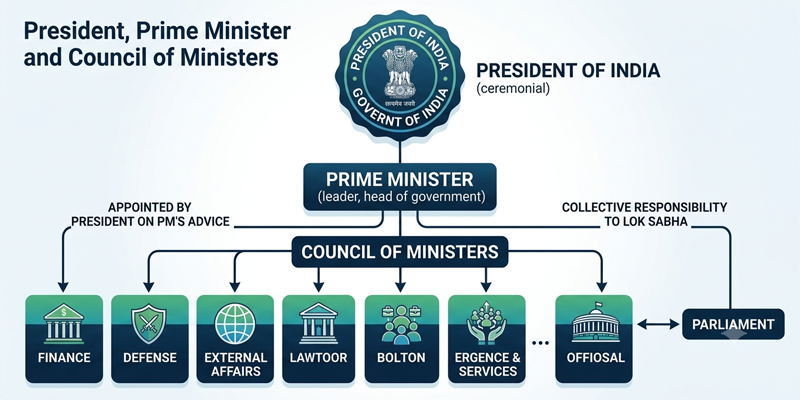
“The President approved the law” most of the people often hear this phrase.
The decision is taken by the Prime Minister or the Cabinet, but this question remains:
Who actually has what power?
If anyone really wants to understand how the Indian government works, then they must understand…
…the difference in work and power between the President, the Prime Minister, and the Council of Ministers.
In this post(President, Prime Minister, Council of Ministers), we will understand this difference in work and power in an easy-to-understand language.
The President of India: The Constitutional Head
The President is the Head of the State and occupies the highest constitutional office in the country.
Article 52 of the Constitution provides for the office of the President.
The President is elected indirectly rather than directly by all citizens. The electoral college includes elected members of both Houses of Parliament and elected members of the Legislative Assemblies of the States, along with elected members of the Legislative Assemblies of Delhi and Puducherry, according to the constitutional scheme.
The President normally holds office for five years, subject to the constitutional provisions governing the office.
The President’s powers include important constitutional functions relating to:
- Appointment of the Prime Minister
- Appointment of other ministers on the Prime Minister’s advice
- Summoning and proroguing Parliament
- Dissolving the Lok Sabha in accordance with constitutional requirements
- Giving assent to Bills
- Issuing Ordinances when the constitutional conditions are satisfied
- Appointing certain constitutional and statutory authorities
- Supreme command of the Defence Forces
- Exercising certain powers relating to emergencies
But it is important to understand one fundamental principle.
The President does not ordinarily run the government independently.
Article 74: The President and the Council of Ministers
Article 74 provides for a Council of Ministers with the Prime Minister at its head to aid and advise the President.
The President generally acts in accordance with this advice.
The Constitution also provides that the President may require the Council of Ministers to reconsider its advice once. After reconsideration, the President is required to act according to the advice tendered.
This creates an important distinction:
The President is the constitutional head, while the elected government exercises executive authority through the Prime Minister and Council of Ministers within the constitutional framework.
Then Who Is the Real Executive?
In India’s parliamentary system, the Prime Minister and Council of Ministers are the political executive.
The Prime Minister is normally the leader of the majority party or coalition that commands the confidence of the Lok Sabha.
The President appoints the Prime Minister.
Once appointed, the Prime Minister leads the Council of Ministers and plays the central role in the functioning of the Union government.
The Prime Minister therefore occupies a unique position at the centre of India’s political and administrative system.
The Prime Minister: Head of the Government
The Prime Minister is the Head of the Government.
The Prime Minister’s responsibilities include:
- Leading the Council of Ministers
- Allocating and coordinating ministerial responsibilities
- Advising the President on the appointment of ministers
- Coordinating the work of different ministries
- Providing leadership on major government policies
- Communicating important decisions of the Council of Ministers to the President
- Advising the President regarding important constitutional matters concerning Parliament and the government
The Prime Minister also acts as an important link between the President and the Council of Ministers.
Article 78 sets out important duties of the Prime Minister in relation to communicating information to the President.
What Is the Council of Ministers?
The Council of Ministers consists of ministers who assist and advise the President under the leadership of the Prime Minister.
It is responsible for the administration of the Union government and for implementing government policies.
The Constitution establishes the Council of Ministers with the Prime Minister at its head.
The Council of Ministers is collectively responsible to the Lok Sabha.
This principle is extremely important.
If the government loses the confidence of the Lok Sabha, the Council of Ministers cannot normally continue in office as the government.
Council of Ministers vs Cabinet
These two terms are often used as if they mean the same thing, but constitutionally they are different.
The Council of Ministers is the larger body.
The Cabinet is the smaller group of senior ministers that plays the central role in making major government decisions.
The 44th Constitutional Amendment strengthened the constitutional recognition of the Cabinet in relation to the President’s exercise of certain powers.
In everyday news reporting, when you hear that “the Cabinet approved” a major proposal, it generally refers to a decision taken by this core group of senior ministers.
How Is a Minister Appointed?
The President appoints ministers on the advice of the Prime Minister.
The ministers hold office during the pleasure of the President, but in the parliamentary system this operates within the framework of the Prime Minister’s leadership and the government’s political responsibility to the Lok Sabha.
There is also an important constitutional rule concerning Parliament membership.
A person who is appointed as a minister but is not a member of either House of Parliament can remain a minister for a maximum period of six consecutive months. Within that period, the person must become a member of Parliament or cease to be a minister.
Collective Responsibility: A Key Principle
Article 75 establishes the principle of collective responsibility to the Lok Sabha.
This means that the Council of Ministers generally acts as a team and is collectively accountable to the elected House.
If the government loses a confidence vote, the Council of Ministers may have to resign.
This principle ensures that the executive remains accountable to the House that directly represents the people.
Can the Prime Minister Remove a Minister?
The Prime Minister has a central role in determining the composition of the Council of Ministers.
Although ministers are formally appointed and removed by the President under the Constitution, this occurs within the parliamentary system and on the Prime Minister’s advice.
Therefore, the Prime Minister exercises significant practical authority over the selection and continuation of ministers.
Who Makes Government Policies?
Government policy is developed through the political executive, particularly the Prime Minister, Cabinet, and concerned ministries.
However, policymaking is not simply one person’s decision.
Major decisions can involve:
- Ministries and departments
- Cabinet committees
- The Cabinet
- Parliament
- Constitutional authorities
- Administrative officials
- Expert bodies
- Public consultations, where applicable
The nature of the decision determines the procedure that must be followed.
What Does the President Do With Bills?
When Parliament passes a Bill, it is presented to the President.
Under Article 111, the President may give assent or withhold assent according to the constitutional procedure.
In the case of a Bill other than a Money Bill, the President may return it to Parliament for reconsideration.
If Parliament passes it again, the President cannot withhold assent.
This is an important constitutional check within the legislative process.
What Is the President’s Ordinance Power?
When Parliament is not in session, the President can promulgate an Ordinance under Article 123 if the constitutional conditions are satisfied.
An Ordinance has the force and effect of an Act of Parliament, but it is temporary and must be placed before Parliament when it reassembles.
It is not the same thing as permanently making a law without Parliament.
Parliament retains its constitutional role in dealing with the matter when it meets.
Who Controls the Armed Forces?
The Constitution places the supreme command of the Defence Forces in the President.
However, this does not mean that the President independently decides military policy in the manner of a presidential system.
India’s parliamentary system requires executive decisions to operate through the constitutional framework of the elected government and the Council of Ministers.
The President’s role is therefore constitutional as well as symbolic, while the elected government is responsible for national policy and administration.
What About Emergency Powers?
The Constitution contains provisions for:
- National Emergency
- President’s Rule in a State
- Financial Emergency
These are exceptional constitutional powers and are subject to specific constitutional procedures.
The President formally issues proclamations under the relevant provisions, but the exercise of these powers is connected with the advice of the Council of Ministers and, in applicable cases, parliamentary approval.
Emergency powers are therefore not simply personal powers of the President.
They operate within constitutional checks and procedures.
President vs Prime Minister: The Simple Difference
A useful way to remember the distinction is:
| President | Prime Minister |
|---|---|
| Constitutional Head of the Union | Head of the Government |
| Head of the State | Leader of the political executive |
| Elected indirectly | Usually leader of majority party/coalition in Lok Sabha |
| Acts within constitutional framework, generally on ministerial advice | Leads the Council of Ministers |
| Performs important constitutional functions | Coordinates government policy and administration |
| Formal executive authority under the Constitution | Exercises executive leadership through the Council of Ministers |
This does not mean the President is merely a ceremonial figure.
The President has important constitutional powers and responsibilities.
But those powers must be understood within India’s parliamentary system.
President vs Council of Ministers
The distinction becomes even clearer when we look at their roles together.
The President is the constitutional head.
The Council of Ministers is the political executive responsible for governing the country.
The President formally exercises many executive functions, but the Council of Ministers, headed by the Prime Minister, provides the constitutional advice on which the President ordinarily acts.
This arrangement is designed to combine constitutional continuity with democratic accountability.
What Happens If No Party Gets a Majority?
Sometimes an election may result in a hung Lok Sabha, meaning no single party has a clear majority.
In such a situation, the President has an important constitutional role in appointing a Prime Minister who is most likely to command the confidence of the Lok Sabha.
The government must then demonstrate that it has the support required to govern.
This illustrates why the President can have an especially significant role during periods of political uncertainty.
Is the President Above the Prime Minister?
The President is the constitutional head of the Union, but it would be misleading to describe the relationship simply as one person being “above” the other.
They perform different constitutional roles.
The President represents the constitutional office of the Head of State.
The Prime Minister leads the elected government.
The Council of Ministers is collectively responsible to the Lok Sabha.
The system is therefore based on constitutional roles, advice, responsibility and accountability, rather than a simple hierarchy between the President and Prime Minister.
Why Does the Prime Minister Have So Much Power?
The Prime Minister’s position is strengthened by several factors.
The Prime Minister:
- Leads the Council of Ministers
- Coordinates government policy
- Advises the President on ministerial appointments
- Plays a major role in Cabinet decision-making
- Leads the government in Parliament
- Represents the government in important national and international matters
However, the Prime Minister is not above the Constitution.
The government must operate within constitutional limits, parliamentary accountability, laws enacted by Parliament, and judicial review.
Can the Prime Minister Make Any Decision Alone?
No.
Although the Prime Minister has enormous political and administrative influence, government decisions are governed by constitutional provisions, laws, rules of business, and the collective functioning of the Council of Ministers and Cabinet.
The Prime Minister cannot simply ignore Parliament, the Constitution, or the judiciary.
Similarly, government authorities must exercise their powers according to law.
Why This System Matters to Citizens
The distinction between the President, Prime Minister and Council of Ministers is not merely theoretical.
It helps citizens understand who is responsible for what.
When a new policy is announced, when Parliament passes legislation, when an emergency is proclaimed, or when a minister answers questions in Parliament, these actions take place within a constitutional structure.
Understanding that structure helps citizens distinguish between:
- Head of State and Head of Government
- Political executive and constitutional head
- Cabinet and Council of Ministers
- Formal constitutional powers and practical executive authority
- Government accountability and individual political authority
Final Takeaway
Friends, in this blog post(President, Prime Minister, Council of Ministers), we have gone through the powers and work of the President, Prime Minister, and Council of Ministers. Important constitutional roles are deliberately separated in the Indian system. President performs various important functions under the Constitution and is considered the constitutional head of the state. Prime Minister is responsible for the political execution and is considered the head of the government. Council Ministers come under the supervision of the Prime Minister, and they assist and advise the President and take care of the Lok Sabha’s work and functions.
The key principle is simple:
President = Constitutional Head
Prime Minister = Head of Government
Council of Ministers = Political Executive responsible to Lok Sabha
Together, these institutions form an important part of India’s parliamentary democracy.
Understanding their particular roles helps citizens understand how the Union government works—and, equally importantly, where constitutional accountability lies.
Disclaimer: This article provides general educational information about India’s constitutional system. It is not legal advice. For specific constitutional or legal questions, consult the Constitution, applicable laws, and qualified legal professionals.
If you have any queries, you can write to us at support@a5theory.com; we will get back to you ASAP.
Hope! You will enjoy this post, “President, Prime Minister, Council of Ministers“.
Please feel free to give your feedback in the comment section below.
Have a great time!