

Hello Friends, in this blog post, we are going to discuss the Right to Freedom in India within the Constitution of India.
Indian Constitution provides a strong assurance of Freedom with this most important Right to Freedom.
Because if the people of the country feel any difficulty in expressing their views, moving freely, choosing their occupation,…
… or living with personal liberty, a democratic country can not function in a proper way to attain prosperity in the country.
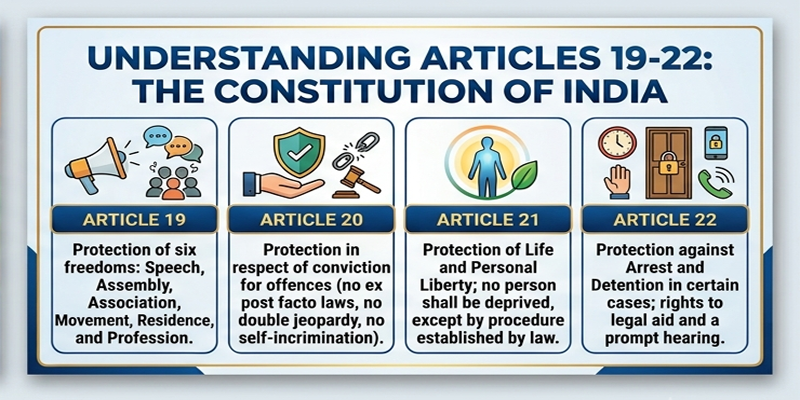
In the Indian Constitution, Articles 19 to 22 completely cover or describe the Right to Freedom in India.
Any citizen can find a bunch of important protection provisions inside these articles.
This Right to Freedom given by the Constitution does not mean that a person is completely free to do anything.
To protect public order, morality, security, and other important interests, the law can impose reasonable restrictions.
In this post(Right to Freedom in India), we are going to explore Articles 19 to 22 in easy-to-understand language.
What Is the Right to Freedom?
The Right to Freedom in India is a group of Fundamental Rights contained in Part III of the Constitution.
The four major Articles in this group are:
- Article 19: Six important freedoms of citizens
- Article 20: Protection in respect of conviction for offences
- Article 21: Protection of life and personal liberty
- Article 22: Protection against certain forms of arrest and detention
These provisions are extremely important because they directly affect everyday life.
Article 19: Six Important Freedoms
Article 19 gives citizens six important freedoms.
These are:
- Freedom of speech and expression
- Freedom to assemble peacefully and without arms
- Freedom to form associations, unions or cooperative societies
- Freedom to move freely throughout India
- Freedom to reside and settle in any part of India
- Freedom to practise any profession, or carry on any occupation, trade or business
These freedoms are available to Indian citizens and are subject to constitutionally permitted reasonable restrictions.
1. Freedom of Speech and Expression
Freedom of speech allows citizens to express their opinions and ideas.
This can include:
- Speaking publicly
- Writing articles
- Publishing opinions
- Peaceful criticism of government policies
- Expressing political views
- Sharing information and ideas
- Peaceful artistic or creative expression
This freedom is one of the foundations of democracy.
Citizens should be able to discuss public issues and question government decisions.
But is freedom of speech unlimited?
No.
Article 19(2) allows the State to impose reasonable restrictions on speech and expression on specified constitutional grounds.
These include matters such as:
- Sovereignty and integrity of India
- Security of the State
- Friendly relations with foreign States
- Public order
- Decency or morality
- Contempt of court
- Defamation
- Incitement to an offence
Therefore, saying “I have freedom of speech” does not automatically protect every statement or activity.
The legality of particular speech depends on the facts, the applicable law, and constitutional limitations.
2. Freedom of Peaceful Assembly
Citizens have the right to assemble peacefully and without arms.
This is important for:
- Peaceful demonstrations
- Public meetings
- Rallies
- Awareness campaigns
- Public discussions
However, this freedom is subject to reasonable restrictions.
Authorities can regulate assemblies in appropriate circumstances, particularly where there are legitimate concerns involving public order, security, or other constitutionally permitted grounds.
Therefore, a peaceful protest is constitutionally protected, but the right does not mean that every gathering can take place anywhere or in any manner without regulation.
3. Freedom to Form Associations
Citizens have the right to form associations, unions and cooperative societies, subject to constitutional restrictions.
This allows people to come together for common purposes.
Examples include:
- Professional associations
- Trade unions
- Social organisations
- Community groups
- Cooperative societies
- Political organisations
This freedom is an important part of democratic participation and collective action.
Again, the right is not absolute and can be restricted in accordance with the Constitution.
4. Freedom to Move Throughout India
An Indian citizen generally has the freedom to move throughout the territory of India.
This means a citizen can travel from one State to another without needing permission simply because they belong to a different State.
For example, a person from Madhya Pradesh can travel, work, or visit Maharashtra, Delhi, Kerala, or any other part of India, subject to applicable laws and legitimate restrictions.
Certain restrictions may exist for constitutionally recognised reasons, including protection of the interests of Scheduled Tribes or the general public.
5. Freedom to Reside and Settle Anywhere in India
Citizens also have the right to reside and settle in any part of India, subject to constitutional restrictions.
This supports India’s idea of national unity.
A person does not lose the basic constitutional ability to settle in another State merely because they were born somewhere else.
However, this freedom is not unlimited. Laws can impose certain restrictions in circumstances permitted by the Constitution.
6. Freedom of Profession, Occupation, Trade or Business
Article 19 also protects the freedom of citizens to practise a profession or carry on an occupation, trade or business.
For example, subject to applicable qualifications and laws, a person may choose to become:
- A teacher
- Engineer
- Doctor
- Lawyer
- Shopkeeper
- Farmer
- Entrepreneur
- Skilled worker
The government can regulate professions and businesses through laws.
For example, certain professions require qualifications, registration, or licences because they involve public safety or specialised knowledge.
Therefore, Article 19 protects the freedom to choose an occupation but does not eliminate legitimate regulation.
Article 20: Protection in Criminal Cases
Article 20 provides important safeguards to people accused of offences.
It contains three major protections.
1. No Ex-Post-Facto Criminal Punishment
A person cannot normally be punished for an act that was not an offence when it was committed.
Similarly, a person cannot ordinarily be subjected to a greater criminal penalty than the law allowed when the offence was committed.
In simple terms:
The criminal law cannot ordinarily be changed later and then used to punish someone for an earlier act.
2. No Double Jeopardy
Article 20 protects a person from being prosecuted and punished more than once for the same offence in the manner prohibited by the Constitution.
This principle is commonly known as double jeopardy.
The exact application depends on the circumstances and the relevant law.
3. Protection Against Self-Incrimination
A person accused of an offence cannot be compelled to be a witness against themselves.
This is an important protection during criminal proceedings.
It reflects the principle that the burden of establishing criminal guilt should not simply be shifted onto an accused person through forced self-incrimination.
Article 21: Protection of Life and Personal Liberty
Article 21(Right to Freedom in India) is one of the most important provisions in the Indian Constitution.
It states that no person shall be deprived of their life or personal liberty except according to procedure established by law.
Notice the word “person”.
Unlike some rights that are specifically available to citizens, Article 21 protects every person, subject to its constitutional framework.
Over the years, the Supreme Court has interpreted Article 21 broadly.
The right to life has been understood as involving more than merely physical survival. Judicial decisions have connected Article 21 with various aspects of dignity and meaningful life.
These interpretations have contributed greatly to the development of constitutional rights in India.
Privacy and Article 21
The right to privacy has also received constitutional recognition through judicial interpretation.
In Justice K.S. Puttaswamy (Retd.) v. Union of India, the Supreme Court recognised privacy as a constitutionally protected right.
Privacy can involve areas such as:
- Personal autonomy
- Family life
- Personal information
- Bodily privacy
- Individual choices
However, the right to privacy is not absolute. Restrictions may be permissible when they satisfy constitutional requirements.
In today’s digital world, understanding privacy is particularly important.
Article 21A: Right to Education
Although Article 21A is not technically one of Articles 19 to 22, it is closely connected with the Right to Freedom series and is important for citizens to know.
Article 21A provides for free and compulsory education for children between 6 and 14 years of age, subject to the constitutional framework and applicable law.
The Right of Children to Free and Compulsory Education Act, 2009 is an important law giving effect to this constitutional provision.
Education is therefore not merely a policy objective; the Constitution specifically recognises this right for children in the specified age group.
Article 22: Protection Against Arrest and Detention
Article 22 provides important safeguards to people who are arrested or detained.
For an ordinary arrest, important protections include:
- The arrested person should be informed of the grounds of arrest.
- The person has the right to consult and be defended by a legal practitioner of their choice.
- The arrested person should generally be produced before the nearest magistrate within 24 hours, excluding the time necessary for the journey.
- Continued detention generally requires legal authority.
These protections are extremely important because an arrest directly affects personal liberty.
What Should You Do If You Are Arrested?
If you are arrested, understanding your basic rights can help you respond calmly and appropriately.
You should:
- Ask the authorities about the grounds of arrest.
- Ask to contact a lawyer.
- Inform a family member or other appropriate person as permitted by law and procedure.
- Keep track of relevant documents and proceedings.
- Cooperate lawfully with the investigation while protecting your legal rights.
- Seek legal assistance as soon as possible.
For serious criminal matters, professional legal assistance is strongly recommended.
Are All Freedoms Absolute?
No.
This is one of the most important things to remember.
Fundamental Rights are powerful, but many of them operate within constitutional limitations.
For example, freedom of speech does not give a person an unlimited right to make defamatory statements or incite an offence.
Similarly, freedom of movement does not mean that every restricted area can be entered without permission.
The Constitution attempts to balance:
Individual freedom + Public interest + National security + Public order + Rights of others
This balance is an important feature of constitutional democracy.
Fundamental Rights and Ordinary Laws
Fundamental Rights provide constitutional protection, but citizens also have rights and obligations under ordinary laws.
For example, criminal law, traffic laws, labour laws, cyber laws and regulatory laws impose various rules on citizens.
Having a Fundamental Right does not mean that ordinary laws can simply be ignored.
If a law itself violates constitutional rights, however, it can potentially be challenged before the appropriate constitutional court.
Why Article 21 Is So Important
Among the Fundamental Rights, Article 21 has become particularly significant because it protects life and personal liberty.
It is relevant to many areas of modern life, including:
- Personal dignity
- Privacy
- Fair legal procedure
- Protection of liberty
- Conditions affecting human dignity
- Various rights developed through judicial interpretation
The courts have played a major role in explaining what “life” and “personal liberty” mean in practical circumstances.
Quick Reference: Articles 19 to 22
| Article | Main Subject | Simple Meaning |
|---|---|---|
| Article 19 | Six freedoms | Speech, assembly, association, movement, residence and profession |
| Article 20 | Criminal convictions | Protection against certain forms of retrospective punishment, double jeopardy and forced self-incrimination |
| Article 21 | Life and personal liberty | No deprivation except according to procedure established by law |
| Article 21A | Education | Free and compulsory education for children aged 6–14 |
| Article 22 | Arrest and detention | Important safeguards for arrested and detained persons |
Final Thoughts
Friends, in this post(Right to Freedom in India), we have gone through the Right to Freedom within the Indian Constitution. This is considered the heart of the Indian democratic system. Six important freedoms of the citizen are protected by Article 19. Using Article 20, a safeguard is provided for people accused of offences. Personal liberty and life are protected under Article 21. And for any arrest and detention, Article 22 provides a safeguard to the people. Using these rights, a citizen is free to speak, move across the country, participate in public life, live with dignity, and choose occupations.
You should remember this fact: this freedom comes along with some constitutional limits. So if the citizen wants a democratic society, then they should understand their rights and duties or responsibilities. If you gain complete knowledge of Articles 19 to 22(Right to Freedom in India), then citizens will better understand when they are exercising a constitutional freedom, when a restriction might be legally imposed, and when they need professional legal advice or assistance.
Your freedom is a constitutional right—but understanding its limits is equally important.
Legal awareness note: This article is for general educational purposes and is not a substitute for professional legal advice. Specific rights, restrictions, and remedies depend on the facts and applicable laws.
If you have any queries, you can write to us at support@a5theory.com; we will get back to you ASAP.
Hope! You will enjoy this post, “Right to Freedom in India“.
Please feel free to give your feedback in the comment section below.
Have a great time!