

Friends, in this blog post, we are going to discuss the Indian Parliament System within the Constitution.
Most of public life depends directly on the discussions happening during Parliament sessions.
In the Indian Parliament, various important national issues are discussed, such as national budgets, major laws, taxes, and government policies.
Now, many curious questions could strike our minds:
- What exactly is the Indian Parliament?
- What is the difference between the Lok Sabha and Rajya Sabha?
- Who makes laws?
- What powers do Members of Parliament have?
In India’s constitutional democracy, Parliament is a central institution, so this matters to almost every citizen.
In this post, we will explain the Indian parliamentary system in easy-to-understand language.
What Is the Parliament of India?
The Constitution establishes the Parliament of India under Article 79.
Parliament consists of:
- The President of India
- The Rajya Sabha
- The Lok Sabha
Therefore, technically, Parliament is not simply the two Houses.
The President is also a constitutional component of Parliament.
The two Houses have different compositions, methods of election, and functions, but both play an important role in the legislative process.
What Is the Lok Sabha?
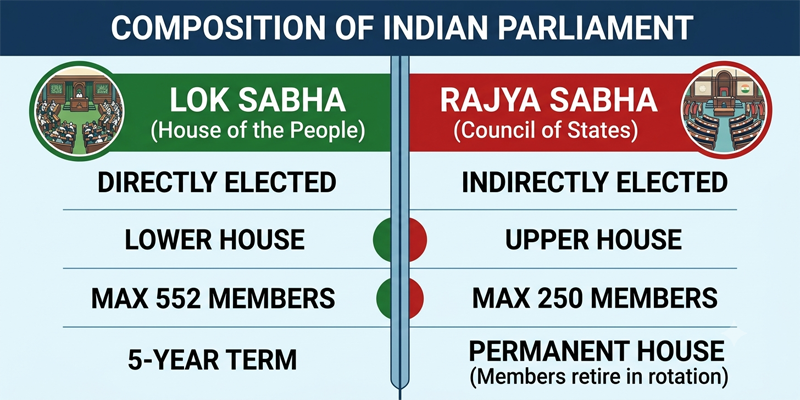
The Lok Sabha is commonly called the House of the People.
Its members are directly elected by voters in parliamentary constituencies.
This direct election gives the Lok Sabha a particularly important connection with the people.
The normal constitutional term of the Lok Sabha is five years, unless it is dissolved earlier. During a National Emergency, its term can be extended by Parliament subject to constitutional limitations.
The Lok Sabha plays a particularly important role in relation to the Council of Ministers because the government must maintain the confidence of the House.
What Is the Rajya Sabha?
The Rajya Sabha is known as the Council of States.
It represents the States and Union Territories at the Union level.
Unlike the Lok Sabha, the Rajya Sabha is a permanent House. It is not dissolved.
Members of the Rajya Sabha generally serve a six-year term, with approximately one-third of the members retiring every two years.
Most elected members of the Rajya Sabha are chosen by elected members of the Legislative Assemblies of the respective States and eligible Union Territories, using proportional representation through the single transferable vote system.
The President also nominates members with special knowledge or practical experience in areas such as literature, science, art, and social service, within the constitutional framework.
Lok Sabha vs Rajya Sabha
The easiest way to understand the two Houses is through their basic differences.
| Lok Sabha | Rajya Sabha |
|---|---|
| House of the People | Council of States |
| Members directly elected by voters | Mostly elected indirectly by elected State legislators |
| Normal term is 5 years | Permanent House |
| Can be dissolved | Cannot be dissolved |
| Minimum age for membership: 25 | Minimum age for membership: 30 |
| Government’s survival depends on its majority/confidence | Government does not need Rajya Sabha majority to remain in office |
| Greater role in Money Bills | Limited role in Money Bills |
| Represents the people directly | Represents States and Union Territories at the Union level |
Both Houses, however, are important parts of Parliament.
Who Can Become a Member of Parliament?
The Constitution and election laws establish qualifications for becoming an MP.
Broadly, a person must be:
- A citizen of India
- At least 25 years old for Lok Sabha
- At least 30 years old for Rajya Sabha
- Qualified under applicable election law
- Not disqualified under the Constitution or relevant legislation
Additional requirements and disqualifications are governed by constitutional provisions and laws such as the Representation of the People Act, 1951.
What Does Parliament Do?
Parliament has several important functions.
1. Makes Laws
One of Parliament’s most visible functions is making laws on matters within Parliament’s legislative competence.
A proposed law normally begins as a Bill.
Depending on its nature, it may be introduced in either House or, in the case of a Money Bill, only in the Lok Sabha.
The Bill is debated and considered.
If both Houses pass it where required, it is presented to the President.
The President may give assent, with constitutional provisions governing the process.
Once the required constitutional procedure is completed, the Bill becomes an Act.
This process ensures that laws are not simply announced by one individual.
They are subjected to parliamentary consideration.
2. Controls Public Money
Parliament plays a major role in deciding how public money is raised and spent at the Union level.
The Union Budget is presented before Parliament.
Parliamentary procedures allow elected representatives to examine government expenditure and taxation proposals.
This is one of the most important ways in which Parliament exercises financial control over the executive.
3. Holds the Government Accountable
India follows a parliamentary system of government.
The Council of Ministers is collectively responsible to the Lok Sabha.
Members of Parliament can question ministers, raise matters of public importance, and scrutinize government policies.
Parliamentary questions, debates, discussions, and committees provide mechanisms through which the executive can be examined.
This is a crucial part of democratic accountability.
What Is Question Hour?
Question Hour is an important parliamentary mechanism.
During Question Hour, Members of Parliament can ask ministers questions about the functioning of their departments.
Questions can relate to subjects such as:
- Government spending
- Public schemes
- Infrastructure
- Employment
- Education
- Healthcare
- Administration
- Policy implementation
Ministers are required to respond according to parliamentary rules and procedures.
Question Hour therefore allows MPs to seek information and hold the government accountable.
What Is Zero Hour?
Zero Hour is a parliamentary practice that developed in India.
It allows MPs to raise matters of urgent public importance.
Unlike Question Hour, Zero Hour is not specifically mentioned in the Constitution.
It operates under parliamentary practice and rules.
It has become an important mechanism through which members can draw attention to pressing issues.
Parliamentary Committees: The Work Behind the Scenes
A large amount of parliamentary work happens through committees.
Parliamentary committees examine Bills, government expenditure, policies, reports and other matters in greater detail.
Some important committees include:
- Public Accounts Committee
- Estimates Committee
- Committee on Public Undertakings
- Department-related Standing Committees
- Various other select and joint committees
Committees allow Members of Parliament to examine complicated subjects in greater detail than may be possible during a full House debate.
They can examine documents, question officials and study government performance, subject to their powers and applicable parliamentary rules.
What Is a Money Bill?
A Money Bill is a special category of Bill defined under Article 110.
It deals exclusively with matters specified in the Constitution, such as certain taxation, government borrowing, and appropriation-related matters.
A Money Bill can be introduced only in the Lok Sabha and generally requires the President’s recommendation for introduction.
The Rajya Sabha cannot reject or amend a Money Bill in the same way as an ordinary Bill.
It can make recommendations, but the Lok Sabha may accept or reject those recommendations.
The Rajya Sabha must return a Money Bill within 14 days.
If it does not, the Bill is deemed to have been passed by both Houses in the form in which it was passed by the Lok Sabha, subject to the constitutional provisions.
The Speaker of the Lok Sabha has the constitutional authority to certify whether a Bill is a Money Bill.
Can the Rajya Sabha Make Laws?
Absolutely.
A common misconception is that the Rajya Sabha cannot make laws.
That is incorrect.
For ordinary legislation within Parliament’s competence, both Houses generally have an important role.
A Bill ordinarily needs to pass both Houses before it can be presented for presidential assent.
The Rajya Sabha also has certain special constitutional powers.
For example, under Article 249, the Rajya Sabha can authorize Parliament to legislate on a matter in the State List if the required special majority considers it necessary or expedient in the national interest.
This demonstrates why the Rajya Sabha is much more than a reviewing chamber.
What Happens If the Two Houses Disagree?
For certain ordinary Bills, if the Lok Sabha and Rajya Sabha disagree, the Constitution provides for the possibility of a joint sitting under Article 108, subject to its conditions.
A joint sitting brings members of both Houses together to vote on the Bill.
However, joint sittings are not available for every type of Bill.
For example, they do not apply to Money Bills or Constitutional Amendment Bills.
What Is a Constitutional Amendment Bill?
Changing the Constitution is different from passing an ordinary law.
A Constitutional Amendment Bill is dealt with under Article 368.
Depending on the amendment, it may require:
- A special majority in Parliament
- Ratification by at least half of the State Legislatures for certain specified matters
There is no joint sitting for Constitutional Amendment Bills.
This higher threshold exists because the Constitution is the fundamental legal framework of the country.
The President’s Role in Parliament
The President is an important constitutional part of Parliament.
The President summons and prorogues Parliament according to constitutional provisions and may dissolve the Lok Sabha in appropriate circumstances.
The President also addresses Parliament at constitutionally specified occasions.
Most importantly, a Bill passed through the required parliamentary process generally becomes law only after receiving the President’s assent, subject to the Constitution.
The President also has certain ordinance-making powers under Article 123 when Parliament is not in session, subject to constitutional conditions.
An ordinance is not a substitute for Parliament and must be placed before Parliament when it reassembles, with constitutional consequences if it is not approved as required.
Can Parliament Make Any Law It Wants?
No.
Parliament has extensive legislative powers, but they are not unlimited.
The Constitution divides legislative subjects between the Union and the States through the Seventh Schedule, which contains:
- Union List
- State List
- Concurrent List
Parliament normally legislates on matters in the Union List and, subject to constitutional provisions, the Concurrent List.
There are also special constitutional situations in which Parliament can legislate on matters ordinarily within the State List.
Most importantly, all laws must remain consistent with the Constitution.
What If Parliament Passes an Unconstitutional Law?
Parliament is powerful, but it is not above the Constitution.
India follows constitutional supremacy.
Courts can review legislation and strike down provisions that violate the Constitution, subject to the scope of judicial review.
For example, if a law violates a Fundamental Right or exceeds constitutional legislative authority, it can be challenged before the appropriate court.
This creates a system of checks and balances.
Parliament makes laws, the executive implements them, and the judiciary interprets the Constitution and reviews government action within its constitutional jurisdiction.
Parliament and the People
Parliament is ultimately connected to citizens through elections.
When citizens vote in Lok Sabha elections, they choose representatives who participate in the national legislative process.
This is why voting is more than simply selecting a candidate.
Citizens are helping determine who will represent their constituency in the national Parliament.
After elections, citizens can also hold representatives accountable by following parliamentary performance, asking questions, participating in democratic discussions, and evaluating policies and legislation.
Why Should Ordinary Citizens Understand Parliament?
Parliamentary proceedings may appear complicated, but their impact is very practical.
Parliament can influence laws concerning:
- Taxes
- Education
- Employment
- Consumer protection
- Criminal law
- Digital technology
- Environment
- Infrastructure
- Social welfare
- Business and economic activity
- National security
Understanding Parliament therefore helps citizens understand how decisions affecting their lives are made.
It also helps citizens distinguish between the roles of Parliament, the government, courts and State legislatures.
Quick Reference
| Institution | Main Role |
|---|---|
| President | Constitutional component of Parliament; performs functions under the Constitution |
| Lok Sabha | Directly elected House; major role in government accountability and financial matters |
| Rajya Sabha | Council of States; represents States/UTs and provides legislative review and special constitutional functions |
| Parliamentary Committees | Detailed examination of Bills, expenditure, policies and government functioning |
| Council of Ministers | Exercises executive power and is collectively responsible to Lok Sabha |
| Judiciary | Interprets the Constitution and exercises judicial review within constitutional limits |
Final Takeaway
Friends, in this blog post(Indian Parliament), we have readily understood the Indian Parliamentary System. It is not just a government official building; rather, it is a house of discussion where several important politicians participate in a debate and discuss the various important concerns related to the country’s development. It is a constitutional institution where the elected representatives participate in various nation-building activities like law-making, scrutinizing government actions, approving public expenditure, and debating matters of national importance
In the Lok Sabha, directly elected representatives by the people participate, whereas the Rajya Sabha represents the states and Union Territories at the Union level. Both the houses are built to perform various important tasks, though they both are not identical in terms of the power given to them. If citizens really know the working of the Indian Parliament, then it means they are already witnessing the indian democracy working.
From now onwards, if any bill is debated and discussed in the Indian Parliament, along with questioning the concerned minister, then you will have a better idea of what is actually happening and what it means to the nation.
Legal Awareness Note
This article(Indian Parliament) is intended for general public awareness and educational purposes. It provides a simplified explanation of constitutional and parliamentary provisions and should not be treated as legal advice. Parliamentary procedures, legislative powers, and constitutional provisions may involve exceptions and detailed rules that are not covered fully here.
If you have any queries, you can write to us at support@a5theory.com; we will get back to you ASAP.
Hope! You will enjoy this post, “Indian Parliament“.
Please feel free to give your feedback in the comment section below.
Have a great time!