

Hello Friends, in this blog post, we are going to discuss FIR and Police Complaints in India within the Indian Constitution.
When a crime takes place around us, the most obvious question that we ask is:
“How to lodge a complaint at a police station?”
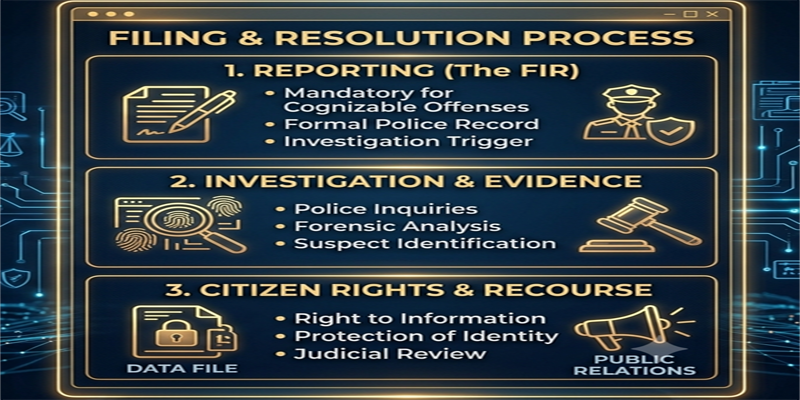
Most of us have heard about FIR, as this is the most common term to hear in the news and media. But very few know the basic facts about the FIR, like:
- When should an FIR be registered?
- What information should it contain?
- What to do if the police refuse to register it?
- What rights a complainant or accused person has during the process?
So, if you know more about the basics, you will have less confusion during the criminal justice process.
Bharatiya Nagarik Suraksha Sanhita, 2023 (BNSS) is primarily responsible for handling criminal justice procedure in India.
Which came into effect on 1 July 2024, when the criminal procedure, 1973, subject to transitional provisions got replaced.
In this post, we will explore “FIR and Police Complaints in India“, along with a discussion on investigations and some important rights in easy-to-understand language.
What Is an FIR?
FIR stands for First Information Report.
In general terms, it is the formal record made by the police when information is given about the commission of a cognizable offence.
A cognizable offence is one for which the law permits the police to arrest without a warrant, subject to the applicable statutory requirements, and to investigate according to law.
An FIR is therefore an important starting point for many criminal investigations.
But an FIR is not a judgment.
It does not establish that the accused person is guilty.
It records information concerning an alleged offence and allows the criminal investigation process to begin.
FIR and Police Complaint: Are They the Same?
Not necessarily.
A police complaint is a broader term for information or a grievance given to the police.
An FIR is a specific statutory record associated with information relating to a cognizable offence.
For example, a person may approach the police with information about an incident.
Depending on the facts and legal classification of the offence, the police may:
- Register an FIR.
- Conduct an inquiry where legally permitted.
- Record the information in another appropriate manner.
- Direct the person to the appropriate authority.
Therefore, simply submitting something called a “complaint” does not automatically mean that an FIR has been registered.
Cognizable and Non-Cognizable Offences
Understanding these two terms is important.
Cognizable Offence
In a cognizable offence, the law gives the police power to investigate without requiring a prior order from a magistrate, subject to the applicable provisions.
Arrest without a warrant may also be permitted in specified circumstances.
Examples can include certain serious offences such as murder, rape, robbery and kidnapping, depending on the applicable law and classification.
Non-Cognizable Offence
For a non-cognizable offence, the police generally cannot investigate without the order of a magistrate, subject to the statutory framework.
The classification depends on the applicable law.
A non-cognizable offence does not mean that the conduct is legal or unimportant. It means that the law provides a different procedure for investigation.
When Should an FIR Be Registered?
The basic principle is that information relating to a cognizable offence should be dealt with according to the statutory requirements governing registration of information.
Under the BNSS, information relating to a cognizable offence may be given to the officer in charge of a police station.
The law also permits electronic communication for giving information in specified circumstances, subject to the required formalities.
This is an important modernization of criminal procedure.
Can an FIR Be Registered Outside the Local Police Station?
The concept commonly known as a Zero FIR is important here.
A person can approach a police station even if the alleged offence occurred outside its ordinary territorial jurisdiction, and the information can be recorded in accordance with the applicable procedure before being transferred to the police station having jurisdiction.
This is particularly useful in serious situations where delaying registration because of an argument about territorial jurisdiction could cause problems.
The exact procedural requirements should be followed.
What Information Should an FIR Contain?
There is no need to write an FIR in complicated legal language.
Information should generally communicate the important facts of the alleged incident.
Depending on the circumstances, this may include:
- Date and approximate time of incident
- Place of incident
- What happened
- Identity or description of persons involved, if known
- Description of injuries or loss
- Names of witnesses, if known
- Relevant documents or evidence
- Information about weapons or vehicles, if relevant
- Other important circumstances
Avoid adding facts that you do not know to be true.
If you are unsure about a particular detail, it is better to say so rather than inventing information.
Can You Give an FIR in Your Own Language?
The law provides mechanisms for recording information given to the police.
A person should be able to communicate the facts in a language they understand, with the information being recorded according to the applicable procedure.
If you do not understand what has been recorded, ask for it to be explained to you before confirming the contents.
Should You Read the FIR Before Signing?
Yes.
If you are the person giving information, carefully check the recorded information for accuracy.
Make sure important facts have not been omitted or incorrectly recorded.
Do not knowingly confirm false information.
The law provides for the recording and authentication of information according to the applicable procedure.
Do You Get a Copy of the FIR?
A person who provides information that is recorded as an FIR is entitled to receive a copy according to the applicable legal provisions.
In practice, the police may provide the FIR without charging the informant for the copy.
FIRs may also become accessible through police or court systems where publication is legally permitted.
However, sensitive information may be subject to restrictions.
What If the Police Refuse to Register an FIR?
This is one of the most important practical questions.
If information concerning a cognizable offence is not properly recorded, the BNSS provides a statutory escalation mechanism.
A person can submit the substance of the information in writing and by post to the Superintendent of Police if the officer in charge of the police station refuses to record the information, subject to the statutory requirements.
If the matter remains unresolved, the person may approach the Magistrate through the appropriate legal procedure.
Depending on the circumstances, constitutional remedies may also be available.
Can You Approach the High Court?
In appropriate cases, a person may approach the High Court under Article 226 of the Constitution.
The High Court has broad writ jurisdiction and may intervene where there is an appropriate constitutional or public-law issue.
However, courts generally consider the statutory remedies and facts of each case.
Therefore, approaching the High Court should not be treated as an automatic replacement for every ordinary police or magistrate procedure.
Can You File a Complaint Online?
Many police departments provide online complaint or reporting facilities.
These can be useful for certain types of complaints.
However, an online complaint is not necessarily the same thing as an FIR.
The legal effect depends on the nature of the information, the offence, and the applicable procedure.
For serious offences, citizens should understand whether the information has actually resulted in registration of an FIR.
What Happens After an FIR Is Registered?
Registration of an FIR generally begins the investigation process.
Depending on the case, police may:
- Visit the place of occurrence
- Examine witnesses
- Collect documents
- Collect physical or electronic evidence
- Conduct searches where legally authorized
- Question relevant persons
- Arrest a suspect where legally justified
- Obtain medical or forensic evidence
- Record statements
- Prepare investigation records
- Submit the appropriate report to the magistrate
The exact investigation depends on the offence.
Does Filing an FIR Mean Someone Will Be Arrested Immediately?
No.
An FIR and an arrest are two different things.
Registration of an FIR means that information concerning an alleged offence has been formally recorded.
Whether someone should be arrested depends on the legal requirements and circumstances of the case.
The Supreme Court has repeatedly emphasized that the power to arrest should not be treated as an automatic consequence of every FIR.
This distinction is important because:
FIR ≠ Arrest ≠ Conviction
They are three different stages or concepts.
What Is a Police Investigation?
An investigation is the process through which police collect evidence and determine whether there is sufficient material to proceed against a person.
Investigation may include:
- Examination of witnesses
- Collection of documents
- Forensic examination
- Digital evidence collection
- Medical evidence
- Search and seizure
- Questioning
- Identification procedures
- Other legally authorized investigative steps
The objective is to collect evidence relevant to the alleged offence.
What Happens After the Investigation?
At the conclusion of an investigation, the police submit the appropriate report to the magistrate in accordance with the law.
Depending on the evidence and circumstances, this may result in a charge sheet or a report indicating that the evidence is insufficient for proceeding in the manner contemplated by law.
A charge sheet is not a declaration of guilt.
The court independently considers the case according to the applicable criminal procedure.
What Is a Charge Sheet?
A charge sheet is the police report submitted after investigation when the investigating agency concludes that the legal conditions for proceeding against the accused are satisfied.
It may contain information such as:
- Alleged offences
- Names of accused persons
- Witnesses
- Evidence collected
- Documents
- Expert reports
- Other investigation material
The court then deals with the matter according to law.
What If the Police Do Not Find Enough Evidence?
An investigation does not guarantee that a charge sheet will be filed against a particular person.
If the evidence does not support prosecution in the manner required by law, the police may submit an appropriate final report.
The magistrate then considers the report according to the applicable legal process.
This is another reason why an FIR should not be treated as proof of guilt.
Can an FIR Be Cancelled or Quashed?
In appropriate cases, an FIR can be challenged.
The High Court has inherent powers under the criminal-procedure framework to prevent abuse of the process of law and secure the ends of justice, subject to the applicable statutory provisions.
A High Court may quash proceedings in appropriate circumstances.
However, quashing is not automatic merely because an accused person denies the allegations.
The facts, evidence, legal provisions and stage of the case matter.
Can the Police Refuse to Investigate a Genuine Case?
The police have legal duties to investigate offences within their jurisdiction and according to the applicable law.
However, the precise duty depends on the nature of the alleged offence and procedural requirements.
Where a person believes the police have failed to perform their legal obligations, the law provides escalation mechanisms involving senior police officers, magistrates and, in appropriate circumstances, constitutional courts.
What Are the Rights of an Accused Person?
Criminal procedure does not only protect complainants.
An accused person also has important legal and constitutional protections.
These include, subject to applicable law:
- Protection against arbitrary arrest
- Right to know the grounds of arrest
- Right to consult a lawyer
- Right to legal aid if eligible
- Right to be produced before a magistrate within the constitutional time limit
- Right to seek bail where available
- Protection against compelled self-incrimination under Article 20(3)
- Right to a fair legal process
Being named in an FIR does not mean that a person has been convicted.
What If Someone Files a False FIR?
A person who believes an FIR contains false allegations has legal remedies.
Depending on the circumstances, they may:
- Seek bail
- Place relevant evidence before the investigating agency or court
- Seek appropriate relief from a magistrate
- Challenge the proceedings before the High Court in an appropriate case
- Seek quashing where the legal requirements are satisfied
- Pursue other remedies available under law
However, simply calling an FIR “false” does not automatically make it legally invalid.
The allegations and evidence must be examined through the appropriate legal process.
What Is a Counter-Complaint?
Sometimes two parties to a dispute make allegations against each other.
The police may receive separate complaints concerning the same incident.
The existence of two complaints does not automatically mean that one must be false.
Each allegation has to be examined according to the evidence and applicable law.
Can You Change an FIR?
An FIR is an official record of information given to the police.
It is not normally rewritten simply because the informant later changes their mind.
If additional information becomes available, it can be brought to the attention of the investigating agency through the appropriate process.
The investigation may collect additional evidence and record further statements.
If the original FIR contains an error, the appropriate legal mechanism depends on the nature of the error and the circumstances.
What If Important Evidence Is Digital?
Modern criminal cases often involve:
- CCTV footage
- Mobile phones
- WhatsApp or other messages
- Emails
- Call records
- GPS/location information
- Online transactions
- Photographs
- Videos
- Social-media records
Citizens should preserve original digital evidence wherever possible.
Do not edit, manipulate or delete potentially relevant material.
If a serious offence is involved, consult a lawyer about the appropriate way to preserve and present digital evidence.
What Should a Complainant Do After Filing an FIR?
After filing an FIR, keep a record of:
- FIR number
- Police station
- Date of registration
- Investigating officer’s details
- Relevant documents
- Medical records
- Photographs and videos
- Witness details
- Communications with the police
- Any important court dates
If the investigation involves a serious matter, legal advice can help you understand the next steps.
What Should You Do If the Police Do Not Register Your Complaint?
A practical sequence is:
Step 1: Clearly Communicate the Facts
Give the police accurate information about the alleged offence.
Step 2: Keep Evidence
Keep copies of your written complaint and supporting documents.
Step 3: Escalate to the Senior Police Officer
If the information is not properly recorded, use the statutory mechanism for approaching the Superintendent of Police or other appropriate senior authority.
Step 4: Approach the Magistrate Where Appropriate
The BNSS provides a judicial mechanism for seeking appropriate directions in specified circumstances.
Step 5: Consider Constitutional Remedies
Depending on the circumstances, a High Court remedy under Article 226 may be available.
The appropriate route depends on the facts.
Important Supreme Court Decisions
Several Supreme Court judgments have influenced the law surrounding FIRs and police investigations.
Lalita Kumari v. Government of Uttar Pradesh
The Supreme Court addressed the registration of FIRs and held that registration is mandatory where information discloses a cognizable offence, subject to the limited situations recognized by law for preliminary inquiry.
This case remains important for understanding the basic principle surrounding FIR registration.
Arnesh Kumar v. State of Bihar
The Court emphasized that arrest should not automatically follow from registration of a criminal case and that statutory safeguards must be followed.
D.K. Basu v. State of West Bengal
This landmark judgment developed safeguards relating to arrest and detention and emphasized protection against custodial abuse.
Together, these cases demonstrate that criminal procedure must balance effective investigation with protection of individual liberty.
FIR vs Complaint vs Charge Sheet
These terms can be remembered simply:
| Term | Meaning |
|---|---|
| Police Complaint | Information or grievance given to police |
| FIR | Formal record of information concerning a cognizable offence, under applicable law |
| Investigation | Process of collecting evidence |
| Charge Sheet | Police report submitted after investigation where prosecution is pursued |
| Trial | Judicial examination of the case |
| Judgment | Court’s decision |
The process can therefore be broadly understood as:
Complaint/information → FIR where applicable → Investigation → Police report → Court proceedings → Judgment
The exact procedure(FIR and Police Complaints in India) can vary depending on the offence and circumstances.
What Every Citizen Should Remember
If you remember only a few points, remember these:
- FIR means First Information Report.
- An FIR generally relates to information about a cognizable offence.
- Filing an FIR does not prove that the accused is guilty.
- An FIR does not automatically mean that an arrest will take place.
- A person can use appropriate legal mechanisms if police fail to record information that should be registered.
- Zero FIR can help avoid delays caused by territorial-jurisdiction issues in appropriate cases.
- The BNSS is the principal criminal-procedure law in force since 1 July 2024.
- An accused person has constitutional and legal protections.
- Keep copies of complaints, FIRs, and important evidence.
- Digital evidence should be preserved carefully.
- If a matter is serious, timely legal advice can be extremely important.
Final Takeaway
Friends, in this post we have understood FIR and Police Complaints in India in detail. In the Indian criminal-justice system, an FIR is an important part of investigation and could be counted as one step in a much larger process.
The worth-remembering basic distinction is:
An FIR reports an allegation or information about an alleged cognizable offence. An investigation piles up evidence. A court eventually decides criminal liability through the judicial process.
Key habits for citizens are very simple:
Record genuine offences. Give precise information. Keep recorded proof. Know the difference between a complaint and an FIR. Understand your rights. And do not assume that an FIR by itself proves guilt or remorse.
Both victims and accused get relief by seeking and protecting their legal rights with no confusion if they fully learn & understand the police procedure(FIR and Police Complaints in India).
Legal Disclaimer
This article “FIR and Police Complaints in India” is intended for general educational and legal-awareness purposes only. It is not legal advice and should not be treated as a substitute for professional legal consultation. Criminal procedure depends on the facts, applicable provisions, and judicial decisions. For a specific complaint, FIR, investigation, or criminal case, consult a qualified lawyer or the appropriate legal services authority.
If you have any queries, you can write to us at support@a5theory.com; we will get back to you ASAP.
Hope! You will have enjoyed this post, “FIR and Police Complaints in India“.
Please feel free to give your feedback in the comment section below.
Have a great time!