

Introduction
Hello Friends, in this blog post(Python Functions Explained), we are going to see the functions in the Python language.
Functions are nothing but a set of instructions or reusable code blocks that perform one or more tasks in the program.
While programming, there are many pieces of code that might be used multiple times in the program.
So if we write it every time we need it, then our program size might be big and complex.
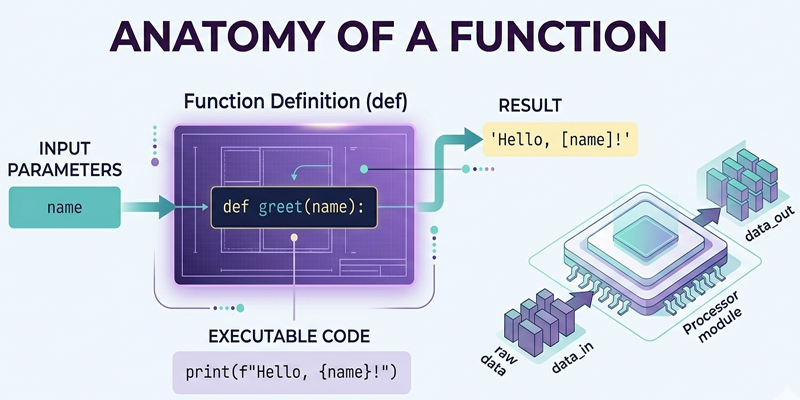
So we create functions and use it whereever it is needed in the program. And this makes our program smaller, organized, cleaner, and simpler.
So for larger and complex programs, functions are very important to use. And it becomes easy to understand the program and also enhances the efficiency of the program.
Functions are used in every single place, from a small simple Python script to large advanced software applications.
In all real-world Python applications, functions must be used. So beginners need to learn this important concept efficiently.
So we are going to teach you Python functions in a very simple and appropriate way, like a beginner.
We are going to cover a function’s syntax, parameters, and return value, along with practical examples, so that you can understand this concept well.
What Are Functions in Python? / Python Functions Explained
A function is a reusable block of code designed to perform a specific task.
Instead of writing the same code multiple times, you can place it inside a function and use it whenever needed.
Why Functions Are Important
- Reduce repetition in code
- Improve readability
- Make programs easier to maintain
- Help organize large programs
- Save development time
Functions are an essential part of writing efficient and professional code.
How to Create a Function in Python
Basic Syntax
In Python, functions are created using the def keyword.
def function_name():
    # code block
Simple Function Example
def greet():
    print("Welcome to Python")
This function is named greet.
Calling a Function
Creating a function is not enough—you also need to call it.
Example:
greet()Output
Welcome to PythonWhen the function is called, the code inside it runs.
Functions with Parameters
What Are Parameters?
Parameters allow functions to accept values as input.
Example
def greet(name):
    print("Hello", name)
Calling the function:
greet("Alex")Output
Hello AlexHere, name is a parameter that receives the value "Alex".
Why Parameters Are Useful
Parameters make functions flexible and reusable because the same function can work with different values.
Functions with Multiple Parameters
Example:
def add(a, b):
    print(a + b)
Calling the function:
add(5, 3)Output
8This function takes two inputs and adds them together.
Return Values in Functions
What Is a Return Statement?
The return The keyword sends a result back from a function.
Example:
def multiply(a, b):
    return a * b
Calling the function:
result = multiply(4, 5)

print(result)
Output
20Return values are important because they allow functions to produce reusable results.
Difference Between print() and return
| Feature | print() | return |
|---|---|---|
| Purpose | Displays output | Sends value back |
| Reusability | Limited | Highly reusable |
| Common Use | Debugging and display | Functional programming |
Understanding this difference is important for writing better programs.
Types of Functions in Python
1. Built-in Functions
Python provides many pre-defined functions.
Examples:
print()
len()
type()
input()
2. User-Defined Functions
Functions created by programmers are called user-defined functions.
Example:
def welcome():
    print("Hello User")
Advantages of Using Functions
Code Reusability
Write once and use multiple times.
Better Organization
Functions divide large programs into smaller sections.
Easy Debugging
Errors are easier to identify and fix.
Improved Readability
Functions make programs easier to understand.
Scope of Variables in Functions
Local Variables
Variables created inside functions are local variables.
Example:
def test():
    message = "Python"
    print(message)
The variable message exists only inside the function.
Common Mistakes Beginners Make
1. Forgetting to Call the Function
Creating a function alone does nothing until it is called.
2. Wrong Indentation
Python depends heavily on proper indentation.
Incorrect indentation causes errors.
3. Missing Parameters
Calling a function without required arguments leads to errors.
Example:
def greet(name):
    print(name)

greet()
This produces an error because the parameter is missing.
Real-Life Uses of Functions
Functions are used in almost every software application:
- Login systems
- Payment processing
- Data analysis
- Web applications
- Automation scripts
- Games and mobile apps
Large applications may contain thousands of functions working together.
Best Practices for Writing Functions
Use Meaningful Names
Choose names that clearly describe the function’s purpose.
Good Example:
calculate_total()Keep Functions Small
Functions should perform one specific task.
Avoid Repetition
If code repeats often, convert it into a function.
Mini Real-World Example
def calculate_area(length, width):
    return length * width

area = calculate_area(10, 5)

print("Area:", area)
Output
Area: 50This demonstrates how functions simplify calculations and improve code organization.
What to Learn After Functions
Once you understand functions, you should move on to:
- Lists and dictionaries
- File handling
- Modules and packages
- Exception handling
- Object-oriented programming
These concepts help you build more advanced Python applications.
Conclusion
So, Friends, in this blog post(Python Functions Explained), we have seen functions in the Python language. Not only in Python but in every programming language, functions are the most powerful and essential features, performing some specific task. To keep programs smaller and organized, reduce repetition, and improve readability, functions play an important role inside the program.
Functions are the most exciting and useful part of programming. When beginners start to gain command over it, they feel an exitement and thrilled about the magic of functions. And it helps them to write professional-level code and enhance their confidence. You can easily learn functions if you practice it regulary inside the program. Always try to code those small projects that have more scope for this reusable code in them.
Programming will be more efficient, structured, and enjoyable when you get comfortable with functions.
In case of any queries, you can write to us at support@a5theory.com; we will get back to you ASAP.
Hope! you would have enjoyed this post(Python Functions Explained).
Please feel free to give your important feedback in the comment section below.
Have a great time!