

Introduction
Hello Friends, in this blog post(types of pronouns in English), I am going to let you know about Pronouns in the English Language.
It’s very common to use these words in reading, writing, and speaking.
Because without using Pronouns, it will be very difficult, especially repeating nouns again and again.
This will make sentences awkward and lengthy.
For example:
Without Pronouns:
Raj is a student. Raj goes to school every day. Raj studies hard.
With Pronouns:
Raj is a student. He goes to school every day. He studies hard.
The word “He” replaces the noun Raj, making the sentence smoother and easier to understand.
In this post, we will discuss the different types of pronouns in English.
Here, we will see all the rules, examples, and common mistakes in detail.
What Is a Pronoun?/Types of Pronouns in English
A Pronoun is a word that can be used in place of a noun in a sentence.
Examples
- He
- She
- It
- They
- We
- You
Sentence Example
- Priya is reading a book.
- She is reading a book.
Here, “She” replaces the noun “Priya.”
Why Are Pronouns Important?
Pronouns help:
- Avoid repetition
- Improve sentence flow
- Make communication easier
- Enhance writing and speaking skills
- Create natural-sounding English
Without pronouns, communication would become repetitive and inefficient.
Types of Pronouns in English
English grammar includes several types of pronouns, each serving a specific purpose.
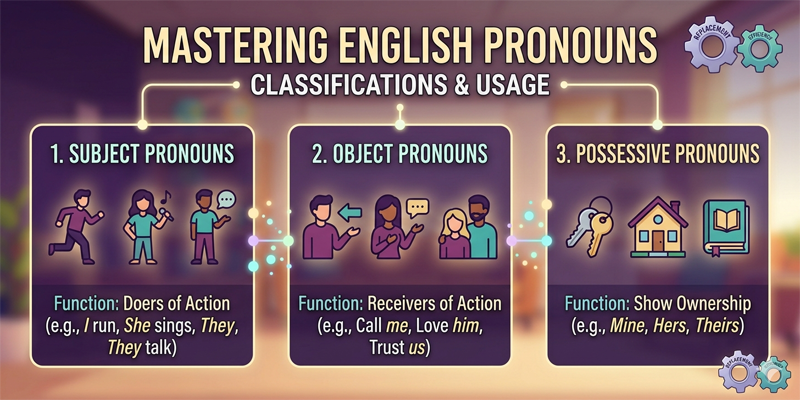
1. Personal Pronouns
What Are Personal Pronouns?
Personal pronouns refer to specific people, animals, places, or things.
Examples
| Subject Pronouns | Object Pronouns |
|---|---|
| I | Me |
| You | You |
| He | Him |
| She | Her |
| It | It |
| We | Us |
| They | Them |
Examples in Sentences
- I am learning English.
- She is my friend.
- Rahul called him.
- The teacher praised us.
2. Possessive Pronouns
What Are Possessive Pronouns?
Possessive pronouns show ownership or possession.
Examples
- Mine
- Yours
- His
- Hers
- Ours
- Theirs
Sentences
- This book is mine.
- That car is hers.
- The house is theirs.
Possessive pronouns eliminate the need to repeat nouns.
3. Demonstrative Pronouns
What Are Demonstrative Pronouns?
Demonstrative pronouns point to specific people or things.
Examples
- This
- That
- These
- Those
Sentences
- This is my laptop.
- That belongs to Rahul.
- These are beautiful flowers.
- Those are my books.
4. Interrogative Pronouns
What Are Interrogative Pronouns?
Interrogative pronouns are used to ask questions.
Examples
- Who
- Whom
- What
- Which
- Whose
Sentences
- Who is your teacher?
- What do you want?
- Which is your favorite subject?
- Whose bag is this?
5. Relative Pronouns
What Are Relative Pronouns?
Relative pronouns connect a clause to a noun or pronoun.
Examples
- Who
- Whom
- Which
- That
- Whose
Sentences
- The boy who won the race is my friend.
- The book that I bought is interesting.
- The teacher whose class I attend is very helpful.
6. Reflexive Pronouns
What Are Reflexive Pronouns?
Reflexive pronouns refer back to the subject of the sentence.
Examples
- Myself
- Yourself
- Himself
- Herself
- Itself
- Ourselves
- Themselves
Sentences
- I taught myself Python.
- She hurt herself while playing.
- They completed the project themselves.
7. Indefinite Pronouns
What Are Indefinite Pronouns?
Indefinite pronouns refer to people or things in a general way.
Examples
- Someone
- Anyone
- Everyone
- Nobody
- Everybody
Sentences
- Someone is knocking at the door.
- Everyone enjoyed the party.
- Nobody knows the answer.
8. Reciprocal Pronouns
What Are Reciprocal Pronouns?
Reciprocal pronouns show mutual actions or relationships.
Examples
- Each other
- One another
Sentences
- They help each other.
- The students respect one another.
9. Distributive Pronouns
What Are Distributive Pronouns?
Distributive pronouns refer to individuals separately rather than collectively.
Examples
- Each
- Either
- Neither
Sentences
- Each of the players received a medal.
- Neither of the answers is correct.
- Either of the options will work.
Quick Summary Table
| Pronoun Type | Examples |
|---|---|
| Personal Pronouns | I, He, She, They |
| Possessive Pronouns | Mine, Yours, Hers |
| Demonstrative Pronouns | This, That, These |
| Interrogative Pronouns | Who, What, Which |
| Relative Pronouns | Who, Which, That |
| Reflexive Pronouns | Myself, Yourself |
| Indefinite Pronouns | Someone, Everyone |
| Reciprocal Pronouns | Each Other, One Another |
| Distributive Pronouns | Each, Either, Neither |
Common Pronoun Mistakes
Mistake 1: Using Subject and Object Pronouns Incorrectly
❌ Him is my friend.
✔ He is my friend.
Mistake 2: Incorrect Possessive Pronouns
❌ This book is her.
✔ This book is hers.
Mistake 3: Confusing “Who” and “Whom”
❌ Whom is coming to the party?
✔ Who is coming to the party?
Mistake 4: Incorrect Reflexive Pronoun Usage
❌ Myself am Rahul.
✔ I am Rahul.
“Myself” should not be used as a subject.
Pronoun Agreement Rules
Pronouns must agree with the nouns they replace.
Examples
- Rahul lost his wallet.
- Priya completed her assignment.
- The students submitted their projects.
Agreement helps maintain clarity and grammatical correctness.
Tips to Master English Pronouns
Practice Daily
Create sentences using different types of pronouns.
Read English Content
Books, blogs, and newspapers expose you to natural pronoun usage.
Focus on Context
Choose pronouns based on what noun they replace.
Avoid Repetition
Communication becomes less repetitive and smoother. Pronouns play an important role in making a natural flow of language efficiently.
How Pronouns Improve Spoken English
Using pronouns correctly:
- Makes speech natural
- Improves fluency
- Reduces repetition
- Enhances communication skills
Whether it is a daily normal conversation or a professional communication, pronouns are very essential for making speaking smoother.
Frequently Asked Questions
Can a pronoun replace any noun?
Yes, by virtue of their definition, they are made to be used in place of nouns and noun phrases.
What is the most commonly used pronoun?
I, you, he, she, and they are the most commonly used and known as personal pronouns.
Why are pronouns very important in English?
Pronouns are very useful in reducing noun repetition in a sentence. Pronouns make communication very smooth and natural.
Conclusion
Friends, in this post(types of pronouns in English), we have seen the pronouns in detail with examples. In English grammar, pronouns are considered one of the fundamental parts that play an important role to estabilish an effective communication. Pronouns basically replace or are used in place of nouns to form a better sentence structure. And using pronouns, language becomes more effective and natural in flow.
If you really want your written and spoken English to be outstanding, then you must learn and understand these personal, possessive, demonstrative, interrogative, relative, reflexive, indefinite, reciprocal, and distributive pronouns
To master pronouns, you would need to have a lot of practice. So practicing reading, writing, and speaking as much as you can would make you confident enough, and you will easily learn to use pronouns accurately in a sentence.
If you have any queries, you can write to us at support@a5theory.com; we will get back to you ASAP.
Hope! You would have enjoyed this post(types of pronouns in English).
Please feel free to give your important feedback in the comment section below.
Have a great time!