

Hello Friends, in this blog post(Force, Motion, and Newton’s Laws), we are going to let you know about some amazing science related to Newton’s laws.
When you stop pedaling, your bicycle stops; when you kick a football, it moves; when a car suddenly stops, all passengers move forward.
Have you ever thought about the science and techniques working behind such actions?
You can get the answers to all such curious questions by understanding the science of force and motion.
In physics, these are the most fundamental concepts that explain the whole science related to objects’ movements and their interactions with the world around us.
Most of you, especially physics lovers, must have heard the name of Sir Isaac Newton.
In the 17th century, he created three simple yet very powerful laws of motion. |Force, Motion, and Newton’s Laws|
You can easily understand the concepts of force and motion through Newton’s rules of motion.
Even today, these laws are used in designing and developing various technologies and machines.
For example, designing cars, airplanes, rockets, sports equipment, and countless everyday technologies.
In this post(Force, Motion, and Newton’s Laws), we will explore all of Newton’s laws of motion in an easy, practical way.
What Is Force?
A force is a push or a pull that can change the state of motion, direction, or shape of an object.
Simply put:
Force is any action that can make an object move, stop, speed up, slow down, or change direction.
Examples of Force
- Kicking a football.
- Pulling a drawer open.
- Pushing a shopping cart.
- Lifting a school bag.
- Opening a door.
Types of Forces
Contact Forces
These forces act only when two objects touch each other.
Examples:
- Muscular force
- Frictional force
- Normal force
- Tension force
Non-Contact Forces
These forces act without physical contact.
Examples:
- Gravitational force
- Magnetic force
- Electrostatic force
What Is Motion?
Motion is the change in the position of an object with time.
If an object changes its position relative to another object, it is said to be in motion.
Examples
- A moving car.
- A flying bird.
- A rotating ceiling fan.
- Earth revolving around the Sun.
- A child running in a playground.
Types of Motion
1. Linear Motion
Movement in a straight line.
Example:
- Train moving on a straight track.
2. Circular Motion
Movement around a fixed point.
Example:
- Clock hands.
- Ferris wheel.
- Ceiling fan.
3. Rotational Motion
An object rotates about its own axis.
Example:
- Earth rotating on its axis.
- Spinning top.
4. Oscillatory Motion
Back-and-forth movement.
Example:
- Pendulum.
- Swing.
- Guitar string.
What Is Speed?
Speed tells us how fast an object moves.
Formula
Speed = Distance ÷ Time
Example:
If a cyclist covers 20 km in 2 hours,
Speed = 20 ÷ 2 = 10 km/h
What Is Velocity?
Velocity is speed in a particular direction.
For example:
- Speed = 60 km/h
- Velocity = 60 km/h towards Delhi
Direction makes velocity different from speed.
What Is Acceleration?
Acceleration is the rate at which velocity changes with time.
A vehicle accelerates when it:
- Speeds up
- Slows down
- Changes direction
Example:
A sports car reaching 100 km/h in a few seconds has high acceleration.
What Is Inertia?
Inertia is the tendency of an object to resist any change in its state of rest or motion.
This means:
- A stationary object wants to remain stationary.
- A moving object wants to keep moving unless acted upon by an external force.
Example:
When a bus suddenly starts moving, passengers lean backward because their bodies tend to remain at rest.
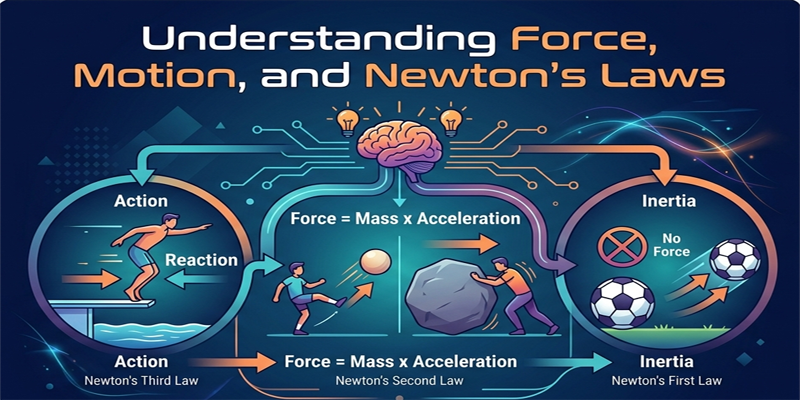
Newton’s First Law of Motion
Law of Inertia
“An object remains at rest or continues moving with uniform speed in a straight line unless acted upon by an external force.”
Everyday Examples
- A football remains still until someone kicks it.
- A parked bicycle stays where it is until someone moves it.
- Passengers move forward when a car suddenly stops.
- Dust comes out of a carpet when it is beaten.
Newton’s Second Law of Motion
This law explains the relationship between force, mass, and acceleration.
Formula
Force = Mass × Acceleration
F = m × a
This means:
- Greater force produces greater acceleration.
- Heavier objects require more force to move.
Everyday Examples
- It is easier to push an empty shopping cart than a full one.
- A cricket ball travels farther when hit with more force.
- A loaded truck requires more force to accelerate than a motorcycle.
Newton’s Third Law of Motion
Action and Reaction
“For every action, there is an equal and opposite reaction.”
Whenever one object exerts a force on another, the second object exerts an equal force in the opposite direction.
Everyday Examples
- Walking: Your feet push the ground backward, and the ground pushes you forward.
- Swimming: Swimmers push water backward, and water pushes them forward.
- Birds fly by pushing air downward.
- Rockets move upward by pushing hot gases downward.
The Role of Friction
Friction is a force that opposes motion between two surfaces in contact.
Advantages
- Helps us walk without slipping.
- Allows vehicles to stop using brakes.
- Enables writing with a pencil.
- Helps tires grip the road.
Disadvantages
- Causes wear and tear.
- Produces unwanted heat.
- Reduces machine efficiency.
- Wastes energy.
Engineers often use lubricants like oil and grease to reduce friction in machines.
Force and Motion in Everyday Life
| Situation | Science Behind It |
|---|---|
| Kicking a football | Force changes motion |
| Riding a bicycle | Balanced forces keep it moving |
| Braking a car | Friction slows motion |
| Throwing a ball | Force and gravity |
| Opening a door | Push or pull force |
| Flying an airplane | Lift, thrust, drag, and gravity |
| Launching a rocket | Newton’s Third Law |
| Playing cricket | Force, momentum, and acceleration |
Fun Facts
- Earth pulls every object toward itself due to gravity.
- Astronauts experience “weightlessness” because they are in continuous free fall around Earth.
- A rocket can move even in the vacuum of space because it carries its own fuel and follows Newton’s Third Law.
- Seat belts are designed based on the concept of inertia.
Common Misconceptions
Myth: Force is needed to keep an object moving.
Fact: Once an object is moving, it continues to move unless another force (like friction) acts on it.
Myth: Heavy objects always fall faster than lighter ones.
Fact: In the absence of air resistance, all objects fall at the same rate due to gravity.
Myth: Motion always means moving fast.
Fact: Even a slow-moving snail is in motion because its position changes over time.
Why This Topic Matters
Understanding force and motion helps us explain:
- How vehicles move.
- Why seat belts save lives.
- How athletes improve performance.
- How elevators work.
- How satellites stay in orbit.
- How rockets reach space.
- How engineers design bridges, machines, and transportation systems.
These concepts are fundamental to physics and are widely used in engineering, aviation, sports science, robotics, and space exploration.
Conclusion
Friends, in this blog post(Force, Motion, and Newton’s Laws), we have seen Newton’s laws of motion in detail with practical examples. The laws of force and motion govern everything we see around us moving. Whether it is a bird flying in the sky, a child kicking a football, or a rocket heading to space, they all work on the same principles.
Sir Isaac Newton’s invented very important laws of motion that completely transformed our understanding of the physical world. Their laws and theories have been constantly guiding our modern science and technology. If a student wants to build a strong foundation in advanced physics topics, then they must understand these laws of motion properly with an appreciation for science and how everyday experiences are explained by it. |Force, Motion, and Newton’s Laws|
From your playground to the highway and even beyond our planet, these laws are always in action if you closely see and observe the world around you. |Force, Motion, and Newton’s Laws|
If you have any queries, you can write to us at support@a5theory.com; we will get back to you ASAP.
Hope! You would have enjoyed this post(Force, Motion, and Newton’s Laws).
Please feel free to give your important feedback in the comment section below.
Have a great time!