

Hello Friends, in this blog post(Work, Energy, and Power), we are going to discuss some amazing topics related to the physics of our daily lives: work, energy, and power.
We often discuss or include these terms (work, energy, and power) in our daily conversations.
- “I don’t have enough energy today.”
- “This car has more power than that one.”
- “I’m tired after so much work.”
But when we talk about the subject of physics, these terms are not treated exactly in the same context that we have in our daily life. Like the “work” that we do in our daily life is not always considered work in science.
For example, if you are holding a heavy parcel in your hand for five minutes. You might feel tired, but as per physics, “no work is done” here, because your parcel does not move.
Did this amaze you? Let’s understand the reason behind this through this post(Work, Energy, and Power).
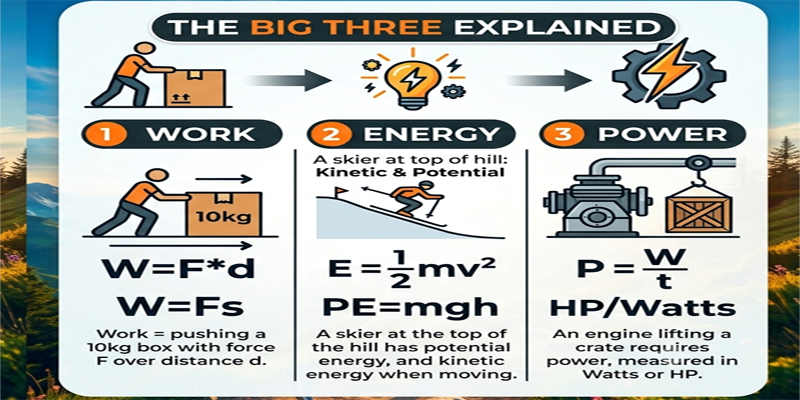
What Is Work?
In physics, work is done when a force causes an object to move in the direction of that force.
Simply applying force is not enough. There must also be movement.
Formula
Work = Force × Distance
W = F × d
Where:
- W = Work
- F = Force applied
- d = Distance moved
SI Unit
The SI unit of work is the Joule (J).
One joule is the work done when a force of 1 Newton moves an object by 1 meter.
When Is Work Done?
Three conditions must be satisfied:
- A force is applied.
- The object moves.
- The movement is in the direction of the applied force.
If any one of these conditions is missing, no work is done in physics.
Examples of Work
Work Is Done
- Pushing a table across the floor.
- Lifting a bucket of water.
- Kicking a football.
- Pulling a suitcase.
No Work Is Done
- Holding a heavy bag without moving.
- Pushing a wall that doesn’t move.
- Sitting on a chair.
- Holding a book in your hand.
What Is Energy?
Energy is the ability to do work.
Without energy, no work can be performed.
Everything that moves or changes uses energy.
Examples:
- Humans need food for energy.
- Cars use fuel.
- Mobile phones use batteries.
- Plants use sunlight.
- Wind turbines use moving air.
Energy cannot be created or destroyed. It only changes from one form to another.
This is known as the Law of Conservation of Energy.
Forms of Energy
Energy exists in many forms.
1. Kinetic Energy
Kinetic energy is the energy possessed by a moving object.
Examples:
- Moving car
- Running athlete
- Flying bird
- Rolling ball
The faster an object moves, the greater its kinetic energy.
2. Potential Energy
Potential energy is stored energy due to an object’s position or condition.
Examples:
- Water stored in a dam.
- A stretched rubber band.
- A compressed spring.
- A book kept on a shelf.
When released, this stored energy can be converted into kinetic energy.
3. Heat Energy
Heat energy is produced due to the movement of particles.
Examples:
- Boiling water.
- Burning wood.
- Cooking food.
4. Light Energy
Light allows us to see the world.
Sources include:
- The Sun.
- Electric bulbs.
- LED lights.
- Fire.
5. Sound Energy
Sound energy is produced by vibrating objects.
Examples:
- Musical instruments.
- Loudspeakers.
- Human voice.
- School bell.
6. Electrical Energy
Electrical energy powers most modern devices.
Examples:
- Television
- Computer
- Washing machine
- Mobile charger
7. Chemical Energy
Chemical energy is stored in substances.
Examples:
- Food
- Batteries
- Petrol
- Diesel
- Coal
8. Nuclear Energy
Nuclear energy is released from the nucleus of atoms.
It is used in:
- Nuclear power plants.
- Space missions.
- Medical treatments.
Law of Conservation of Energy
One of the most important laws of science states:
Energy can neither be created nor destroyed. It can only be transformed from one form into another.
Examples:
- Electric bulb:
Electrical Energy → Light Energy + Heat Energy - Car engine:
Chemical Energy → Mechanical Energy + Heat - Hydroelectric dam:
Potential Energy → Kinetic Energy → Electrical Energy - Solar panel:
Sunlight → Electrical Energy
What Is Power?
Power is the rate at which work is done.
It tells us how quickly work is completed.
Formula
Power = Work ÷ Time
P = W ÷ t
SI Unit
The SI unit of power is the Watt (W).
One watt means one joule of work is done in one second.
Why Power Matters
Imagine two students lifting identical boxes to the same height.
- Student A takes 10 seconds.
- Student B takes 5 seconds.
Both do the same amount of work, but Student B has greater power because the work is completed in less time.
Work vs Energy vs Power
| Quantity | Meaning | Unit |
|---|---|---|
| Work | Force causing movement | Joule (J) |
| Energy | Ability to do work | Joule (J) |
| Power | Rate of doing work | Watt (W) |
Real-Life Examples
Walking Upstairs
Your body converts chemical energy from food into mechanical energy.
Hydroelectric Power Plant
Water stored behind a dam has potential energy.
As it falls:
Potential Energy → Kinetic Energy → Mechanical Energy → Electrical Energy
Solar Panels
Sunlight is converted into electricity.
Electric Fan
Electrical energy becomes mechanical energy.
Mobile Phone
Battery stores chemical energy.
It converts into electrical energy to operate the phone.
Roller Coaster
At the top:
High Potential Energy
As it moves downward:
Potential Energy → Kinetic Energy
At the bottom:
Maximum Kinetic Energy
Everyday Examples of Energy Conversion
| Device | Energy Conversion |
|---|---|
| Electric bulb | Electrical → Light + Heat |
| Ceiling fan | Electrical → Mechanical |
| Car | Chemical → Mechanical |
| Solar panel | Solar → Electrical |
| Human body | Chemical → Mechanical + Heat |
| Wind turbine | Wind → Electrical |
| Torch | Chemical → Electrical → Light |
Fun Facts
- The Sun produces enough energy every second to power Earth many times over.
- Food labels measure energy in Calories, which are converted into usable energy by our bodies.
- Lightning releases enormous amounts of electrical energy in a fraction of a second.
- Hydroelectric power is one of the cleanest renewable energy sources.
Common Misconceptions
Myth: Feeling tired means you’ve done more work in physics.
Fact: In physics, work depends on force and movement—not how tired you feel.
Myth: Energy gets used up completely.
Fact: Energy is never destroyed; it simply changes from one form to another.
Myth: Powerful machines always do more work.
Fact: Power tells us how fast work is done, not how much work is done.
Why This Topic Matters
Understanding work, energy, and power helps explain:
- How vehicles operate.
- How electricity powers our homes.
- How renewable energy systems work.
- Why machines have different performance levels.
- How athletes improve efficiency.
- How engineers design engines and electrical systems.
These concepts are essential for physics, engineering, environmental science, and modern technology.
Conclusion
Friends, in this post(Work, Energy, and Power), we have clearly understood the concepts of work, energy, and power. They are closely connected and help us understand how the physical world actually functions.
You can easily witness and observe these principles in action while you watch a hydroelectric dam generate electricity, charge your phone, switch on a light, cycle, or even simply walk. |Work, Energy, and Power|
If you really want to build a strong foundation for advanced topics in physics, you must get a good command of these concepts. This would definitely develop a deep appreciation in you towards the science that is fantastically powering our daily lives. |Work, Energy, and Power|
If you have any queries, you can write to us at support@a5theory.com; we will get back to you ASAP.
Hope! You would have enjoyed this post(Work, Energy, and Power).
Please feel free to give your important feedback in the comment section below.
Have a great time!