

Hello Friends, in this blog post(“Why Do Volcanoes Erupt”), we are going to let you know about another interesting topic that is “Volcanic eruption“.
Most of you probably have seen pictures and videos of a volcanic eruption on the internet or television.
However, it is very rare and difficult to see this natural event live at the spot, as it could be life-risky sometimes.
And the reason behind this is the dangerous situation created at the spot. |Why Do Volcanoes Erupt|
Like the ground starts to shake in the mountain area, and smoke starts to rise into the sky with a sudden bursting of red glowing…
… lava from the top or mouth of the volcano. Within a few minutes, the whole surroundings are filled with hot ash or lava.
You might relate this scene description given above about the volcanic eruption to a movie,…
… but this is actually a real natural event and even more scary and powerful than a movie scene.
Volcanoes have the power to create new islands and mountains, demolish cities, and even…
… affect the global climate as they have been reshaping the Earth’s surface for millions of years. |Why Do Volcanoes Erupt|
After knowing about this natural event, it is obvious to think about a few important and curious questions related to it, like:
- But why do volcanoes erupt?
- Where does lava come from?
- Can scientists predict eruptions?
In this post(Why Do Volcanoes Erupt), we are going to discuss this amazing natural phenomenon of science occurring beneath the Earth’s surface in a detailed yet simple manner.
What Is a Volcano?
A volcano is an opening or crack in Earth’s crust through which magma, gases, ash, and rock fragments escape from deep inside the Earth.
Think of a volcano as a natural pressure-release valve for our planet.
The Structure of the Earth
To understand volcanoes, we first need to understand Earth’s interior.
Earth has four main layers.
1. Crust
- The thin outer solid layer.
- Where humans, animals, and plants live.
- Thickness varies from about 5 km under oceans to about 70 km under continents.
2. Mantle
- Extends to a depth of about 2,900 km.
- Made of hot rocks that can slowly flow over long periods.
- Most magma originates here.
3. Outer Core
- Mostly liquid iron and nickel.
- Generates Earth’s magnetic field.
4. Inner Core
- Mostly solid iron and nickel.
- Extremely hot, with temperatures comparable to the surface of the Sun.
What Is Magma?
Magma is molten (melted) rock found beneath Earth’s surface.
It contains:
- Melted rock
- Dissolved gases
- Mineral crystals
Because it is trapped underground, pressure builds over time.
What Is Lava?
When magma reaches Earth’s surface during an eruption, it is called lava.
Easy Way to Remember
- Magma = Underground
- Lava = Above Ground
Why Do Volcanoes Erupt?
Volcanoes erupt when pressure inside Earth becomes greater than the strength of the rocks above.
The main process is:
- Rocks deep inside Earth melt.
- Magma collects in underground chambers.
- Gases dissolved in the magma increase pressure.
- Cracks develop in Earth’s crust.
- Magma rises through these cracks.
- The volcano erupts.
The trapped gases expand rapidly as pressure decreases, making some eruptions highly explosive.
What Causes Rocks to Melt?
Rocks can melt for several reasons.
High Temperature
Deep inside Earth, temperatures are extremely high.
Pressure Changes
As hot mantle material rises, pressure decreases, allowing melting to occur.
Water
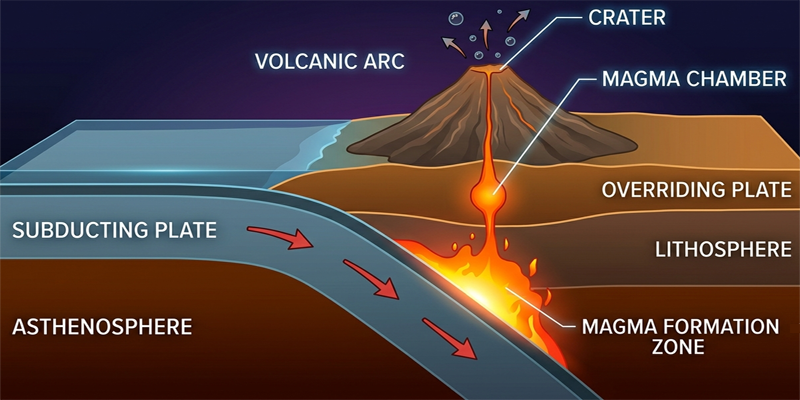
Water released from one tectonic plate beneath another lowers the melting point of rocks, helping magma form.
Plate Tectonics: The Main Cause of Volcanoes
Earth’s crust is divided into giant pieces called tectonic plates.
These plates move slowly—typically only a few centimeters each year.
Volcanoes commonly form where plates interact.
Divergent Plate Boundaries
Two plates move apart.
Magma rises to fill the gap.
Example:
- Mid-ocean ridges
Convergent Plate Boundaries
One plate moves beneath another in a process called subduction.
The descending plate helps generate magma, leading to volcano formation.
Many of the world’s most explosive volcanoes form this way.
Hotspots
Some volcanoes form away from plate boundaries.
These occur above hotspots, where unusually hot mantle material rises toward the surface.
As a tectonic plate moves over a hotspot, a chain of volcanoes can form.
Types of Volcanoes
1. Shield Volcano
Characteristics:
- Broad and gently sloping.
- Lava flows easily.
- Usually less explosive.
2. Composite (Stratovolcano)
Characteristics:
- Tall and steep.
- Built from layers of lava and ash.
- Often capable of powerful eruptions.
Many famous volcanoes belong to this type.
3. Cinder Cone Volcano
Characteristics:
- Smaller in size.
- Formed mainly from volcanic fragments.
- Often have short-lived eruptions.
What Comes Out During an Eruption?
A volcanic eruption may release:
- Lava
- Ash
- Steam
- Carbon dioxide
- Sulfur dioxide
- Volcanic rocks
- Hot gases
Not every eruption produces large lava flows. Some eruptions mainly release ash and gases.
What Is the Ring of Fire?
The Ring of Fire is a horseshoe-shaped region around much of the Pacific Ocean where many earthquakes and volcanoes occur.
It is one of the most geologically active regions on Earth because several tectonic plates meet there.
A large share of the world’s active volcanoes are found in this region.
Are All Volcanoes Active?
No.
Volcanoes are generally classified into three categories.
Active Volcano
Has erupted recently or is expected to erupt again.
Dormant Volcano
Currently inactive but may erupt in the future.
Extinct Volcano
Not expected to erupt again based on current geological understanding.
Can Scientists Predict Volcanic Eruptions?
Scientists cannot predict the exact date and time of every eruption.
However, they monitor warning signs such as:
- Small earthquakes
- Ground swelling
- Rising temperatures
- Increased gas emissions
- Satellite observations
These clues help authorities issue warnings and reduce risks.
Benefits of Volcanoes
Although dangerous, volcanoes also provide important benefits.
Fertile Soil
Volcanic ash can enrich soil, making it suitable for agriculture.
New Land
Many islands have formed from volcanic activity.
Minerals
Volcanic regions contain valuable minerals.
Geothermal Energy
Heat from volcanic areas can be used to generate electricity.
Tourism
Many volcanic landscapes attract visitors from around the world.
Dangers of Volcanoes
Volcanic eruptions can cause:
- Lava flows
- Ash fall
- Pyroclastic flows (fast-moving clouds of hot gas, ash, and rock)
- Landslides
- Mudflows (lahars)
- Air pollution
- Damage to crops and buildings
- Disruption to air travel
Volcanoes in India
India has very few active volcanoes.
The best-known active volcano is Barren Island, located in the Andaman Sea.
It is the only confirmed active volcano in India.
India also has ancient volcanic regions such as the Deccan Traps, formed by massive lava flows millions of years ago.
Famous Volcanoes Around the World
Some well-known volcanoes include:
- Mount Vesuvius
- Mount Fuji
- Mauna Loa
- Mount St. Helens
- Krakatoa
Each has contributed significantly to the study of volcanology.
Science Around You
Even if you don’t live near a volcano, volcanic activity affects the world.
Examples include:
- Fertile farming regions
- Geothermal power plants
- Volcanic rocks used in construction
- Beautiful mountain landscapes
- Natural hot springs
Did You Know?
- The hottest lava can exceed 1,100°C.
- Volcanic ash is made of tiny fragments of rock and glass, not the soft ash left after burning wood.
- Some underwater volcanoes create entirely new islands.
- The largest volcanic eruptions can temporarily cool Earth’s climate by sending particles high into the atmosphere.
- Thousands of volcanoes exist on Earth, but only a fraction are currently active.
Try This at Home (Safe Experiment)
Baking Soda Volcano
You’ll Need
- Small bottle
- Baking soda
- Vinegar
- Dish soap (optional)
- Red food coloring (optional)
Steps
- Place baking soda in the bottle.
- Add a few drops of food coloring and dish soap.
- Pour in vinegar.
Observation
Foamy liquid erupts from the bottle like lava.
What It Demonstrates
The chemical reaction produces carbon dioxide gas, increasing pressure and forcing the foam out—similar to how expanding gases help drive volcanic eruptions (though real volcanoes involve molten rock and much greater pressures).
Common Mistakes Students Make
❌ Thinking lava and magma are different substances.
✔ They are essentially the same molten rock; the name depends on whether it is below or above Earth’s surface.
❌ Believing every volcano erupts explosively.
✔ Some volcanoes produce gentle lava flows, while others erupt violently.
❌ Assuming volcanoes only exist on land.
✔ Many volcanoes are located beneath the oceans.
❌ Thinking extinct volcanoes can easily become active again.
✔ Extinct volcanoes are generally not expected to erupt again, although geological classifications can be revised with new evidence.
Frequently Asked Questions (FAQs)
1. Why do volcanoes erupt?
Because pressure from magma and dissolved gases builds beneath Earth’s surface until it escapes through cracks in the crust.
2. What is the difference between magma and lava?
Magma is molten rock below Earth’s surface; once it reaches the surface, it is called lava.
3. Which is the only active volcano in India?
Barren Island.
4. Can volcanoes create new land?
Yes. Repeated eruptions can build new islands and expand existing land.
5. Can scientists stop a volcanic eruption?
No. Scientists cannot stop eruptions, but monitoring systems help provide warnings that can save lives.
Why This Topic Matters
Understanding volcanoes helps explain:
- How Earth’s surface changes over time.
- Why earthquakes and volcanoes often occur together.
- How mountains and islands are formed.
- The importance of plate tectonics.
- How natural disasters are monitored.
- How geothermal energy can be used for clean electricity.
Volcanoes connect geology, geography, physics, chemistry, and environmental science into one fascinating subject.
Conclusion
Friends, in this blog(Why Do Volcanoes Erupt), we have understood the science behind volcanic eruptions. They could be considered one of the most powerful natural forces on the Earth’s surface. Though they can be destructive sometimes, they can create new lands, enrich soils, provide geothermal energy, and give us several important clues related to our planet’s interior.
Our planet, or home, is very dynamic in nature; if we want to have a full grip on this amazing natural event, then we will have to have a deeper understanding of magma, lava, tectonic plates, and volcanic eruptions. |Why Do Volcanoes Erupt|
So after reading this blog post, you will not be much surprised when you see a volcano documentary or read about an eruption in the news, as you already know the amazing science behind this eruption beneath Earth’s surface. |Why Do Volcanoes Erupt|
If you have any queries, you can write to us at support@a5theory.com; we will get back to you ASAP.
Hope! You would have enjoyed this post(Why Do Volcanoes Erupt).
Please feel free to give your important feedback in the comment section below.
Have a great time!