

Hello Friends, in this blog post(Why Does a Pressure Cooker Cook Food Faster), we are going to explain the science behind faster cooking with a pressure cooker.
A pressure cooker is generally available in every kitchen; it might differ in shape or size, but they exist in most kitchens, especially in Indian kitchens.
It becomes very easy to cook food quickly using a pressure cooker. |Why Does a Pressure Cooker Cook Food Faster|
You just need to put dal, rice, vegetables, or other food inside, add some water, close the lid of the cooker, and place it on the stove or gas.
After a while, “Whistle” or “सीटी!” sound: the cooker whistles. |Why Does a Pressure Cooker Cook Food Faster|
And it is amazing to see soft and tasty food ready in a quick time, which could have taken a little long time if it were cooked in another ordinary pot.
But have you ever thought about how this happens so fast?
If your answer is heat alone, then it will not be a sufficient and complete answer to justify this question.
However, the actual reason is even more interesting to know:–
We all know there is a boiling point of water at normal atmospheric pressure.
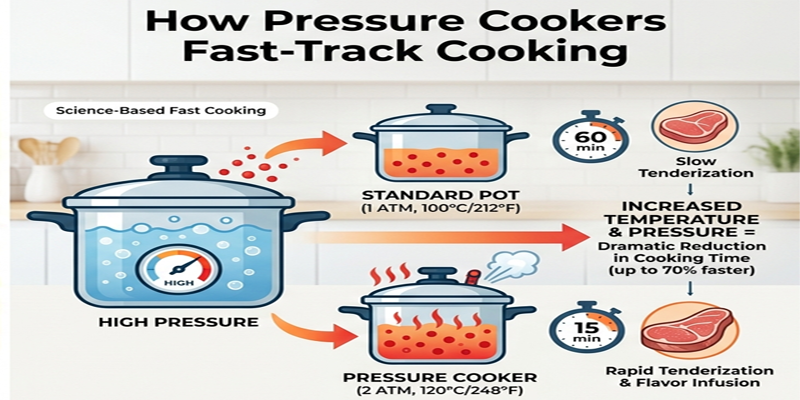
But when this water is inside the pressure cooker, the boiling point of water rises due to the pressure increase inside the vessel.
Because of this, the water and steam reach a much higher temperature than their usual boiling point.
Many foods can be cooked very fast at this higher cooking temperature inside the vessel. |Why Does a Pressure Cooker Cook Food Faster|
What Happens When Water Boils Normally?
At normal atmospheric pressure near sea level, water boils at approximately:
100°C
When water reaches its boiling point, liquid water changes into steam.
If you continue supplying heat to boiling water in an open pot, much of the additional energy goes into changing liquid water into vapor rather than simply increasing the temperature of the boiling water.
So under ordinary atmospheric conditions, liquid water doesn’t simply keep getting hotter and hotter while boiling. |Why Does a Pressure Cooker Cook Food Faster|
What Is Pressure?
Pressure is the force exerted over a given area.
In simple terms:
Pressure = Force ÷ Area
We experience atmospheric pressure all the time, even though we normally don’t notice it.
Air has weight, and the atmosphere exerts pressure on Earth’s surface.
What Happens Inside a Pressure Cooker?
A pressure cooker has a lid that seals the cooking chamber.
When water inside is heated:
Water → Steam
In an ordinary open pot, much of that steam escapes directly into the atmosphere.
In a pressure cooker, the steam is largely trapped.
As more steam is produced, the pressure inside the sealed cooker increases.
The increased pressure raises the boiling point of water.
The Big Secret: Higher Pressure Means a Higher Boiling Point
This is the most important concept in pressure cooking.
At normal atmospheric pressure:
Water boils at about 100°C.
Inside a typical pressure cooker operating at elevated pressure, water can reach roughly 120°C, depending on the cooker and its operating pressure.
That difference may look small.
But it makes a huge difference in cooking. |Why Does a Pressure Cooker Cook Food Faster? |
Why Does Higher Temperature Cook Food Faster?
Cooking involves many physical and chemical changes.
Heat causes:
- Proteins to change structure
- Starches to gelatinize
- Tough plant tissues to soften
- Collagen in some foods to break down
- Chemical reactions to proceed faster
When the cooking environment becomes hotter, many of these processes happen more rapidly.
Therefore:
Higher cooking temperature → faster cooking
This is why pressure cooking is particularly useful for foods such as:
- Dal
- Chickpeas
- Kidney beans
- Potatoes
- Tough cuts of meat
- Certain grains
- Dense vegetables
Why Doesn’t Water Simply Boil Away Inside?
It actually does produce steam.
But the cooker is designed to control the escape of steam.
As pressure rises to the intended operating range, a pressure-regulating mechanism allows some steam to escape.
This prevents pressure from continuing to increase indefinitely.
So the cooker maintains a controlled pressure rather than becoming an uncontrolled sealed container.
What Does the Whistle Actually Do?
The familiar pressure-cooker whistle is not just a signal that your food is ready.
It is associated with pressure regulation.
When the pressure reaches the level at which the regulator operates, steam pushes against the pressure regulator and escapes.
The escaping steam produces the characteristic:
“Whistle!”
The process helps regulate pressure inside the cooker. |Why Does a Pressure Cooker Cook Food Faster|
Why Does the Cooker Whistle Repeatedly?
In traditional stovetop pressure cookers, heating continues after the cooker reaches operating pressure.
Steam is periodically released through the pressure regulator.
As the pressure rises and falls around the operating range, you may hear repeated whistles.
The exact number of whistles depends on:
- Heat level
- Amount of food
- Amount of liquid
- Cooker design
- Cooking method
So a whistle is not a universal scientific timer.
Why Is Steam So Important?
Steam plays a major role in pressure cooking.
Steam is hot water vapor.
It can transfer thermal energy efficiently to the food.
Inside the pressure cooker, hot water and steam surround the food, allowing heat to transfer into it.
This combination of:
Higher temperature + hot water + steam + pressure
makes pressure cooking highly effective. |Why Does a Pressure Cooker Cook Food Faster|
Does Pressure Itself Cook the Food?
This is an important distinction.
Pressure doesn’t magically cook food simply by squeezing it.
The main benefit of increased pressure is that it raises the boiling point of water, allowing the cooking environment to reach a higher temperature.
So a better way to think about it is:
Pressure → Higher boiling point → Higher cooking temperature → Faster cooking
Why Does Food Become Soft?
Different foods contain different structures.
For example, pulses and beans contain complex carbohydrates and proteins, while many vegetables contain plant cell structures.
Heating with moisture causes these structures to change.
In foods containing collagen, prolonged heating can help convert collagen into gelatin, making some tough foods softer.
Pressure cooking speeds up many of these processes by creating a hotter, moist environment.
Why Is Pressure Cooking Different From Frying?
Consider the temperatures involved.
Boiling
Food is surrounded by water at around its boiling temperature.
Pressure Cooking
Water can reach a temperature significantly above 100°C because of the increased pressure.
Frying
Oil can reach temperatures substantially above the boiling point of water.
The cooking method therefore changes:
- Temperature
- Heat transfer
- Moisture
- Cooking time
- Texture
Why Does Water Boil at Lower Temperatures on Mountains?
This is the opposite side of the same scientific principle.
At high altitudes, atmospheric pressure is lower.
Therefore, water can boil at a temperature below 100°C.
So:
Lower pressure → Lower boiling point
while:
Higher pressure → Higher boiling point
This is one reason cooking conditions can differ at high altitudes. |Why Does a Pressure Cooker Cook Food Faster|
A Simple Example
Imagine two pots.
Pot A
Open pot at normal atmospheric pressure.
Water boils at approximately:
100°C
Pot B
Pressure cooker at elevated pressure.
Water may reach approximately:
120°C
The food in Pot B is exposed to a significantly hotter, moist environment.
Therefore, it can cook faster.
Why Is the Pressure Cooker So Useful for Dal?
Dal can take considerable time to become soft when cooked in an ordinary pot.
Inside a pressure cooker:
- Water reaches a higher temperature.
- Steam surrounds the food.
- Heat transfers efficiently.
- The higher temperature accelerates softening.
That’s why pressure cooking is particularly convenient for Indian foods such as dal and beans.
Why Does the Cooker Need Water?
Water is essential for the normal operation of a pressure cooker because the steam generated from the water is what builds the pressure.
Without sufficient liquid, the cooker cannot operate as intended.
The exact minimum amount depends on the cooker and recipe, so users should follow the manufacturer’s instructions.
What Happens If You Open the Cooker Too Quickly?
This is where pressure cooking becomes a serious safety topic.
When the cooker is under pressure, the liquid and steam inside are extremely hot.
If pressure is released suddenly, the boiling point of the water drops rapidly.
Some of the hot liquid can rapidly turn into steam.
This is called flash boiling or rapid vaporization.
The escaping steam and hot contents can cause severe burns.
Therefore:
Never attempt to force open a pressurized pressure cooker.
Always follow the manufacturer’s instructions for pressure release. |Why Does a Pressure Cooker Cook Food Faster|
Why Does the Lid Lock?
Modern pressure cookers commonly include mechanisms that prevent the lid from being opened while significant internal pressure remains.
This is an important safety feature.
The basic idea is simple:
Pressure present → Lid remains locked
Pressure safely released → Lid can be opened
The exact mechanism varies by cooker.
What Safety Features Does a Pressure Cooker Have?
Modern pressure cookers can include several safety systems, such as:
- Pressure regulator
- Safety valve
- Lid-locking mechanism
- Pressure-release system
- Sealing ring
- Overpressure protection
These features are designed to prevent dangerous pressure buildup and unsafe opening.
Why Should the Steam Vent Be Kept Clean?
The steam-release pathway is essential for pressure regulation.
If food particles or other material obstruct the vent, the pressure-control system may not function correctly.
Therefore, keeping the vent, valve, and sealing components clean and following the manufacturer’s maintenance instructions is important. |Why Does a Pressure Cooker Cook Food Faster|
Pressure Cooker vs Ordinary Pot
| Ordinary Pot | Pressure Cooker |
|---|---|
| Open to atmosphere | Sealed cooking chamber |
| Water boils around 100°C at sea level | Water can reach a higher temperature |
| Steam escapes freely | Steam is controlled |
| Lower cooking temperature | Higher cooking temperature |
| Longer cooking time for many foods | Faster cooking for many foods |
Pressure Cooker vs Electric Pressure Cooker
The basic science is similar.
Traditional Pressure Cooker
Uses a stove or other external heat source.
Electric Pressure Cooker
Uses an electrical heating element and electronic controls.
Both rely on the fundamental relationship between:
Pressure ↔ Boiling Point ↔ Temperature
Modern electric models may automatically control temperature, pressure, and cooking programs.
Can a Pressure Cooker Save Energy?
Because pressure cooking can reduce cooking time, it can also reduce the amount of energy needed for some dishes.
However, the actual energy savings depend on:
- Food
- Cooking time
- Cooker efficiency
- Heat source
- Quantity of food
- Cooking method
So it is better to say pressure cookers can improve cooking efficiency rather than claiming a fixed percentage of energy savings. |Why Does a Pressure Cooker Cook Food Faster|
The Science Behind the Whistle
Let’s look at the sequence.
Step 1: Water is heated.
⬇️
Step 2: Water begins producing steam.
⬇️
Step 3: Steam becomes trapped.
⬇️
Step 4: Pressure increases.
⬇️
Step 5: The boiling point increases.
⬇️
Step 6: Water and food reach a higher temperature.
⬇️
Step 7: The pressure regulator releases steam when the operating pressure is reached.
⬇️
Step 8: The food cooks faster.
That little whistle is therefore connected to a fascinating chain of physics.
What Does the Ideal Gas Law Have to Do With It?
You may have heard of:
PV = nRT
This is the ideal gas law.
It relates:
- P = Pressure
- V = Volume
- n = Amount of gas
- R = Gas constant
- T = Temperature
The actual behavior of steam and water in a pressure cooker is more complicated than simply applying the ideal gas law, but the equation helps students understand the relationship between pressure, temperature, volume, and amount of gas.
Why Does Pressure Change the Boiling Point?
Boiling occurs when the vapor pressure of a liquid becomes equal to the pressure acting on its surface.
If the surrounding pressure increases, the liquid must reach a higher temperature before its vapor pressure becomes high enough for boiling.
Therefore:
Higher external pressure → Higher boiling temperature
This is the fundamental scientific principle behind the pressure cooker.
An Interesting Connection: Cooking at High Altitudes
Now imagine climbing a very high mountain.
Atmospheric pressure decreases.
Water can then boil at a temperature lower than 100°C.
That can make cooking certain foods more difficult or slower.
A pressure cooker partially counteracts the effect by increasing the pressure inside the cooking vessel.
So the same physics works in opposite directions:
Mountain → Lower pressure → Lower boiling point
Pressure cooker → Higher pressure → Higher boiling point
Did You Know?
- At normal atmospheric pressure, water boils at approximately 100°C.
- A typical pressure cooker can allow water to reach around 120°C, depending on its operating pressure.
- Pressure cooking works mainly by raising the boiling point and therefore the cooking temperature.
- The whistle is associated with controlled steam release.
- Pressure cookers and laboratory autoclaves use related principles of pressure and steam, although their purposes and operating conditions differ.
- Lower atmospheric pressure at high altitude lowers water’s boiling point.
Try This at Home
Observe Evaporation and Cooling
You don’t need a pressure cooker for this experiment.
You’ll Need:
- Two small plates
- A little water
- A fan
Steps
- Put equal amounts of water on both plates.
- Leave one plate still.
- Place the other near a fan.
- Observe which water evaporates faster.
- Notice the cooling effect associated with evaporation.
What Does It Demonstrate?
Evaporation involves energy transfer and can produce a cooling effect.
This is related to one part of the science used in many thermal systems, although it is not itself a model of pressure cooking.
Never attempt to build or modify a pressure vessel as a home experiment.
Common Mistakes Students Make
❌ Thinking pressure itself makes food hot.
✔ Increased pressure raises the boiling point, allowing water and steam to reach a higher temperature.
❌ Thinking the whistle means the food is automatically cooked.
✔ A whistle indicates that the cooker is releasing steam at its operating pressure. Cooking time still depends on the food and conditions.
❌ Thinking water always boils at exactly 100°C.
✔ The boiling point depends on pressure. At different pressures, water boils at different temperatures.
❌ Thinking steam is simply hot air.
✔ Steam is water in the gas phase.
❌ Thinking you can safely open a pressure cooker immediately after cooking.
✔ The cooker must be depressurized according to its manufacturer’s instructions before opening.
Frequently Asked Questions (FAQs)
1. Why does a pressure cooker cook food faster?
Because increased pressure raises the boiling point of water, allowing the cooking environment to reach a higher temperature than in an ordinary open pot. |Why Does a Pressure Cooker Cook Food Faster? |
2. At what temperature does water boil in a pressure cooker?
It depends on the operating pressure and cooker design. A typical pressure cooker may allow water to reach around 120°C at common operating pressures.
3. Why does a pressure cooker whistle?
The pressure regulator releases steam when the cooker reaches its operating pressure, producing the familiar whistling sound.
4. Why does water boil at a lower temperature on mountains?
Atmospheric pressure decreases with altitude, lowering the boiling point of water.
5. Is pressure cooking safe?
Modern pressure cookers are designed with safety features, but they must be used and maintained according to the manufacturer’s instructions. Never open a cooker while it remains pressurized.
Why This Topic Matters
The pressure cooker sitting in your kitchen is a practical demonstration of several important scientific concepts:
- Pressure
- Temperature
- Heat transfer
- Phase changes
- Steam
- Boiling point
- Thermodynamics
- Gas laws
It shows students that physics isn’t limited to textbooks and laboratories.
You can find advanced physics in an ordinary Indian kitchen.
Conclusion
Friends, in this post(Why Does a Pressure Cooker Cook Food Faster), we have understood the science behind the fast cooking of food with a pressure cooker. A pressure cooker is one of the best and smart application of physics, which is much more than a pot with a lid.
Basically, with the help of increasing pressure as a result of trapped steam, it raises the boiling point of water. And this lets water and steam both reach a much higher temperature. This process creates a much hotter cooking environment inside the cooker, which can cook many foods faster. |Why Does a Pressure Cooker Cook Food Faster|
You can see this entire procedure of faster cooking in a proper flow below:
Heat → Steam → Pressure → Higher Boiling Point → Higher Temperature → Faster Cooking
And during this food-cooking process, you will also hear the sound of whistling, which actually sounds like “Physics at work” and gives us the indication that the food is almost cooked. |Why Does a Pressure Cooker Cook Food Faster|
If you have any queries, you can write to us at support@a5theory.com; we will get back to you ASAP.
Hope! You will enjoy this post(Why Does a Pressure Cooker Cook Food Faster).
Please feel free to give your feedback in the comment section below.
Have a great time!