

Hello Friends, in this blog post (Electric Motor and Generator), we are going to discuss the working of an electric motor and a generator.
Have you ever thought about the inside workings of science while doing such an activity almost every day in your daily life, like:
- Switching on the fan: – How do the blades move very fast within a fraction of time?
- Starting a mixer grinder: – How do the blades spin with a very high speed?
- Riding an electric scooter: – How does it’s wheels move silently?
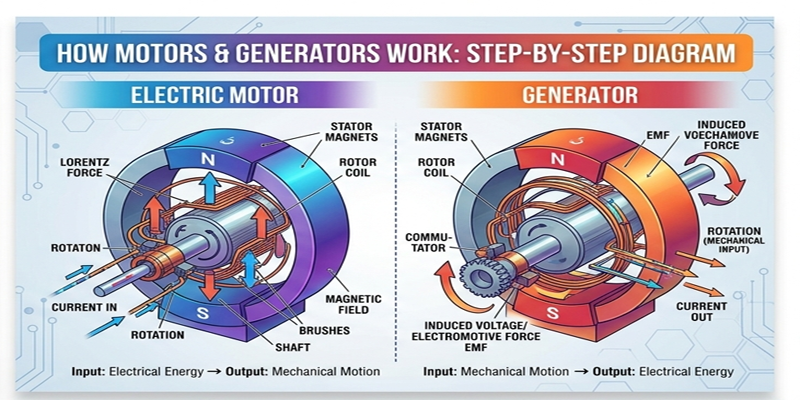
Now imagine the reverse direction:
Flowing water in a hydroelectric power plant pushes and rotates huge turbines; it produces electricity that is used to light thousands of houses.
Here it is very amazing to see this fact that one machine is responsible for converting electricity into motion while the other converts motion into electricity.
These two ultimate inventions are called the electric motor and the electric generator.
Both machines are based on the close relationship between magnetism and electricity; however, they both perform different or opposite tasks. |Electric Motor and Generator|
In modern science, they both have been proved as a great and amazing inventions that make our daily life easy and comfortable. |Electric Motor and Generator|
In this post(Electric Motor and Generator), we are going to explore the working of these two amazing machines simply and practically.
What Is an Electric Motor?
An electric motor is a machine that converts electrical energy into mechanical energy (motion).
Whenever you see something rotating because of electricity, an electric motor is usually doing the work.
Examples
- Ceiling fan
- Mixer grinder
- Water pump
- Washing machine
- Electric scooter
- Electric car
- Vacuum cleaner
- Hair dryer
Basic Parts of an Electric Motor
A simple electric motor contains:
- Permanent magnet or electromagnet
- Coil of wire (Armature)
- Battery or power supply
- Split-ring commutator (in many DC motors)
- Carbon brushes
- Shaft
Each part helps convert electrical energy into rotational motion.
How Does an Electric Motor Work?
The working principle is simple.
When electric current flows through a wire placed in a magnetic field, the wire experiences a force and starts moving.
This is known as the motor effect.
Step-by-Step Working
Step 1
Electric current flows through the coil.
↓
Step 2
The magnetic field interacts with the current.
↓
Step 3
A force acts on opposite sides of the coil.
↓
Step 4
The coil begins to rotate.
↓
Step 5
The split-ring commutator reverses the direction of current every half turn.
↓
Step 6
The coil continues rotating in the same direction.
This continuous rotation drives machines like fans, pumps, and electric vehicles.
Fleming’s Left-Hand Rule
To determine the direction of motion in a motor, we use Fleming’s Left-Hand Rule.
Stretch your:
- First Finger → Magnetic Field
- Second Finger → Current
- Thumb → Motion (Force)
This simple rule helps engineers determine the direction in which the motor will rotate.
Types of Electric Motors
1. DC Motor
Operates using direct current.
Used in:
- Toys
- Battery-powered devices
- Electric vehicles
- Portable tools
2. AC Motor
Operates using alternating current.
Used in:
- Ceiling fans
- Air conditioners
- Refrigerators
- Washing machines
- Industrial machinery
Most household appliances use AC motors.
What Is an Electric Generator?
A generator is a machine that converts mechanical energy into electrical energy.
Instead of using electricity to produce motion, it uses motion to produce electricity.
This is exactly the opposite of an electric motor.
Working Principle of a Generator
Generators work on Faraday’s Law of Electromagnetic Induction.
When a conductor moves through a magnetic field, an electric current is induced in it.
The faster the motion, the greater the electricity produced (under suitable conditions).
Basic Parts of a Generator
A generator contains:
- Magnet
- Rotating coil
- Shaft
- Slip rings (in many AC generators)
- Brushes
- Turbine or engine
How Does a Generator Work?
Step 1
A turbine rotates the shaft.
↓
Step 2
The shaft rotates the coil inside a magnetic field (or rotates magnets around coils).
↓
Step 3
The changing magnetic field induces electric current.
↓
Step 4
The generated electricity is supplied to homes, industries, or the power grid.
Fleming’s Right-Hand Rule
To determine the direction of the induced current in a generator, we use Fleming’s Right-Hand Rule.
Stretch your:
- First Finger → Magnetic Field
- Thumb → Motion
- Second Finger → Induced Current
Electric Motor vs Generator
| Feature | Electric Motor | Electric Generator |
|---|---|---|
| Converts | Electrical → Mechanical | Mechanical → Electrical |
| Input | Electricity | Mechanical Motion |
| Output | Motion | Electricity |
| Principle | Motor Effect | Electromagnetic Induction |
| Rule Used | Fleming’s Left-Hand Rule | Fleming’s Right-Hand Rule |
A simple way to remember:
- Motor = Electricity in → Motion out
- Generator = Motion in → Electricity out
Where Do Generators Get Mechanical Energy?
Different power plants use different energy sources to rotate turbines.
Thermal Plant
Steam from burning fuel.
Hydroelectric Plant
Flowing water.
Wind Farm
Wind.
Nuclear Plant
Steam produced by nuclear fission.
Diesel Generator
Diesel engine.
Bicycle Dynamo
Wheel rotation.
What Is a Dynamo?
A dynamo is a small generator that produces electricity using mechanical motion.
Examples:
- Bicycle lights
- Hand-crank flashlights
- Emergency radios
Science Around You
Electric motors are everywhere.
You use them daily in:
- Ceiling fans
- Water pumps
- Refrigerators
- Mixers
- Washing machines
- Electric toothbrushes
- Elevators
- Escalators
- Drones
- Electric vehicles
Generators are found in:
- Power stations
- Diesel generators
- Wind turbines
- Hydroelectric dams
- Backup power systems
Did You Know?
- A modern electric car may use one or more powerful electric motors depending on its design.
- The largest hydroelectric generators can produce hundreds of megawatts of electricity.
- Electric motors are generally highly efficient, with many converting a large percentage of electrical energy into useful mechanical energy.
- Wind turbines contain giant generators located inside the nacelle (the housing behind the blades).
- The same basic scientific principles discovered nearly two centuries ago still power many modern machines.
Try This at Home (Safe Experiment)
Make a Simple Electromagnet
You’ll Need
- One iron nail
- Insulated copper wire
- One AA battery
Steps
- Wrap the wire around the nail several times.
- Connect the ends of the wire to the battery briefly.
- Bring the nail close to small paper clips.
Observation
The nail attracts the paper clips while current flows.
Reason
Electric current creates a magnetic field, turning the nail into an electromagnet.
Note: Disconnect the battery after a short time to prevent overheating.
Common Mistakes Students Make
❌ Thinking motors and generators are the same machine.
✔ They are similar in construction but perform opposite functions.
❌ Believing generators create energy.
✔ Generators convert mechanical energy into electrical energy. They do not create energy from nothing.
❌ Assuming every motor runs on batteries.
✔ Many motors run on AC electricity supplied through the electrical grid.
❌ Thinking electricity alone causes rotation.
✔ Rotation occurs because of the interaction between electric current and magnetic fields.
Frequently Asked Questions (FAQs)
1. What is the main difference between a motor and a generator?
A motor converts electrical energy into mechanical energy, while a generator converts mechanical energy into electrical energy.
2. Why do ceiling fans use electric motors?
Because motors convert electrical energy into the rotational motion needed to spin the blades.
3. Why do power plants use generators?
Generators convert the mechanical energy of turbines into electricity for homes and industries.
4. Can one machine act as both a motor and a generator?
Yes. Some machines can operate in either mode depending on how they are connected and controlled. For example, certain electric vehicle motors can also act as generators during regenerative braking.
5. Why are magnets important in motors and generators?
Magnets create the magnetic fields needed for the interaction that produces motion in motors and electricity in generators.
Why This Topic Matters
Understanding motors and generators helps explain:
- How ceiling fans rotate.
- How electric vehicles move.
- How hydroelectric dams generate electricity.
- How wind turbines produce power.
- How backup generators work.
- How factories operate.
- How renewable energy systems function.
These machines are at the heart of modern transportation, manufacturing, healthcare, energy production, and household appliances.
Future of Electric Motors and Generators
As technology advances, motors and generators are becoming:
- More energy-efficient
- Smaller and lighter
- Smarter with electronic control systems
- Essential for electric vehicles
- Key components in renewable energy systems
- Important in robotics and automation
Future innovations may include even more efficient magnetic materials, improved battery-powered motors, and advanced generators that support cleaner energy grids.
Conclusion
Friends, in this post(Electric Motor and Generator), we have seen and learned the working of electric motors and generators. In modern science and engineering, they are the most important and amazing inventions. One is responsible for transforming electricity into motion, while the other is transforming motion into electricity. Several technologies are built using these machines together. They both work like a backbone of these technologies that provides power to our houses, transportation systems, industries, and renewable energy projects.
Students could better appreciate the way science connects magnetism, electricity, and mechanical motion to improve our daily life only if they understand these machine concepts clearly with a practical approach. |Electric Motor and Generator|
So next time you turn on the fan or see a wind turbine spin on the horizon, you will be observing the ultimate join between generators and motors. |Electric Motor and Generator|
If you have any queries, you can write to us at support@a5theory.com; we will get back to you ASAP.
Hope! You would have enjoyed this post(Electric Motor and Generator).
Please feel free to give your important feedback in the comment section below.
Have a great time!