

Hello Friends, in this blog post(How Does a Microwave Oven Heat Food), we are going to let you know the science behind microwave heat.
Microwaves have been a very common appliance generally found in most of the kitchens.
A microwave is normally used to heat food; you just need to put the bowl or plate of cold food inside it.
Once you press the button, within a few minutes your food becomes hot. |How Does a Microwave Oven Heat Food|
However, no flames are present inside it, and no hot pan is touching the food directly.
Now it is very obvious to have one curious question in your mind:
- Where does this heat come from inside?
- How does a microwave oven heat something from inside?
To answer these questions, you must understand the concepts of electromagnetic waves,…
… molecular motion, and electric fields, along with a special process called dielectric heating.
If we are looking for a wonderful example of a scientific principle in physics that becomes a very…
… useful technology used every day in most houses, Mircrowave ovens will be one of them. |How Does a Microwave Oven Heat Food|
What Is a Microwave Oven?
A microwave oven is an appliance that uses microwave electromagnetic radiation to heat food.
The microwaves interact with molecules in the food, particularly polar molecules such as water.
This interaction causes energy to be transferred into the material, increasing its thermal energy.
In simple terms:
Electrical energy → Microwaves → Energy absorbed by food → Heating
What Exactly Is a Microwave?
A microwave is a type of electromagnetic wave.
Electromagnetic waves include:
- Radio waves
- Microwaves
- Infrared
- Visible light
- Ultraviolet
- X-rays
- Gamma rays
They are all part of the electromagnetic spectrum.
The main difference between them is their frequency and wavelength.
Are Microwaves the Same as Radio Waves?
They are related.
Both are electromagnetic waves.
Microwaves occupy a higher-frequency region of the electromagnetic spectrum than many commonly used radio waves.
In fact, the microwave region overlaps with frequencies used for communication technologies such as radar, satellite communication, Wi-Fi, and mobile communications.
The important point is:
A microwave oven uses a controlled electromagnetic field to transfer energy to food.
What Frequency Does a Microwave Oven Use?
Most household microwave ovens operate at approximately:
2.45 GHz
GHz means gigahertz.
1 GHz = 1 billion cycles per second.
So a 2.45 GHz microwave field oscillates billions of times every second.
This frequency is useful for heating many foods efficiently while allowing the microwaves to penetrate the food to some extent.
What Happens When You Start a Microwave?
When you press the Start button, several things happen.
In simplified form:
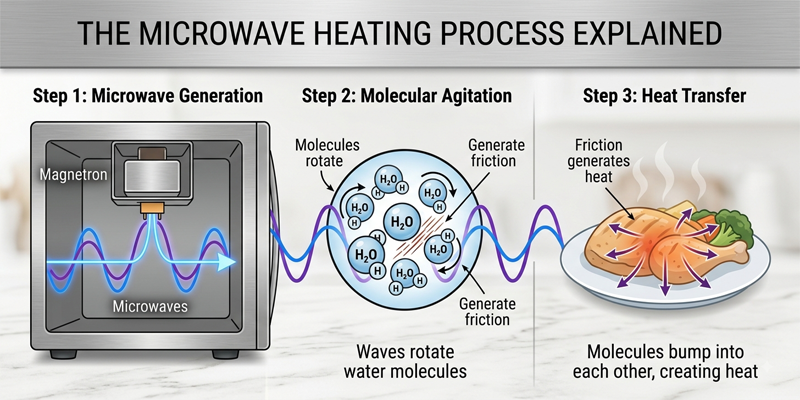
Electricity → Magnetron → Microwaves → Food → Heating
The key component traditionally used in household microwave ovens is called a:
Magnetron
What Is a Magnetron?
A magnetron is a device that converts electrical energy into microwave electromagnetic radiation.
It generates the microwave energy that enters the oven’s cooking chamber.
Modern microwave technologies can use different approaches, including solid-state systems, but the magnetron remains the traditional component in many household ovens. |How Does a Microwave Oven Heat Food|
What Happens Inside the Cooking Chamber?
The microwaves are directed into the metal cooking cavity.
The metal walls reflect the microwaves.
This creates an electromagnetic field inside the chamber.
The food placed inside absorbs some of this energy.
The absorbed energy eventually becomes thermal energy.
Why Does Food Heat Up?
This is the heart of microwave cooking.
Many foods contain a significant amount of water.
Water molecules are polar molecules.
That means their electrical charge is distributed unevenly.
The oxygen side has a partial negative charge, while the hydrogen side has partial positive charges.
This gives the molecule an electric dipole.
What Does an Oscillating Electric Field Do?
Microwaves contain an oscillating electric field.
When this changing electric field interacts with polar molecules, it causes them to continually attempt to orient themselves with the changing field.
The field changes direction extremely rapidly.
The molecules respond by rotating and moving.
Their interactions with surrounding molecules cause energy to be dissipated as thermal energy.
This is called:
Dielectric heating
Does the Microwave “Shake” Water Molecules?
This is a common way of explaining microwave heating.
It is useful as a basic analogy, but the actual physics is more subtle.
Microwaves produce an alternating electromagnetic field that interacts with polar molecules and other charge distributions.
The molecules don’t simply rotate perfectly back and forth like tiny mechanical balls.
Their response involves molecular rotation, polarization, collisions, and energy dissipation.
So:
Microwaves → Molecular response → Energy dissipation → Heating
Why Is Water So Important?
Water is abundant in many foods and responds strongly to microwave-frequency electric fields.
This makes water-rich foods particularly suitable for microwave heating.
But water isn’t the only substance involved.
Other molecules and ions in food can also contribute to microwave absorption and heating.
Does a Microwave Oven Heat Food From the Inside Out?
Not exactly.
This is one of the most common misconceptions about microwave ovens.
Microwaves can penetrate into food to some depth, allowing energy to be deposited within the food rather than only at its surface.
However, they do not necessarily heat the entire inside uniformly.
The depth of penetration depends on factors such as:
- Food composition
- Water content
- Temperature
- Frequency
- Shape
- Density
Heat can also move through the food by ordinary thermal conduction after microwave energy has been absorbed. |How Does a Microwave Oven Heat Food|
Why Does Microwave Food Sometimes Have Cold Spots?
You may have experienced this:
The outside of the food feels hot.
You take a bite.
The center is still cold.
Why?
Microwave energy isn’t distributed perfectly uniformly.
The electromagnetic field inside the oven can form patterns of stronger and weaker intensity.
Food shape and composition also affect absorption.
As a result, some regions receive more microwave energy than others. |How Does a Microwave Oven Heat Food|
What Are Hot Spots?
Hot spots are regions where more energy has been absorbed.
They can develop because of:
- Uneven microwave fields
- Food geometry
- Different water concentrations
- Uneven thickness
- Different material properties
This is why microwave ovens often include a rotating turntable.
Why Does the Plate Rotate?
The rotating plate changes the position of the food relative to the microwave field.
As the food moves, different regions experience different parts of the electromagnetic field.
This helps improve the overall uniformity of heating.
It doesn’t guarantee perfectly even heating, but it helps.
Why Do Microwave Ovens Sometimes Have a Metal Rack?
Some microwave ovens include specially designed metal racks.
These are engineered for use in that particular oven.
This is different from randomly placing metal objects inside a microwave.
Always follow the manufacturer’s instructions. |How Does a Microwave Oven Heat Food|
Why Shouldn’t You Put Metal Objects in a Microwave?
Metal contains mobile electrons.
When exposed to the strong oscillating electric fields inside a microwave oven, charges can redistribute along the metal surface.
If the shape has sharp edges, points, or gaps, the electric field can become concentrated.
Under suitable conditions, this can produce electrical discharges or sparks.
Why Does Aluminium Foil Sometimes Spark?
Thin metal foil can develop intense electric fields around sharp edges, wrinkles, or points.
These can promote electrical discharges through the surrounding air.
A small piece of smooth metal may behave differently from crumpled foil, but that does not mean metal is automatically safe in every microwave.
Always follow the microwave manufacturer’s instructions.
Why Does a Metal Spoon Sometimes Behave Differently?
The shape and position of a metal object matter.
A smooth, rounded object may not produce sparks under some conditions, while sharp edges and gaps can greatly increase the likelihood of arcing.
However, putting metal objects into a microwave without specific manufacturer guidance is not recommended.
Why Doesn’t the Metal Oven Door Block Microwaves From Escaping?
Look closely at the door of a microwave oven.
You may notice a dark mesh or perforated metal screen.
The holes are much smaller than the wavelength of the microwave radiation used by the oven.
This helps prevent the microwave radiation from escaping significantly while still allowing visible light to pass through so you can see the food. |How Does a Microwave Oven Heat Food|
Is a Microwave Oven a Faraday Cage?
The metal cooking cavity behaves approximately like a Faraday enclosure for the microwave radiation.
Conductive walls help confine electromagnetic energy within the cooking chamber.
The door’s metal mesh is designed to maintain this shielding while allowing visibility.
Why Can We See Through the Door?
Visible light has a much shorter wavelength than the microwave radiation used for cooking.
The metal mesh openings are designed so that visible light can pass through while microwave radiation is strongly attenuated.
That’s why you can see your food without the cooking microwaves freely escaping.
Are Microwaves Dangerous?
Microwaves are a form of non-ionizing electromagnetic radiation.
They do not have enough photon energy to directly ionize atoms in the way that X-rays and gamma rays can.
The primary biological effect of sufficiently intense microwave exposure is heating.
A properly functioning microwave oven is designed to keep microwave leakage within regulated safety limits.
What Is the Difference Between Ionizing and Non-Ionizing Radiation?
This is an important scientific distinction.
Ionizing Radiation
Has enough energy per photon to ionize atoms or molecules.
Examples include:
- X-rays
- Gamma rays
Non-Ionizing Radiation
Generally does not have enough photon energy to directly ionize atoms.
Examples include:
- Radio waves
- Microwaves
- Infrared
- Visible light
This doesn’t mean every form of non-ionizing radiation is harmless at any intensity. Strong electromagnetic radiation can still produce heating and other effects.
Does Microwave Cooking Make Food Radioactive?
No.
This is a common misconception.
Microwave ovens use non-ionizing electromagnetic radiation.
The food does not become radioactive simply because it was heated in a microwave.
Microwave cooking is fundamentally a method of transferring energy to food.
Does Microwave Cooking Destroy Nutrients?
Cooking can change nutrients, regardless of the cooking method.
The nutritional effect depends on:
- Temperature
- Cooking time
- Amount of water
- Type of food
- Nutrient involved
Microwave cooking can sometimes preserve certain nutrients well because it can use relatively short cooking times and little water.
So it is incorrect to say that microwave cooking automatically destroys all nutrients. |How Does a Microwave Oven Heat Food|
Why Does Food Sometimes Explode in a Microwave?
Some foods can build up pressure when heated.
Examples can include:
- Eggs in shells
- Whole potatoes
- Certain sausages
- Foods with thick skins
Water inside the food can turn into steam.
If steam cannot escape easily, pressure can build.
Eventually the structure may rupture.
That’s why foods with skins or enclosed structures may need to be pierced or prepared according to appropriate cooking instructions.
Why Can Grapes Produce Sparks?
A particularly interesting phenomenon can occur when certain grape arrangements are placed in a microwave.
Closely positioned grape halves can interact strongly with the microwave electromagnetic field and create regions of intense electric fields.
Under the right conditions, this can produce a small plasma-like glow or sparks.
Do not try this experiment in a microwave.
It can damage the oven and create a fire hazard.
What Is Plasma?
Plasma is often described as the fourth state of matter.
It is an ionized gas containing free charged particles.
Examples include:
- Lightning
- The Sun
- Neon signs
- Some electrical sparks
The glowing discharge associated with some microwave experiments is related to ionization and plasma formation.
Why Does a Microwave Sometimes Make Strange Sounds?
Several sounds can occur during normal operation.
You may hear:
- Fan noise
- Magnetron-related sounds
- Electrical humming
- Turntable movement
- Clicking from control components
Some foods can also produce popping or sizzling sounds as water and other materials heat.
A sudden unusual noise accompanied by sparks, burning smells, smoke, or malfunction should be treated as a safety concern. |How Does a Microwave Oven Heat Food|
Why Does a Microwave Oven Have a Fan?
The fan helps:
- Cool internal components
- Move air through the appliance
- Remove heat and moisture
- Protect the electronics
Some models also use fans during or after cooking to manage heat.
Can Microwaves Heat an Empty Oven?
You should not run a microwave oven empty unless the manufacturer specifically says it is safe.
If there is no suitable load to absorb the microwave energy, energy can be reflected within the cavity and potentially damage components.
Always follow the manufacturer’s instructions.
Why Does a Microwave Oven Use So Much Power?
A microwave oven converts electrical energy into microwave electromagnetic energy and then into heat in the food.
Some energy is also consumed by:
- The magnetron or microwave generator
- Fan
- Turntable motor
- Control electronics
- Lighting
The appliance’s electrical input is therefore greater than the useful thermal energy delivered to the food.
Is a Microwave Oven Faster Than a Conventional Oven?
For many foods, yes.
A microwave can deposit electromagnetic energy directly within the food rather than relying mainly on hot air or a hot surface to transfer heat inward.
This can make reheating and cooking many foods significantly faster.
However, microwaves are not ideal for every type of cooking.
Why Doesn’t a Microwave Make Food Crispy Like an Oven?
Microwaves are excellent at heating water-rich foods.
But crispy browning usually requires the surface to reach much higher temperatures and undergo chemical reactions associated with browning.
A conventional oven or grill can heat the surface strongly and dry it out.
Microwave heating often leaves more moisture near the surface.
That’s why microwaved bread can become soft or chewy instead of crispy. |How Does a Microwave Oven Heat Food|
What Is the Maillard Reaction?
The Maillard reaction is a group of chemical reactions between amino acids and reducing sugars that contributes to the browning and complex flavours of cooked foods.
It generally becomes significant at temperatures much higher than the boiling point of water on a moist food surface.
This is one reason conventional high-temperature cooking produces browning more easily than ordinary microwave heating.
Can Microwave Ovens Boil Water?
Yes.
A microwave can transfer enough energy to water to raise its temperature to its boiling point.
However, heating water in a microwave requires care.
In some conditions, water can become superheated—heated above its normal boiling point without obvious boiling.
A disturbance can then trigger sudden boiling.
This can cause hot water to erupt unexpectedly.
Always handle heated liquids carefully. |How Does a Microwave Oven Heat Food|
Why Does a Microwave Have a Glass Plate?
The rotating glass plate provides a convenient heat-resistant surface for the food.
Its rotation also helps move food through different regions of the microwave field, improving heating uniformity.
Can Microwaves Pass Through Food?
Yes, to some extent.
The degree of penetration depends on the food’s composition and the microwave frequency.
Microwave energy is absorbed progressively as it travels through the material.
This is different from visible light, which may pass through transparent materials much more easily.
Why Does a Thick Piece of Food Heat Differently From a Thin Piece?
Microwave energy is absorbed as it travels through the food.
A thick piece can therefore develop a different temperature distribution from a thin piece.
Heat conduction also becomes important after the microwave energy has been absorbed.
This is why allowing food to stand for a short time after heating can help temperatures become more uniform.
Why Do Microwave Instructions Say “Stir and Stand”?
Two simple actions can improve heating:
Stirring: redistributes hot and cold regions.
Standing: gives heat time to move through the food by conduction.
This is why microwave cooking instructions often include a standing period. |How Does a Microwave Oven Heat Food|
Microwave Heating vs Conventional Heating
| Microwave Heating | Conventional Heating |
|---|---|
| Uses electromagnetic waves | Uses hot air, surfaces, radiation, or combinations |
| Can deposit energy within food | Heat generally enters from the surface |
| Often very fast for reheating | Can take longer |
| Excellent for many moist foods | Better for browning and crisping |
| Heating can be uneven | Can also be uneven |
| Uses microwave-frequency electromagnetic fields | Uses thermal energy from a hot environment or surface |
A Simple Science Demonstration
You can safely demonstrate one important microwave principle without putting unusual objects inside the oven.
Try This
Take a cup of water and heat it according to your microwave’s normal instructions.
After heating, carefully observe the temperature at different parts of the container.
The important lesson is that heating may not be perfectly uniform.
Never touch or taste very hot food or liquids immediately after heating.
Did You Know?
- Household microwave ovens commonly operate around 2.45 GHz.
- Microwaves are electromagnetic waves.
- Water is a polar molecule.
- Microwave heating is strongly associated with dielectric heating.
- Microwaves do not make food radioactive.
- The metal cavity helps confine microwave radiation.
- The door contains a specially designed metal mesh.
- A rotating turntable helps improve heating uniformity.
- Microwave cooking doesn’t necessarily mean food is heated uniformly from the inside out.
- Microwave ovens can heat water enough to produce dangerous superheating under certain conditions.
Common Mistakes Students Make
❌ Thinking microwaves contain tiny flames or heaters that directly heat the food.
✔ The primary heating mechanism is electromagnetic energy absorbed by the food.
❌ Thinking microwaves cook only by making water boil.
✔ Water is important, but microwave absorption involves molecular and dielectric properties more broadly.
❌ Thinking microwave radiation is the same as X-rays.
✔ Both are electromagnetic radiation, but microwaves are non-ionizing and have much lower photon energy.
❌ Thinking food becomes radioactive in a microwave.
✔ Microwave heating does not make ordinary food radioactive.
❌ Thinking microwave ovens heat everything uniformly.
✔ Heating patterns depend on the electromagnetic field, food composition, shape, and other factors.
❌ Thinking all metal is guaranteed to explode in a microwave.
✔ Metal can reflect microwaves and may cause arcing under certain conditions, especially with sharp edges or unsuitable objects. Follow the manufacturer’s instructions.
Frequently Asked Questions (FAQs)
1. How does a microwave oven heat food?
It generates microwave electromagnetic radiation that interacts with molecules in the food, causing energy to be absorbed and converted into thermal energy. |How Does a Microwave Oven Heat Food|
2. Why does water heat well in a microwave?
Water is a polar molecule and responds to the microwave-frequency electric field, contributing strongly to dielectric heating.
3. Why does metal spark in a microwave?
The microwave electric field causes charges in the metal to redistribute. Sharp edges and gaps can concentrate electric fields and produce electrical discharges.
4. Are microwave ovens radioactive?
No. Microwave ovens use non-ionizing electromagnetic radiation and do not make food radioactive.
5. Why does microwave food sometimes have cold spots?
Microwave fields are not perfectly uniform, and food absorbs energy differently depending on its composition and shape.
6. Why does a microwave oven have a rotating plate?
The rotation moves different parts of the food through different regions of the microwave field, helping make heating more uniform.
7. Why can’t you run a microwave empty?
Without a suitable load to absorb the microwave energy, excessive reflected energy can potentially damage the microwave generator or other components.
Why This Topic Matters
A microwave oven turns an advanced concept from physics into something we use every day.
It connects:
- Electromagnetic waves
- Electric fields
- Molecular physics
- Energy transfer
- Heat
- Dielectric materials
- Radiation
- Engineering
- Food science
The next time you press Start on a microwave, remember that billions of electromagnetic oscillations are interacting with the microscopic structure of your food.
Conclusion
Friends, in this blog post(How Does a Microwave Oven Heat Food), we have understood the full working concepts of a microwave oven. It does not have any hidden flame to heat the food; rather, it uses electromagnetic waves inside. Electromagnetic radiation of around 2.45 GHz is produced inside the oven by the microwave generator. There is an interaction of waves with the molecules and other food components. Here, the molecules are particularly polar molecules such as water.
Molecular polarization and motion take place due to the change in the electric field. As a result, energy is dissipated as heat. And that’s the reason cold food becomes hot instantly within a few minutes. This is why you can also hear someone saying this:
“Microwaves just shake the water molecules.”
Now, you will better understand the deep-down story behind this simple statement. In you kitchen counter, a microwave oven can be considered a small and essential physics laboratory. |How Does a Microwave Oven Heat Food|
If you have any queries, you can write to us at support@a5theory.com; we will get back to you ASAP.
Hope! You will enjoy this post, “How Does a Microwave Oven Heat Food“.
Please feel free to give your feedback in the comment section below. |How Does a Microwave Oven Heat Food|
Have a great time!