

Hello Friends, in this blog post, we are going to discuss the Directive Principles of State Policy within the Indian Constitution.
Usually, we think about the Fundamental Rights, elections, parliament, and judiciary when we get a chance to speak about the Indian Constitution.
But besides these, we also have another set of extremely important and fascinating principles stating…
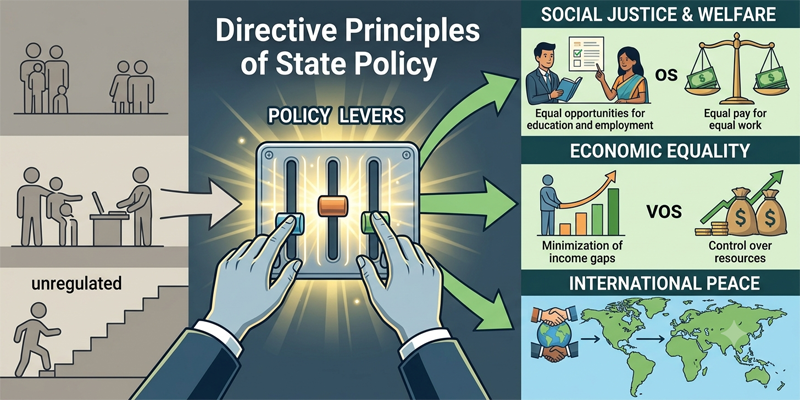
…the duties and achievements that should be accomplished by the Indian state in favour of society.
In general, they are known as DPSPs, which is ultimately described as Directive Principles of State Policy as its full form.
Articles 36 to 51, Part IV within the Constitution completely define these state policies and principles.
Equal opportunities, education, public health, village governance, environmental protection, workers’ welfare, international peace,…
… and social and economic justice are a few very important subjects that get a complete safeguard through these Directive Principles.
Whether it is social justice and welfare-based democracy in the country, these policies and principles play a very important role within the constitutional vision of India.
In this post, we are going to explore the Directive Principles of State Policy in easy-to-understand language.
What Are Directive Principles of State Policy?
Directive Principles are constitutional principles that guide the State in making laws and policies.
They tell governments what kind of society the Constitution seeks to promote.
The word “Directive” is important.
These principles are essentially directions or guidelines to the State for governance.
They are different from Fundamental Rights.
Fundamental Rights generally protect important individual freedoms and provide constitutional remedies when those rights are violated.
Directive Principles, on the other hand, provide a broader social and economic roadmap for governance.
Where Are Directive Principles Found?
Directive Principles are contained in Part IV of the Constitution, covering Articles 36 to 51.
Article 36 defines the term “State” for this Part broadly in line with its meaning under Article 12.
Article 37 is particularly important.
It says that the provisions contained in Part IV cannot be enforced by any court.
However, the Constitution also declares that these principles are fundamental in the governance of the country and that it is the duty of the State to apply them when making laws.
This creates an important distinction:
DPSPs are not directly enforceable in court, but they are constitutionally important guidelines for government.
Why Were Directive Principles Included?
The Constitution-makers wanted India to become more than just a country with political democracy.
They wanted democracy to improve people’s actual living conditions.
Having the right to vote is important, but people also need:
- Education
- Healthcare
- Employment opportunities
- Adequate nutrition
- Fair working conditions
- Social security
- Equal opportunities
- Access to justice
- A clean environment
Directive Principles express many of these goals.
They therefore focus significantly on social and economic democracy.
Fundamental Rights vs Directive Principles
The easiest way to understand the difference is this:
| Fundamental Rights | Directive Principles |
|---|---|
| Protect important individual rights | Guide the State towards social and economic goals |
| Mainly found in Part III | Found in Part IV |
| Generally enforceable by courts | Not directly enforceable by courts |
| Include equality and freedoms | Include welfare, livelihood, health, education and social justice goals |
| Provide remedies for violations | Guide law and policy-making |
The two are not enemies.
A strong constitutional democracy needs both individual liberty and social welfare.
Important Directive Principles Everyone Should Know
There are many provisions in Part IV, but some are particularly important for understanding everyday governance.
Article 38: Social Order Based on Justice
Article 38 directs the State to promote the welfare of the people by securing a social order in which social, economic and political justice informs all institutions of national life.
It also directs the State to minimize inequalities in income and eliminate inequalities in status, facilities and opportunities.
This principle reflects the Constitution’s concern about extreme inequality.
Democracy is not only about political equality. The Constitution also recognizes the importance of reducing social and economic disadvantages.
Article 39: Livelihood, Equal Pay and Protection of Children
Article 39 contains several important principles.
The State should work towards ensuring that citizens have adequate means of livelihood.
It also refers to the distribution of material resources to best serve the common good and to prevent the concentration of wealth and means of production to the common detriment.
Another important principle is equal pay for equal work for both men and women.
Article 39 also calls for protecting the health and strength of workers and ensuring that children are not forced by economic necessity into unsuitable employment.
It further emphasizes protecting children and young people against exploitation and against conditions that could harm their development.
These principles have influenced numerous laws and government policies.
Article 39A: Equal Justice and Free Legal Aid
Article 39A is especially important from the perspective of ordinary citizens.
It directs the State to ensure that the legal system promotes justice based on equal opportunity.
It also calls upon the State to provide free legal aid through suitable legislation or schemes so that economic or other disabilities do not prevent citizens from obtaining justice.
This principle is one of the constitutional foundations behind India’s system of legal aid.
It is particularly important for people who cannot afford legal representation.
Article 40: Organisation of Village Panchayats
Article 40 directs the State to organize village panchayats and give them the powers and authority necessary to function as units of self-government.
This principle is closely connected with India’s system of local democracy.
The later constitutional recognition of Panchayats through the 73rd Constitutional Amendment significantly strengthened the constitutional framework for rural local government.
Today, Gram Panchayats form an important part of India’s grassroots democratic structure.
Article 41: Right to Work, Education and Public Assistance
Article 41 asks the State, within its economic capacity and development, to make effective provision for the right to work, education and public assistance in certain situations.
These include situations such as:
- Unemployment
- Old age
- Sickness
- Disablement
- Other cases of undeserved want
The provision recognizes that a welfare-oriented State should help people facing serious social and economic difficulties.
Article 42: Humane Working Conditions and Maternity Relief
Article 42 directs the State to make provisions for securing just and humane conditions of work and maternity relief.
This principle is important in understanding India’s labour and social-welfare framework.
Various labour and employment laws have reflected these constitutional objectives.
Article 43: Living Wage and Decent Standard of Life
Article 43 asks the State to endeavour to secure, by suitable legislation or economic organization, work for all and a living wage, decent conditions of work and a decent standard of life for workers.
It also promotes opportunities for workers to participate in certain forms of management of industries.
This goes beyond merely ensuring that a worker receives some payment.
The constitutional objective is to promote conditions that allow workers and their families to live with dignity.
Article 43A: Workers’ Participation in Management
Article 43A directs the State to take steps to secure the participation of workers in the management of undertakings, establishments or other organizations engaged in industry.
It reflects the idea that workers should have some meaningful role in decisions affecting industrial life.
Article 44: Uniform Civil Code
Article 44 says that the State shall endeavour to secure for citizens a Uniform Civil Code throughout the territory of India.
This provision is frequently discussed in public debates.
The important point is that Article 44 is a Directive Principle, not a directly enforceable Fundamental Right.
It therefore expresses a constitutional objective rather than automatically creating a legal requirement that can be enforced by an individual through a court under Part III.
Questions concerning personal laws, equality, religious freedom and a Uniform Civil Code can involve complex constitutional and legislative issues.
Article 45: Early Childhood Care and Education
Article 45 now directs the State to endeavour to provide early childhood care and education for all children until they complete the age of six years.
This provision changed after the constitutional recognition of the Right to Education.
Article 21A separately provides a Fundamental Right to education for children in the 6–14 age group, subject to the constitutional framework.
Thus, Articles 21A and 45 together cover different stages of childhood.
Article 46: Protection of Weaker Sections
Article 46 directs the State to promote with special care the educational and economic interests of the weaker sections of the people, particularly the Scheduled Castes and Scheduled Tribes.
It also asks the State to protect them from social injustice and exploitation.
This principle is closely connected with India’s broader constitutional commitment to social justice and affirmative measures.
Article 47: Nutrition, Public Health and Standard of Living
Article 47 places a duty on the State to raise the level of nutrition and the standard of living of its people and to improve public health as among its primary duties.
It also contains a directive concerning the prohibition of intoxicating drinks and drugs injurious to health, subject to the constitutional wording.
Public health programmes, nutrition initiatives and welfare policies can be understood partly against this constitutional background.
Article 48: Agriculture and Animal Husbandry
Article 48 directs the State to organize agriculture and animal husbandry on modern and scientific lines.
It also contains specific provisions concerning preservation and improvement of breeds and restrictions relating to the slaughter of certain categories of cattle, subject to the constitutional text.
This provision has had a significant role in legal and political debates concerning agriculture and cattle.
Article 48A: Protection of the Environment
Article 48A directs the State to protect and improve the environment and to safeguard forests and wildlife.
This provision was added by the 42nd Constitutional Amendment Act, 1976.
It is closely connected with Article 51A(g), which places a corresponding Fundamental Duty on citizens to protect and improve the natural environment.
Together, these provisions demonstrate that environmental protection is both a responsibility of the State and a responsibility of citizens.
Article 49: Protection of Monuments
Article 49 directs the State to protect monuments, places and objects of artistic or historic interest that are declared to be of national importance.
This reflects the constitutional importance of preserving India’s historical and cultural heritage.
Article 50: Separation of Judiciary from Executive
Article 50 directs the State to take steps to separate the judiciary from the executive in the public services of the State.
The principle supports judicial independence and the proper functioning of the justice system.
An independent judiciary is essential for constitutional democracy because courts must be able to decide disputes impartially, including cases involving government authorities.
Article 51: International Peace and Security
Article 51 encourages the State to:
- Promote international peace and security
- Maintain just and honourable relations between nations
- Foster respect for international law and treaty obligations
- Encourage settlement of international disputes through arbitration
This demonstrates that India’s Constitution also looks beyond domestic governance.
Are Directive Principles Legally Useless Because Courts Cannot Enforce Them?
No.
This is a common misunderstanding.
Article 37 makes DPSPs non-justiciable in themselves, but they remain constitutionally significant.
They can influence:
- Legislative policy
- Government schemes
- Public welfare programmes
- Interpretation of laws
- Constitutional interpretation
- Judicial reasoning
Courts have repeatedly recognized the importance of harmonizing Fundamental Rights and Directive Principles.
Over time, several principles originally expressed as directives have also influenced the development of constitutional rights.
For example, constitutional jurisprudence concerning education, legal aid, livelihood, health and environmental protection has developed significantly through legislation and judicial interpretation.
Can a Citizen Go to Court to Enforce a Directive Principle?
Generally, not directly under Part IV itself.
For example, a person generally cannot simply file a petition asking a court to order the government to implement every Directive Principle immediately because Article 37 says these provisions are not enforceable by any court.
However, the situation can become different when:
- Parliament or a State Legislature has enacted a law based on a Directive Principle.
- A government policy creates enforceable legal rights.
- A Directive Principle helps a court interpret an existing law.
- The issue also involves a Fundamental Right or another enforceable legal provision.
Therefore, the fact that a DPSP is non-justiciable does not mean that laws and rights connected with it are unenforceable.
How Directive Principles Affect Ordinary Life
You may encounter the influence of Directive Principles without realizing it.
Consider:
Free legal aid: Article 39A supports the constitutional goal of ensuring access to justice regardless of economic circumstances.
Panchayats: Article 40 supports grassroots self-government.
Worker protection: Articles 39, 42 and 43 reflect constitutional objectives concerning working conditions, wages and worker welfare.
Public health: Article 47 emphasizes nutrition and health.
Environmental protection: Article 48A supports State responsibility for environmental protection.
Education: Articles 41 and 45, together with Article 21A, demonstrate the Constitution’s strong commitment to education.
This is why Directive Principles matter even though they cannot generally be enforced directly in court.
Directive Principles and a Welfare State
The idea of a welfare state is central to understanding DPSPs.
A welfare-oriented government does not merely maintain law and order.
It also works towards improving people’s social and economic conditions.
This can involve:
- Education
- Healthcare
- Social security
- Employment
- Worker protection
- Rural development
- Environmental protection
- Legal aid
- Nutrition
- Protection of disadvantaged communities
The Directive Principles provide constitutional guidance for these objectives.
Why Should Citizens Know About DPSPs?
Knowing about DPSPs helps citizens understand why governments make many welfare policies and laws.
When a government introduces a programme related to education, public health, worker welfare, local government or environmental protection, citizens can better understand the constitutional principles behind such policies.
They also provide a useful way to evaluate governance.
Citizens can ask:
- Are policies reducing inequality?
- Is access to justice improving?
- Are children receiving education?
- Are workers treated fairly?
- Is public health being protected?
- Is the environment being preserved?
- Are weaker sections receiving meaningful opportunities?
These are not merely political questions. Many are closely connected with the constitutional vision contained in Part IV.
The Bigger Constitutional Picture
The Indian Constitution can be understood as creating a balance between liberty, equality, justice and social welfare.
Fundamental Rights protect important freedoms and individual interests.
Fundamental Duties remind citizens of their responsibilities.
Directive Principles guide the State towards social and economic goals.
Together, these provisions present a much broader vision of democracy.
The Constitution does not merely ask:
“How should the government be controlled?”
It also asks:
“What kind of society should the government work towards creating?”
The Directive Principles provide much of the answer.
Quick Reference
| Article | Main Principle |
|---|---|
| 36 | Definition of State for Part IV |
| 37 | Application and non-enforceability of DPSPs |
| 38 | Social order based on justice |
| 39 | Livelihood, equal pay, distribution of resources and protection of children |
| 39A | Equal justice and free legal aid |
| 40 | Village Panchayats |
| 41 | Work, education and public assistance |
| 42 | Humane working conditions and maternity relief |
| 43 | Living wage and decent standard of life |
| 43A | Workers’ participation in management |
| 44 | Uniform Civil Code |
| 45 | Early childhood care and education |
| 46 | Weaker sections, especially SCs and STs |
| 47 | Nutrition, standard of living and public health |
| 48 | Agriculture and animal husbandry |
| 48A | Environment, forests and wildlife |
| 49 | Protection of monuments |
| 50 | Separation of judiciary from executive |
| 51 | International peace and security |
Final Takeaway
Friends, in this blog post, we have learned about the Directive Principles of State Policy within the Indian Constitution. It is one of the most important yet often misunderstood parts of the Indian Constitution. Courts do not enforce them directly, but that does not make them any less meaningful.
The Government gets great help in the form of a constitutional roadmap in order to work in the important areas of economic fairness, social justice, education, public health, worker welfare, environmental protection, and a much better quality of life.
At one end, Fundamental Rights in the Constitution provide the freedoms and protections to the citizens, and at the other end, it reminds about the fundamental duties and responsibilities. The Directive Principles of State Policy describe many of the targets or goals the state should achieve.
If you understand all these three categories, you will probably have a clear picture of what is being tried to be accomplished by the Indian Constitution.
Legal Awareness Note
This article “Directive Principles of State Policy” is intended for general public awareness and educational purposes. It provides a simplified explanation of constitutional provisions and should not be treated as legal advice. The application of any constitutional provision may depend on legislation, judicial interpretation, and the facts of a particular case.
If you have any queries, you can write to us at support@a5theory.com; we will get back to you ASAP.
Hope! You will have enjoyed this post, “Directive Principles of State Policy“.
Please feel free to give your important feedback in the comment section below.
Have a great time!