

Hello Friends, in this blog post, we are going to discuss the Basic Structure Doctrine.
The Constitution of India is considered the supreme law of the country.
It is responsible for laying down the foundation or framework for Parliament, the government, courts, Fundamental Rights, and elections.
But it becomes very curious to know the answer to this question:
If Parliament has the power to amend the Constitution, could it change absolutely anything in it?
No is the straightforward answer to this question.
It is clearly stated by the Supreme Court of India that amendments can be made to the Constitution…
…by Parliament, but its basic structure can neither be destroyed nor altered.
This principle is known as the Basic Structure Doctrine.
In Indian constitutional law, it has been the most basic and important principle.
It draws a line by limiting Parliament’s power to amend the Constitution.
In this post, we will explain the Basic Structure Doctrine in easy-to-understand language.
What Is the Basic Structure Doctrine?
The Basic Structure Doctrine means that certain fundamental features of the Constitution cannot be destroyed even through a constitutional amendment.
Parliament has wide power to amend the Constitution under Article 368. However, that power is not unlimited.
The Constitution can be changed to meet the needs of society, but an amendment cannot transform the Constitution in a way that destroys its essential identity.
In simple words:
Parliament can change the Constitution, but it cannot destroy the Constitution’s basic character.
How Did This Doctrine Come About?
The Basic Structure Doctrine was established by the Supreme Court in the landmark case of Kesavananda Bharati v. State of Kerala in 1973.
The case involved a religious institution in Kerala and constitutional questions concerning property rights and the extent of Parliament’s power to amend the Constitution.
The case was heard by a very large bench of the Supreme Court consisting of 13 judges.
The judgment was delivered on 24 April 1973.
By a narrow majority, the Supreme Court held that Parliament’s power to amend the Constitution is broad, but it cannot alter its basic structure.
This became known as the Basic Structure Doctrine.
Why Was Such a Doctrine Necessary?
Imagine that a temporary parliamentary majority could completely rewrite the Constitution.
In theory, it might attempt to:
- Remove judicial review
- End democratic elections
- Abolish the independence of courts
- Destroy federalism
- Remove important constitutional freedoms
- Give unlimited power to the government
If such changes could be made simply by following the amendment procedure, the Constitution could potentially be used to destroy the very system it created.
The Basic Structure Doctrine provides a constitutional safeguard against this possibility.
It protects the fundamental framework of the Constitution while still allowing necessary amendments.
Does the Constitution Itself List the Basic Structure?
No.
There is no single Article in the Constitution containing a list titled “Basic Structure.”
The doctrine was developed by the Supreme Court through constitutional interpretation.
Over several cases, the Court has identified various features that form part of the Constitution’s basic structure.
The exact list is not completely closed. Whether a particular constitutional principle forms part of the basic structure depends on constitutional interpretation and the facts of the case.
What Are Some Elements of the Basic Structure?
The Supreme Court has recognised or treated various principles as part of the basic structure.
These include, among others:
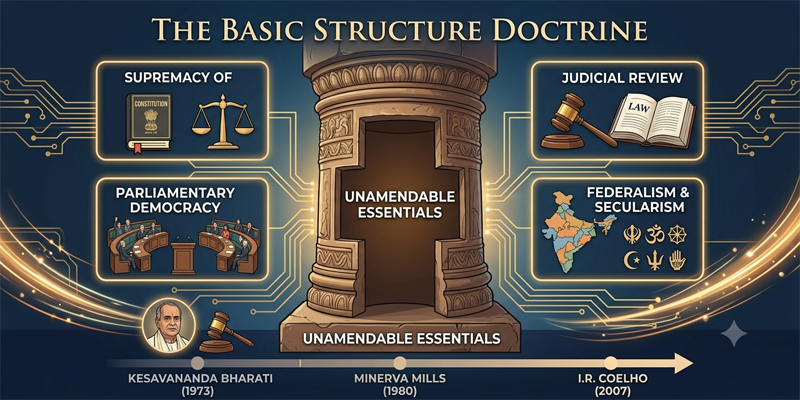
- Supremacy of the Constitution
- Rule of law
- Judicial review
- Separation of powers
- Federalism
- Secularism
- Democracy
- Republican form of government
- Free and fair elections
- Independence of the judiciary
- Dignity and certain fundamental freedoms
- Constitutional supremacy
Not every constitutional provision is automatically part of the basic structure.
The doctrine focuses on fundamental principles that give the Constitution its essential identity.
Parliament’s Power to Amend the Constitution
Article 368 provides the constitutional framework for amendments.
A Constitutional Amendment Bill generally requires a special majority in Parliament.
For certain federal provisions, ratification by at least half of the State Legislatures is also required.
However, even after following the correct parliamentary procedure, an amendment can be challenged before the Supreme Court if it is alleged to violate the basic structure.
This is an important distinction:
Following the correct procedure does not automatically make every constitutional amendment valid.
The Important Cases Behind the Doctrine
The Basic Structure Doctrine did not appear in isolation. It developed through a series of important constitutional cases.
Shankari Prasad Case – 1951
In Shankari Prasad v. Union of India, the Supreme Court initially took the view that Parliament could amend Fundamental Rights using its constitutional amendment power.
Sajjan Singh Case – 1965
In Sajjan Singh v. State of Rajasthan, the Supreme Court again largely accepted Parliament’s power to amend Fundamental Rights.
However, some judges began expressing concerns about whether there should be limits on the amendment power.
Golaknath Case – 1967
In I.C. Golaknath v. State of Punjab, the Supreme Court took a different approach.
The majority held that Parliament could not amend Fundamental Rights in the way it had been doing.
This created significant constitutional tension between Parliament and the judiciary.
The Constitution was subsequently amended to strengthen Parliament’s stated power to amend constitutional provisions.
The dispute eventually led to the landmark Kesavananda Bharati case.
Kesavananda Bharati Case – 1973
The Kesavananda Bharati case fundamentally changed Indian constitutional law.
The Supreme Court held that Parliament can amend the Constitution, including Fundamental Rights, but cannot alter or destroy the basic structure of the Constitution.
This created a middle position between two extremes.
The Court did not say:
“Parliament cannot amend the Constitution.”
Nor did it say:
“Parliament can change absolutely anything.”
Instead, it established:
Wide amendment power + constitutional limitation.
This balance is at the heart of the Basic Structure Doctrine.
What Happened During the Emergency Period?
The Basic Structure Doctrine became especially important during the period of the Emergency in the 1970s.
The 42nd Constitutional Amendment Act, 1976 attempted to make extensive constitutional changes and included provisions intended to limit the ability of courts to examine constitutional amendments.
The Supreme Court later examined important parts of these changes.
In Minerva Mills v. Union of India (1980), the Court reaffirmed the Basic Structure Doctrine.
The Court held that Parliament’s limited power to amend the Constitution itself forms part of the basic structure.
This is an important idea.
If Parliament could use its amendment power to remove all limits on its own amendment power, the limitation established by the Constitution would become meaningless.
Minerva Mills and the Balance Between Rights and Governance
The Minerva Mills case also reinforced the importance of maintaining a balance between Fundamental Rights and Directive Principles of State Policy.
The Constitution contains both individual rights and broader goals of social and economic governance.
Neither side can simply be used to destroy the constitutional framework.
This reflects a broader principle:
The Constitution is a carefully balanced system, not merely a collection of isolated provisions.
Other Important Cases
The Basic Structure Doctrine has been considered in several later cases.
Waman Rao Case – 1981
The Supreme Court considered the application of the Basic Structure Doctrine to constitutional amendments and placed important temporal limits in relation to laws placed in the Ninth Schedule.
I.R. Coelho Case – 2007
In I.R. Coelho v. State of Tamil Nadu, the Supreme Court held that laws inserted into the Ninth Schedule after 24 April 1973 could be examined if they damage the basic structure.
This demonstrated that simply placing a law in a constitutionally protected Schedule does not automatically place it beyond judicial scrutiny.
NJAC Case – 2015
In the Supreme Court Advocates-on-Record Association v. Union of India case, commonly associated with the National Judicial Appointments Commission (NJAC), the Supreme Court struck down the constitutional amendment and related legislation creating the NJAC framework.
The majority relied on the constitutional principle of judicial independence, treating it as part of the basic structure.
The case remains an important example of the doctrine being applied to a constitutional amendment.
Is Judicial Review Part of the Basic Structure?
Yes.
Judicial review is one of the key principles associated with the Basic Structure Doctrine.
Judicial review allows courts to examine whether laws and government actions comply with the Constitution.
It also means that constitutional amendments themselves can, within the Basic Structure Doctrine, be examined by the judiciary.
Without judicial review, there would be no effective judicial mechanism for enforcing the constitutional limits on amendment power.
Does the Basic Structure Doctrine Mean Judges Have Unlimited Power?
No.
The doctrine does not give judges a general power to rewrite the Constitution.
The Supreme Court examines whether a constitutional amendment damages or destroys a fundamental feature of the constitutional framework.
The Court does not normally invalidate an amendment simply because it disagrees with its policy.
This distinction is important.
Constitutional review is not the same as political disagreement.
Can Parliament Amend Fundamental Rights?
Yes.
The Basic Structure Doctrine does not make Fundamental Rights completely unchangeable.
Parliament can amend constitutional provisions relating to Fundamental Rights, provided the amendment does not violate the Constitution’s basic structure.
For example, the Constitution itself has changed significantly over time through amendments.
The important question is not simply:
“Has a Fundamental Right been changed?”
The deeper question is:
“Does the amendment destroy a fundamental feature of the Constitution?”
Basic Structure and Democracy
At first glance, it may seem unusual that an unelected judiciary can place limits on an elected Parliament.
But the constitutional system works on the principle that even democratic majorities are bound by the Constitution.
Parliament gets its authority from the Constitution.
Therefore, Parliament cannot use constitutional power to eliminate the constitutional framework that gives it that power.
This is one reason the Basic Structure Doctrine is closely connected with constitutional democracy and the rule of law.
Is the Basic Structure Doctrine Controversial?
Yes.
The doctrine has been debated by constitutional scholars, politicians, and legal experts.
Supporters argue that it:
- Protects the Constitution from authoritarian changes
- Protects democracy
- Preserves judicial independence
- Prevents temporary majorities from destroying fundamental constitutional principles
- Maintains the rule of law
Critics have raised concerns that:
- The Constitution does not expressly mention the doctrine
- The Supreme Court determines what constitutes the basic structure
- The doctrine can give significant power to unelected judges
- Its boundaries are not always precisely defined
Despite these debates, the Basic Structure Doctrine remains an established principle of Indian constitutional law.
What Does This Mean for Ordinary Citizens?
The doctrine may sound highly technical, but it has practical significance.
It means that constitutional democracy cannot simply be transformed through a temporary parliamentary majority.
For citizens, it provides an additional layer of constitutional protection.
It helps preserve principles such as:
- Democratic government
- Independent courts
- Rule of law
- Judicial review
- Federalism
- Constitutional supremacy
- Free and fair elections
These principles affect the functioning of government and the protection of citizens’ rights.
Basic Structure vs. Fundamental Rights
These two concepts are related but not identical.
Fundamental Rights are constitutional rights guaranteed to individuals under Part III.
The Basic Structure Doctrine is a judicial doctrine limiting Parliament’s constitutional amendment power.
Some Fundamental Rights or their underlying principles may be connected to the basic structure, but not every provision of Part III is necessarily immune from amendment.
This distinction is important when studying constitutional law.
A Simple Example
Imagine that Parliament passes a constitutional amendment saying:
“India will no longer hold democratic elections, and all political power will permanently belong to one authority.”
Even if Parliament followed the required voting procedure, such an amendment would raise an obvious Basic Structure issue because democracy and related constitutional principles are recognised as fundamental features of the constitutional system.
The doctrine therefore acts as a constitutional boundary.
It does not prevent change.
It prevents destructive change.
Why Is the Doctrine Important?
The Indian Constitution must survive changing political circumstances.
Governments change.
Political parties change.
Parliamentary majorities change.
Social and economic conditions change.
But certain foundational principles need continuity.
The Basic Structure Doctrine attempts to ensure that constitutional change does not become constitutional destruction.
It therefore represents a balance between:
Change and continuity.
Parliamentary democracy and constitutional supremacy.
Government power and constitutional limitations.
Majority rule and protection of fundamental principles.
Final Takeaway
Friends, in this blog post, we have understood the basic structure doctrine principle. And as per this principle, it is clearly stated that Parliament can never change everything in the Constitution. Though a broad power to amend the Constitution under Article 368 is given to the parliament yet, it is clearly dictated by the Supreme Court that this power can never be used to destroy or alter the basic structure of the Constitution.
In Kesavananda Bharati v. State of Kerala in 1973, the doctrine was established and has been developed through subsequent constitutional cases.
The most important protection is given to the Indian Constitution with the basic structure doctrine.
In simple words:
There could be evolution in the Constitution, but its basic and essential identity and structure can never be destroyed using any amendment process in Parliament.
Legal Disclaimer: This article is intended for general educational and legal-awareness purposes only. It is not legal advice. Constitutional doctrines and their application can be complex and depend on judicial interpretation and the facts of each case. For a specific legal issue, consult a qualified legal professional.
If you have any queries, you can write to us at support@a5theory.com; we will get back to you ASAP.
Hope! You will have enjoyed this post, “The Basic Structure Doctrine“.
Please feel free to give your feedback in the comment section below.
Have a great time!