

Hello Friends, in this blog post, we are going to discuss constitutional amendments in India within the Constitution.
Indian Constitution, being the supreme law of the country, never denies the scope for change if needed for the welfare of the country’s citizens.
The Indian Constitution was designed to be both stable and capable of adapting to changing circumstances.
As technology develops, society changes, democratic institutions evolve, and new challenges emerge.
That’s the reason there could be some amendments within the existing framework, using some available mechanism in the Constitution.
And we call this process as a constitutional amendment.
But unlike the process of passing an ordinary law, Parliament can’t simply make changes in the Constitution.
Though, there are some special procedures described under Article 368 within the Constitution itself to make any amendments.
The Constitutional Amendments in India can affect the structure of center-state relations, representation, elections, Fundamental Rights, government, and many more other aspects of the nation’s life.
That’s the reason it is very important to understand and be aware of all these procedures well.
In this post, we are going to explore Constitutional Amendments in India in an easy-to-understand language.
What Are the Constitutional Amendments in India?
A constitutional amendment means a formal change made to the Constitution.
An amendment may:
- Add a new provision
- Remove an existing provision
- Modify existing constitutional provisions
- Change the wording of an Article
- Add or modify a Schedule
- Make structural changes permitted by the Constitution
The Constitution has been amended many times because it is a living document intended to function in changing circumstances.
However, the power to amend the Constitution is not unlimited.
This limitation is particularly important because of the Basic Structure Doctrine, which will be discussed in the next article in this series.
Why Does the Constitution Need to Be Amended?
The Constitution came into force in 1950, but India has changed enormously since then.
For example, India’s population, economy, technology, political institutions and social conditions have changed significantly.
Amendments can therefore be necessary to:
- Improve constitutional governance
- Respond to changing social conditions
- Strengthen democratic institutions
- Reform elections and representation
- Adjust Centre-State arrangements
- Strengthen local government
- Address emerging constitutional requirements
One important example is the 73rd and 74th Constitutional Amendments, which gave constitutional recognition to Panchayats and Municipalities.
Another major example is the 86th Constitutional Amendment, which inserted Article 21A and made the right to education for children aged 6 to 14 a Fundamental Right.
Who Can Amend the Constitution?
Parliament has the principal power to amend the Constitution.
Under Article 368, a constitutional amendment Bill can be introduced in either House of Parliament.
Unlike an ordinary Bill, a Constitutional Amendment Bill does not require the approval of a State Legislature merely to introduce it in Parliament.
It must, however, satisfy the special procedure required for the particular amendment.
The President also has a constitutional role. Once a Constitutional Amendment Bill has been duly passed according to Article 368, the President gives assent to it.
Is Every Constitutional Amendment Passed in the Same Way?
No.
This is one of the most important things to understand.
Broadly, constitutional provisions can be changed through different procedures.
Amendments by Simple Majority
Some constitutional provisions can be changed by Parliament through an ordinary legislative procedure requiring a simple majority.
These changes are technically not treated as amendments under Article 368.
Examples include certain matters relating to:
- Formation or alteration of States under the relevant constitutional provisions
- Creation or abolition of Legislative Councils in States
- Certain changes involving Schedules and administrative arrangements
The exact constitutional provision must always be checked because the procedure depends on the subject.
Amendments by Special Majority
Most provisions that are amended under Article 368 require a special majority in Parliament.
This generally means:
- A majority of the total membership of that House; and
- A majority of not less than two-thirds of the members of that House who are present and voting.
Both Houses must separately pass the Bill with the required majority.
There is no joint sitting for a Constitutional Amendment Bill.
This makes the amendment procedure more demanding than the ordinary law-making process.
Amendments Requiring State Ratification
Some constitutional provisions are considered especially important to the federal structure of India.
For these provisions, Parliament must pass the amendment by the required special majority and at least half of the State Legislatures must ratify it.
These provisions include matters connected with areas such as:
- Election of the President
- Extent of executive power of the Union and States in specified constitutional contexts
- Supreme Court and High Courts
- Distribution of legislative powers between Union and States
- Representation of States in Parliament
- Article 368 itself
The purpose is to ensure that changes affecting the federal structure cannot be made solely by the Union Parliament without State participation.
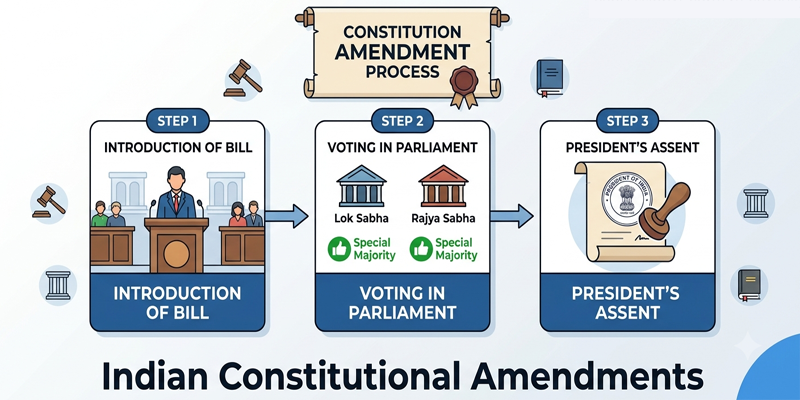
The Constitutional Amendment Process
The process can be understood in simple steps.
Step 1: Introduction of the Amendment Bill
A Constitutional Amendment Bill can be introduced in either the Lok Sabha or Rajya Sabha.
It can be introduced by a Minister or by a private member of Parliament.
There is no requirement that it must first be introduced in the Lok Sabha.
Step 2: Parliamentary Debate
Members of Parliament discuss the proposed amendment.
They may examine:
- Why the amendment is needed
- What constitutional provision is being changed
- How the change may affect citizens
- Whether the amendment has unintended consequences
Parliamentary committees may also examine Bills where appropriate, although committee referral is not mandatory for every Constitutional Amendment Bill.
Step 3: Voting in the First House
The Bill must receive the constitutionally required majority.
For amendments under Article 368, the special majority requirement applies.
The exact voting requirement is therefore stricter than that applicable to an ordinary Bill.
Step 4: Approval by the Other House
The Bill then has to be passed by the other House with the required majority.
Both Houses must agree to the amendment.
If one House rejects the Bill, the amendment cannot be passed.
There is no joint sitting to resolve a deadlock on a Constitutional Amendment Bill.
Step 5: State Ratification, Where Required
If the amendment concerns one of the constitutional subjects requiring State ratification, at least half of the State Legislatures must approve it.
The Constitution does not require every State to ratify such an amendment.
Step 6: President’s Assent
After the constitutional requirements have been fulfilled, the Bill is presented to the President.
Under Article 368, the President shall give assent to a Constitutional Amendment Bill duly passed according to the constitutional procedure.
After assent, the Constitution stands amended in accordance with the amendment Act.
Can a Constitutional Amendment Be Challenged in Court?
Yes.
This is a crucial feature of India’s constitutional system.
Parliament’s power to amend the Constitution is subject to constitutional limitations.
The most important limitation is the Basic Structure Doctrine.
The doctrine was established by the Supreme Court in the landmark Kesavananda Bharati v. State of Kerala case in 1973.
The Supreme Court held that Parliament can amend the Constitution, including important constitutional provisions, but it cannot destroy or alter its basic structure.
What Is the Basic Structure?
The Constitution does not contain a single Article listing everything that forms its basic structure.
Instead, the Supreme Court has identified various principles through constitutional cases.
These have included principles such as:
- Supremacy of the Constitution
- Rule of law
- Judicial review
- Separation of powers
- Federalism
- Secularism
- Democracy
- Republican form of government
- Free and fair elections
- Dignity and certain fundamental freedoms
- Independence of the judiciary
The exact scope of the Basic Structure Doctrine has developed through judicial decisions.
This means Parliament has broad amendment power, but that power does not allow it to destroy the fundamental identity of the Constitution.
Constitutional Amendment vs Ordinary Law
A constitutional amendment is different from an ordinary law.
| Constitutional Amendment | Ordinary Law |
|---|---|
| Changes the Constitution | Operates under the Constitution |
| Usually requires special majority under Article 368 | Usually requires ordinary parliamentary majority |
| Some amendments require State ratification | Generally does not require State ratification |
| No joint sitting | Joint sitting may be available for certain ordinary Bills |
| Subject to the Basic Structure Doctrine | Subject to the Constitution and judicial review |
| Governed by constitutional amendment procedures | Governed by ordinary legislative procedures |
This distinction is important because Parliament’s law-making power and its constitutional amendment power are not identical.
Some Important Constitutional Amendments
India has adopted many constitutional amendments over the decades. Some have had particularly significant effects.
1st Amendment, 1951
The First Amendment made several important changes, including changes concerning Fundamental Rights and the constitutional framework for certain restrictions and land reform measures.
42nd Amendment, 1976
Often called one of the most significant amendments, the 42nd Amendment made wide-ranging changes during the Emergency period.
Among other things, it added the words “Socialist” and “Secular” to the Preamble and changed several constitutional provisions.
Some of its changes were later modified or reversed through subsequent amendments and judicial decisions.
44th Amendment, 1978
The 44th Amendment made important changes following the Emergency period.
One major change was removing the Right to Property from the list of Fundamental Rights.
Property rights were instead protected constitutionally under Article 300A.
61st Amendment, 1988
The voting age for elections to the Lok Sabha and State Legislative Assemblies was reduced from 21 to 18 years.
73rd Amendment, 1992
This gave constitutional status to the Panchayati Raj system and introduced a framework for rural local self-government.
74th Amendment, 1992
This provided constitutional recognition to urban local bodies such as municipalities.
86th Amendment, 2002
This inserted Article 21A, making free and compulsory education for children aged 6 to 14 a Fundamental Right.
It also modified the constitutional framework concerning education and introduced a Fundamental Duty concerning the education of children.
101st Amendment, 2016
The 101st Amendment introduced the constitutional framework for the Goods and Services Tax (GST).
It significantly changed India’s indirect taxation structure and strengthened coordination between the Union and States in GST administration.
103rd Amendment, 2019
This introduced constitutional provisions enabling special provisions relating to economically weaker sections, including reservation in educational institutions and public employment subject to the constitutional framework.
These examples show that constitutional amendments can cover very different subjects.
Can Parliament Change Fundamental Rights?
Yes, Parliament can amend constitutional provisions concerning Fundamental Rights, but it cannot use the amendment power to destroy the Constitution’s basic structure.
This principle has evolved through several important Supreme Court decisions.
The relationship between Parliament’s amendment power, Fundamental Rights, and the Basic Structure Doctrine is one of the most important subjects in Indian constitutional law.
Why Is the Amendment Procedure Kept Strict?
The Constitution needs to balance two competing needs.
On one side, it must be possible to change the Constitution when necessary.
On the other side, the Constitution should not be changed casually whenever a temporary political majority wants to do so.
The amendment procedure therefore creates a balance between:
Flexibility and stability.
Some provisions can be changed relatively easily, while important constitutional provisions require a special parliamentary majority and, in certain cases, State ratification.
The Basic Structure Doctrine provides another constitutional safeguard.
Can Citizens Propose a Constitutional Amendment Directly?
An ordinary citizen cannot introduce a Constitutional Amendment Bill directly in Parliament.
The formal amendment process operates through Parliament.
However, citizens can influence constitutional change indirectly through:
- Voting
- Contacting elected representatives
- Public debate
- Constitutional advocacy
- Academic and civil society discussions
- Participating in democratic processes
Citizens can also challenge unconstitutional constitutional amendments before the courts in appropriate cases.
Why Constitutional Amendments Matter to Ordinary Citizens
Constitutional amendments may sound like a subject meant only for lawyers and politicians, but their effects can reach everyday life.
Changes to the Constitution can affect:
- Voting and representation
- Education
- Local government
- Taxation
- Reservation
- Fundamental Rights
- Centre-State relations
- Courts and judicial institutions
- Government powers
Therefore, constitutional awareness is an important part of being an informed citizen.
Final Takeaway
Friends, in this post, we have fully understood Constitutional Amendments in India within the Constitution. It is neither fully rigid nor completely flexible. For different types of constitutional changes, it has different procedures.
There are still some provisions which could be changed simply through the parliamentary process. But for rest of the amendments which comes under Article 368 need a special majority. And the amendments which affect the structure of certain federal provisions also need ratification by at least half of the state legislatures.
Parliament has limited power to amend the Constitution due to the Basic Structure Doctrine; it is completely restricted from amending the Constitution in such a way that it destroys the fundamental identity of the Constitution.
In simple words:-
Constitution can be changed or modified without destroying its basic constitutional character and identity.
And this fascinating balance between change and continuity is one of the key features of the Indian constitutional system(Constitutional Amendments in India).
Legal Disclaimer: This article “Constitutional Amendments in India” is intended for general educational and legal-awareness purposes only. It is not legal advice. Constitutional amendment procedures and their interpretation can involve complex legal questions. For specific legal matters, consult a qualified legal professional.
If you have any queries, you can write to us at support@a5theory.com; we will get back to you ASAP.
Hope! You will have enjoyed this post, “Constitutional Amendments in India“.
Please feel free to give your feedback in the comment section below.
Have a great time!