

Hello Friends, in this blog post, we’ll discuss children’s legal rights in India under the Constitution.
As young and future youth of the country, they also have numerous important rights under the Indian Constitution and laws.
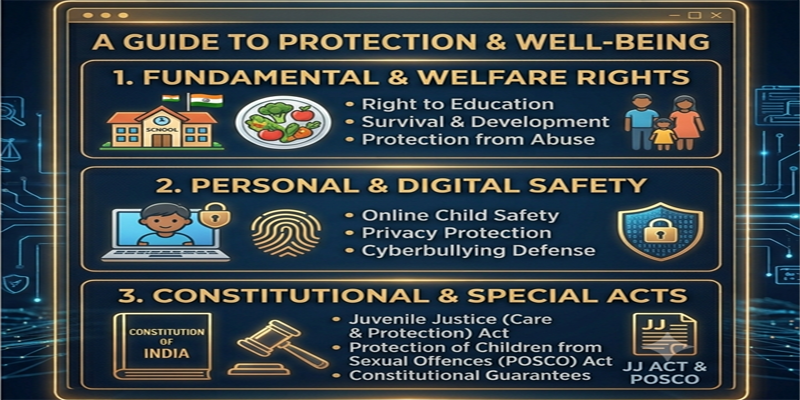
These Rights for children mainly cover:
- Right to education
- Protection from exploitation
- Child labour
- Abuse
- Trafficking
- Sexual offences
- Early marriage
- Adoptoin
- Juvenile justice and access to legal assistance
In general, the main focus remains on food, education, and safety that are provided by the parents, teachers, and caretakers at home.
But along with these basic and necessary facilities, it is equally important to be aware of the legal rights(Children’s Legal Rights in India) of children.
Because there might be cases when children are not able to report exploitation, recognize abuse, or protect their own interests.
For keeping children’s protection in mind, there are several provisions and laws created within the Indian Constitution.
In this post, “Children’s Legal Rights in India,” we are going to explore some of the most important provisions and laws related to child protection in easy-to-understand language.
Children and the Indian Constitution
The Constitution provides several protections that directly or indirectly concern children.
Article 15(3): Special Protection for Children
Article 15 generally prohibits certain forms of discrimination by the State.
Importantly, Article 15(3) allows the State to make special provisions for women and children.
This provides constitutional support for laws and schemes designed specifically to protect children.
Article 21: Life and Personal Liberty
Article 21 protects the life and personal liberty of every person.
Children are also entitled to this protection.
The constitutional understanding of life and dignity extends beyond merely physical survival and has been interpreted to include important aspects of a dignified life.
Article 21A: Right to Education
One of the most important constitutional rights of children is Article 21A.
It provides for free and compulsory education for children in the age group of 6 to 14 years, in the manner determined by law.
The principal legislation implementing this constitutional guarantee is the Right of Children to Free and Compulsory Education Act, 2009, commonly called the RTE Act.
Right to Free and Compulsory Education
The RTE Act establishes a legal framework for free and compulsory elementary education for children within the constitutionally specified age group.
Parents and guardians should understand that the right is not simply about being allowed to enter a school.
The law addresses matters such as:
- Admission
- Elementary education
- Responsibilities of government and local authorities
- Responsibilities of schools
- Teacher-related requirements
- Norms and standards
- Protection of children from certain forms of exclusion
The exact rights and obligations depend on the applicable provisions and circumstances.
Can a School Refuse Admission Because a Child Is Poor?
The RTE framework is designed to prevent children from being denied elementary education because of circumstances such as economic disadvantage.
The Act also contains provisions concerning admission of children from disadvantaged groups and weaker sections in specified private unaided schools, subject to the statutory framework.
Parents should therefore check the applicable RTE provisions and State rules rather than assuming that a child’s economic circumstances make private-school education legally inaccessible in every situation.
Protection Against Child Labour
Children have legal protection against exploitation through both the Constitution and legislation.
Article 24 prohibits the employment of children below the age of 14 years in factories, mines or other hazardous employment.
The main statutory framework is the Child and Adolescent Labour (Prohibition and Regulation) Act, 1986, as amended.
The law distinguishes between children and adolescents and places restrictions on their employment.
In particular, employment of children in prohibited occupations and processes is restricted by law, while adolescents are protected from hazardous occupations and processes covered by the statute.
The legal position is therefore more detailed than simply saying that “children cannot work.”
Why Child Labour Is a Serious Legal Issue
Child labour can interfere with:
- Education
- Physical development
- Mental well-being
- Safety
- Future employment opportunities
- Freedom from exploitation
If a child is being employed in circumstances prohibited by law, the matter can be reported to the appropriate authorities.
Parents should also remember that poverty can make families vulnerable to exploitation. A child being forced to work should not be treated merely as a family or employment matter when the law prohibits the circumstances.
Protection Against Child Sexual Abuse
Children have specific protection against sexual offences under the Protection of Children from Sexual Offences Act, 2012, commonly known as the POCSO Act.
POCSO is a special law dealing with sexual offences against children.
For the Act, a child means a person below 18 years of age.
The law addresses offences including:
- Penetrative sexual assault
- Sexual assault
- Sexual harassment
- Using a child for pornographic purposes
- Certain aggravated forms of these offences
The law also provides procedures intended to make the reporting, investigation, and trial process more child-sensitive.
What Should a Parent Do If a Child Reports Abuse?
The priority should be the child’s safety.
Parents or caregivers should:
- Move the child away from immediate danger.
- Listen calmly.
- Avoid blaming or threatening the child.
- Preserve relevant evidence where possible.
- Report the matter through the appropriate legal channel.
- Seek medical assistance where necessary.
- Obtain appropriate legal and psychological support.
A child should never be made to feel responsible for the abuse.
Mandatory Reporting Under POCSO
POCSO contains provisions concerning the reporting of offences.
Certain persons who have knowledge or apprehension of specified offences are subject to statutory reporting obligations.
This is important because child sexual abuse can remain hidden when adults assume that the matter should be dealt with privately.
The precise reporting obligations and consequences depend on the facts and the statutory provisions applicable to the situation.
Child Marriage Is Prohibited
Child marriage is prohibited under Indian law.
The principal legislation is the Prohibition of Child Marriage Act, 2006.
The law defines a “child” differently for males and females for child marriage.
Generally, it treats:
- A male below 21 years as a child
- A female below 18 years as a child
A marriage involving a child can have significant legal consequences.
The law also provides protections and remedies concerning child marriages, including provisions relating to making certain marriages voidable and dealing with specified circumstances in which a child marriage can be treated as void.
Why Parents Should Not Treat Child Marriage as a Family Matter
Child marriage can affect:
- Education
- Health
- Economic independence
- Personal development
- Ability to make informed life decisions
- Protection from exploitation
A parent, relative, or community member should not assume that a marriage is legally acceptable simply because the family agrees to it.
If a child is at risk of being forced into marriage, immediate assistance should be sought from the appropriate authorities.
Children and Trafficking
The Constitution prohibits trafficking in human beings under Article 23.
Children can be particularly vulnerable to trafficking for purposes including:
- Forced labour
- Sexual exploitation
- Begging
- Domestic servitude
- Illegal activities
- Other forms of exploitation
Trafficking is a serious offence, and children who are victims require protection rather than blame.
If a child disappears or there is suspicion of trafficking, the matter should be reported promptly to the police and appropriate child-protection authorities.
Juvenile Justice System
Children who come into conflict with the law are not supposed to be treated exactly like adult offenders.
The principal legislation is the Juvenile Justice (Care and Protection of Children) Act, 2015.
The law creates a framework for dealing with:
- Children in conflict with the law
- Children in need of care and protection
- Rehabilitation
- Social reintegration
- Adoption
- Institutional and non-institutional care
The system is intended to focus on the child’s welfare, rehabilitation and reintegration while also addressing the legal process.
Who Is a Child in Conflict With Law?
A child in conflict with law is generally a child who is alleged or found to have committed an offence and who was below the legally relevant age at the time of the offence.
The juvenile justice system has specialized procedures and institutions for such cases.
A child should therefore not automatically be treated like an adult merely because an allegation is serious.
Juvenile Justice Board
The Juvenile Justice Board (JJB) deals with matters involving children in conflict with the law.
The Board follows the procedures established under the Juvenile Justice Act.
For certain serious offences, the law contains special provisions concerning children in the 16–18 age group, including a preliminary assessment mechanism in specified circumstances.
This does not mean that every 16–18-year-old accused of a serious offence is automatically tried as an adult.
The statutory procedure must be followed.
Children in Need of Care and Protection
Some children are not accused of any offence but still require protection.
They may include children who are:
- Homeless
- Abandoned
- Missing
- Exploited
- Living on the streets
- Victims of abuse
- Without appropriate family care
- Vulnerable to trafficking or exploitation
Such children can come within the child-protection framework under the Juvenile Justice Act.
Child Welfare Committee
The Child Welfare Committee (CWC) plays an important role in cases involving children in need of care and protection.
It can deal with children who require protection, care, rehabilitation, and appropriate placement.
The objective is not simply to remove a child from a difficult situation but to determine what arrangement best protects the child’s welfare within the legal framework.
Right to Adoption and Alternative Care
Children who cannot safely remain with their biological families may require alternative care.
The Juvenile Justice framework contains provisions concerning adoption and other forms of care.
The Central Adoption Resource Authority (CARA) plays an important role in regulating and facilitating adoption through the legally prescribed system.
Parents or prospective adoptive parents should use the official adoption process rather than relying on informal arrangements.
Why Informal Adoption Can Be Risky
A child should not simply be handed over permanently to another family through an informal agreement.
Legal adoption involves specific procedures intended to protect:
- The child’s identity
- Legal status
- Welfare
- Inheritance-related consequences
- Future rights
- Protection from trafficking or exploitation
Anyone considering adoption should use the legally recognized process.
Children and Online Safety
Children increasingly use smartphones, social media, online games, and educational platforms.
This creates new risks, including:
- Cyberbullying
- Online grooming
- Sexual exploitation
- Identity misuse
- Blackmail
- Exposure to inappropriate content
- Fraud
- Unwanted contact with strangers
Parents should teach children not to share sensitive information, passwords, private photographs or personal details with strangers online.
If online conduct amounts to a criminal offence, evidence such as messages, usernames, URLs, screenshots and transaction details can become important.
Children’s Right to Privacy
Children also have an interest in privacy and dignity.
Parents, schools and others should exercise care before publicly sharing a child’s personal information, photographs or sensitive circumstances.
This becomes particularly important in cases involving sexual offences, juvenile justice proceedings, adoption and other sensitive matters where laws may specifically restrict disclosure of a child’s identity.
Special Protection of a Child’s Identity
Indian laws provide specific protections concerning the disclosure of the identity of children involved in certain sensitive proceedings.
For example, in cases involving sexual offences against children, the identity of the child victim is subject to legal protection.
Media organizations, social-media users and even private individuals should therefore avoid publicly revealing identifying details in such cases.
Sharing a child’s name, photograph, address, school or other identifying information can have serious consequences depending on the circumstances.
Children and Legal Aid
Children can receive legal assistance through India’s legal services system.
Children are specifically recognized among the categories eligible for legal services under the Legal Services Authorities Act, 1987, subject to the applicable legal framework.
Legal aid can be important in matters involving:
- Child abuse
- Child labour
- Child marriage
- Juvenile justice proceedings
- Custody
- Maintenance
- Protection and rehabilitation
- Other legal disputes involving children
Parents, guardians or appropriate authorities can seek assistance from the relevant Legal Services Authority.
What Should a Parent Do If a Child Goes Missing?
A missing child should be treated seriously.
Parents should report the disappearance to the police as soon as possible and provide useful information such as:
- Recent photograph
- Name and age
- Clothing worn
- Last known location
- School details
- Friends or contacts
- Phone number, if any
- Relevant medical information
- Any other identifying details
Do not wait unnecessarily before reporting a missing child.
What If a School Physically Punishes a Child?
Children are entitled to protection from physical punishment and mental harassment in schools under the framework of the Right to Education Act and applicable rules.
Parents should raise complaints through the appropriate school authorities and education authorities when necessary.
Physical punishment should not be treated as a normal or necessary part of education.
What If a Child Is Being Abused at Home?
Abuse does not become legally acceptable simply because it happens inside a family.
Depending on the circumstances, conduct may fall under criminal law, child-protection legislation or other applicable laws.
If a child is in immediate danger, the priority should be getting the child to safety and contacting the appropriate emergency or law-enforcement authority.
Important Child Protection Numbers
For urgent child-related assistance, citizens should know about Child Helpline 1098, which operates as part of India’s child-protection system.
Depending on the situation, people may also need to contact:
- Police
- Child Welfare Committee
- District Child Protection Unit
- Child Helpline
- Appropriate legal services authority
- Other competent child-protection authorities
Emergency situations should be reported promptly rather than relying solely on an online complaint.
A Parent’s Practical Child-Rights Checklist
Parents should remember these basic points:
- Children have constitutional rights.
- Children between 6 and 14 years have a constitutional right to free and compulsory education under Article 21A, implemented through the RTE framework.
- Child labour is restricted by law.
- Children below 18 are protected by the POCSO Act from specified sexual offences.
- Child marriage is prohibited.
- Trafficking of children is a serious offence.
- Children in conflict with the law are dealt with under the juvenile justice framework.
- Children requiring protection can come before the Child Welfare Committee.
- Legal adoption should follow the prescribed legal process.
- Children’s identity and privacy receive special protection in several situations.
- Children can receive legal aid under the legal services framework.
- A missing or endangered child should be reported to the appropriate authorities without unnecessary delay.
What Every Parent Should Teach a Child
Legal protection works better when children know basic safety principles.
Parents should teach children:
- Your body belongs to you.
- You can say no to inappropriate touching.
- Tell a trusted adult if someone makes you uncomfortable.
- Do not keep secrets about unsafe behaviour.
- Never share passwords or private photographs with strangers.
- Be careful when communicating with unknown people online.
- Tell an adult if someone threatens or blackmails you.
- If something goes wrong, asking for help is not your fault.
Most importantly, children should know that they will be listened to when they report something that makes them feel unsafe.
Final Thoughts
Friends, in this post, we have understood Children’s Legal Rights in India within the Indian Constitution. Basically, children are much dependent on adults for their nurturing and protection, but they still have some legal rights. Some necessary protections, which mainly cover safety, dignity, education, freedom from exploitation, protection from sexual offences, juvenile justice, and access to legal assistance, are provided by the Indian Constitution and laws. It does not mean that parents should become legal experts in any case. But it is a basic responsibility that they should be aware of their rights enough, so that they can easily identify when children’s rights might be at risk and where to look for the appropriate help.
The key principle is very simple:
A child’s dignity, safety and welfare should come before convenience, social pressure or fear of embarrassment.
Action on time can make a significant difference when a child faces abuse, exploitation, trafficking, child marriage or another serious legal problem.
Legal Disclaimer: This article “Children’s Legal Rights in India” is intended only for general educational and legal-awareness purposes. Laws, procedures, government programmes and judicial interpretations may change. The correct legal remedy depends on the facts and circumstances of each case. For a specific matter involving a child, consult a qualified lawyer, the appropriate child-protection authority or the relevant Legal Services Authority.
If you have any queries, you can write to us at support@a5theory.com; we will get back to you ASAP.
Hope! You will enjoy this post, “Children’s Legal Rights in India“.
Please feel free to give your important feedback in the comment section below.
Have a great time!