

Introduction
Hello Friends, in this blog post(Formal vs Informal English), we are going to let you know about formal and informal English communication.
The style of English speaking or writing is not going to be the same all the time.
You speak in a different tone and language with your friend.
And you can not carry and use this same tone and language in your job interview, academic assignment, business email, or a professional meeting.
So it is really very important to understand the difference between formal and informal English…
… to make your communication much better and more effective, leaving a good impression behind.
If you use a casual or incorrect style of English, it may sound a little rude and sometimes create complicated situations.
For example, writing “Hey buddy, send me the file ASAP” to your project manager may not sound professional…
… while saying “I would appreciate it if you could send me the file at your earliest convenience” to your close friend may sound unnatural.
In this post(Formal vs Informal English), we will let you know the key differences between formal and informal English.
We will also tell you when exactly you should use each style and confidently make a switch between them.
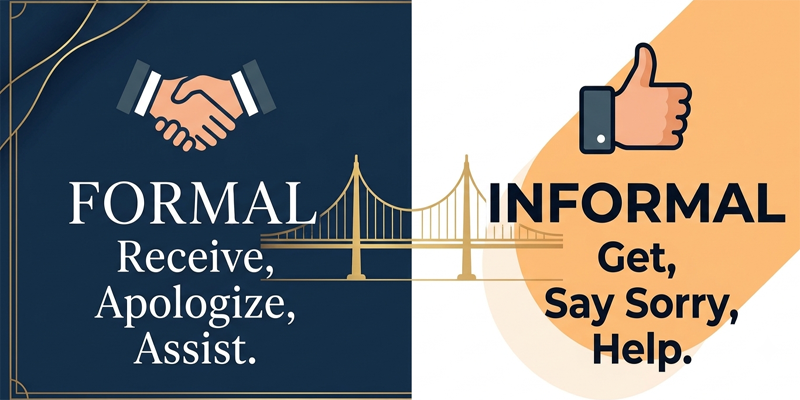
What Is Formal English?
Formal English is used in professional, academic, and official situations. It focuses on clear, respectful, and well-structured communication.
Common Situations
- Job interviews
- Business meetings
- Professional emails
- Academic writing
- Government documents
- Reports
- Presentations
Characteristics
- Polite tone
- Complete sentences
- Correct grammar
- Professional vocabulary
- No slang or abbreviations
What Is Informal English?
Informal English is used in relaxed, everyday conversations with people you know well.
Common Situations
- Talking with friends
- Family conversations
- Text messages
- Social media chats
- Casual emails
Characteristics
- Friendly tone
- Short sentences
- Contractions
- Everyday vocabulary
- Slang and idioms (when appropriate)
Key Differences Between Formal and Informal English
| Feature | Formal English | Informal English |
|---|---|---|
| Tone | Professional and respectful | Friendly and relaxed |
| Vocabulary | Precise and professional | Simple and conversational |
| Grammar | Complete sentences | May use sentence fragments in casual speech |
| Contractions | Used sparingly | Common (I’m, can’t, we’ll) |
| Slang | Avoided | Frequently used |
| Audience | Employers, teachers, clients | Friends, family, classmates |
Examples of Formal vs Informal English
| Formal | Informal |
|---|---|
| I would like to… | I’d like to… |
| Could you please…? | Can you…? |
| I apologize for the delay. | Sorry I’m late. |
| Thank you for your assistance. | Thanks for your help. |
| I appreciate your time. | Thanks for your time. |
| I am unable to attend. | I can’t come. |
| Please let me know. | Let me know. |
| I look forward to hearing from you. | Talk to you soon. |
| I require additional information. | I need more information. |
| Would you mind…? | Can you…? |
When Should You Use Formal English?
Use formal English when:
- Applying for a job
- Writing a resume or cover letter
- Sending business emails
- Speaking with clients
- Giving presentations
- Writing academic assignments
- Communicating with teachers or senior officials
Example:
Dear Mr. Sharma,
Thank you for your email. I would appreciate it if you could share the project details by Friday.
Kind regards,
Ankit Verma
When Should You Use Informal English?
Informal English is suitable for:
- Friends
- Family members
- Close colleagues
- Text messages
- Social media
- Casual conversations
Example:
Hey Rahul,
Thanks for your message! I’ll send the details this evening.
See you soon!
Formal vs Informal Vocabulary
| Formal Word | Informal Alternative |
|---|---|
| Purchase | Buy |
| Assist | Help |
| Inform | Tell |
| Request | Ask |
| Commence | Start |
| Terminate | End |
| Reside | Live |
| Obtain | Get |
| Require | Need |
| Apologize | Say sorry |
Choosing the right vocabulary depends on your audience and purpose.
Formal vs Informal Email Example
Formal Email
Subject: Request for Leave
Dear Ms. Gupta,
I hope you are doing well. I would like to request leave for 12 July due to a family function. I have completed my current assignments and will ensure a smooth handover of any pending work.
Thank you for your understanding.
Kind regards,
Amit Sharma
Informal Email
Hi Rahul,
I’m taking a day off next Friday because of a family event. I’ll catch up with you when I’m back.
Thanks!
Amit
Common Mistakes to Avoid
1. Using Slang in Professional Communication
❌ Hey dude, send me the report.
✔ Could you please send me the report?
2. Being Too Formal with Friends
❌ I sincerely appreciate your invitation.
✔ Thanks for inviting me!
3. Using Abbreviations in Official Emails
Avoid:
- BTW
- ASAP (unless commonly accepted in your workplace)
- LOL
- OMG
Use complete words instead.
4. Ignoring the Audience
Always consider:
- Who are you speaking to?
- Why are you communicating?
- What impression do you want to create?
Quick Tips
- Match your language to the situation.
- Use polite expressions in professional settings.
- Avoid slang in formal writing.
- Keep business emails concise and respectful.
- Practice rewriting informal sentences into formal ones.
- Read professional emails and articles to learn formal writing styles.
Practice Exercises
Exercise 1
Rewrite these informal sentences in a formal style:
- Can you send me the file?
- Sorry, I can’t come today.
- Thanks for your help.
Exercise 2
Choose the correct style:
Situation: Writing to your college professor.
Would you write:
A. “Hey, can you check my assignment?”
B. “Dear Professor, could you please review my assignment?”
(Answer: B)
Exercise 3
Write:
- A short formal email requesting information.
- A casual message inviting a friend to dinner.
Frequently Asked Questions
Is formal English always better?
No. The best style depends on the situation. Formal English is suitable for professional and academic communication, while informal English is appropriate for conversations with friends and family.
Can I use contractions in formal writing?
Some contractions (such as I’m or don’t) are acceptable in modern business writing, but very formal or academic documents often avoid them.
How can I improve my formal English?
Read professional emails, business articles, academic content, and practice writing formal messages. Paying attention to vocabulary and tone will help you improve over time.
Key Takeaways
- Formal English is used in professional and academic situations.
- Informal English is used in everyday conversations.
- Choose your language based on your audience.
- Avoid slang and abbreviations in formal communication.
- Practice switching between formal and informal styles to become a more effective communicator.
Conclusion
Friends, in this blog post(Formal vs Informal English), we have seen the comparison between formal and informal English communication along with their style and use. It is a very important and useful communication skill that makes our conversations effective and alive. It is a way to express your thoughts and feelings appropriately in different situations like writing an email, attending an interview, gossiping with friends, or academic assignment preparation.
If you have a good command of your English speaking and understanding the purpose, audience, and communication tone, you would definitely be a confident English speaker and writer. And if you keep practicing both styles on a daily basis with full consistency, it would be very helpful for you to adapt this language in any kind of situation. |Formal vs Informal English|
If you have any queries, you can write to us at support@a5theory.com; we will get back to you ASAP.
Hope! You would have enjoyed this post(Formal vs Informal English).
Please feel free to give your important feedback in the comment section below.
Have a great time!