

Introduction
Hello Friends, in this amazing blog post(Parts of Speech in English), we are going to let you know about the Parts of speech.
These parts of speech cover the very basic foundation of the English language, whether it is to read, write, or speak this wonderful language.
This language connects you across international boundaries while establishing your communication for various purposes such as business, education, etc.
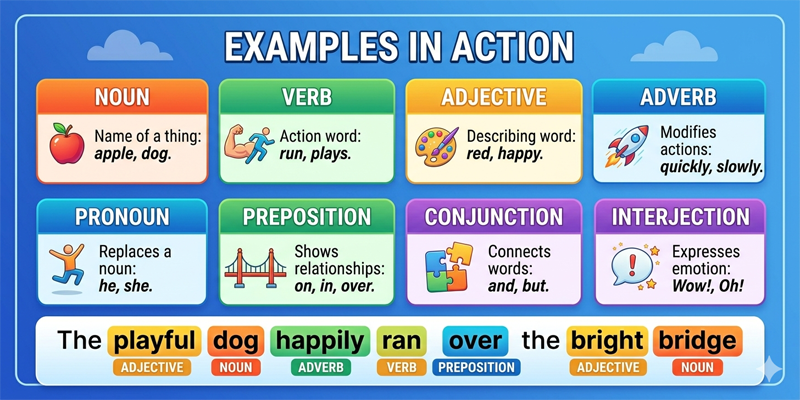
So basically, our speech in the form of sentences has various words. And each word offers a unique function.
And with the help of these functions, we can understand the meaning and structure of a sentence.
So these different categories of words are simply considered as Parts of Speech.
It is very important to have a full command and understanding of these parts of speech.
These parts of speech build your English foundation strong and help you in grammar, reading, writing, or communication skills.
In this post(Parts of Speech in English), we are going to cover all the important parts of speech in the English language.
Here we will dive deep into their rules, functions, and examples in a very easy and beginner-friendly manner.
Define Parts of Speech?/Parts of Speech in English
Parts of speech are simply a categorization of words based on their roles and functions in a sentence.
For example, in the sentence:
“John plays football every evening.”
- John = Noun
- Plays = Verb
- Football = Noun
- Every = Determiner
- Evening = Noun
Each word has a specific and unique job, and that job determines its part of speech.
Why Are Parts of Speech Important?
Understanding parts of speech helps you:
- Construct grammatically correct sentences
- Improve spoken English
- Enhance writing skills
- Understand sentence structure
- Learn advanced grammar more easily
If you don’t learn parts of speech, then it would be very difficult to get a command over English grammar.
1. Noun
What Is a Noun?
A noun is a word that names a person, place, thing, animal, or idea.
Examples
- Rahul
- Delhi
- Dog
- Computer
- Happiness
Sentences
- Rahul is my friend.
- Delhi is the capital of India.
- The dog is barking.
Types of Nouns
Proper Noun
Names a specific person or place.
Examples:
- India
- Rahul
- London
Common Noun
General names of people, places, or things.
Examples:
- City
- Boy
- School
Collective Noun
Names a group.
Examples:
- Team
- Family
- Class
Abstract Noun
Names an idea, quality, or feeling.
Examples:
- Honesty
- Love
- Courage
2. Pronoun
What Is a Pronoun?
A pronoun is a word used in place of a noun to avoid repetition.
Examples
- He
- She
- It
- They
- We
Sentence
Instead of saying:
Rahul is a student. Rahul studies every day.
We say:
Rahul is a student. He studies every day.
Here, “He” replaces Rahul.
Types of Pronouns
- Personal Pronouns (I, You, He)
- Demonstrative Pronouns (This, That)
- Reflexive Pronouns (Myself, Yourself)
- Relative Pronouns (Who, Which)
- Interrogative Pronouns (Who, What)
3. Verb
What Is a Verb?
A verb expresses an action, occurrence, or state of being.
Examples
- Run
- Eat
- Write
- Sleep
- Is
Sentences
- She writes a letter.
- They play cricket.
- He is happy.
Without verbs, a sentence cannot express action or existence.
Types of Verbs
Action Verbs
Show physical or mental actions.
Examples:
- Run
- Think
- Write
Helping Verbs
Assist the main verb.
Examples:
- Is
- Am
- Are
- Have
- Will
Linking Verbs
Connect the subject with information about it.
Examples:
- Is
- Become
- Seem
4. Adjective
What Is an Adjective?
An adjective describes or modifies a noun or pronoun.
Examples
- Beautiful
- Tall
- Smart
- Red
Sentences
- She wears a red dress.
- Rahul is a smart student.
- It is a beautiful garden.
Adjectives provide additional information about nouns.
5. Adverb
What Is an Adverb?
An adverb modifies a verb, adjective, or another adverb.
Examples
- Quickly
- Slowly
- Very
- Carefully
Sentences
- She speaks clearly.
- The train moved slowly.
- He works very hard.
Adverbs often answer questions such as:
- How?
- When?
- Where?
- To what extent?
6. Preposition
What Is a Preposition?
A preposition shows the relationship between a noun or pronoun and another word in a sentence.
Common Prepositions
- In
- On
- At
- Under
- Between
- Behind
Examples
- The book is on the table.
- She lives in Mumbai.
- The cat is under the chair.
Prepositions help indicate location, direction, time, and relationships.
7. Conjunction
What Is a Conjunction?
A conjunction joins words, phrases, or clauses.
Common Conjunctions
- And
- But
- Or
- Because
- Although
Examples
- Rahul and Amit are friends.
- She is tired but happy.
- I stayed home because it was raining.
Conjunctions help create longer and more meaningful sentences.
8. Interjection
What Is an Interjection?
An interjection expresses sudden emotions or feelings.
Examples
- Wow!
- Oh!
- Hurrah!
- Alas!
Sentences
- Wow! That is amazing.
- Hurrah! We won the match.
- Alas! He lost the opportunity.
Interjections are often followed by an exclamation mark.
9. Determiner
What Is a Determiner?
A determiner introduces or provides information about a noun.
Examples
- A
- An
- The
- Some
- Many
- This
- That
Sentences
- The book is interesting.
- I bought a car.
- These students are hardworking.
Determiners help specify quantity, ownership, and identification.
Quick Summary Table
| Part of Speech | Function | Example |
|---|---|---|
| Noun | Names a person, place, thing, or idea | Rahul, City |
| Pronoun | Replaces a noun | He, She |
| Verb | Shows action or state | Run, Is |
| Adjective | Describes a noun | Beautiful, Tall |
| Adverb | Modifies verbs or adjectives | Quickly, Very |
| Preposition | Shows relationships | In, On, At |
| Conjunction | Joins words or clauses | And, But |
| Interjection | Expresses emotion | Wow!, Alas! |
| Determiner | Specifies a noun | The, Some |
Common Mistakes Beginners Make
Confusing Adjectives and Adverbs
Incorrect:
- He runs quick.
Correct:
- He runs quickly.
Using Pronouns Incorrectly
Incorrect:
- Me and Rahul went to school.
Correct:
- Rahul and I went to school.
Prepositions Misuse
Incorrect:
- She arrived in Monday.
Correct:
- She arrived on Monday.
Few Tips to Master Parts of Speech
Practice Reading English every day
Newspapers, books, short stories, and articles help identify different parts of speech naturally.
Sentence Analysis Practice
While writing or reading, make sure you understand the role of each word in the sentence.
Practice Writing Daily
Daily writing practice will definitely strengthen your grammar awareness and sentence-making.
Learn With Examples
Examples help you learn and remember the concepts best.
Conclusion
Friends, in this post(Parts of Speech in English), we have gone through the parts of speech, which is a strong foundation of English grammar without a doubt. The words present in each sentence perform different functions such as expressing emotions, linking ideas, presenting action, describing, naming, etc.
If you are looking to improve your English grammar, writing, and spoken English skills effectively. then you will have to have command over basic but powerful foundation concepts like nouns, pronouns, verbs, adjectives, adverbs, prepositions, conjunctions, interjections, and determiners.
In an English learning journey where your goal is to become the best & confident English writer and speaker, these are very beginning steps. Once you achieve perfection over these parts of speech or basic building blocks, you would definately enjoy the learning of advanced concepts with ease.
If you have any queries, you can write to us at support@a5theory.com; we will get back to you ASAP.
Hope! You would have enjoyed this post(Parts of Speech in English).
Please feel free to give your important feedback in the comment section below.
Have a great time!